
The Misconfiguration Epidemic
The vast majority of cloud breaches do not involve sophisticated zero-day exploits or nation-state malware. They involve mundane human error. An engineer temporarily opens a security group to 0.0.0.0/0 to troubleshoot a connection and forgets to close it. A developer attaches a highly permissive IAM role to a testing instance that is accidentally left running. These cloud misconfigurations are the digital equivalent of leaving the front door of a bank wide open.
When an organization operates dozens of AWS accounts, hundreds of Kubernetes clusters, and thousands of virtual machines, manual security audits are mathematically impossible. By the time a human auditor completes a review of an environment, Infrastructure as Code (IaC) pipelines have already deployed hundreds of new, potentially vulnerable resources.
The solution to the misconfiguration epidemic is continuous, automated verification. This is the domain of Cloud Security Posture Management (CSPM). This guide outlines how to implement a CSPM practice that actually improves security, rather than simply generating thousands of ignored alerts.
What is CSPM? (And What It Isn't)
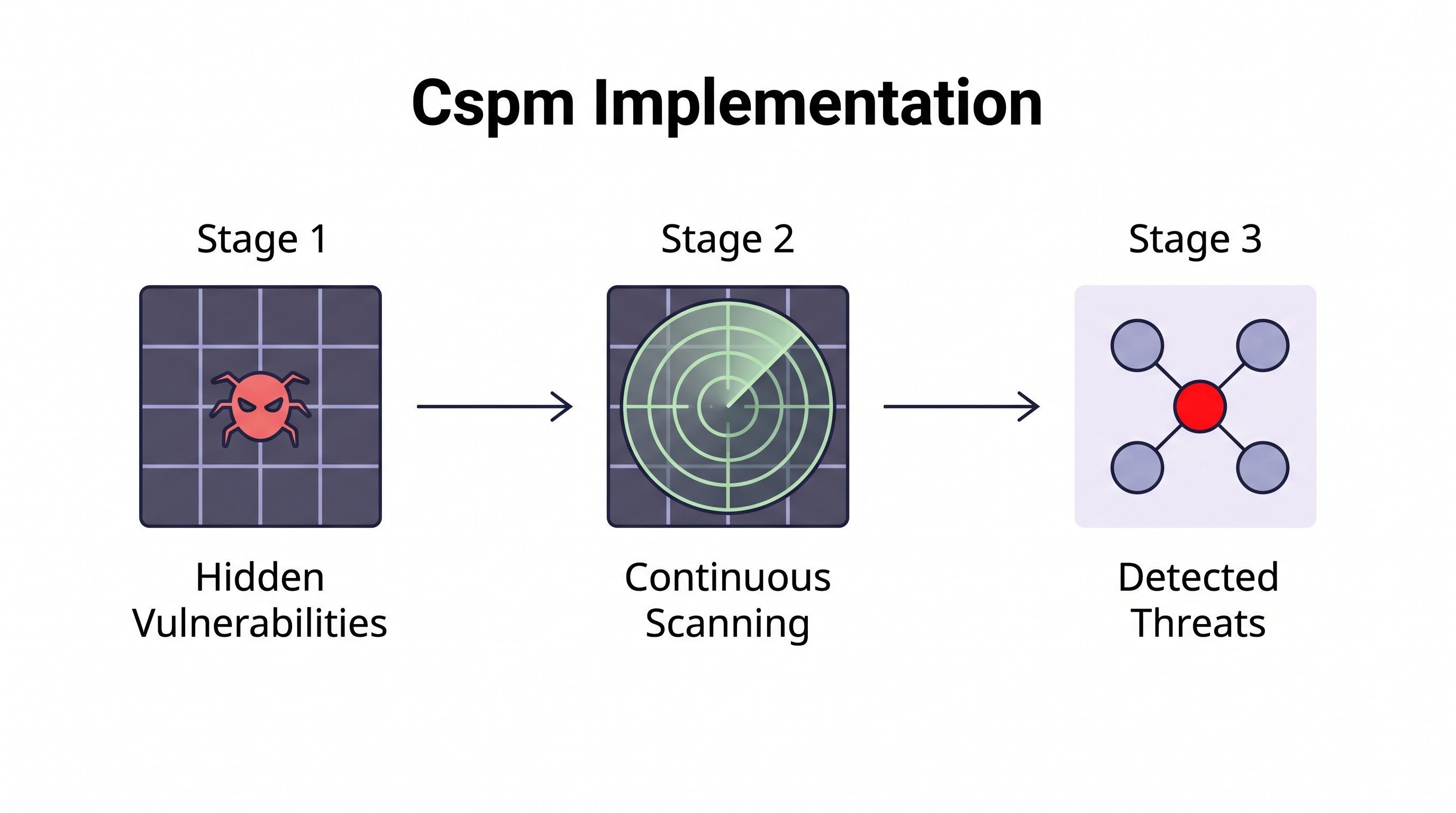
A CSPM tool connects to your cloud environments (AWS, Azure, GCP) via read-only APIs. It continuously scans the metadata and configuration of your resources—comparing them against established security frameworks (like CIS Foundations, SOC 2, or HIPAA) and internal company policies.
If a CSPM detects an S3 bucket lacking encryption, or an IAM user without MFA, it generates a finding.
What CSPM is NOT:
It is not a Web Application Firewall (WAF); it does not inspect incoming HTTP traffic.
It is not an Endpoint Detection and Response (EDR) tool; it generally does not look inside the OS of an EC2 instance to detect running malware.
It is not merely a reporting tool. Modern CSPM is an operational engine designed to fix the problems it finds.
The 4 Phases of CSPM Implementation
Deploying a CSPM tool is technically trivial; it usually requires running a simple CloudFormation or Terraform script to grant cross-account read access. The challenge is organizational. Turning on a CSPM in a mature cloud environment usually generates tens of thousands of findings. If you dump 10,000 "Critical" alerts on your DevOps team on a Friday afternoon, they will ignore the tool forever.
Successful implementation requires a phased approach.
Phase 1: Visibility and the Baseline Scan
The objective of Phase 1 is strictly informational for the security team. Do not route alerts to engineering yet.
Connect All Environments: Ensure 100% coverage. A CSPM is useless if the "sandbox" account where developers experiment is excluded from scanning.
Run the Baseline: Execute the initial scan against a standard framework like the CIS Benchmarks.
Assess the Damage: You will likely see thousands of failures. The security team must categorize these. Are they systemic (e.g., we never encrypt EBS volumes) or isolated (one specific team leaves ports open)?
Phase 2: Tuning the Noise (Beating Alert Fatigue)
A security tool that alerts on everything alerts on nothing. Phase 2 involves aggressive suppression to ensure that when an alert fires, it is legitimate and actionable.
Contextual Suppression: An unencrypted storage bucket is a critical risk if it contains PII. It is zero risk if it contains public marketing assets. Use your cloud tagging strategy to tell the CSPM to suppress "unencrypted" warnings for buckets tagged
DataClassification: Public.Accepting Risk: If a legacy application legitimately requires an open port that violates a CIS benchmark, document the exception in the CSPM and suppress the alert. Do not let "known issues" clutter the dashboard.
Prioritize by Blast Radius: Focus initially only on "Critical" and "High" severity issues that are exposed to the public internet or involve high-level IAM privileges. Ignore "Low" severity informational findings until the critical queue is empty.
Phase 3: Routing and Workflow Integration
Security teams do not fix infrastructure; DevOps teams do. The CSPM must integrate seamlessly into the tools the engineers already use.
Do not force developers to log into a specialized security dashboard. If the CSPM detects a critical misconfiguration, it should automatically open a Jira ticket in the specific team's backlog, or ping the team's dedicated Slack channel. The alert must contain the resource ID, the specific violation, and the exact remediation steps (e.g., the AWS CLI command to enable encryption).
Shift-Left Integration: Integrate the CSPM engine into the CI/CD pipeline. Scan Terraform and CloudFormation templates before they are deployed. Blocking a misconfiguration at the pull-request stage is infinitely cheaper than fixing it in production.
Phase 4: Automated Remediation
The holy grail of cloud security is automated remediation. If a developer accidentally makes a database publicly accessible, a human should not be involved in fixing it. The window of exposure should be measured in seconds, not hours.
Modern CSPM platforms offer auto-remediation capabilities. When the platform detects a specific, high-confidence violation (e.g., "S3 Bucket Public Access Block Disabled"), it triggers a serverless function (Lambda) to execute the API call that reverts the change.
Implement auto-remediation cautiously:
Start with non-destructive actions (e.g., enabling VPC flow logs, turning on encryption).
Test thoroughly in staging environments. An aggressive auto-remediation script that indiscriminately shuts down security groups can cause massive self-inflicted application outages.
Selecting a CSPM Platform
While cloud providers offer native CSPM-like capabilities (AWS Security Hub, Azure Defender for Cloud), enterprise environments often require third-party platforms for true multi-cloud parity and deeper contextual analysis.
When selecting a platform like CloudAtler, evaluate its ability to not just list misconfigurations, but to build an "attack path graph." Advanced CSPMs connect the dots: they realize that a low-severity vulnerable EC2 instance is actually a Critical threat because it is attached to an overly permissive IAM role that has access to a sensitive RDS database. Context is what separates modern CSPM from legacy scanners.
Key Takeaway
CSPM is the foundational defense against the most common cause of cloud breaches: human error. Successful implementation requires ruthless alert tuning to prevent fatigue, deep integration into DevOps ticketing workflows, and eventual progression to automated remediation. A CSPM should act as an automated, continuous auditor that empowers developers to fix their own misconfigurations before an attacker finds them.
All in One Place
Atler Pilot decodes your cloud spend story by bringing monitoring, automation, and intelligent insights together for faster and better cloud operations.