
The Splintering of the Global Cloud
The original promise of the cloud was a borderless, global infrastructure. An engineer in London could deploy an application to a datacenter in Tokyo with a single API call. Data flowed freely across the globe, optimized for latency and cost.
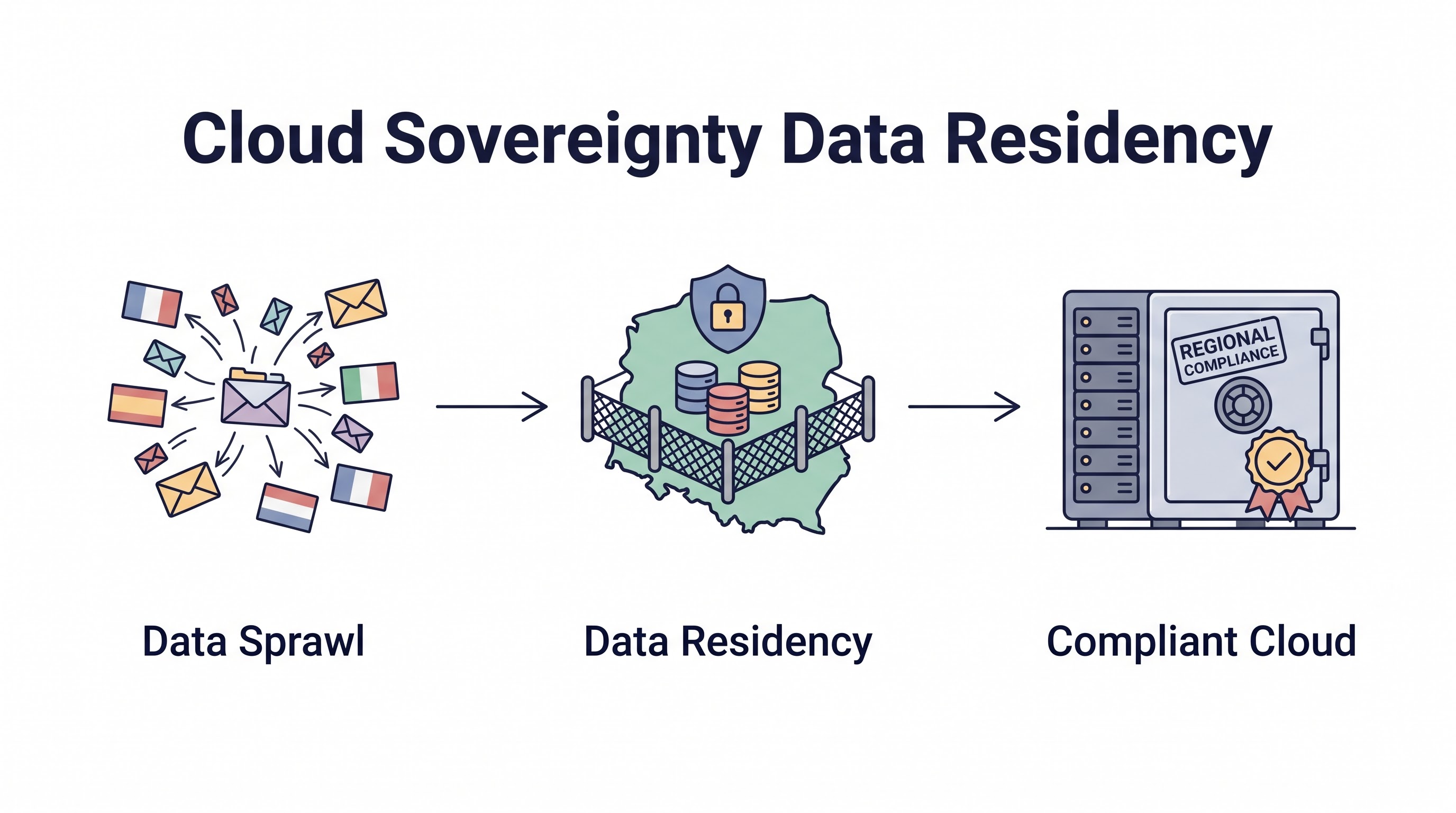
In 2026, the legal landscape has violently fractured this global vision. Driven by privacy concerns, geopolitical tensions, and sweeping regulations, governments worldwide are demanding that data concerning their citizens remains within their physical borders and out of the reach of foreign intelligence agencies. This is the era of "Cloud Sovereignty."
Designing cloud architecture is no longer just a technical exercise; it requires deep legal compliance. This guide clarifies the difference between data residency and sovereignty, and explores how cloud providers are adapting to serve highly regulated industries.
Data Residency vs. Cloud Sovereignty
These terms are often used interchangeably, but they represent vastly different technical requirements.
Data Residency: The legal requirement that data must physically reside within a specific geographic boundary. (e.g., "Customer data for German citizens must be stored on servers physically located in Germany"). This is easily solved by ensuring your S3 buckets and RDS databases are provisioned only in the
eu-central-1(Frankfurt) region.Cloud Sovereignty: A much stricter standard. It mandates that not only must the data reside in the country, but the control of the cloud infrastructure must also be isolated from foreign interference. If a US-based cloud provider (like AWS or Azure) stores data in Germany, the US government could theoretically subpoena that data under the CLOUD Act. Sovereignty requires that the foreign cloud provider mathematically cannot access the data, or that the infrastructure is operated by a localized, national entity.
The Drivers: GDPR, Schrems II, and Geopolitics
The European Union leads the sovereignty charge. The GDPR established strict rules on data transfer outside the EU. The "Schrems II" ruling invalidated the Privacy Shield framework, making it legally perilous for European companies to use US cloud providers without implementing massive supplementary cryptographic safeguards.
Beyond Europe, nations like India, China, and Saudi Arabia have implemented stringent data localization laws, recognizing citizen data as a critical national security asset.
The Three Tiers of Sovereign Cloud
To prevent losing massive enterprise contracts, the hyper-scalers (AWS, Azure, GCP) have introduced distinct sovereign cloud models.
Logical Sovereignty (Cryptographic Control): The data resides in a standard public cloud region, but the customer controls the encryption keys using an external Key Management System (External KMS) physically located outside the cloud. The cloud provider mathematically cannot read the data, satisfying many sovereignty requirements without leaving the public cloud ecosystem.
Trusted Partner Sovereign Cloud: The cloud provider licenses its technology stack (e.g., Azure Stack) to a trusted, local telecommunications or IT provider in the host country (e.g., T-Systems in Germany). The local provider owns the data centers, holds the keys, and manages the operations. The US hyper-scaler provides the software but has zero operational access.
Air-Gapped Sovereign Cloud: The highest level, reserved for classified government intelligence (e.g., AWS Top Secret). These regions are physically disconnected from the public internet, operated by security-cleared citizens of the host nation, and offer a restricted subset of cloud services.
The Architectural Impact: Local Regions and Outposts
If an enterprise is bound by residency laws, the architecture must adapt.
No Global Databases: You cannot use global replication features like DynamoDB Global Tables to sync data between the US and Europe if European data must not leave the EU.
Edge Solutions: Organizations increasingly rely on Cloud-Edge solutions like AWS Outposts. A rack of AWS hardware sits inside the customer's physical data center in the regulated country. The compute and storage happen locally (satisfying residency), but the infrastructure is managed via the standard AWS control plane.
The Cryptographic Boundary: Key Management
The most critical element of sovereignty is Key Management. If you use the cloud provider's native Key Management Service (e.g., AWS KMS Default Keys), the provider technically has the ability to decrypt the data.
To achieve true sovereignty in the public cloud, organizations must use Customer Managed Keys (CMK) and, increasingly, External Key Management (EKM). In EKM, the encryption keys are generated and stored in a physical Hardware Security Module (HSM) located in a private data center. The cloud provider must request permission from the external HSM for every single decryption operation, providing the customer with an absolute "kill switch" to revoke the cloud's access to the data instantly.
The Operational and FinOps Burden
Cloud sovereignty destroys the economies of scale. Running separate, isolated infrastructure stacks in specific countries is vastly more expensive than running a unified global architecture. Sovereign clouds generally do not benefit from standard Enterprise Discount Programs. Organizations must carefully categorize their data, storing only the highly regulated data in the expensive sovereign environment, and keeping non-sensitive operational data in the cheaper, public cloud.
Key Takeaway
The borderless cloud is dead for regulated industries. Organizations must differentiate between simple Data Residency (locating data in a specific country) and Cloud Sovereignty (preventing foreign government access). Achieving sovereignty requires abandoning global replication features, relying heavily on External Key Management (EKM) to maintain cryptographic control over the hyper-scalers, or utilizing "Trusted Partner" cloud regions operated by local national entities.
All in One Place
Atler Pilot decodes your cloud spend story by bringing monitoring, automation, and intelligent insights together for faster and better cloud operations.