
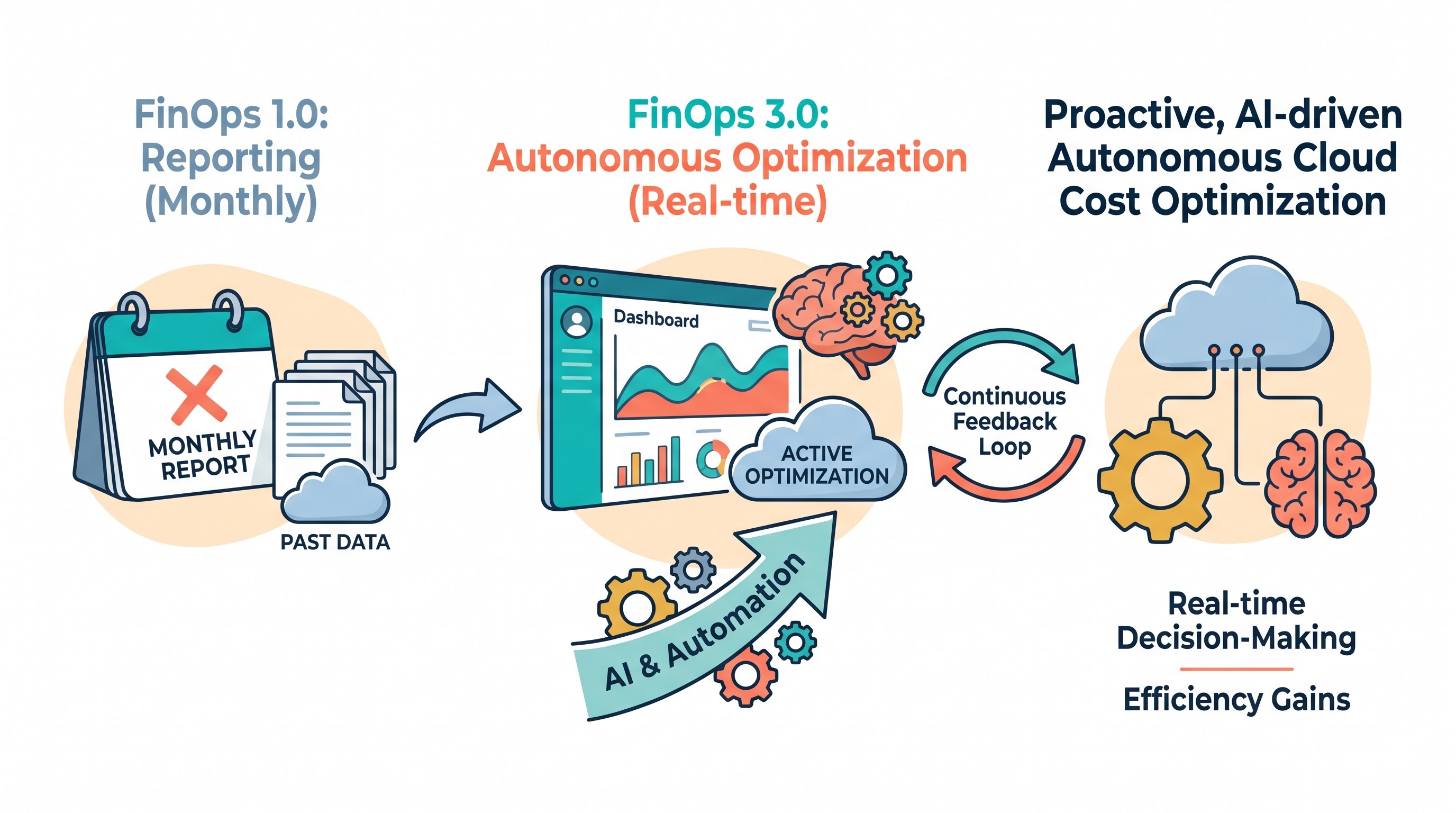
For years, cloud cost management followed a familiar pattern.
Engineering teams built applications. Finance teams reviewed the monthly cloud bill. FinOps practitioners spent hours creating dashboards, analyzing reports, and trying to explain why costs increased. Recommendations were shared, tickets were created, meetings were scheduled, and eventually someone optimized a few workloads.
Then the cycle repeated the following month.
This approach worked when cloud environments were relatively simple.
Today, it doesn't.
Modern cloud infrastructure changes by the minute. Kubernetes clusters scale automatically, serverless functions spin up and disappear within seconds, AI agents execute thousands of tasks independently, GPUs are dynamically allocated for machine learning workloads, and infrastructure provisioning happens continuously through automated CI/CD pipelines.
By the time a monthly cost report reaches the engineering team, the infrastructure that generated those costs may no longer exist.
That's the challenge organizations face today.
Cloud environments have become real-time systems, but many FinOps practices still operate on historical data.
This gap is driving the next evolution of cloud financial management.
Instead of simply reporting what happened yesterday, organizations want systems that understand what's happening right now, predict what is likely to happen next, and automatically optimize cloud resources before unnecessary spending occurs.
This new approach is often described as FinOps 3.0.
In this article, we'll explore what FinOps 3.0 really means, why traditional cost management approaches are reaching their limits, and how autonomous optimization is reshaping the future of cloud operations.
How FinOps has Evolved?
To understand where FinOps is heading, it's useful to understand how it has evolved.
The earliest cloud cost management practices focused primarily on visibility.
Organizations wanted answers to relatively simple questions.
How much are we spending?
Which cloud services cost the most?
How has spending changed since last month?
This first stage established the foundation for cloud financial management by making cloud costs visible across engineering and finance teams.
As cloud adoption accelerated, visibility alone became insufficient.
Organizations needed to understand who owned cloud resources, how costs should be allocated, and where optimization opportunities existed.
This led to stronger collaboration between engineering, finance, and business teams.
Tagging strategies improved, chargeback and showback models became more common, and FinOps matured into an operational discipline rather than a collection of financial reports.
Today, another shift is taking place.
Cloud environments have become too dynamic for manual optimization alone.
Engineering teams cannot realistically review thousands of Kubernetes workloads, AI inference services, autoscaling events, and infrastructure changes every day.
Optimization itself is becoming automated.
Rather than simply reporting inefficiencies, modern FinOps platforms increasingly identify optimization opportunities continuously and, in some cases, execute approved actions automatically.
This marks the beginning of what many organizations describe as FinOps 3.0.
Why is Traditional FinOps Reporting Not Enough?
Dashboards remain valuable.
Monthly reports remain valuable.
Budget forecasting remains valuable.
The problem isn't that these practices are wrong.
The problem is that they're no longer sufficient on their own.
Consider a Kubernetes cluster supporting hundreds of microservices.
Throughout the day, workloads scale up and down based on customer demand. New containers are deployed every few minutes. Development teams release application updates continuously. AI inference workloads appear during business hours before disappearing overnight.
Now imagine reviewing that environment using a report generated three weeks later.
Many of the workloads no longer exist.
The recommendations are technically accurate, but operationally outdated.
The same challenge applies to AI infrastructure.
GPU clusters may remain idle for only a few hours before being reused. Temporary inference workloads might consume significant resources during a product launch and then disappear entirely.
Waiting for a monthly optimization review means many opportunities have already been missed.
Cloud optimization is increasingly becoming a real-time operational challenge rather than a historical reporting exercise.
What Makes FinOps 3.0 Different?
The defining characteristic of FinOps 3.0 isn't simply better reporting.
It's continuous decision-making.
Instead of collecting cloud billing information once a month and producing recommendations, modern FinOps systems continuously evaluate infrastructure behavior, workload performance, cloud costs, utilization trends, and operational context.
This creates a feedback loop where optimization becomes an ongoing activity rather than a scheduled event.
For example, instead of discovering idle GPU clusters weeks after they stopped processing workloads, intelligent systems can detect underutilization within hours.
Rather than identifying oversized Kubernetes nodes during quarterly reviews, optimization platforms can recognize changing utilization patterns as they occur.
Instead of waiting for engineers to manually investigate cost anomalies, machine learning models can correlate spending spikes with recent deployments, infrastructure changes, or unexpected workload behavior.
The objective shifts from explaining cloud costs to actively influencing them.
The Rise of Autonomous Optimization
Autonomous optimization doesn't mean removing engineers from the process.
It means reducing the number of repetitive decisions that engineers have to make manually.
Today, cloud operations teams spend significant time identifying underutilized resources, reviewing rightsizing recommendations, analyzing idle infrastructure, validating autoscaling policies, and investigating unexpected spending increases.
Many of these activities follow predictable patterns.
If a development environment remains unused for several days, it may be safe to recommend shutting it down.
If GPU utilization remains consistently low across multiple inference workloads, rightsizing recommendations can be generated automatically.
If Kubernetes clusters repeatedly overprovision resources relative to demand, optimization opportunities can be surfaced without waiting for manual reviews.
Rather than replacing engineering expertise, automation handles routine optimization while allowing engineers to focus on architectural improvements, platform reliability, and strategic innovation.
This balance between human oversight and intelligent automation is what makes autonomous optimization practical for enterprise cloud environments.
Why AI is Accelerating the Evolution of FinOps?
Artificial intelligence isn't just creating new cloud costs.
It's fundamentally changing how cloud infrastructure behaves.
AI workloads are dynamic by nature.
Training jobs consume massive GPU capacity for short periods. Inference traffic fluctuates throughout the day. AI agents execute unpredictable workflows, while retrieval systems, vector databases, and orchestration frameworks continuously interact with cloud infrastructure.
Traditional optimization methods were designed primarily for relatively stable virtual machines and predictable workloads.
AI introduces entirely new resource consumption patterns.
As a result, organizations increasingly need FinOps systems capable of understanding infrastructure behavior in real time rather than relying exclusively on historical billing data.
This is one of the strongest drivers behind the emergence of FinOps 3.0.
Optimization is no longer simply about reducing cloud costs.
It's about continuously adapting cloud infrastructure to rapidly changing operational demands.
The Technologies Powering FinOps 3.0
The transition to FinOps 3.0 isn't driven by a single technology. Instead, it's the result of several capabilities coming together to create a much more intelligent approach to cloud cost management.
Cloud observability platforms now collect infrastructure telemetry in real time, giving organizations continuous visibility into compute resources, Kubernetes clusters, storage, networking, and AI infrastructure. At the same time, AI-powered analytics engines can process enormous amounts of operational data, identify patterns that would be difficult for humans to detect, and highlight optimization opportunities almost instantly.
Automation platforms complete the picture by translating these insights into action. Rather than simply notifying engineers about inefficient resource usage, they can recommend rightsizing, identify idle workloads, adjust scaling policies, or trigger predefined workflows that reduce unnecessary cloud spending.
The result is an optimization process that operates continuously instead of waiting for monthly reviews.
From Cost Visibility to Cost Intelligence
For many years, the primary goal of FinOps was visibility.
Organizations wanted dashboards that showed how much they were spending and where those costs originated.
Visibility remains important, but it is only the first step.
Modern cloud environments generate an enormous amount of operational data every second. Simply displaying that information on dashboards doesn't necessarily help teams make faster or better decisions.
This is where cost intelligence becomes valuable.
Instead of only showing that spending increased by twenty percent, intelligent FinOps platforms explain what changed.
Perhaps a Kubernetes deployment introduced oversized resource requests.
Maybe an AI inference service experienced an unexpected surge in traffic.
A newly deployed application may have triggered additional API requests, while idle GPU clusters continued running after model training completed.
Providing context transforms financial data into operational insight.
Instead of reacting to numbers, engineering teams understand the infrastructure behavior driving those numbers.
Why is Context the Foundation of Autonomous Optimization?
Autonomous optimization cannot rely on billing information alone.
Cloud invoices describe what organizations paid for.
They rarely explain why those costs occurred.
Imagine receiving an alert that GPU spending doubled overnight.
Without additional context, engineers still need to investigate infrastructure changes, deployment activity, workload behavior, and resource utilization before deciding how to respond.
A mature FinOps platform performs much of this analysis automatically.
It correlates cost anomalies with deployment timelines, Kubernetes scheduling events, GPU utilization, workload ownership, and infrastructure telemetry.
By understanding relationships between operational events and financial outcomes, optimization recommendations become significantly more accurate.
Context prevents automation from making decisions based solely on isolated metrics.
Instead, recommendations reflect the broader operational state of the cloud environment.
Human-in-the-Loop Remains Essential
The phrase "autonomous optimization" sometimes creates the impression that cloud platforms will eventually manage themselves without human involvement.
In reality, enterprise organizations continue to require human oversight for many optimization decisions.
Automatically shutting down production workloads simply because utilization appears low would introduce unnecessary operational risk.
Similarly, reducing GPU capacity during temporary periods of low activity could negatively affect upcoming machine learning jobs.
The future of FinOps is therefore not fully autonomous infrastructure.
It is human-guided autonomy.
Routine optimization tasks such as identifying idle development environments, detecting abandoned storage resources, highlighting oversized Kubernetes workloads, or recommending rightsizing opportunities can often be automated safely.
Higher-impact decisions involving business-critical applications, compliance requirements, or production infrastructure continue to benefit from engineering review.
This collaborative approach combines the speed of automation with the judgment of experienced engineers.
How AI is Changing Cost Optimization?
Artificial intelligence is influencing FinOps in two important ways.
First, AI workloads have become major contributors to cloud spending.
Second, AI itself is improving how cloud optimization is performed.
Machine learning algorithms can analyze historical infrastructure behavior, identify recurring cost patterns, forecast future cloud spending, and detect subtle anomalies that traditional monitoring systems may overlook.
Instead of reviewing thousands of utilization metrics manually, engineers receive prioritized recommendations based on operational significance.
For example, an AI-powered optimization engine might recognize that several Kubernetes workloads consistently request twice the resources they actually consume.
Another recommendation might identify inference services that remain significantly overprovisioned outside business hours.
These insights help organizations optimize continuously rather than relying exclusively on scheduled cost reviews.
Best Practices for Adopting FinOps 3.0
Transitioning to FinOps 3.0 requires more than deploying new software.
Organizations should begin by treating cloud cost optimization as an operational capability rather than a finance-only function. Engineering, platform, DevOps, security, and finance teams all contribute to the decisions that influence cloud spending, making cross-functional collaboration essential.
It is equally important to establish accurate ownership across cloud resources. Applications, Kubernetes namespaces, AI workloads, GPU clusters, storage resources, and shared services should all have clearly defined owners. Without ownership, even the most advanced optimization recommendations become difficult to implement.
Organizations should also prioritize continuous monitoring over periodic reporting. Infrastructure changes every minute, particularly in environments running Kubernetes, serverless applications, and AI workloads. Regular operational reviews supported by real-time telemetry provide significantly greater value than relying solely on monthly cost reports.
Finally, automation should be introduced gradually. Begin by automating recommendations and low-risk operational tasks before expanding toward more advanced optimization workflows. This phased approach builds confidence while reducing operational risk.
Measuring the Success of FinOps 3.0
The success of FinOps 3.0 should not be measured solely by how much cloud spending decreases.
Reducing costs is important, but sustainable optimization balances efficiency with performance, reliability, and business value.
Organizations should evaluate outcomes such as:
Faster identification of cloud cost anomalies.
Improved infrastructure utilization.
Reduced time spent investigating cloud spending.
Better forecasting accuracy.
Increased engineering productivity.
Stronger collaboration between finance and engineering teams.
Higher percentage of optimization recommendations successfully implemented.
These indicators demonstrate that optimization processes themselves are becoming more effective—not just less expensive.
Accelerate FinOps 3.0 with Atler Pilot
Moving toward autonomous optimization requires a complete understanding of how cloud infrastructure behaves.
Cost data alone is not enough.
Engineering teams need visibility into Kubernetes workloads, AI infrastructure, GPU utilization, deployment activity, workload ownership, infrastructure telemetry, and cloud resource consumption.
Atler Pilot brings these perspectives together through a unified platform that combines infrastructure intelligence, workload observability, cloud cost visibility, utilization analytics, and operational context.
Instead of relying on isolated billing reports, engineering, platform, DevOps, and FinOps teams gain continuous insight into how infrastructure decisions influence cloud spending.
By correlating workload behavior with utilization trends and cloud costs, Atler Pilot helps organizations identify optimization opportunities earlier, improve resource efficiency, strengthen governance, and support the transition from reactive reporting toward intelligent, continuous optimization.
As cloud environments become increasingly dynamic, this operational context becomes the foundation for successful FinOps 3.0 adoption.
Conclusion
Cloud infrastructure has evolved dramatically over the past decade.
Static virtual machines have given way to Kubernetes clusters, serverless platforms, AI workloads, GPU infrastructure, and highly dynamic cloud-native applications that change continuously throughout the day.
FinOps is evolving alongside them.
Reporting will always remain an important part of cloud financial management, but reporting alone can no longer keep pace with modern infrastructure.
FinOps 3.0 represents the next stage of maturity.
Instead of focusing exclusively on historical cloud spending, it combines real-time infrastructure telemetry, operational intelligence, AI-driven analytics, and automation to identify optimization opportunities continuously.
This doesn't eliminate the need for engineering expertise.
Instead, it enables engineers to spend less time performing repetitive optimization tasks and more time improving platform architecture, application performance, and business innovation.
The organizations that succeed in the next generation of cloud operations will not simply be those with the lowest cloud bills.
They will be the organizations capable of understanding their infrastructure continuously, responding intelligently to changing conditions, and optimizing cloud resources before inefficiencies become expensive problems.
Because the future of FinOps isn't just seeing cloud costs.
It's continuously improving them.
Frequently Asked Questions
How is FinOps 3.0 different from traditional FinOps?
Traditional FinOps primarily focuses on cost visibility, reporting, budgeting, and collaboration. FinOps 3.0 builds on these principles by introducing intelligent recommendations, continuous optimization, automation, and real-time decision support for dynamic cloud environments.
Why is automation important in FinOps?
Modern cloud environments change too quickly for manual optimization alone. Automation helps organizations identify idle resources, rightsizing opportunities, cloud cost anomalies, and inefficient infrastructure much faster than traditional reporting processes.
Does FinOps 3.0 replace engineers?
No. FinOps 3.0 supports engineers by automating repetitive analysis and highlighting optimization opportunities. Strategic decisions involving production workloads, compliance, architecture, and business priorities still require human expertise and oversight.
All in One Place
Atler Pilot decodes your cloud spend story by bringing monitoring, automation, and intelligent insights together for faster and better cloud operations.