
Site Reliability Engineering has become one of the most important disciplines in modern technology organizations. As digital services grow more complex, businesses rely on SRE teams to maintain uptime, improve reliability, manage incidents, and ensure systems scale smoothly. These teams sit at the intersection of software engineering and operations, carrying the responsibility of keeping critical services stable while enabling rapid innovation.
However, the demands placed on SRE teams continue to rise. Infrastructure is now distributed across multi-cloud environments, containers, microservices, APIs, data pipelines, and third-party platforms. Every new service adds more telemetry, more dependencies, and more potential failure points. While systems scale rapidly, human attention does not scale at the same pace.
This creates a common challenge for many SRE teams. They spend too much time searching through dashboards, triaging alerts, reviewing logs, investigating recurring issues, and manually correlating data across tools. Valuable engineering time is often consumed by operational noise rather than long-term reliability improvements.
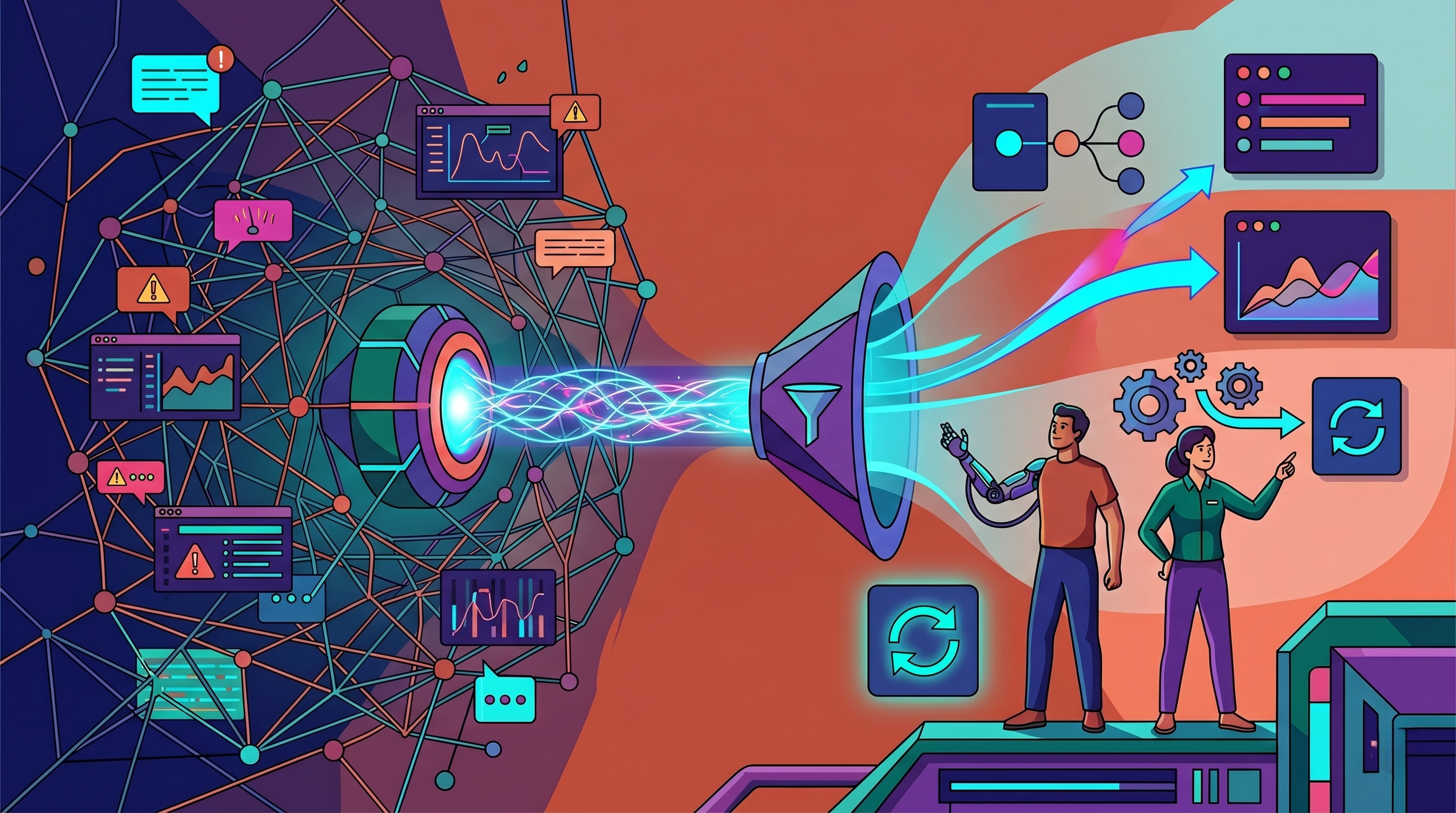
This is where AI-powered operational insights create real value. By transforming raw operational data into meaningful intelligence, AI helps SRE teams detect patterns faster, reduce noise, prioritize risk, and act with greater confidence. It does not replace engineering expertise. It amplifies it.
In this blog, we will explore how AI-powered operational insights improve SRE workflows, where the greatest gains are achieved, and why intelligent operations are becoming essential for reliability-focused teams.
Why Traditional SRE Workflows Face Pressure
The original promise of SRE was clear: use software engineering practices to run systems more reliably and efficiently. That mission remains relevant, but the operational environment has changed significantly.
Modern systems generate massive amounts of metrics, traces, logs, events, alerts, and configuration changes every minute. A single customer request may pass through dozens of services before completion. One infrastructure issue can cascade across multiple applications. Meanwhile, customer expectations for uptime and performance continue rising.
As a result, many SRE teams operate under constant pressure. They are expected to respond faster, prevent outages, optimize reliability, and support growth with limited resources. Manual workflows that once worked at a smaller scale now create delays and fatigue.
AI-powered insights help close this gap by allowing SRE teams to operate intelligently at scale.
Faster Signal Detection
One of the most valuable uses of AI in SRE workflows is identifying meaningful signals quickly.
Traditional monitoring often depends on static thresholds. CPU above a certain level, latency above a fixed number, or memory beyond a percentage triggers alerts. While useful, static rules often create false positives or miss subtle changes.
AI-powered systems analyze patterns over time. They learn what normal behavior looks like for services, workloads, traffic cycles, and infrastructure usage. This allows them to identify anomalies that matter rather than every temporary fluctuation.
For SRE teams, this means faster awareness of real risk conditions and fewer distractions from harmless noise. Engineers spend less time reviewing alerts and more time addressing actual reliability concerns.
Smarter Alert Management
Alert fatigue remains one of the most common operational challenges for reliability teams. Too many notifications reduce trust in monitoring systems and slow down response during real incidents.
AI improves alert workflows by grouping related alerts, suppressing duplicates, and prioritizing incidents based on likely impact. Instead of receiving dozens of disconnected warnings, SRE teams get clearer signals tied to actual events.
For example, a database slowdown may create alerts in APIs, background workers, and customer transactions simultaneously. AI can recognize that these are connected symptoms of one root issue.
This dramatically improves triage efficiency and reduces unnecessary escalation pressure.
Faster Root Cause Analysis
During incidents, time is often lost not in fixing the issue but in discovering what caused it.
SRE teams typically need to compare logs, metrics, deployment timelines, infrastructure changes, and dependency behavior across multiple systems. This manual investigation process can be slow, especially in distributed environments.
AI-powered operational insights accelerate diagnosis by correlating signals automatically. They may highlight that a recent deployment aligns with error growth, that one region showed degradation first, or that a dependency timeout pattern preceded failures.
This helps engineers begin an investigation with better direction rather than starting from zero. Faster root cause analysis reduces downtime and lowers operational stress.
Better Incident Prioritization
Not every issue deserves the same urgency. Yet many organizations still treat alerts similarly, causing confusion and wasted effort.
AI helps prioritize incidents based on severity, customer impact, service criticality, historical patterns, and blast radius. A minor internal dashboard delay should not compete with a checkout failure affecting customers.
This enables SRE teams to allocate attention more intelligently. High-value engineering time goes to the problems that matter most.
When priorities become clearer, workflows become calmer and more effective.
Capacity Planning and Reliability Forecasting
Reliability problems often begin before incidents occur. Capacity margins shrink, traffic patterns shift, storage growth accelerates, or scaling behavior becomes unstable.
AI-powered systems analyze historical trends, seasonality, release patterns, and workload growth to forecast future risk. SRE teams can see where infrastructure limits may become dangerous before service disruption happens.
This supports proactive actions such as scaling resources, tuning autoscaling rules, optimizing workloads, or redesigning bottlenecks.
Forecasting helps SRE teams move from reactive firefighting to preventive reliability engineering.
Reducing Toil Through Automation
A core principle of SRE is reducing repetitive operational toil. Yet many teams still spend valuable time on routine manual tasks such as restarting services, resizing clusters, rerunning jobs, or collecting incident evidence.
AI-powered insights help identify where automation can create the most value. They can also trigger approved workflows when known patterns appear.
Examples include:
Restarting unhealthy workloads
Scaling resources during traffic surges
Routing incidents to the correct owners
Opening incident channels automatically
Generating summaries for responders
Running diagnostics when anomalies appear
This reduces manual burden and frees SRE teams for higher-value engineering work.
Improving Error Budget Decisions
Error budgets help balance reliability and feature velocity. However, many teams struggle to interpret reliability trends quickly enough to make good decisions.
AI can analyze service health, recurring incident patterns, deployment risk, latency trends, and historical burn rates to provide clearer visibility into error budget status.
This allows SRE leaders and product teams to make smarter tradeoffs. They can decide when to slow releases, invest in resilience, or continue shipping confidently.
Better visibility leads to better governance without unnecessary friction.
Stronger Cross-Team Collaboration
Reliability issues rarely belong to one team alone. Application engineers, platform teams, security teams, database teams, and leadership may all need to coordinate during major incidents.
AI-powered operational insights improve collaboration by creating shared context. Incident summaries, likely impacted services, ownership mapping, timelines, and recommended next actions help teams align quickly.
Instead of each team interpreting fragmented data separately, everyone works from a clearer operational picture.
This reduces confusion and speeds coordinated response.
Better Learning After Incidents
High-performing SRE teams improve continuously through post-incident learning. However, gathering accurate timelines and evidence manually can be time-consuming.
AI can preserve logs, event sequences, alerts, communication history, remediation actions, and system behavior automatically during incidents. This makes retrospectives faster and more accurate.
Teams spend less time reconstructing what happened and more time improving systems. Better learning loops reduce repeat incidents over time.
Supporting Lean SRE Teams
Not every company has a large reliability organization. Many fast-growing SaaS businesses run lean SRE teams supporting significant infrastructure scale.
For these teams, efficiency matters enormously.
AI-powered insights act as leverage. They help smaller teams detect issues faster, prioritize better, automate repetitive tasks, and maintain service reliability without proportionally increasing headcount.
This allows lean teams to support growth with greater confidence.
Where Atler Pilot Creates Strategic Value
Strong SRE workflows depend on more than alerts and dashboards. Teams also need visibility into cloud efficiency, infrastructure waste, resource utilization, and operational priorities. Without this clarity, reliability efforts can become reactive and expensive.
That is where Atler Pilot creates measurable value.
Atler Pilot helps organizations transform fragmented cloud and operational signals into actionable intelligence. Instead of manually piecing together utilization gaps, inefficient spending, or unclear optimization priorities, teams gain a clearer view of where action is needed most.
This supports stronger control, faster decisions, and more efficient scaling for modern reliability teams. If your SRE team is managing growing complexity with limited bandwidth, Atler Pilot can help restore operational clarity.
Start with Atler Pilot and give reliability teams the insights to operate smarter every day.
Common Mistakes to Avoid
Some organizations expect AI to solve reliability automatically. In reality, AI works best when paired with strong engineering practices, clear ownership, and clean telemetry data.
Another mistake is adding intelligence without fixing noisy monitoring foundations. If alerts are poor and service ownership unclear, AI outputs will also struggle.
Teams should also avoid over-automation early. Start with recommendations and low-risk workflows first, then expand based on confidence and outcomes.
Conclusion
SRE teams are expected to protect uptime, improve performance, and support rapid growth in increasingly complex environments. Traditional workflows alone are no longer enough to meet those expectations efficiently.
AI-powered operational insights help teams detect faster, prioritize smarter, diagnose quicker, automate toil, and plan proactively. They turn overwhelming telemetry into a useful direction.
The result is not only stronger reliability. It is more focused engineers, healthier workflows, and more time spent improving systems rather than chasing noise.
The future of SRE will not be built on more dashboards alone. It will be built on better intelligence and faster action.
All in One Place
Atler Pilot decodes your cloud spend story by bringing monitoring, automation, and intelligent insights together for faster and better cloud operations.