
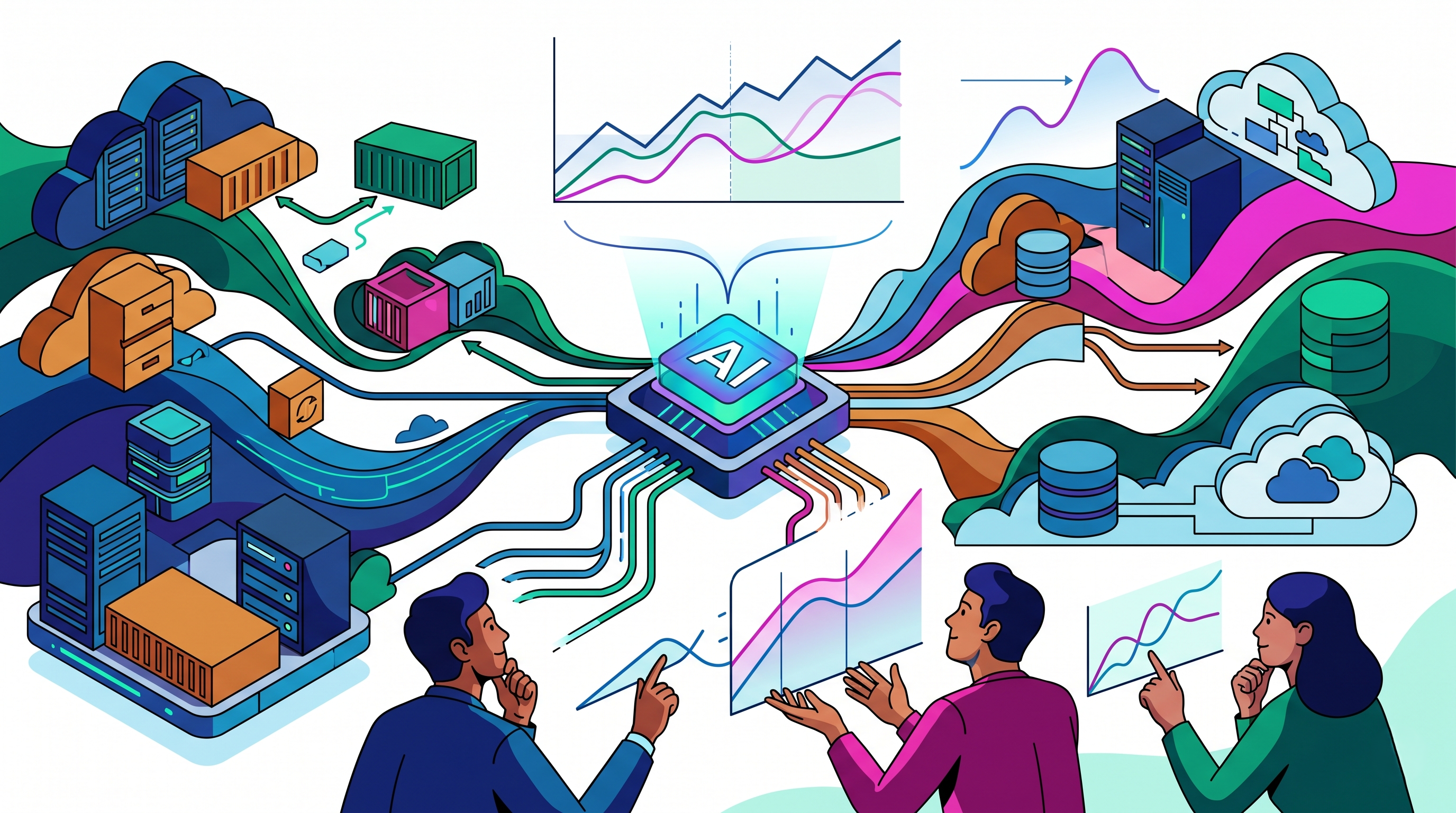
Cloud infrastructure gave businesses something previous generations of IT teams could only imagine: elastic capacity. Resources can scale in minutes, workloads can expand globally, and organizations no longer need to buy years of hardware upfront. This flexibility changed how companies build and operate technology.
Yet flexibility did not eliminate planning.
In many ways, it made planning more difficult.
Instead of forecasting hardware purchases once a year, teams now manage constantly changing workloads across virtual machines, containers, serverless platforms, databases, storage systems, and multi-cloud environments. Demand can rise overnight, traffic patterns can shift unexpectedly, and costs can grow silently in the background. If capacity is underestimated, performance suffers. If it is overestimated, budgets are wasted.
This is why capacity planning remains one of the most important disciplines in cloud operations.
The difference today is that manual spreadsheets, static assumptions, and reactive scaling are no longer enough. Modern environments generate enormous amounts of telemetry that humans alone cannot interpret efficiently. This is where AI creates real value.
AI helps organizations analyze historical usage, identify patterns, forecast demand, detect inefficiencies, and recommend smarter resource decisions. It transforms capacity planning from guesswork into a data-driven operational advantage.
In this blog, we will explore how to use AI for capacity planning in cloud infrastructure environments, where it delivers the strongest impact, and how organizations can move from reactive scaling to intelligent planning.
Why Traditional Capacity Planning Struggles in the Cloud
In on-premise environments, capacity planning was often periodic. Teams estimated growth, purchased hardware, and hoped assumptions held until the next cycle. While imperfect, workloads were usually more predictable.
Cloud environments are different.
Applications now scale dynamically. Traffic changes by hour, campaign, season, geography, or product release. New services launch quickly. Containers appear and disappear constantly. Developers may provision resources independently. Multiple teams share infrastructure layers.
This creates two common problems.
First, many organizations under-plan. They rely heavily on reactive autoscaling and only respond when systems approach stress. This can lead to latency spikes, throttling, degraded user experience, or outages.
Second, many organizations over-plan. They keep large safety buffers, oversized clusters, idle instances, and excess storage “just in case.” This protects reliability but wastes money.
AI helps solve both problems by making planning more precise.
What AI Means in Capacity Planning
Using AI for capacity planning does not necessarily mean futuristic autonomous systems making every decision.
In practical terms, it usually means applying machine learning, predictive analytics, anomaly detection, and pattern recognition to infrastructure data.
This data may include:
CPU utilization
Memory usage
Network traffic
Storage growth
Request volume
Queue depth
Response times
Deployment history
Cost trends
Seasonal traffic patterns
Incident history
AI systems use these signals to identify trends, forecast future demand, detect abnormal behavior, and recommend resource adjustments.
The goal is simple: have the right capacity at the right time for the right cost.
Forecasting Demand More Accurately
One of the strongest uses of AI is workload forecasting.
Traditional forecasting often relies on averages or recent growth assumptions. But cloud workloads rarely grow in straight lines. They fluctuate based on user behavior, campaigns, launches, billing cycles, holidays, and regional events.
AI models can analyze historical patterns and detect recurring cycles that humans may miss. They can recognize that traffic rises every Monday morning, storage growth accelerates at quarter-end, or API demand spikes after product announcements.
This allows teams to prepare capacity before demand arrives.
Better forecasting improves performance readiness while reducing unnecessary overprovisioning.
Smarter Autoscaling Decisions
Autoscaling is valuable, but it is not always enough on its own.
Many scaling systems react after thresholds are breached. By the time new capacity launches, users may already feel slower performance. In some workloads, delayed scaling can cause queue backlogs or cascading failures.
AI improves autoscaling by making it predictive rather than purely reactive.
Instead of waiting for the CPU to hit a threshold, AI can anticipate likely traffic growth based on historical behavior, time-of-day trends, or known events. Resources can scale earlier and more smoothly.
This helps maintain performance while avoiding aggressive over-scaling.
Predictive scaling is especially valuable for e-commerce launches, media events, seasonal spikes, and recurring enterprise workloads.
Reducing Cloud Waste
Capacity planning is not only about avoiding shortages. It is also about avoiding waste.
Many organizations run oversized instances, underused Kubernetes clusters, idle databases, forgotten development environments, and storage that grows without review. These costs accumulate quietly.
AI helps identify where provisioned capacity consistently exceeds actual demand. It can recommend rightsizing compute, reducing idle resources, consolidating workloads, or shutting down unused environments during off-hours.
This creates direct financial value.
For many businesses, AI-driven capacity optimization pays for itself simply through waste reduction.
Planning Across Multi-Cloud Environments
Multi-cloud strategies add flexibility but also complexity.
Different providers offer different instance types, pricing models, scaling behaviors, quotas, and monitoring systems. Capacity planning across multiple platforms becomes difficult when visibility is fragmented.
AI can help unify planning across environments by comparing utilization trends, workload placement efficiency, and cost-performance patterns across providers.
This supports better decisions, such as:
Where to place new workloads
Which cloud has spare headroom
Where costs are rising fastest
Which platform offers better efficiency for specific workloads
Without intelligent analysis, multi-cloud planning often becomes reactive and political rather than data-driven.
Capacity Planning for Kubernetes
Kubernetes environments are powerful but frequently inefficient.
Teams often over-request CPU and memory to stay safe. Clusters grow larger than necessary. Pods remain underutilized. Autoscaling policies may be poorly tuned.
AI can analyze pod behavior, node utilization, workload patterns, and scheduling efficiency to improve Kubernetes capacity planning.
It may recommend:
Adjusting requests and limits
Rightsizing nodes
Improving cluster autoscaling rules
Rebalancing workloads
Detecting wasted reserved capacity
This improves both performance and cost efficiency in containerized environments.
Preventing Performance Bottlenecks
Not all capacity issues appear as high CPU or low memory. Sometimes bottlenecks form in databases, storage IOPS, network throughput, connection pools, message queues, or shared services.
AI can correlate signals across systems to identify where pressure is building before full incidents occur.
For example, rising query latency combined with storage saturation and growing request volume may indicate a database scaling need. Queue backlog growth plus worker saturation may signal compute shortages downstream.
This allows teams to fix constraints proactively rather than discovering them during outages.
Supporting Business Events and Launches
Many capacity failures happen during important business moments.
Product launches, flash sales, new customer onboarding waves, marketing campaigns, live streaming events, and financial deadlines often create demand spikes.
AI can incorporate business calendars, historical campaign data, and external signals into planning models. This helps teams prepare resources in advance rather than guessing manually.
When business and infrastructure planning align, revenue opportunities are protected more effectively.
Capacity planning should not operate separately from business strategy.
Better Budgeting and Forecasting
Finance and engineering often need different views of the same problem.
Engineering asks whether systems can handle demand. Finance asks what the demand will cost.
AI helps bridge these needs by forecasting both resource requirements and spend trends together. If projected growth suggests higher compute usage next quarter, teams can plan budgets early rather than reacting to surprise bills.
This improves communication between technical and business leaders.
Good capacity planning is operationally smart and financially responsible.
Building a Practical AI Capacity Planning Program
Organizations do not need to automate everything immediately.
A strong starting approach includes:
Centralize infrastructure telemetry and cost data.
Identify the most expensive or business-critical workloads.
Use forecasting models for compute, storage, and traffic demand.
Review rightsizing recommendations regularly.
Integrate predictions into scaling and budgeting workflows.
Measure savings, performance improvements, and forecast accuracy.
Starting with one environment or workload often creates fast wins and internal trust.
Common Mistakes to Avoid
Some companies assume AI can fix poor cloud hygiene automatically. If tagging is inconsistent, ownership unclear, and monitoring is weak, recommendations will be limited. Others over-automate too early. High-impact scaling decisions should initially include human review.
Another mistake is focusing only on cost reduction. Under-provisioning to save money can damage customer experience and revenue. The best capacity planning balances cost, performance, resilience, and growth readiness.
How Atler Pilot Improves Cloud Decision-Making?
Capacity planning depends on clear visibility into utilization, waste, growth patterns, and optimization priorities. Many organizations have the raw data but lack a practical way to turn it into confident action.
That is where Atler Pilot creates a measurable advantage.
Atler Pilot helps teams transform fragmented cloud and operational signals into actionable intelligence. Instead of manually piecing together utilization gaps, inefficient spend, and unclear infrastructure priorities, organizations gain a clearer view of where resources should be optimized and where attention is needed most.
This supports smarter planning, stronger cost control, and more efficient scaling as environments grow.
If your cloud footprint is expanding faster than your planning model can keep up, Atler Pilot can help restore clarity.
Start with Atler Pilot and make cloud capacity decisions with greater confidence.
The Human Role Still Matters
AI can analyze patterns at scale, but human expertise remains essential.
Engineers understand application behavior, customer priorities, architecture tradeoffs, compliance needs, and business risk tolerance. Leaders understand strategic launches, partnerships, and plans that historical data alone cannot predict.
The strongest model combines machine intelligence with human judgment.
AI brings speed and pattern recognition. Humans bring context and decision-making.
Together, they create smarter capacity planning.
Conclusion
Cloud infrastructure removed many old capacity constraints, but it also created new planning complexity. Elastic resources are powerful only when managed intelligently.
Manual forecasting and reactive scaling are no longer enough for modern environments. AI helps organizations predict demand, optimize resources, reduce waste, prevent bottlenecks, and align infrastructure planning with business growth.
The result is not just lower cost. It is a stronger performance, better resilience, and more confident decision-making.
The organizations that lead in the cloud era will not simply scale faster. They will scale smarter.
All in One Place
Atler Pilot decodes your cloud spend story by bringing monitoring, automation, and intelligent insights together for faster and better cloud operations.