
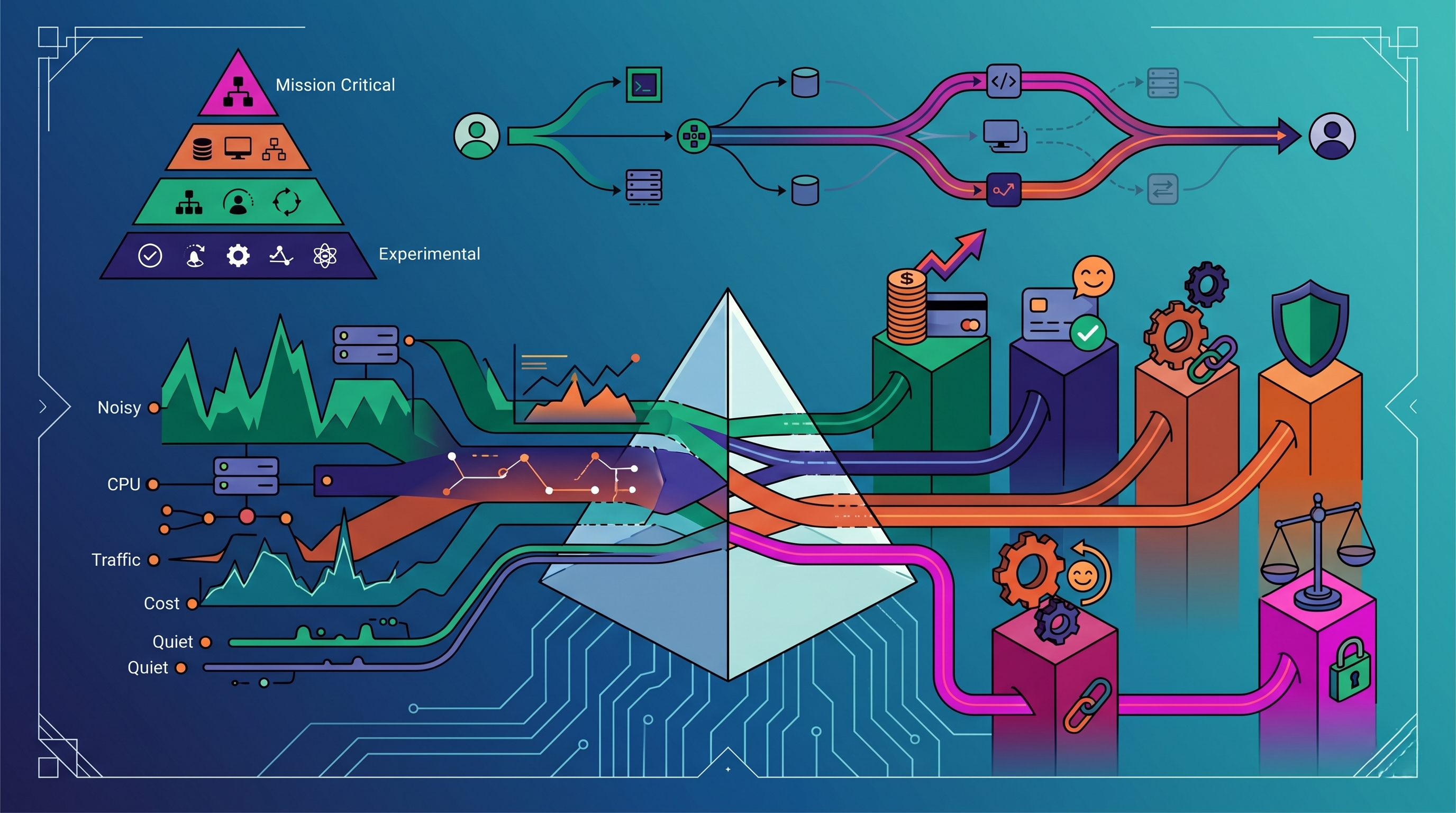
Every system has services that look important. They consume resources, generate alerts, appear in dashboards, and often sit at the center of technical conversations. But appearances can be misleading.
Some services run quietly in the background while directly protecting revenue. Others generate noise but have limited real business impact when they fail. A minor authentication delay can block thousands of paying users. A small payment API slowdown can halt transactions instantly. Meanwhile, a heavily monitored internal tool outage may create inconvenience but little commercial damage. This is where many organizations get priorities wrong.
Engineering teams often classify criticality through technical signals alone, like CPU load, request volume, latency, dependency count, or infrastructure cost. Those metrics matter, but they do not answer the most important question of what happens to the business if this service degrades.
That is the purpose of business context analysis. Instead of judging systems only by technical behavior, business context analysis connects services to revenue flows, customer journeys, compliance exposure, operational continuity, and strategic outcomes. In simple terms, it helps teams understand not just what is running, but what truly matters.
In this blog, let’s break down how organizations can identify critical services through the lens of business context.
Why Technical Metrics Alone Fail
Most organizations begin service prioritization with technical data. They rank systems based on traffic, uptime history, infrastructure spend, or dependency graphs. These are useful inputs, but incomplete.
A service with low traffic may support enterprise billing cycles worth millions. A backend reconciliation engine may process only a few scheduled jobs each day but be essential for financial accuracy. A customer login service may consume modest compute resources while controlling access to the entire product.
When teams rely only on technical metrics, they often overprotect visible systems and underprotect commercially vital ones.
This creates dangerous blind spots:
Critical systems receive insufficient redundancy.
Incident response focuses on noisy alerts instead of revenue impact.
Engineering effort is spent on optimizing the wrong workloads.
Leadership gets an inaccurate view of operational risk.
What is Business Context Analysis?
Business context analysis means evaluating services based on their relationship to outcomes that leadership and customers care about. Instead of asking whether a service is busy or expensive, teams ask whether it influences revenue, retention, trust, legal exposure, or employee productivity. This changes how priorities are set.
A service becomes critical not because it is architecturally complex, but because the cost of failure is high. That cost may be financial, reputational, operational, or strategic. Once organizations understand this distinction, engineering priorities become more aligned with business value.
The Four Dimensions of Criticality
To identify truly critical services, teams should assess systems across four dimensions rather than a single technical score.
Revenue Impact
If a service fails, does it interrupt sales, subscriptions, transactions, renewals, or billing?
Examples include payment gateways, checkout flows, pricing engines, authentication layers, and customer provisioning systems. These services often deserve top-tier resilience because downtime converts directly into lost money.
Customer Experience
Some systems may not process revenue directly, but strongly shape trust and retention. Examples include login systems, notification engines, support chat tools, onboarding flows, and content delivery services.
Customers may tolerate minor inconvenience once. Repeated friction leads to churn.
Operational Dependency
Internal systems are often underestimated. If engineering teams cannot deploy, support teams cannot access records, or finance cannot reconcile accounts, business operations slow dramatically.
Examples include CI/CD pipelines, identity systems, ERP integrations, analytics pipelines, and internal admin portals.
Risk Exposure
Certain services create outsized compliance, legal, or reputational exposure if they fail.
Examples include audit logging, data retention controls, fraud detection, privacy systems, and security monitoring layers. These may not generate visible revenue but are strategically critical.
Mapping Services to Business Journeys
One of the best ways to identify critical services is to start with business journeys rather than architecture diagrams. Instead of reviewing components in isolation, teams should examine how value is delivered.
Consider journeys such as a user signing up, a customer upgrading plans, an order being placed, a support issue being resolved, or a new release being deployed.
Once those journeys are mapped, the services involved become clearer. Teams often discover that small or forgotten systems support multiple high-value workflows.
A background scheduler may trigger invoicing. A simple API may enable onboarding and renewals. Journey mapping transforms hidden dependencies into visible priorities.
Tiering Services the Right Way
Once context is clear, services should be grouped into meaningful criticality tiers.
Tier 1: Mission Critical
Failure causes immediate revenue loss, broad customer disruption, or severe operational damage. Examples: authentication, payments, checkout, production databases, traffic routing.
Tier 2: Business Essential
Failure causes moderate disruption, slows teams, or affects segments of users. Examples: analytics pipelines, internal operations tools, recommendation engines.
Tier 3: Important but Non-Urgent
Failure creates inconvenience but limited near-term impact. Examples: archive services, internal dashboards, low-priority reporting tools.
Tier 4: Experimental or Low Impact
Non-core services where risk tolerance is higher. Examples: pilots, sandbox environments, and optional features.
Tiering helps organizations align uptime targets, staffing, monitoring depth, recovery objectives, and investment levels.
How Incident Response Improves
Without a business context, incidents are handled based on technical severity. With a business context, they are handled based on business consequences.
That distinction matters.
A CPU spike in a low-impact service may not deserve executive attention. A slight latency increase in payment authorization during peak demand absolutely does.
Business-aware incident response enables:
Faster prioritization
Better escalation decisions
Clearer stakeholder communication
Smarter resource allocation
Reduced revenue impact during outages
When teams know what is truly critical, response becomes sharper and calmer.
Where Most Organizations Go Wrong
Many organizations assign criticality labels once and never revisit them. But priorities shift as products evolve, customer segments grow, and revenue models change. A secondary service today may become central next quarter. Static labels quickly become outdated.
Another common mistake is allowing engineering alone to define importance. Product, finance, operations, customer success, and security teams all hold valuable context. Criticality should be cross-functional because business impact is cross-functional.
Finally, many teams treat all downtime equally. In reality, five minutes of checkout failure may be worse than two hours of internal reporting disruption. Duration matters, but consequence matters more.
A Practical Framework
Organizations can start with a simple recurring review model. For every service, score:
Revenue dependency
Customer impact
Operational dependency
Risk exposure
Recovery complexity
Peak-time sensitivity
Then rank services quarterly. This creates a living map of operational criticality instead of a static spreadsheet nobody trusts. Done well, this framework also guides:
SRE priorities
Disaster recovery plans
Observability investment
Automation roadmaps
Cloud spend allocation
Leadership reporting
Why This Matters More in Cloud Environments
Cloud environments grow quickly, and complexity often grows even faster. Microservices, containers, managed services, APIs, and multi-cloud architectures create more dependencies than most teams can track manually. As a result, many organizations know what exists but not what matters most.
Modern outages are rarely caused by one dramatic failure. They often emerge through chains of small issues across interconnected systems. Business context helps teams cut through that complexity and focus attention where it protects the most value.
Atler Pilot as an Advantage
Most teams have metrics, logs, traces, and alerts. What they often lack is decision context.
That is where Atler Pilot changes the game.
Instead of forcing teams to manually connect infrastructure signals with business importance, Atler Pilot helps surface what deserves attention first. It brings clarity to noisy environments, highlights priority services, and helps engineering teams act with business awareness and not just with technical urgency.
This means faster triage, smarter prioritization, and stronger operational confidence when pressure is highest.
For modern teams, the real advantage is not more dashboards. It is a better decision.
If your environment is growing faster than your visibility, now is the right time to explore Atler Pilot and see how intelligent context can transform operations.
Conclusion
The most critical services in your business are not always the loudest, largest, or most expensive. They are the ones whose failure creates the greatest consequence. That is why technical monitoring alone is no longer enough.
Organizations that understand business context can prioritize better, respond faster, invest smarter, and protect what truly drives growth. Those who do not often discover criticality only during an outage. By then, the lesson is expensive.
The smartest teams identify critical services before failure forces the conversation.
All in One Place
Atler Pilot decodes your cloud spend story by bringing monitoring, automation, and intelligent insights together for faster and better cloud operations.