
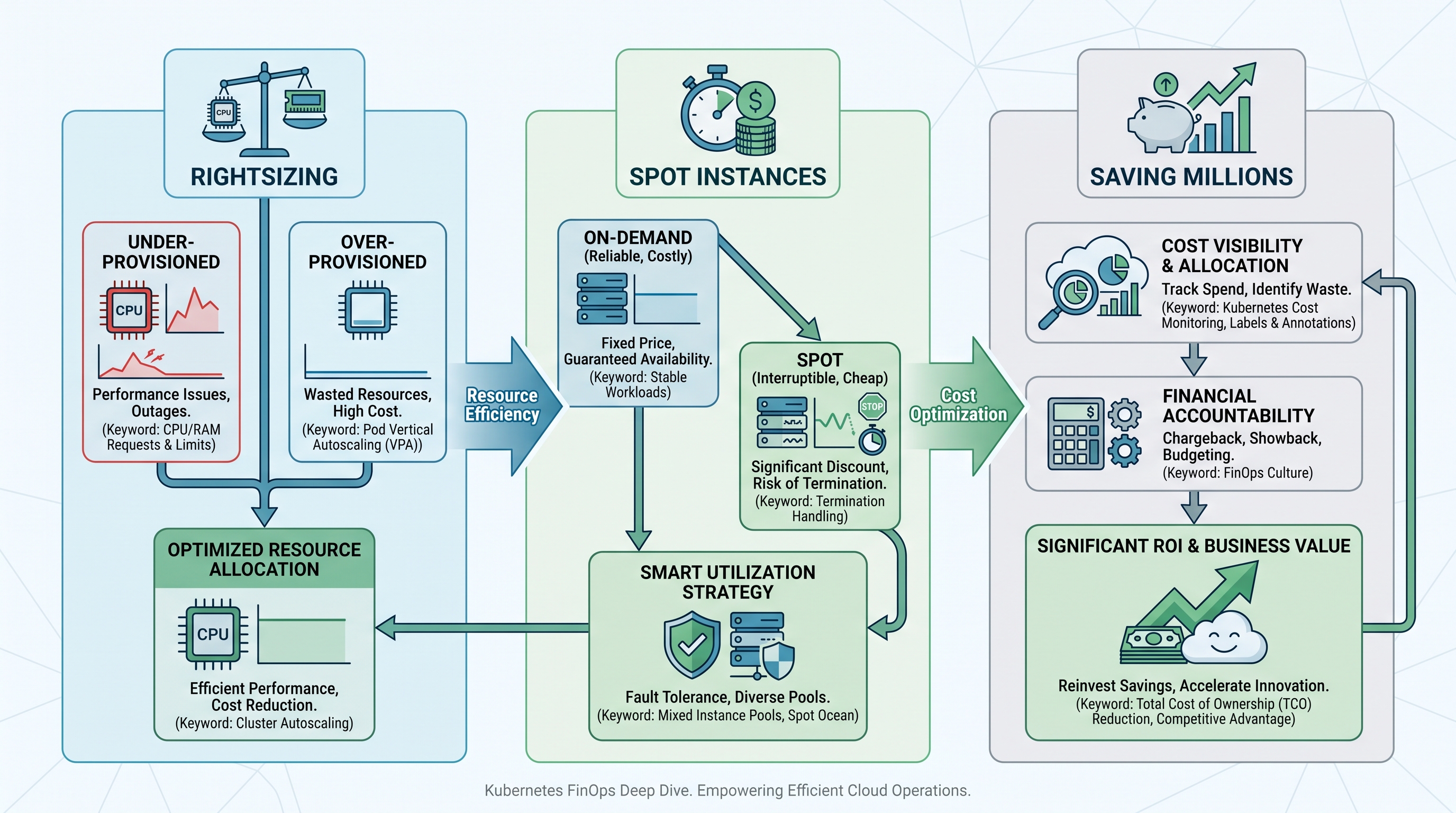
In the dynamic landscape of cloud-native architectures, Kubernetes has become the de facto standard for orchestrating containerized applications. Its power lies in abstracting underlying infrastructure, enabling unparalleled agility and scalability. However, this abstraction often comes with a significant challenge: cost visibility and control. Without a robust FinOps framework, Kubernetes environments can quickly become a black hole for cloud spend, eroding the very efficiency gains they promise.
For enterprise organizations managing complex, large-scale Kubernetes deployments across multiple cloud providers like AWS, Azure, GCP, and Oracle, the stakes are incredibly high. Unoptimized clusters can lead to millions in wasted expenditure annually. This deep dive will dissect two of the most impactful FinOps strategies for Kubernetes: intelligent rightsizing of workloads and the strategic adoption of spot instances. We'll explore the technical intricacies, architectural considerations, and the transformative role of AI-powered platforms in unifying FinOps, cloud security, and automated operations to achieve exponential savings.
The Kubernetes Cost Conundrum: Why FinOps is Essential
Kubernetes introduces layers of abstraction that, while beneficial for developers and operations teams, can obscure the true cost of resources. Pods, deployments, services, and ingresses consume CPU, memory, storage, and network bandwidth, which ultimately map to underlying virtual machines, managed databases, and other cloud services. The challenge intensifies with:
Dynamic Scaling: Auto-scaling groups, Horizontal Pod Autoscalers (HPAs), and Vertical Pod Autoscalers (VPAs) introduce fluctuating resource consumption.
Resource Pooling: Multiple workloads sharing node resources make granular cost attribution difficult.
Developer Autonomy: Developers often provision resources based on worst-case scenarios, leading to significant over-provisioning.
Lack of Visibility: Standard cloud billing tools often fail to provide the Kubernetes-native granularity required for effective cost management.
Multi-Cloud Complexity: Managing costs across disparate cloud provider billing models adds another layer of difficulty.
FinOps, a cultural practice that brings financial accountability to the variable spend model of cloud, is not just beneficial but critical for Kubernetes. It bridges the gap between engineering, finance, and business, fostering collaboration and informed decision-making. The core FinOps principles—Inform, Optimize, Operate—are directly applicable:
Inform: Gaining granular visibility into Kubernetes resource consumption and correlating it with business value.
Optimize: Implementing strategies like rightsizing and leveraging spot instances to reduce waste.
Operate: Automating cost optimization processes and continuously monitoring for new opportunities.
This proactive, continuous approach is what transforms cloud spending from an uncontrolled expense into a strategic investment. To learn more about how to embed FinOps into your organization, explore our dedicated FinOps solutions.
Deep Dive into Rightsizing Kubernetes Workloads
Rightsizing is the act of allocating the correct amount of compute resources (CPU and memory) to your Kubernetes pods. It's a delicate balance: too little, and your applications suffer performance degradation or crashes; too much, and you're paying for idle resources. The impact of effective rightsizing can be profound, often reducing infrastructure costs by 30-50% for many organizations.
Understanding Resource Requests and Limits
At the heart of Kubernetes rightsizing are resource requests and limits defined in your pod specifications:
Requests: Define the minimum amount of resources a container needs. The Kubernetes scheduler uses requests to decide which node a pod can run on. If a node doesn't have enough allocatable resources to satisfy a pod's requests, the pod won't be scheduled there.
Limits: Define the maximum amount of resources a container can consume. If a container tries to exceed its CPU limit, it will be throttled. If it exceeds its memory limit, the container (and potentially the entire pod) will be terminated by the kernel's Out-Of-Memory (OOM) killer.
These settings directly influence a pod's Quality of Service (QoS) class, which in turn affects its scheduling priority and eviction policy:
Guaranteed: Requests and limits are equal and non-zero for both CPU and memory. These pods have the highest priority and are least likely to be evicted. They are also the most expensive.
Burstable: Requests are less than limits (or limits are unset) for at least one resource. These pods have medium priority and can burst beyond their requests if resources are available, but are more susceptible to eviction than Guaranteed pods.
BestEffort: Neither requests nor limits are set. These pods have the lowest priority and are the first to be evicted under resource pressure. They are ideal for non-critical, batch jobs.
Misconfigurations are rampant:
Over-provisioning (High Requests/Limits): Leads to nodes being underutilized because the scheduler reserves more resources than the application actually needs. This is the primary driver of wasted spend.
Under-provisioning (Low Requests/Limits): Results in application performance issues (CPU throttling), frequent OOM kills, and increased pod restarts, leading to poor user experience and operational overhead.
The Role of Observability and Metrics
Effective rightsizing is impossible without granular observability. You need to understand the actual resource consumption patterns of your workloads over time. Key metrics include:
CPU Utilization: Average, peak, and percentile usage (e.g., 90th or 95th percentile) for containers and pods.
Memory Usage: Average, peak, and working set memory usage.
Network I/O and Disk I/O: While not directly used for CPU/memory rightsizing, these can indicate bottlenecks that might influence compute needs.
Tools like Prometheus for metric collection and Grafana for visualization are indispensable. Historical data (weeks or even months) is crucial to identify trends, seasonality, and outlier events. For instance, a batch processing job might have a high CPU spike once a day, but an API service might have consistent, moderate CPU usage with predictable daily peaks.
Automated Rightsizing Tools and Strategies
Manual rightsizing is unsustainable at scale. Automation is key:
Kubernetes Vertical Pod Autoscaler (VPA): VPA continuously monitors the actual resource usage of pods and recommends (or automatically sets) optimal CPU and memory requests.
How it works: VPA consists of an admission controller, recommender, and updater. The recommender analyzes historical usage, and the updater can automatically update pod resource requests/limits.
Limitations: VPA currently requires pods to be restarted to apply new resource requests/limits, which can cause service disruption. It also only adjusts requests, not limits, unless configured to do so.
Horizontal Pod Autoscaler (HPA): While not directly rightsizing, HPA scales the number of pod replicas based on observed CPU utilization or custom metrics. Combining HPA with VPA (or a VPA-like recommendation engine) is a powerful strategy: VPA ensures each pod is optimally sized, while HPA ensures the correct number of pods are running.
Custom Controllers and AI/ML Platforms: For more sophisticated scenarios, custom controllers can integrate with external optimization engines. AI/ML-driven platforms like CloudAtler analyze vast datasets of resource usage, performance metrics, and cost data across your multi-cloud environment. They can predict optimal resource allocations, identify anomalous consumption patterns, and even suggest proactive adjustments, often without requiring pod restarts by optimizing node sizing and bin-packing. This holistic approach significantly reduces human effort and maximizes savings. These platforms often leverage advanced algorithms to provide precise rightsizing recommendations, factoring in application criticality, performance SLAs, and cost constraints.
Example: An e-commerce API service running in Kubernetes consistently shows 10% CPU utilization and 200MiB memory usage, but its pod requests are set to 1 core and 2GiB. A VPA or an AI-powered FinOps platform would recommend reducing the requests to 200m CPU and 500MiB memory (allowing for some buffer), freeing up significant resources on the underlying nodes, which can then be de-provisioned by the Cluster Autoscaler, leading to direct cost savings.
Leveraging Spot Instances for Massive Kubernetes Savings
After rightsizing, the next frontier for massive cost savings in Kubernetes is the strategic adoption of cloud provider spot instances. Spot instances are spare compute capacity offered by cloud providers (AWS EC2 Spot, Azure Spot VMs, GCP Spot VMs) at significantly discounted prices, often 70-90% less than on-demand instances. The catch: these instances can be interrupted with short notice (typically 30 seconds to 2 minutes) if the cloud provider needs the capacity back.
Architectural Considerations for Spot Workloads
To effectively utilize spot instances without compromising application availability, your workloads must be designed for resilience and fault tolerance:
Stateless Applications: Ideal candidates for spot instances. Microservices, API gateways, web servers, batch processing jobs, and message queue consumers that don't maintain session state locally can be easily restarted on a new instance.
Graceful Termination: Applications should handle
SIGTERMsignals gracefully, allowing them to complete in-flight requests, flush data, and shut down cleanly within the interruption notice period. Kubernetes Pod Disruption Budgets (PDBs) are crucial here, ensuring a minimum number of replicas are available during voluntary disruptions (like node draining or upgrades) and can also help during spot interruptions by preventing too many pods from being evicted simultaneously.Data Persistence: Stateful applications (databases, caches) are generally not suitable for running directly on spot instances unless their data is stored on highly available, network-attached storage (e.g., EBS, Azure Disks, GCP Persistent Disks) and they can tolerate restarts and potential data synchronization delays. Even then, careful consideration and robust failover mechanisms are required.
Diversification: Distribute your spot workloads across multiple instance types, availability zones, and purchasing options to minimize the impact of a single interruption event.
Integrating Spot Instances into Kubernetes Clusters
Integrating spot instances into a Kubernetes cluster requires careful orchestration of node provisioning and pod scheduling:
Dedicated Node Groups/Pools: Create separate node groups or pools specifically for spot instances. This allows you to apply specific taints to these nodes and use tolerations on pods that can run on spot instances. For example, a
spot=true:NoScheduletaint on spot nodes, with corresponding tolerations on stateless pods.Cluster Autoscaler: The Kubernetes Cluster Autoscaler dynamically adjusts the number of nodes in your cluster. It can be configured to provision new nodes from spot instance pools when pods are pending and scale down underutilized nodes.
Karpenter (AWS Specific, but Conceptually Generalizable): Karpenter is an open-source, high-performance Kubernetes cluster autoscaler built by AWS that significantly improves the efficiency and cost-effectiveness of running workloads on Amazon EKS. Unlike the traditional Cluster Autoscaler, Karpenter directly provisions optimal compute resources in response to unschedulable pods, often using a mix of spot and on-demand instances based on specific requirements. It can provision nodes from diverse instance types and purchasing options, maximizing spot utilization and minimizing cost. Similar concepts exist or are emerging for other cloud providers.
Pod Affinity/Anti-affinity and Topology Spread Constraints: Use these to ensure high availability by spreading critical pods across different nodes or availability zones, even within spot instance pools.
Node Taints and Tolerations: Taint your spot nodes (e.g.,
kubernetes.io/lifecycle=spot:NoSchedule) and add tolerations to your stateless workloads. This ensures that only resilient applications are scheduled on spot instances, preventing critical services from being interrupted.
Example: A large analytics platform processes vast amounts of data using Apache Spark on Kubernetes. The Spark worker pods are stateless and can tolerate interruptions. By configuring a dedicated spot node group with appropriate taints and ensuring Spark workers have tolerations, the organization can run 80% of its compute-intensive analytics on spot instances, reducing costs by millions annually. The remaining 20% (e.g., Spark master, critical APIs) run on on-demand instances for stability.
Cost Savings Potential and Risk Mitigation
The cost savings from spot instances are substantial, often ranging from 50% to 90% compared to on-demand pricing. For an enterprise with thousands of CPU cores running in Kubernetes, this translates into millions of dollars annually.
Mitigating the risk of interruption involves:
Diversification: Requesting multiple instance types and sizes across different availability zones. If one type is interrupted, others are likely still available.
Fallback to On-Demand: Configure your autoscaler (e.g., Karpenter) to fall back to on-demand instances if spot capacity is unavailable or if a workload is deemed too critical to risk interruption.
Proactive Monitoring: Monitor spot interruption rates and adjust strategies as needed. CloudAtler's platform, for instance, can provide real-time insights into spot market availability and historical interruption patterns, informing optimal provisioning decisions.
Advanced FinOps Strategies and the CloudAtler Advantage
Beyond rightsizing and spot instances, a comprehensive FinOps strategy for Kubernetes involves several other critical components, all of which benefit immensely from a unified, AI-powered platform like CloudAtler.
Cost Allocation and Showback/Chargeback
Understanding who owns which costs is fundamental. Kubernetes labels and namespaces are powerful tools for cost attribution. By consistently labeling pods, deployments, and namespaces with team, project, or cost center information, you can accurately map Kubernetes resource consumption back to specific business units. CloudAtler integrates with your cloud billing data and Kubernetes metadata to provide granular cost visibility, enabling accurate showback (informing teams of their costs) and chargeback (billing teams for their usage).
Anomaly Detection and Waste Identification
Manual identification of waste in large Kubernetes clusters is nearly impossible. An AI-powered platform can continuously monitor for:
Idle Resources: Pods with extremely low CPU/memory utilization.
Zombie Pods/Deployments: Resources left running unnecessarily after their purpose is served.
Misconfigured Resources: Requests/limits that are wildly out of sync with actual usage.
Cost Spikes: Sudden, unexplained increases in spending, potentially indicating inefficient deployments or security incidents.
CloudAtler's automated operations capabilities include proactive alerts and recommendations for these scenarios, helping teams act quickly to mitigate waste. This is a crucial aspect of operational efficiency, directly linked to our automated operations offerings.
Unified Platform for Holistic Optimization
The true power of CloudAtler lies in its ability to unify FinOps, cloud security, and automated operations across diverse cloud environments. For Kubernetes, this means:
AI-Powered Rightsizing: Automated, intelligent recommendations for CPU and memory requests/limits based on historical data, performance SLAs, and cost targets, often without requiring manual restarts.
Optimal Spot Instance Utilization: Recommendations for which workloads are best suited for spot, intelligent provisioning strategies, and real-time monitoring of spot market conditions to maximize savings and minimize interruptions.
Cost Anomaly Detection: Proactive identification of unexpected cost increases, giving teams immediate insights into potential issues.
Security Posture Management: Integrating security checks into the FinOps process. For example, identifying over-privileged service accounts or network policies that could lead to data exfiltration risks or resource abuse, which ultimately impacts costs.
Automated Remediation: Beyond recommendations, CloudAtler can automate specific optimization actions, such as adjusting resource requests or scaling down idle resources, based on predefined policies.
Multi-Cloud Visibility: Providing a single pane of glass for FinOps and security across AWS, Azure, GCP, and Oracle Kubernetes environments, simplifying management for complex enterprise architectures. For example, our platform provides deep insights into AWS cost and security posture alongside other cloud providers.
Security Considerations in FinOps
It's imperative to recognize that FinOps and cloud security are not isolated disciplines; they are deeply intertwined. Security vulnerabilities can directly translate into significant financial liabilities. For instance:
Resource Abuse: Compromised containers or overly permissive IAM roles can lead to cryptocurrency mining or other unauthorized resource consumption, driving up cloud bills dramatically.
Data Breaches: Security incidents involving data exfiltration can incur massive fines, legal costs, and reputational damage, dwarfing any operational cost savings.
Compliance Overhead: Failure to adhere to compliance standards due to security misconfigurations can lead to auditing costs and penalties.
A unified platform like CloudAtler inherently understands this nexus. By integrating robust cloud security posture management with FinOps, it ensures that cost optimizations do not introduce security risks, and conversely, that security best practices are implemented cost-effectively. For example, identifying and remediating overly broad network policies can not only reduce attack surface but also prevent unnecessary resource consumption from unauthorized access attempts.
Conclusion: Unifying Your Cloud Operations for Exponential Savings
The journey to FinOps maturity in Kubernetes is not a sprint, but a continuous process of learning, optimizing, and automating. By meticulously rightsizing your workloads and strategically leveraging spot instances, enterprise organizations can unlock multi-million dollar savings while maintaining or even improving application performance and resilience. The complexity of managing these strategies across vast, multi-cloud Kubernetes environments, however, necessitates a sophisticated approach.
CloudAtler provides the AI-powered intelligence and automation required to navigate this complexity. Our platform unifies FinOps, cloud security, and automated operations, offering unparalleled visibility, actionable insights, and automated remediation capabilities across AWS, Azure, GCP, and Oracle. Stop leaving millions on the table and transform your cloud spend into a strategic advantage.
Ready to unify your cloud operations, optimize your Kubernetes costs, and fortify your security posture?
Discover how CloudAtler can help your enterprise save millions and achieve operational excellence. Visit CloudAtler.com today to schedule a demo and see the power of unified cloud management.
All in One Place
Atler Pilot decodes your cloud spend story by bringing monitoring, automation, and intelligent insights together for faster and better cloud operations.