
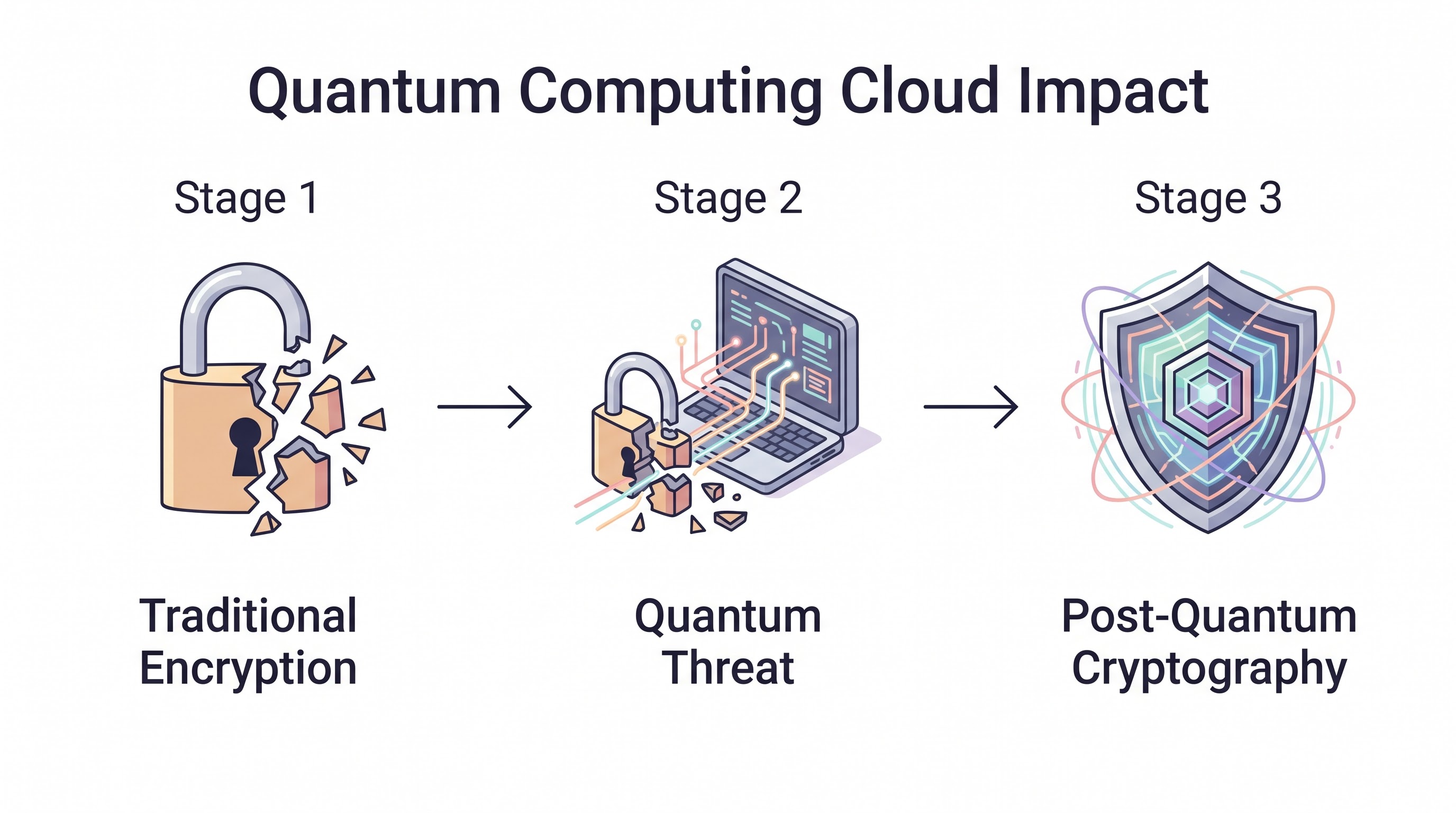
The Approaching Q-Day
The security of the entire modern internet—every banking transaction, every encrypted S3 bucket, every secure SSH connection—relies on a single mathematical premise: standard computers cannot efficiently factor massive prime numbers. The cryptographic algorithms we use (RSA, Elliptic Curve) are virtually unbreakable by classical computers.
Quantum computers operate on different physics. They utilize quantum bits (qubits) to perform specific types of calculations exponentially faster than classical supercomputers. "Q-Day" is the theoretical date when a sufficiently stable, large-scale quantum computer is built. On that day, the mathematical premise of modern encryption shatters.
While Q-Day may be years away, the threat to cloud security is immediate. This guide details the cryptographic shift occurring across major cloud providers and the urgent steps organizations must take to adopt Post-Quantum Cryptography (PQC).
The Threat: Shor's Algorithm and the End of RSA
In 1994, mathematician Peter Shor published a quantum algorithm that can easily factor large prime numbers. Shor's Algorithm proved that a powerful quantum computer can instantly crack RSA and Elliptic Curve Cryptography (ECC)—the foundations of Public Key Infrastructure (PKI).
If an attacker possesses a quantum computer, they can forge digital certificates, impersonate legitimate cloud APIs, and decrypt intercepted TLS web traffic in real-time. The entire Zero Trust perimeter, which relies entirely on cryptographic identity validation, collapses.
The Immediate Danger: Harvest Now, Decrypt Later
A common executive response is, "Quantum computers won't be powerful enough for a decade; we have time." This ignores the primary strategy of nation-state threat actors: Harvest Now, Decrypt Later (HNDL).
Attackers are currently capturing and storing massive volumes of highly sensitive, encrypted internet traffic (financial data, government communications, proprietary corporate IP). They cannot decrypt it today. But they are stockpiling the encrypted files in data lakes, waiting for Q-Day. If your organization's data has a required secrecy lifespan of 10-20 years (e.g., healthcare records, classified IP), and it is captured today using classical RSA encryption, it is already compromised.
The Solution: Post-Quantum Cryptography (PQC)
The defense against quantum computing is not quantum computing; it is new mathematics. Post-Quantum Cryptography (PQC) refers to new cryptographic algorithms designed to be run on standard, classical computers, but based on math problems (like lattice-based cryptography) that quantum computers find incredibly difficult to solve.
The National Institute of Standards and Technology (NIST) has spent years analyzing PQC algorithms and has officially standardized the first set of quantum-resistant algorithms (such as Kyber for key encapsulation and Dilithium for digital signatures).
Migrating the Cloud to PQC
Migrating the entire global IT infrastructure to PQC is a massive, decade-long undertaking, similar to the Y2K bug, but vastly more complex. The major cloud providers (AWS, Azure, GCP) are already upgrading their internal infrastructure.
The strategy is Hybrid Cryptography. During the transition period, systems will encrypt data using both a classical algorithm (like ECC) and a new PQC algorithm. This ensures that even if the new PQC algorithm contains an undiscovered flaw, the data remains protected by the classical algorithm against modern threats.
Securing Data in Transit (TLS and VPNs)
The most vulnerable vector for the "Harvest Now, Decrypt Later" attack is data traveling across the public internet. Organizations must upgrade their data-in-transit protocols.
AWS Key Management Service (KMS): AWS KMS now supports hybrid post-quantum TLS for API endpoints. You can configure your applications to communicate with AWS using these quantum-resistant connections immediately.
VPNs and Load Balancers: Cloud VPNs (like AWS Client VPN) and Application Load Balancers are being updated to support PQC cipher suites. Cloud Operations teams must prioritize updating the TLS configurations on all internet-facing load balancers to enforce hybrid PQC encryption, blocking attackers from intercepting useful data today.
Securing Data at Rest (KMS and S3)
While data at rest (stored in an S3 bucket or RDS database) is generally encrypted using symmetric algorithms (like AES-256), which are highly resistant to quantum attacks, the keys used to decrypt that data are often protected by vulnerable asymmetric algorithms (RSA).
Organizations must audit their entire Key Management infrastructure. Any process that utilizes RSA for digital signatures, secure boot processes, or key exchange within the cloud environment must be mapped and scheduled for migration to NIST-approved PQC algorithms over the next 3-5 years.
Key Takeaway
The threat of quantum computing is not a future problem; the "Harvest Now, Decrypt Later" strategy means vulnerable data transmitted today is already at risk. Cloud security must evolve immediately. Organizations should inventory their cryptographic assets, transition their public-facing load balancers and VPNs to utilize hybrid Post-Quantum Cryptography (PQC) TLS cipher suites, and prepare for a multi-year migration to replace all legacy RSA/ECC infrastructure.
All in One Place
Atler Pilot decodes your cloud spend story by bringing monitoring, automation, and intelligent insights together for faster and better cloud operations.