
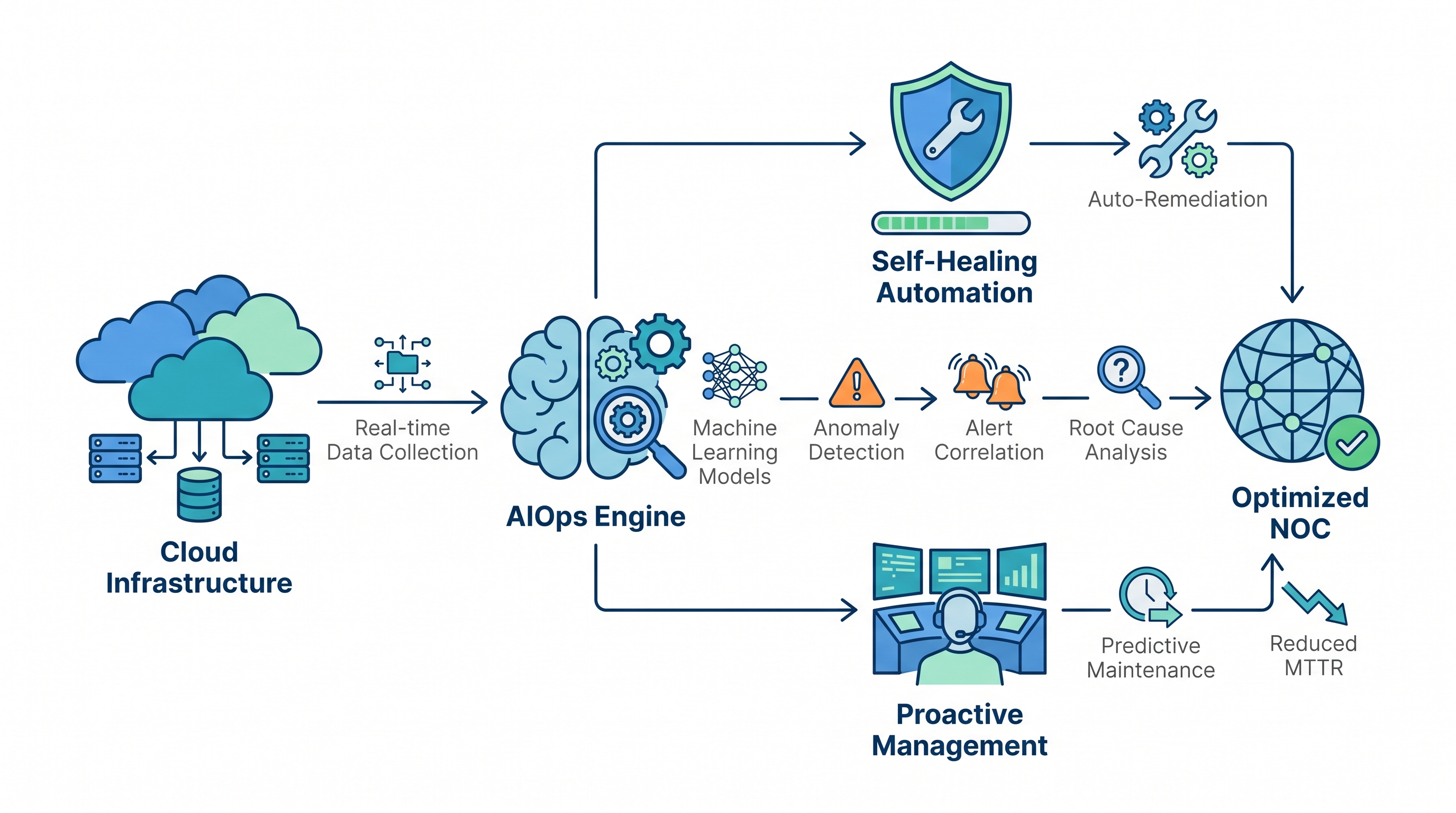
The relentless pace of digital transformation has propelled enterprises into complex, dynamic multi-cloud ecosystems. Managing these sprawling infrastructures, which often span AWS, Azure, GCP, and Oracle environments, presents unprecedented challenges for traditional operations teams. The sheer volume of telemetry data – logs, metrics, traces, events, security alerts, and cost reports – generated by thousands of microservices, containers, and serverless functions has rendered manual monitoring and reactive incident response obsolete. This is where the AI-Powered NOC, driven by advanced AIOps and self-healing mechanisms, emerges as an indispensable paradigm shift, moving enterprises from reactive firefighting to proactive, predictive, and autonomous cloud operations.
The Evolving Landscape of Cloud Operations: Beyond Traditional NOCs
For decades, the Network Operations Center (NOC) served as the central nervous system for IT infrastructure, a command center staffed by engineers meticulously monitoring dashboards and responding to alerts. In monolithic architectures and on-premises data centers, this model, while labor-intensive, was largely effective. However, the advent of cloud computing fundamentally altered the operational landscape:
Explosive Scale and Elasticity: Cloud environments can scale from tens to thousands of instances in minutes, making static baselines and manual thresholding impractical.
Distributed Architectures: Microservices, serverless functions, and containerization introduce ephemeral components and intricate interdependencies that are difficult to track manually.
Multi-Cloud Complexity: Enterprises increasingly adopt hybrid and multi-cloud strategies, integrating services from AWS, Azure, GCP, and Oracle, each with its unique APIs, monitoring tools, and operational nuances.
Data Overload ("Alert Fatigue"): The volume of telemetry data generated by modern cloud infrastructure is staggering, leading to alert fatigue and obscuring critical issues amidst noise.
Security and FinOps Integration: Operational concerns are no longer solely about uptime; they are intrinsically linked to cost optimization (FinOps) and maintaining a robust security posture.
Traditional NOCs, with their reliance on human operators correlating disparate events and manually executing runbooks, are simply overwhelmed. This often results in slower Mean Time To Resolution (MTTR), increased operational costs, and elevated risks to both service availability and security. The solution lies in automation, intelligence, and the ability to not just detect, but to predict and automatically remediate issues.
What is AIOps? Beyond Simple Monitoring
AIOps, or Artificial Intelligence for IT Operations, is not merely an upgrade to existing monitoring tools; it represents a fundamental shift in how IT operations are managed. It's the application of machine learning, analytics, and automation to IT operations data to automatically detect, analyze, and resolve issues, often before they impact users. The core tenets of AIOps include:
Data Ingestion and Aggregation: Collecting all relevant operational data – logs, metrics, traces, events, security findings, configuration data, and cost data – from diverse sources across the entire IT estate.
Intelligent Anomaly Detection: Moving beyond static thresholds to use machine learning models that dynamically learn normal behavior patterns and identify genuine deviations.
Correlation and Contextualization: Connecting disparate alerts and events into meaningful incidents, understanding their relationships, and reducing noise. This involves understanding dependencies and service maps.
Root Cause Analysis (RCA): Pinpointing the exact cause of an incident, rather than just identifying symptoms, often leveraging causal inference and topology mapping.
Predictive Analytics: Forecasting future issues based on historical trends and current state, enabling proactive intervention.
Automated Remediation: Triggering pre-defined or dynamically generated actions to resolve issues without human intervention (self-healing).
Continuous Learning: AIOps platforms continuously learn from new data, human feedback, and successful/unsuccessful remediations to improve accuracy and efficiency over time.
At its heart, AIOps aims to create a unified, intelligent operational fabric that understands the intricate dynamics of a modern cloud environment, empowering teams to focus on innovation rather than operational toil. CloudAtler embodies this vision, providing a unified AI-powered platform designed to bring clarity and control to these complex environments.
Architecting the AI-Powered NOC: A Technical Deep Dive
Building an effective AI-Powered NOC requires a robust architectural foundation capable of handling massive data volumes, performing complex analytics, and integrating with existing operational tools. Here's a breakdown of its key components:
1. Unified Data Ingestion and Normalization Layer
The bedrock of any AIOps solution is its ability to ingest and normalize data from every corner of the enterprise cloud estate. This includes:
Logs: Application logs, system logs, security logs (e.g., CloudTrail, Azure Activity Logs, GCP Audit Logs, Oracle Audit Vault), network flow logs (VPC Flow Logs, NSG Flow Logs).
Metrics: Performance metrics (CPU, memory, disk I/O, network throughput), application-specific metrics (request latency, error rates), infrastructure metrics from services like CloudWatch, Azure Monitor, Google Cloud Monitoring, Oracle Cloud Monitoring.
Traces: Distributed tracing data from microservices, providing end-to-end visibility into request flows.
Events: System events, configuration changes, CI/CD pipeline events, security events from SIEMs or native cloud security services.
Configuration Data: CMDB data, infrastructure-as-code definitions (Terraform, CloudFormation), inventory of cloud resources.
Cost Data: Billing reports (AWS CUR, Azure Cost Management, GCP Billing, Oracle Cost Analysis), resource utilization data.
This data, often in disparate formats, must be collected, parsed, enriched, and normalized into a consistent schema within a centralized data lake (e.g., S3, ADLS Gen2, GCS) or a purpose-built operational data store. Technologies like Kafka, Kinesis, Fluentd, Logstash, and cloud-native ingestion services play a crucial role here.
2. Machine Learning Core: The Brain of the AIOps Platform
Once data is ingested, the ML core applies various algorithms to derive actionable insights:
Anomaly Detection:
Statistical Anomaly Detection: Utilizing techniques like Z-score, IQR, or Exponentially Weighted Moving Averages (EWMA) for time-series data.
Machine Learning-based Anomaly Detection: Employing algorithms such as Isolation Forests, One-Class SVMs, Autoencoders, or LSTM networks to learn complex normal patterns and identify deviations in high-dimensional data. This is crucial for detecting subtle shifts in application behavior or resource utilization that static thresholds would miss.
Behavioral Baselines: Dynamically establishing baselines for metrics and logs, adapting to seasonality and evolving system behavior.
Correlation and Contextualization:
Event Clustering: Using algorithms like DBSCAN or K-means to group similar log messages or events, reducing noise.
Topological Analysis: Building a real-time dependency graph of services, applications, and infrastructure components across AWS, Azure, GCP, and Oracle environments. This allows the system to understand causal relationships between events (e.g., a database CPU spike impacting an application service).
Natural Language Processing (NLP): Analyzing unstructured log data to extract entities, sentiment, and identify patterns in error messages that point to common issues.
Root Cause Analysis (RCA):
Causal Inference Models: Applying techniques like Bayesian networks or Granger causality to determine the most probable root cause from a set of correlated anomalies.
Knowledge Graph Integration: Combining the dependency graph with historical incident data and runbooks to provide context-rich RCA suggestions.
Predictive Analytics:
Time-Series Forecasting: Using models like ARIMA, Prophet, or recurrent neural networks (RNNs) to predict future resource utilization, traffic patterns, or potential service degradation. This enables proactive scaling actions or incident prevention.
Capacity Planning: Forecasting future resource needs based on growth trends and historical data, preventing resource exhaustion.
Generative AI for Operational Intelligence:
Runbook Generation/Recommendation: Leveraging large language models (LLMs) to analyze incident context and suggest relevant runbook steps, or even generate new, context-aware remediation scripts.
Knowledge Management Augmentation: Summarizing incident reports, extracting key learnings, and populating knowledge bases.
3. Automation and Orchestration Engine
The insights generated by the ML core are only valuable if they can trigger automated actions. This engine integrates with various tools:
ITSM/ITOM Platforms: ServiceNow, Jira Service Management for automated incident creation, enrichment, and tracking.
Configuration Management & Orchestration: Ansible, Terraform, Puppet, Chef for executing remediation scripts, applying configuration changes, or provisioning/deprovisioning resources.
Cloud-Native Automation: AWS Systems Manager Automation, Azure Automation, GCP Cloud Functions/Runbooks for specific cloud actions.
Security Orchestration, Automation, and Response (SOAR): For automated security incident response workflows.
Self-Healing Cloud Operations: From Remediation to Prevention
The pinnacle of the AI-Powered NOC is its self-healing capability. This moves beyond merely alerting to actively resolving issues. Self-healing mechanisms can be categorized:
Reactive Self-Healing: Triggered immediately upon detection of an anomaly or incident.
Example (Performance): AIOps detects high CPU utilization on an EC2 instance; automated action scales up the instance type or adds more instances to an Auto Scaling group.
Example (Security): AIOps detects an unusual login attempt from a suspicious IP address; automated action blocks the IP at the WAF/firewall level and isolates the compromised user account.
Proactive Self-Healing: Triggered based on predictive analytics, preventing an incident from occurring.
Example (Capacity): AIOps predicts a storage volume will reach 90% capacity within 24 hours based on current growth; automated action expands the volume size or archives old data.
Example (Cost): AIOps identifies a consistent pattern of underutilized resources in a specific department; automated action recommends rightsizing and schedules the change, potentially even executing it during off-peak hours.
Key to self-healing is the concept of "policy-as-code," where operational, FinOps, and security guardrails are defined programmatically and enforced automatically. This ensures that automated remediations align with organizational policies and do not introduce new risks.
FinOps Optimization with AIOps: Driving Cloud Cost Efficiency
One of the most immediate and tangible benefits of an AI-Powered NOC is its profound impact on cloud FinOps. Cloud costs are notoriously complex and dynamic, with numerous factors influencing spend. AIOps brings intelligence and automation to this domain:
Cost Anomaly Detection:
Unusual Spend Spikes: Identifying sudden, unexplained increases in cloud spend across specific services (e.g., unexpected data transfer costs, rogue resource provisioning).
Idle Resource Detection: Automatically flagging resources that are provisioned but consistently underutilized (e.g., idle databases, unattached EBS volumes, oversized virtual machines).
Misconfiguration Detection: Identifying configurations that lead to unnecessary costs, such as public IP addresses remaining attached to stopped instances or expensive storage tiers being used for non-critical data.
Automated Rightsizing and Resource Optimization:
AIOps continuously analyzes resource utilization patterns (CPU, memory, network I/O) across your AWS, Azure, GCP, and Oracle compute instances and databases.
It then leverages machine learning to recommend optimal instance types or sizes that meet performance requirements while minimizing cost.
Automated workflows can then apply these rightsizing recommendations, either directly or after approval, ensuring continuous cost alignment without manual effort.
Waste Elimination:
Automated identification and decommissioning of orphaned resources (e.g., unattached snapshots, old load balancers).
Scheduling automatic shutdown/startup of non-production environments during off-hours.
Proactive Budget Management and Forecasting:
AIOps analyzes historical spend and current resource usage to provide accurate cost forecasts, alerting FinOps teams to potential budget overruns before they occur.
It can identify cost trends and deviations from expected spending patterns, allowing for timely adjustments.
By automating cost detection and optimization, enterprises can achieve significant savings, reallocate resources more effectively, and ensure that cloud spend aligns with business value. This proactive approach to cost management is a cornerstone of effective FinOps, and CloudAtler empowers organizations to achieve this across their multi-cloud footprint.
Enhancing Cloud Security Posture with AIOps
Beyond operational efficiency and cost optimization, AIOps is a powerful ally in strengthening cloud security. The dynamic nature of cloud environments, coupled with sophisticated threat actors, demands an intelligent and automated approach to security:
Advanced Threat Detection and Anomaly Identification:
User and Entity Behavior Analytics (UEBA): AIOps models learn normal user and service account behavior (login patterns, resource access, API calls). Deviations, such as an administrator logging in from an unusual location at an odd hour or a service account performing actions outside its typical scope, trigger high-fidelity alerts.
Network Anomaly Detection: Analyzing network flow logs (VPC Flow Logs, NSG Flow Logs) to detect suspicious traffic patterns, such as unusual port scans, data exfiltration attempts, or communication with known malicious IPs.
Configuration Drift Detection: Identifying unauthorized or non-compliant changes to security configurations (e.g., S3 bucket policy changes, security group modifications, IAM role alterations).
Automated Incident Response and Remediation:
Quarantining Compromised Resources: Upon detecting a compromised VM or container, AIOps can automatically isolate it from the network, preventing lateral movement of threats.
Blocking Malicious IPs: Integrating with WAFs, Network ACLs, or security groups to automatically block IP addresses identified as sources of attack.
Enforcing Security Policies: Automatically reverting non-compliant security configurations to their desired state, ensuring continuous adherence to security baselines.
Credential Rotation: If compromised credentials are suspected, AIOps can trigger automated rotation of API keys or access tokens.
Continuous Compliance and Governance:
AIOps continuously audits cloud resources against regulatory frameworks (e.g., GDPR, HIPAA, PCI DSS) and internal security policies.
It identifies compliance gaps in real-time and can initiate automated remediation workflows to bring resources back into compliance, providing an always-on governance layer.
This intelligent automation transforms security operations from a reactive, manual process into a proactive, self-defending mechanism. By unifying security visibility and automating responses across multi-cloud environments, an AI-Powered NOC significantly enhances an organization's cloud security posture, reducing the attack surface and minimizing breach impact.
Operational Excellence and Reliability: The Ultimate Goal
The overarching benefit of the AI-Powered NOC is the profound impact on operational excellence and the reliability of cloud services:
Reduced Mean Time To Resolution (MTTR): By accurately correlating events, identifying root causes, and initiating automated remediation, AIOps drastically cuts down the time it takes to resolve incidents.
Proactive Problem Management: Predictive capabilities allow operations teams to address potential issues before they escalate into outages, moving from a break-fix model to a preventive one.
Improved Service Availability and Performance: Consistent monitoring, intelligent insights, and automated adjustments ensure services remain highly available and perform optimally.
Enhanced Team Productivity and Morale: Freeing up highly skilled engineers from repetitive, manual tasks and alert fatigue allows them to focus on innovation, architectural improvements, and strategic initiatives. This also contributes to better job satisfaction and reduced burnout.
Data-Driven Decision Making: Operations teams gain access to deep, actionable insights into their infrastructure's health, performance, and cost, enabling more informed strategic decisions.
The journey towards automated operations is critical for any enterprise striving for true digital resilience and competitive advantage in the cloud era.
Implementing an AI-Powered NOC with CloudAtler
The vision of an AI-Powered NOC, delivering unified FinOps, robust security, and automated operations, can seem daunting given the complexity of multi-cloud environments. This is where a specialized platform like CloudAtler becomes indispensable.
CloudAtler is purpose-built to address the challenges of modern cloud operations. Our AI-powered platform unifies data ingestion, analysis, and automation across your entire cloud footprint, whether you operate on AWS, Azure, GCP, or Oracle. We provide:
Unified Visibility: A single pane of glass for all your operational, security, and cost telemetry, eliminating data silos.
Intelligent Insights: Leveraging advanced machine learning to detect anomalies, correlate events, identify root causes, and provide predictive analytics for performance, security, and cost.
Automated FinOps: Granular cost anomaly detection, automated rightsizing recommendations, waste elimination, and proactive budget management, ensuring your cloud spend is optimized and aligned with business value.
Proactive Cloud Security: Real-time threat detection, UEBA, automated compliance checks, and intelligent security incident response to fortify your cloud defenses.
Self-Healing Operations: Orchestrated automated remediation workflows that resolve issues autonomously, reducing MTTR and improving service reliability across your diverse cloud environments, including AWS, Azure, GCP, and Oracle.
By abstracting away the underlying complexity of integrating disparate cloud services and applying sophisticated AI, CloudAtler empowers your teams to achieve operational excellence, maintain a strong security posture, and optimize cloud costs without needing to build and maintain complex in-house AIOps solutions.
Conclusion: The Future is Autonomous and Intelligent
The AI-Powered NOC is no longer a futuristic concept but a strategic imperative for enterprises navigating the complexities of multi-cloud. It represents a fundamental shift from human-centric, reactive operations to an intelligent, automated, and self-healing paradigm. By harnessing the power of AIOps, organizations can transcend the limitations of traditional NOCs, achieving unparalleled levels of operational efficiency, cost optimization through advanced FinOps practices, and an unassailable cloud security posture.
Embrace the future of cloud operations. Move beyond alert fatigue and manual toil. Transform your operational model to one that is proactive, predictive, and autonomous. It's time to unify your cloud operations, strengthen your security, and optimize your FinOps with intelligence at its core.
Ready to revolutionize your cloud operations? Discover how CloudAtler's AI-powered platform can unify your FinOps, cloud security, and automated operations across AWS, Azure, GCP, and Oracle environments. Visit CloudAtler.com today to schedule a demo and transform your enterprise cloud management.
All in One Place
Atler Pilot decodes your cloud spend story by bringing monitoring, automation, and intelligent insights together for faster and better cloud operations.