
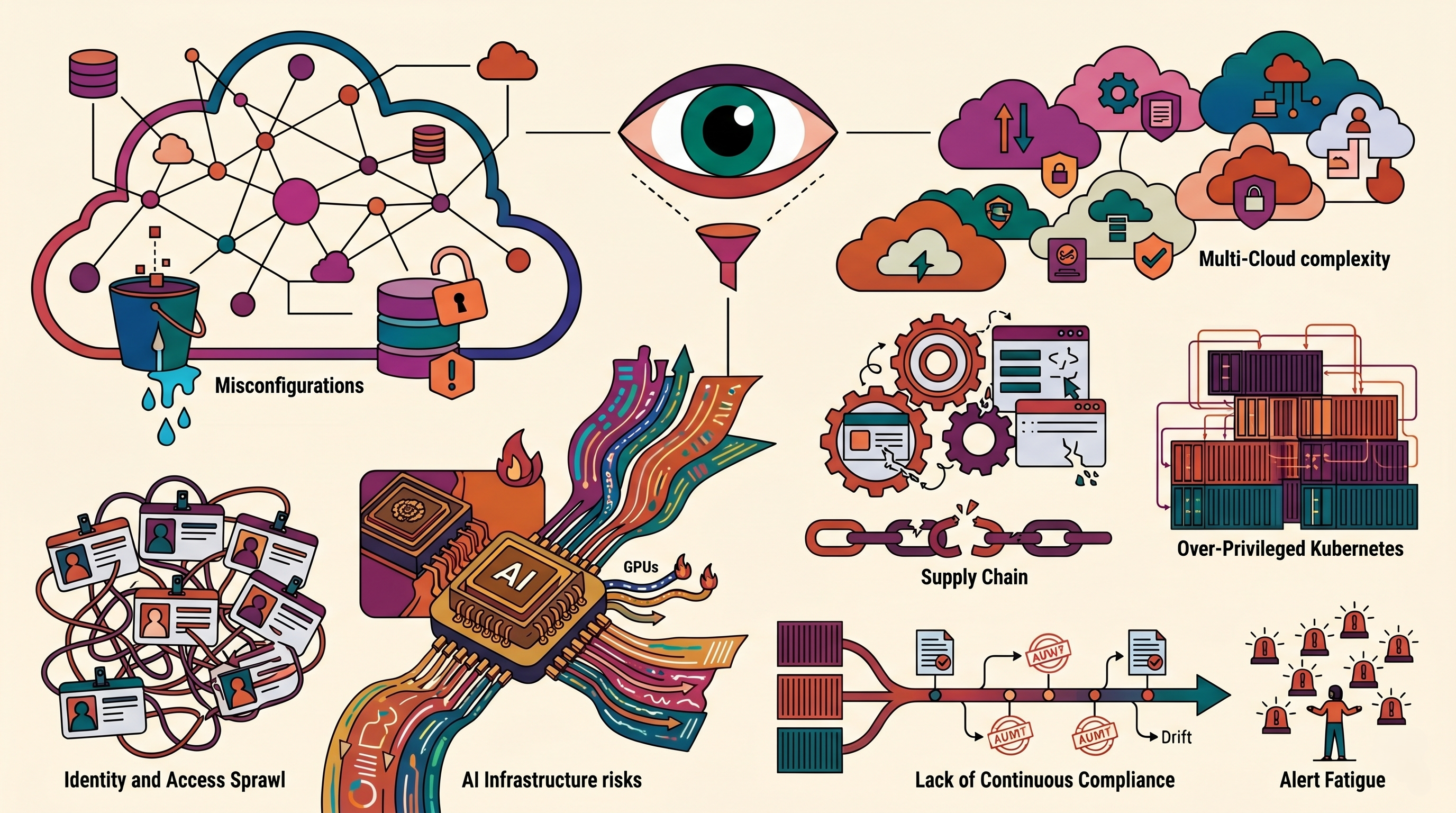
Cloud adoption is no longer just a technology strategy. It is now the operational backbone of modern businesses. Organizations rely on cloud infrastructure for everything from SaaS applications and AI workloads to customer platforms and internal operations. However, as cloud environments continue to scale and become more distributed, security risks are evolving just as quickly.
In 2026, the challenge is no longer limited to protecting servers or blocking external attacks. Organizations are now dealing with identity sprawl, AI infrastructure risks, fragmented multi-cloud visibility, Kubernetes misconfigurations, API vulnerabilities, and continuous compliance pressure. Many of these risks are not caused by sophisticated attacks alone, but by operational blind spots and a lack of visibility across dynamic environments.
In this blog, we will explore the biggest cloud security risks organizations face in 2026, why these risks are becoming harder to manage, and how modern Cloud Security Posture Management (CSPM) strategies are helping organizations regain control over rapidly evolving cloud environments.
Misconfigurations Remain the Biggest Threat
Despite years of cloud maturity, misconfigurations continue to be one of the leading causes of cloud security incidents. The reason is simple: cloud environments are constantly changing. New workloads are deployed daily, permissions evolve continuously, and infrastructure configurations shift automatically through DevOps pipelines and autoscaling systems.
A single exposed storage bucket, publicly accessible database, or overly permissive identity role can create significant risk exposure. The challenge becomes even greater in large-scale environments where thousands of resources are changing simultaneously across multiple accounts and regions. Many organizations already have security tools in place, but they still struggle because visibility into real-time configuration drift remains limited. Without continuous monitoring, security gaps can remain unnoticed until after they are exploited.
Identity and Access Sprawl Is Growing Rapidly
Identity has effectively become the new security perimeter in cloud-native infrastructure. As organizations adopt more cloud services, APIs, automation tools, and AI workflows, the number of users, service accounts, and machine identities increases rapidly. Over time, permissions accumulate across environments, and temporary access often becomes permanent without proper review.
This creates identity sprawl, where organizations lose a clear understanding of who has access to what resources. Excessive permissions dramatically increase the impact of compromised credentials or insider threats. In many cases, service accounts and automation systems end up with far broader permissions than they actually require. As environments grow, manually reviewing and controlling these permissions becomes increasingly difficult without centralized visibility and governance.
AI Infrastructure Introduces New Security Challenges
AI adoption is accelerating across cloud environments, but AI infrastructure also introduces an entirely new category of security challenges. Organizations are now managing GPU clusters, vector databases, training pipelines, model-serving systems, and large-scale AI APIs, often processing highly sensitive business and customer data.
The problem is that many teams are deploying AI workloads faster than they are implementing proper governance and visibility controls. AI systems are highly distributed, resource-intensive, and deeply integrated with cloud infrastructure. As a result, they create new attack surfaces that traditional cloud security models were not designed to handle. Attackers are increasingly targeting AI-related infrastructure because these environments often contain valuable data and operate with elevated permissions.
Multi-Cloud Complexity Weakens Security Visibility
Modern organizations rarely operate within a single cloud provider anymore. Multi-cloud and hybrid strategies are becoming increasingly common because they provide flexibility, resilience, and scalability. However, they also create major visibility challenges for security teams.
Different cloud providers use different identity systems, monitoring tools, networking models, and security policies. As environments become fragmented, organizations struggle to maintain a consistent understanding of their overall security posture. Misconfigurations may go unnoticed in one environment while policies remain inconsistent in another. Security ownership also becomes harder to define across distributed systems. Without centralized visibility, organizations often end up managing cloud security in silos rather than as a unified operational strategy.
API Security Risks Are Expanding
Cloud-native applications rely heavily on APIs for communication between services, applications, and third-party systems. As API usage grows, APIs are becoming one of the fastest-expanding attack surfaces in cloud environments.
The challenge is that APIs evolve rapidly and often operate across multiple systems simultaneously. Weak authentication, excessive data exposure, insecure integrations, and poorly configured endpoints can all create vulnerabilities that are difficult to detect manually. Many APIs are also deployed quickly through agile development workflows, which can cause security reviews to fall behind deployment speed. An overlooked API can quietly become a major entry point for attackers without generating obvious operational alerts.
Supply Chain Attacks are Becoming More Sophisticated
Cloud-native development relies heavily on third-party libraries, open-source packages, CI/CD pipelines, container registries, and automation tools. While this ecosystem accelerates innovation, it also creates significant supply chain risk.
Attackers increasingly target software dependencies and deployment pipelines because compromising a trusted component allows them to infiltrate environments indirectly. Organizations may unknowingly inherit vulnerabilities through software packages or compromised build systems without realizing it. Supply chain attacks are particularly dangerous because they often appear as legitimate operational activity, making them difficult to identify using traditional security approaches alone.
Over-Privileged Kubernetes Environments
Kubernetes continues to dominate cloud-native infrastructure, but many production clusters remain heavily over-permissioned and insufficiently segmented. In fast-moving environments, teams often prioritize operational convenience over strict access control, which creates long-term security exposure.
Common issues include privileged containers, excessive RBAC permissions, weak network isolation, insecure secrets management, and exposed administrative interfaces. As Kubernetes environments scale, these risks become harder to identify manually because workloads, namespaces, and permissions change continuously. Kubernetes security requires constant operational visibility rather than occasional configuration reviews.
Lack of Continuous Compliance Monitoring
Regulatory requirements are becoming stricter in 2026, especially around operational resilience, data protection, and infrastructure governance. However, many organizations still rely on periodic audits and static compliance reviews that cannot keep pace with modern cloud environments.
Cloud systems change constantly. A workload that passes compliance checks today may become non-compliant tomorrow because of a deployment change or permission update. Without continuous monitoring, organizations experience compliance drift without realizing it. This creates both security exposure and regulatory risk. Continuous compliance visibility is becoming essential because traditional audit-based models are no longer sufficient for dynamic cloud infrastructures.
Security Alert Fatigue Is Reducing Response Efficiency
Security teams today are overwhelmed with alerts coming from monitoring systems, SIEM platforms, APIs, infrastructure tools, and workload telemetry. The problem is not a lack of data, but a lack of prioritization and context.
Many alerts are low priority, duplicate, or operationally irrelevant, which creates alert fatigue and reduces response efficiency. When teams are flooded with excessive noise, genuinely critical issues become harder to identify quickly. Modern cloud security requires more than raw detection capabilities. It requires contextual understanding of which risks actually matter most based on operational impact and business relevance.
Why CSPM Is Becoming Essential in 2026
As cloud environments become more dynamic and distributed, organizations can no longer rely solely on isolated security tools or manual reviews.
This is why Cloud Security Posture Management (CSPM) is becoming increasingly important.
CSPM solutions help organizations:
Continuously monitor cloud configurations
Detect security misconfigurations in real time
Identify compliance drift
Improve visibility across multi-cloud environments
Prioritize risks based on operational context
The goal is not just detecting problems after they happen. It is maintaining continuous awareness of cloud security posture as environments evolve.
Strengthening Cloud Security Visibility with CSPM in Atler Pilot
Maintaining cloud security visibility manually is becoming increasingly difficult as infrastructures scale across multiple cloud providers, Kubernetes environments, APIs, and AI workloads. This is where the CSPM capabilities within Atler Pilot help organizations regain operational clarity.
By continuously monitoring infrastructure configurations, operational signals, and security posture across environments, Atler Pilot helps teams identify misconfigurations, compliance gaps, and security risks before they escalate into larger problems. Instead of relying on fragmented dashboards and disconnected security reviews, organizations gain a more unified and contextual understanding of their cloud environments.
This allows security and operations teams to prioritize risks more effectively, respond faster, and maintain stronger governance across evolving infrastructures. In 2026, when cloud environments change constantly, continuous posture visibility is becoming one of the most important components of a modern cloud security strategy.
Sign up for Atler Pilot now for free and explore how its CSPM capabilities can help your team strengthen cloud security visibility, reduce misconfigurations, and maintain better control across modern cloud environments.
Conclusion
The biggest cloud security risks in 2026 are not isolated technical problems. They are the result of increasing operational complexity, fragmented visibility, rapidly changing infrastructure, and expanding cloud-native ecosystems.
Organizations that succeed will not simply deploy more security tools. They will focus on building continuous operational awareness, stronger governance models, and context-driven security visibility across their environments.
Because in modern cloud infrastructure, security is no longer just about responding to attacks after they happen. It is about understanding evolving systems well enough to prevent risks before they escalate.
All in One Place
Atler Pilot decodes your cloud spend story by bringing monitoring, automation, and intelligent insights together for faster and better cloud operations.