
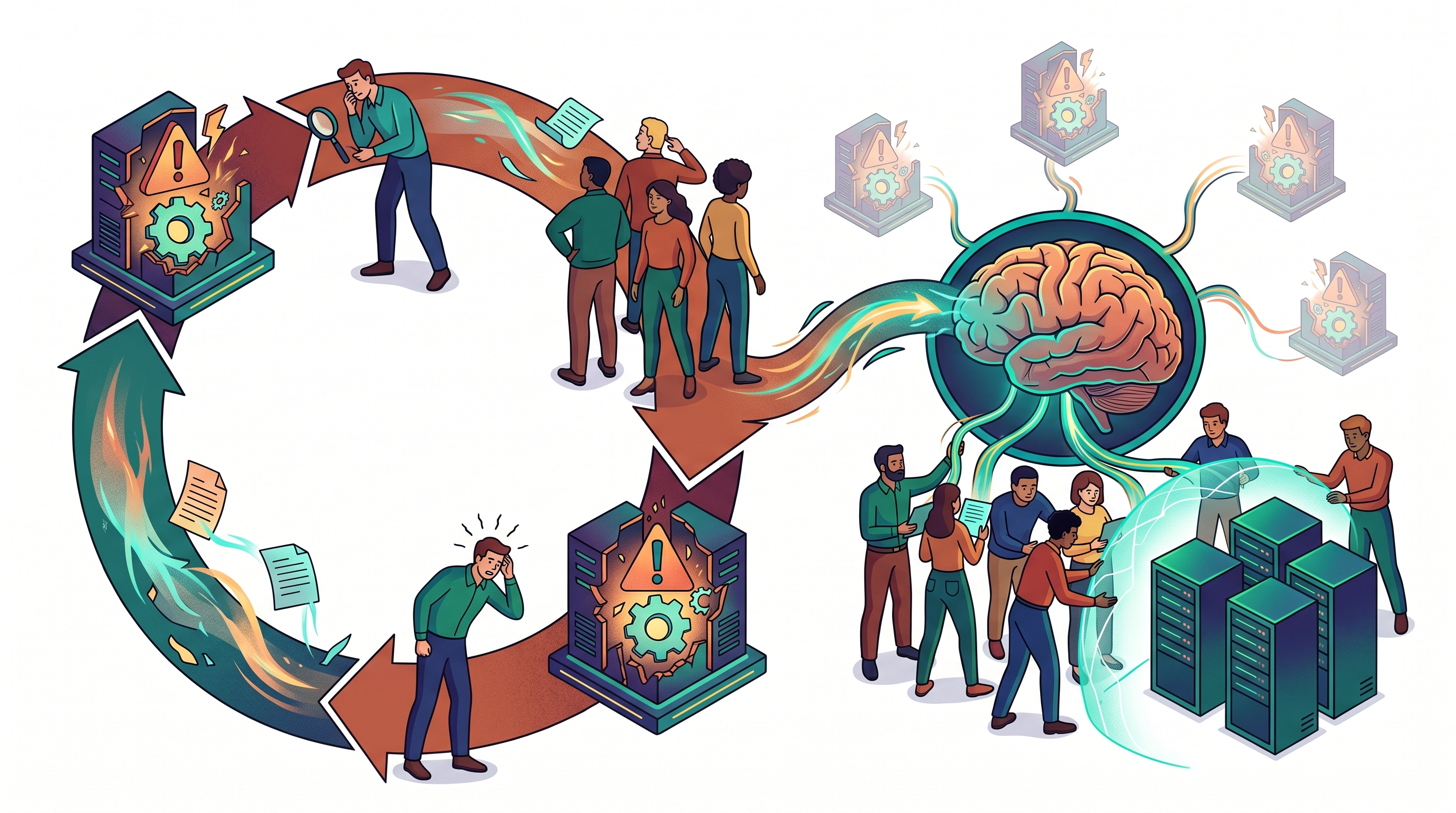
Every engineering organization experiences incidents. Infrastructure failures, Kubernetes misconfigurations, deployment issues, dependency outages, cloud resource constraints, observability gaps, and application performance problems are an unavoidable part of operating modern cloud-native systems.
What separates high-performing teams from struggling ones is not whether incidents occur. It is how effectively organizations learn from them.
Most teams invest significant effort into incident response. Engineers investigate root causes, review logs, analyze metrics, coordinate across teams, and work under pressure to restore services as quickly as possible. Once stability returns, postmortems are created, lessons are documented, and action items are assigned.
Yet despite these efforts, many organizations unknowingly pay a hidden operational cost: they end up relearning the same incident multiple times.
A resource allocation issue reappears months later. A Kubernetes scaling problem resurfaces in a different cluster. A deployment-related outage follows a familiar pattern. A cloud cost spike emerges from the same underlying behavior that was previously investigated.
The symptoms may look slightly different, the teams involved may change, and the affected services may not be identical. However, the underlying operational lessons remain remarkably similar.
When organizations repeatedly rediscover the same problems, they waste engineering time, increase operational risk, slow innovation, and create unnecessary infrastructure costs. More importantly, they miss one of the most valuable opportunities in operations: turning experience into organizational intelligence.
As cloud-native environments continue growing in complexity, the ability to retain, apply, and operationalize lessons from previous incidents is becoming just as important as resolving incidents themselves.
Incident Knowledge Frequently Remains Trapped Within Individuals
One of the primary reasons organizations relearn incidents is that valuable operational knowledge often remains attached to the people who responded to the event rather than becoming part of the organization’s operational framework.
During an incident, engineers develop a deep understanding of infrastructure behavior, workload dependencies, failure conditions, and mitigation strategies. They learn nuances that are difficult to capture fully in a ticket, chat thread, or postmortem document. While some of this knowledge may be documented, much of the contextual understanding remains informal and gradually disappears as teams change, responsibilities shift, or employees move on.
When future teams encounter a similar issue, they often lack access to the practical lessons learned previously. As a result, engineers repeat the same investigative process, spending valuable time rediscovering information that already existed somewhere within the organization. The cost is not only duplicated effort but also the loss of cumulative operational maturity.
Similar Incidents Rarely Present Themselves in the Same Way
A major challenge in operational learning is that recurring problems often appear different on the surface even when their root causes are fundamentally the same.
A Kubernetes resource allocation issue may affect one workload today and an entirely different workload several months later. A dependency bottleneck might appear as application latency in one environment and scaling instability in another. Because the symptoms vary, teams frequently treat each occurrence as a new and unrelated problem.
This leads to repeated investigations, repeated troubleshooting efforts, and repeated discovery of conclusions that were already known. Organizations become highly effective at solving incidents but less effective at recognizing patterns across incidents.
The most successful engineering teams focus on identifying recurring operational behaviors rather than only analyzing individual failures. This broader perspective allows them to address systemic issues instead of repeatedly treating different versions of the same problem.
Kubernetes Complexity Makes Historical Learning More Difficult
Kubernetes environments introduce a level of operational complexity that makes pattern recognition increasingly challenging.
Clusters continuously adapt through autoscaling, workload scheduling, resource allocation changes, deployment activity, and infrastructure updates. Incidents often emerge from the interaction of multiple systems rather than from a single failure point.
A resource fragmentation issue, for example, may manifest as latency problems in one cluster, cloud cost increases in another, and scheduling inefficiencies in a third. While these incidents appear unrelated, they may share the same underlying cause.
Without visibility into historical operational behavior and infrastructure trends, engineering teams often fail to recognize these connections. They investigate symptoms independently instead of leveraging previous operational knowledge. As Kubernetes ecosystems grow larger and more distributed, the ability to connect past incidents with present conditions becomes increasingly valuable.
Repeated Incident Investigations Consume Valuable Engineering Capacity
Every incident investigation requires significant investment from engineering teams. Logs must be analyzed, metrics reviewed, hypotheses tested, stakeholders coordinated, and remediation plans executed.
When organizations repeatedly investigate familiar problems, engineering effort is consumed without generating meaningful new knowledge. Teams spend time rebuilding understanding rather than advancing reliability, improving platforms, or delivering new capabilities.
The hidden productivity cost can be substantial. Even relatively minor recurring incidents can consume hundreds of engineering hours over the course of a year. Those hours could otherwise be invested in innovation, infrastructure optimization, technical debt reduction, or customer-facing improvements.
Organizations often measure incident response metrics such as Mean Time to Resolution (MTTR), but they rarely measure the cost of repeatedly solving the same underlying issue. In many cases, this hidden inefficiency represents one of the largest drains on engineering productivity.
Failure to Apply Lessons Often Leads to Higher Cloud Spending
The impact of repeated incident learning extends beyond operational efficiency and directly affects cloud economics.
Many recurring incidents involve inefficient resource allocation, excessive autoscaling, oversized workloads, infrastructure fragmentation, or observability overhead. When organizations fail to operationalize lessons from previous incidents, these inefficiencies continue influencing cloud spending long after the original problem appears resolved.
For example, a team may investigate a cloud cost spike caused by overprovisioned Kubernetes workloads but fail to implement governance processes that prevent the same behavior elsewhere. Months later, another team experiences a similar issue, resulting in both additional investigation effort and continued infrastructure waste.
This creates a double cost. Organizations pay for the engineering effort required to rediscover the issue and simultaneously pay for the inefficient infrastructure that the lesson was supposed to eliminate.
Postmortems Often Capture Lessons Without Operationalizing Them
Most engineering organizations conduct postmortems after significant incidents. These reviews help identify root causes, document findings, and establish action items for improvement.
However, documentation alone does not create organizational learning.
Many postmortems are completed, stored, and rarely referenced again. Valuable insights become disconnected from deployment processes, infrastructure governance, operational workflows, and engineering decision-making. Over time, the lessons fade from daily operations even though the documentation technically exists.
True learning occurs when incidental knowledge influences future behavior. This may involve updating infrastructure policies, improving observability practices, refining deployment processes, strengthening automation, or enhancing governance controls.
Organizations derive the greatest value from postmortems when lessons become embedded within operational systems rather than remaining archived as historical records.
AI and Distributed Architectures Increase the Cost of Relearning
Modern cloud-native environments are becoming more complex due to the growth of AI workloads and distributed architectures.
GPU-intensive systems, model-serving platforms, vector databases, event-driven applications, and multi-cloud deployments introduce operational dynamics that are often difficult to analyze and compare. The volume of telemetry increases, dependencies become less visible, and identifying recurring patterns becomes significantly harder.
As complexity grows, the cost of relearning incidents rises as well. Teams must navigate larger amounts of operational data, coordinate across more systems, and evaluate increasingly intricate infrastructure relationships.
Without stronger mechanisms for preserving and applying operational knowledge, organizations risk accumulating years of incident history without converting that experience into meaningful operational intelligence.
High-Performing Teams Build Organizational Memory
The most effective engineering organizations treat incident knowledge as a strategic asset rather than a temporary byproduct of incident response.
Instead of focusing exclusively on resolving individual failures, they invest in creating organizational memory. This means developing the ability to recognize recurring patterns, understand historical context, and apply previous lessons proactively.
When teams can quickly answer questions such as "Have we seen this before?" or "What solved this last time?", they dramatically reduce investigation time and improve decision quality.
Organizational memory allows engineering teams to build upon accumulated experience rather than repeatedly starting from zero. Over time, this creates a compounding advantage that improves reliability, efficiency, and operational maturity across the entire organization.
Operational Intelligence Transforms Experience into Prevention
The future of incident management is not simply about responding faster. It is about learning more effectively.
Operational intelligence helps organizations connect incident history with workload behavior, infrastructure utilization, deployment activity, autoscaling patterns, and system dependencies. This broader understanding enables teams to identify familiar risk patterns before they create production issues.
Instead of repeatedly solving the same problems, organizations can proactively address the conditions that generate those problems. Incident knowledge becomes a tool for prevention rather than merely a record of past failures.
This shift fundamentally changes the value of operational learning. The greatest benefit of an incident is no longer the speed of recovery but the organization's ability to ensure the same lesson does not need to be learned again.
Build Operational Memory with Atler Pilot
As cloud-native environments become more distributed and complex, engineering teams need more than incident reports and historical documentation. They need visibility into workload behavior, Kubernetes utilization, infrastructure dependencies, operational patterns, and recurring conditions that influence reliability.
Atler Pilot helps organizations gain a unified view of infrastructure behavior by connecting workload intelligence, operational telemetry, utilization insights, and governance visibility. This enables teams to identify recurring patterns, understand infrastructure trends, and apply historical lessons more effectively across distributed environments.
By improving visibility into resource allocation, autoscaling behavior, workload performance, and operational dependencies, Atler Pilot helps organizations reduce repeated investigations, strengthen reliability, and transform operational experience into actionable intelligence.
The most valuable incident lesson is the one that prevents the next incident. Sign up for Atler Pilot and discover how deeper operational visibility can help your teams stop relearning familiar problems and start building lasting operational intelligence.
Conclusion
Every incident creates an opportunity to improve reliability, efficiency, and operational understanding. However, organizations lose much of that value when the same lessons must be rediscovered repeatedly.
Modern cloud-native environments are complex enough that recurring problems often appear different even when their root causes remain familiar. Without strong organizational memory and operational visibility, engineering teams spend valuable time rebuilding knowledge that already exists.
The hidden costs include lost productivity, increased operational risk, higher cloud spending, and slower innovation. Organizations that succeed in the future will not simply become better at resolving incidents. They will become better at ensuring that hard-earned lessons remain part of the operational system.
Because the most expensive incident is often not the one that happens for the first time. It is the one the organization already solved and still had to solve again.
All in One Place
Atler Pilot decodes your cloud spend story by bringing monitoring, automation, and intelligent insights together for faster and better cloud operations.