
The Executive Guide to Scaling FinOps Across Complex Cloud Environments
Are you grappling with multi-cloud sprawl, nuanced billing models, and the challenging gap between engineering agility and financial accountability? If so, you're not alone. The cloud is the indispensable core of enterprise innovation and agility. Yet for many executives, the promise of cloud efficiency has become a source of significant complexity and unpredictable costs.
The solution is not a single tool or a simple budget cut. It's a profound cultural and operational shift known as FinOps. This guide is crafted specifically for you, the executive, to simplify scaling FinOps and lay out a strategic roadmap for embedding FinOps best practices into your organization.
We will explore how to transition from fragmented cost management to a sustainable enterprise FinOps strategy that delivers true business value, even within the most intricate of FinOps in complex cloud environments.
The FinOps Imperative
FinOps (Cloud Financial Operations) is a set of cultural practices that bring financial accountability to the variable spend model of the cloud. It is a collaborative effort between technology, finance, and business stakeholders to enable an organization to make business trade-offs on speed, cost, and quality.
For a large enterprise operating in complex, often multi-cloud environments, FinOps is a mandatory strategy. Without it, the speed of cloud deployment inevitably outpaces the governance, leading to wasted resources and unexpected expenditures on the antithesis of sound cloud cost management for enterprises.
The Three Pillars of the FinOps Framework
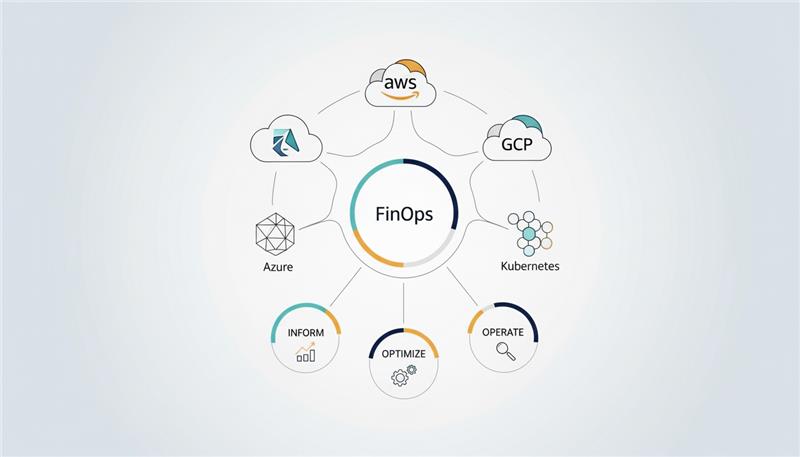
Inform (Visibility & Allocation): You cannot manage what you cannot see. This initial phase focuses on providing accessible and timely FinOps data to all relevant teams. Establish a mandatory, standardized tagging strategy for all cloud resources. And granular tagging is the non-negotiable foundation for accurate cost allocation and chargeback/showback to specific teams, products, or business units. In this way, ensure financial reports move beyond total spending to show unit economics (e.g., cost per customer, cost per transaction) to link cloud spending directly to business value.
Optimize (Rates & Usage): Once visibility is achieved, the next step should be to shift focus to reducing waste and improving cloud efficiency. Implement continuous rightsizing by matching instance size and configuration to actual workload needs to avoid common over-provisioning. Strategically manage commitment-based discounts like Reserved Instances (RIs) or Savings Plans (SPs) to optimize cloud rates for predictable workloads. Automation tools are crucial here to manage complexity and prevent lock-in risk.
Operate (Continuous Improvement & Governance): This is the phase of cultural change that will ensure FinOps practices become an ongoing, sustainable operational model for your business. Integrate automated governance policies such as auto-scaling rules and automatic shutdown of unused resources (e.g., development environments after hours). Also, establish a dedicated, centralized FinOps team or Cloud Center of Excellence (CCoE) to own, educate, and drive consistent best practices across the organization, transforming cloud cost management for enterprises from a reactive chore into a proactive, embedded practice.
Strategic Levers for Scaling FinOps in Complex Cloud Environments
For large organizations, simply implementing the three phases isn't enough. The sheer complexity of multiple cloud providers, thousands of resources, and varied technical stacks requires a multi-layered approach to successfully deploy your enterprise FinOps strategy.
Foster True Cross-Functional Collaboration:
The most critical principle of FinOps is that teams need to collaborate. Scaling FinOps hinges on breaking down the traditional silos between finance, engineering, and product teams. Engineers must treat cost as an efficiency metric just like latency or stability, and Finance must understand the technical trade-offs. This cultural shift is your primary ladder of success.
Embrace Multi-Cloud Tooling and Abstraction:
Multi-cloud deployments create fragmented billing data, which is a major roadblock for visibility.
Invest in third-party FinOps platforms (e.g, Atler Pilot) that can ingest and normalize data from AWS, Azure, GCP, and Kubernetes into a single, unified view. This abstraction is key to applying consistent financial logic across disparate technical stacks.
Automate Cost Governance and Anomaly Detection:
In environments of immense scale, manual processes are destined to fail. Leverage AI and Machine Learning tools for real-time anomaly detection by catching unexpected spikes in spending immediately, before they become a major budget issue. Furthermore, automated policy enforcement ensures resources without the correct mandatory tags are flagged or even automatically shut down. This is foundational for managing FinOps in complex cloud environments.
Integrate FinOps into the CI/CD Pipeline:
Shifting left by making engineers cost-aware before deployment is vital. Integrate cost estimation tools directly into your CI/CD pipeline (e.g., pull requests) to provide engineers with immediate, pre-deployment cost projections for any infrastructure changes. This empowers developers to take ownership of their cloud usage and aligns with the principle that everyone takes ownership of their cloud usage.
The Executive Takeaway
Atler Pilot is an intelligent cloud management platform, powered by Cloud Atler, that helps to maximize the business value of your cloud spend. It fundamentally shifts the conversation from "how much we spent" to "what business value did we gain for that spend". By championing a collaborative culture, enforcing granular visibility, and automating optimization with Atler Pilot, you ensure your technology spend is a strategic enabler, not a financial liability. This disciplined approach sustains your agility while driving measurable ROI across your enterprise.
Put your cloud on Atler Pilot today for free to automate and scale this FinOps discipline.
All in One Place
Atler Pilot decodes your cloud spend story by bringing monitoring, automation, and intelligent insights together for faster and better cloud operations.