
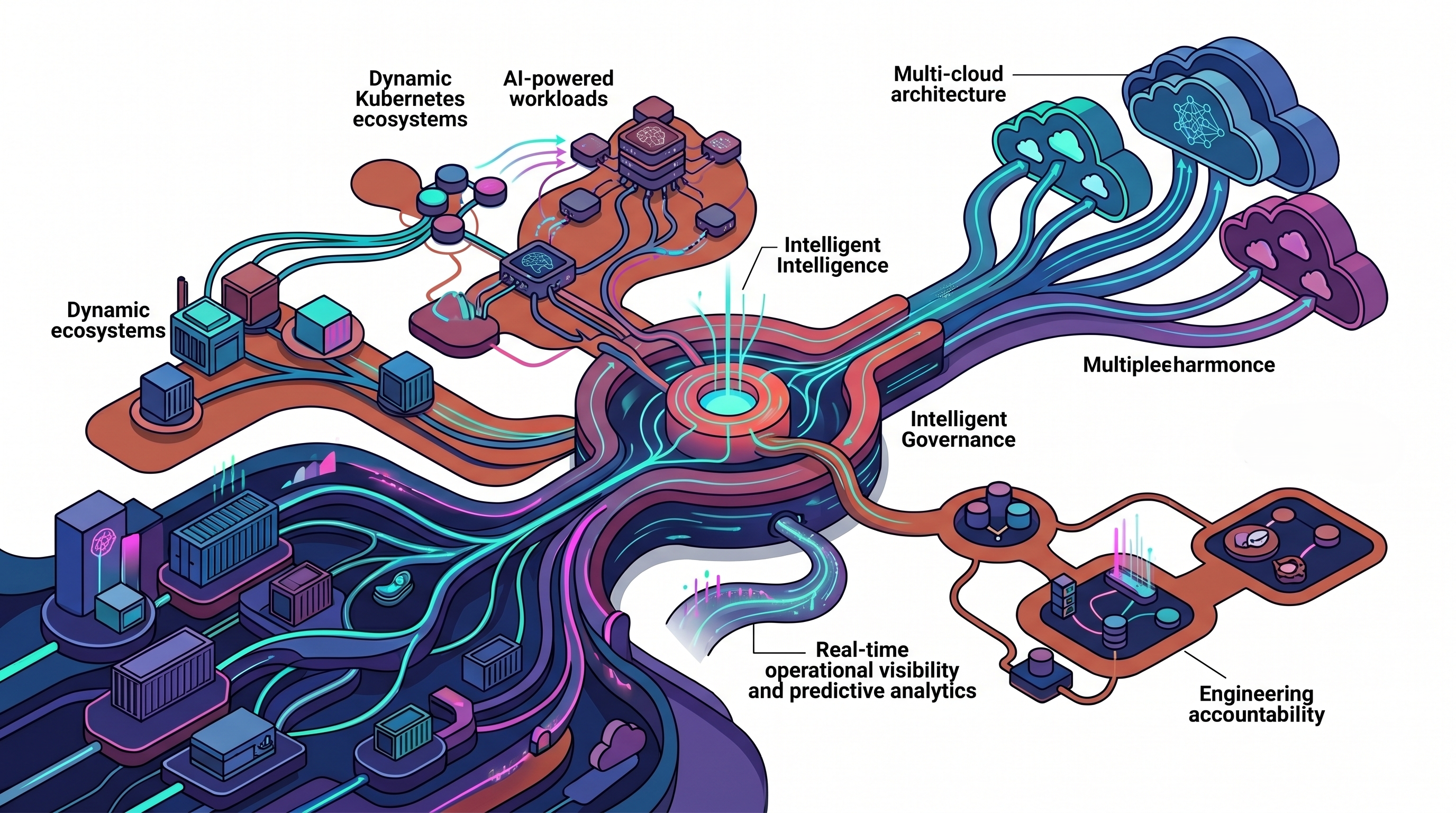
Modern cloud infrastructure is evolving at an extraordinary speed. Kubernetes ecosystems, AI-powered workloads, globally distributed applications, multi-cloud architectures, serverless platforms, edge computing, and autonomous deployment systems are transforming how organizations build and scale digital operations.
Infrastructure today is no longer static, centralized, or manually managed. It is highly dynamic, continuously changing, and deeply interconnected across distributed cloud-native ecosystems.
While this evolution has enabled faster innovation and unprecedented scalability, it has also introduced a new level of operational complexity. Infrastructure environments now generate massive volumes of operational signals, workload interactions, autoscaling events, security telemetry, AI resource consumption patterns, and governance challenges continuously in real time.
Traditional governance models are struggling to keep pace.
Static policies, delayed reporting cycles, manual infrastructure reviews, and isolated operational tooling are increasingly ineffective in environments where workloads scale dynamically across Kubernetes clusters, AI systems, observability pipelines, and multi-cloud environments simultaneously.
This is why infrastructure governance is entering a new phase: intelligent infrastructure governance.
The future of governance will no longer depend primarily on reactive oversight or centralized operational control alone. Instead, governance systems will increasingly rely on real-time operational intelligence, contextual infrastructure awareness, predictive analytics, workload-level visibility, and intelligent automation capable of adapting continuously to cloud-native operational behavior.
The goal is not simply to control infrastructure. It is enabling infrastructure ecosystems to scale securely, efficiently, sustainably, and intelligently without slowing innovation or engineering agility.
In this blog, we will explore why traditional governance approaches are becoming insufficient, the forces driving intelligent infrastructure governance, and how modern organizations are evolving governance strategies to support the next generation of cloud-native operations.
Infrastructure has Become Too Dynamic for Static Governance Models
Traditional governance frameworks were designed for relatively stable infrastructure environments where operational change occurred gradually through controlled deployment cycles and centralized oversight processes.
Modern cloud-native environments behave very differently. Kubernetes workloads scale automatically, AI systems generate unpredictable resource demand, observability pipelines expand dynamically, and distributed applications evolve continuously through automated deployment systems operating across regions and cloud providers simultaneously.
The challenge is that infrastructure behavior now changes faster than manual governance processes can respond operationally. By the time traditional reviews identify inefficiencies, security gaps, or scalability risks, operational complexity may already be deeply embedded across environments.
Static governance models struggle because they assume infrastructure remains relatively predictable. Cloud-native ecosystems are increasingly adaptive, distributed, and continuously evolving operationally.
This shift is forcing governance itself to become more adaptive, context-aware, and operationally intelligent.
Governance is Expanding Beyond Security and Compliance
Infrastructure governance was historically associated primarily with security controls, compliance validation, and policy enforcement. While these areas remain essential, modern governance responsibilities are expanding significantly.
Today’s infrastructure governance increasingly includes:
Cloud financial accountability
Kubernetes resource efficiency
AI infrastructure utilization
Workload scalability governance
Sustainability optimization
Infrastructure resilience
Operational accountability
Observability management
The reason is simple: infrastructure decisions now directly influence business scalability, profitability, operational efficiency, customer experience, and long-term sustainability.
For example, oversized Kubernetes workloads affect not only operational efficiency but also cloud economics and environmental impact. AI infrastructure governance now influences GPU utilization, operational scalability, and infrastructure sustainability simultaneously.
Modern governance therefore, increasingly operates at the intersection of engineering, operations, finance, security, and business strategy.
The future of governance is becoming deeply operational rather than purely administrative.
Real-Time Operational Visibility is Becoming Foundational
One of the biggest limitations of traditional governance is delayed visibility. Monthly billing analysis, periodic audits, and isolated operational dashboards rarely provide enough context to govern modern infrastructure ecosystems proactively.
By the time governance issues become visible through traditional reporting systems, organizations may already face:
Kubernetes resource fragmentation
AI infrastructure inefficiencies
Security drift
Excessive observability growth
Multi-cloud operational sprawl
Scaling instability
Modern governance increasingly depends on continuous operational awareness capable of understanding infrastructure behavior as it evolves in real time.
Organizations now require visibility into:
Workload utilization patterns
Kubernetes autoscaling behavior
AI resource consumption
Infrastructure ownership
Cross-region networking activity
Operational dependencies
This level of awareness allows governance systems to move from reactive monitoring toward proactive operational intelligence.
Real-time infrastructure visibility is becoming the foundation of intelligent governance.
Kubernetes Governance Will Become More Autonomous
Kubernetes has become the operational core of modern cloud-native infrastructure, but it has also introduced enormous governance complexity. Workloads scale dynamically, namespaces evolve continuously, autoscaling systems behave unpredictably, and infrastructure utilization changes rapidly across clusters and regions operationally.
Manual governance models cannot sustainably manage Kubernetes ecosystems operating at enterprise scale.
The future of Kubernetes governance will increasingly involve intelligent systems capable of:
Detecting inefficient workload allocation
Identifying autoscaling anomalies
Monitoring resource fragmentation
Enforcing governance policies continuously
Improving workload accountability automatically
Instead of relying solely on static thresholds or manual intervention, governance systems will increasingly analyze operational behavior contextually and adapt dynamically to changing infrastructure conditions.
Kubernetes governance is evolving from policy enforcement toward workload-aware operational intelligence.
AI Infrastructure Governance Will Become a Strategic Priority
AI-powered systems are rapidly transforming cloud-native operations, but they are also introducing entirely new governance challenges. GPU clusters, inference systems, vector databases, and distributed training pipelines consume infrastructure resources at unprecedented scale and operational intensity.
The challenge is that AI infrastructure behaves far more dynamically than traditional workloads. GPU utilization fluctuates continuously, inference demand scales unpredictably, and AI observability systems generate massive telemetry growth operationally.
Traditional governance systems were not designed for highly adaptive AI ecosystems.
The future of intelligent infrastructure governance will increasingly require AI-specific operational awareness involving:
GPU utilization efficiency
AI workload attribution
Inference scalability governance
AI infrastructure sustainability
Distributed AI resource optimization
Organizations that fail to govern AI infrastructure intelligently may struggle with rapidly escalating operational costs, infrastructure inefficiency, and scalability instability as AI adoption accelerates globally.
AI infrastructure governance is becoming foundational to sustainable cloud-native scalability.
Governance Will Become More Predictive Than Reactive
One of the most important shifts in modern infrastructure governance is the move from reactive oversight toward predictive operational intelligence.
Traditional governance identifies issues after they occur operationally. Intelligent governance increasingly focuses on identifying emerging risks before they become operationally disruptive or financially expensive.
Predictive governance systems will increasingly analyze:
Infrastructure scaling trends
Kubernetes utilization patterns
AI workload behavior
Security drift indicators
Observability expansion dynamics
Multi-cloud operational dependencies
This allows organizations to identify inefficiencies, governance risks, and scalability bottlenecks earlier before they escalate operationally across distributed environments.
Predictive governance improves not only operational resilience but also infrastructure efficiency and financial sustainability simultaneously.
The future of governance is becoming anticipatory rather than purely corrective.
Multi-Cloud Governance Requires Unified Operational Intelligence
Most enterprises now operate across AWS, Azure, Google Cloud, Kubernetes ecosystems, SaaS environments, edge infrastructure, and hybrid architectures simultaneously.
While this improves operational flexibility and resilience, it also creates major governance fragmentation. Each provider introduces different APIs, pricing models, governance frameworks, observability systems, and operational behaviors.
Traditional governance approaches often manage cloud providers independently rather than governing infrastructure holistically across distributed ecosystems.
The future of intelligent infrastructure governance increasingly depends on unified operational intelligence capable of connecting workload behavior, infrastructure utilization, operational ownership, security posture, financial governance, and AI resource allocation continuously across cloud-native ecosystems, regardless of platform boundaries.
Unified visibility is becoming essential because governance itself must operate across interconnected infrastructure ecosystems rather than isolated environments.
Engineering Accountability Will Become Central to Governance
Intelligent governance will increasingly depend on stronger workload-level accountability across engineering organizations.
In many modern enterprises, infrastructure complexity scales faster than ownership visibility. Workloads, Kubernetes clusters, AI systems, and observability pipelines evolve continuously across distributed engineering teams without sufficient operational accountability structures.
The future of governance increasingly requires connecting infrastructure utilization directly to:
Engineering teams
Services
AI workloads
Kubernetes environments
Operational domains
Business objectives
This improves not only governance visibility but also operational culture. Engineering teams become more aware of how architectural and workload decisions affect scalability, infrastructure efficiency, sustainability, and cloud economics operationally.
Governance becomes significantly more effective when operational accountability exists close to infrastructure behavior itself.
Intelligent governance is, therefore, as much organizational as it is technological.
Intelligent Automation Will Drive Governance Scalability
As infrastructure ecosystems become more distributed and operationally complex, governance will increasingly rely on intelligent automation to maintain scalability.
Modern governance automation will evolve beyond static rule enforcement toward contextual operational intelligence capable of:
Detecting anomalies dynamically
Optimizing workload allocation
Identifying infrastructure inefficiencies
Monitoring governance drift continuously
Improving scalability predictability
The goal is not eliminating human oversight, but enabling governance systems capable of scaling alongside cloud-native operational complexity without introducing excessive manual operational burden.
Governance automation will increasingly become adaptive, workload-aware, and infrastructure-contextual rather than static and policy-centric.
This transition represents one of the most important operational evolutions in modern cloud-native infrastructure management.
Building Intelligent Governance Visibility with Atler Pilot
As cloud-native ecosystems become more distributed and operationally complex, maintaining visibility into workload behavior, Kubernetes utilization, AI infrastructure efficiency, observability growth, and multi-cloud operations becomes increasingly important for intelligent infrastructure governance. This is where Atler Pilot helps organizations gain a deeper operational understanding across modern infrastructure ecosystems through a unified operational view.
By connecting infrastructure insights, workload intelligence, operational visibility, utilization awareness, and governance context, Atler Pilot helps organizations identify inefficiencies, autoscaling anomalies, underutilized resources, governance drift, and scalability risks earlier across distributed cloud-native environments. Instead of relying solely on fragmented dashboards or delayed infrastructure reporting, engineering and leadership teams gain more contextual operational awareness into how infrastructure behaves and where governance decisions influence scalability, efficiency, and operational sustainability.
This allows organizations to strengthen accountability, optimize Kubernetes governance, improve AI infrastructure visibility, simplify multi-cloud operations, and build more intelligent governance strategies capable of scaling alongside modern cloud-native architectures.
The future of infrastructure governance requires more than static policies and reactive oversight alone. Atler Pilot helps organizations simplify infrastructure complexity, improve operational visibility, and make more informed decisions around Kubernetes optimization, AI infrastructure governance, workload accountability, and cloud operational sustainability.
Sign up for Atler Pilot and explore how unified operational visibility can help your teams build smarter and more intelligent infrastructure governance strategies for the future of cloud-native operations.
Conclusion
Cloud-native infrastructure has transformed how modern organizations scale digital systems, but it has also introduced operational complexity far beyond what traditional governance models were designed to manage. Kubernetes ecosystems, AI workloads, observability expansion, multi-cloud architectures, and autonomous infrastructure systems all require governance models capable of adapting continuously to dynamic operational behavior.
Organizations that succeed in the future of infrastructure governance will not rely solely on reactive oversight, static policy enforcement, or delayed operational visibility. They will build governance strategies centered around real-time infrastructure intelligence, predictive operational awareness, workload accountability, AI infrastructure governance, and adaptive automation across distributed cloud-native ecosystems.
Because the future of intelligent infrastructure governance is no longer only about controlling infrastructure. It is about enabling infrastructure ecosystems to scale securely, efficiently, sustainably, and intelligently alongside the future of modern digital operations.
All in One Place
Atler Pilot decodes your cloud spend story by bringing monitoring, automation, and intelligent insights together for faster and better cloud operations.