
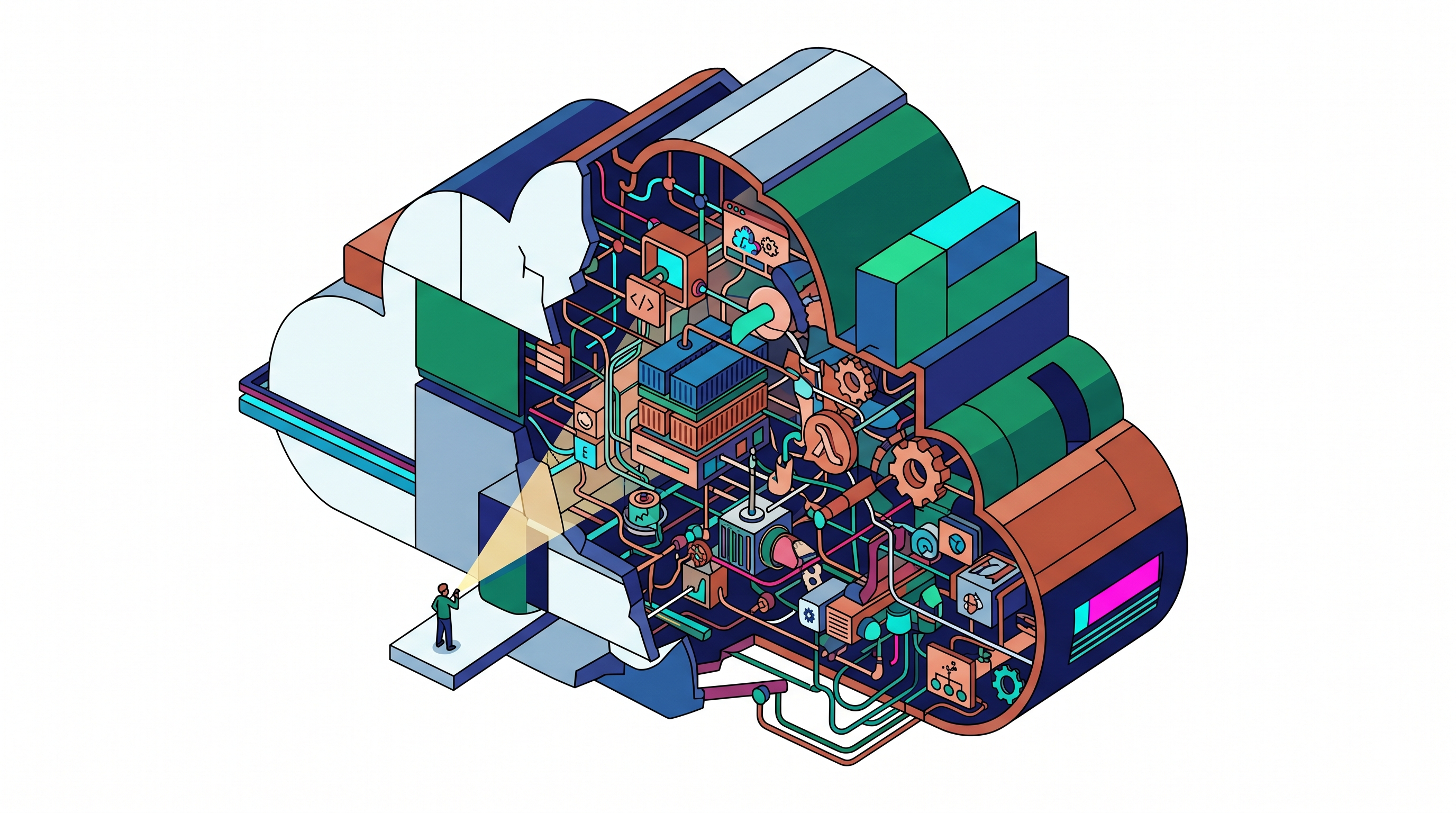
Modern cloud platforms promise simplicity. With a few clicks or API calls, organizations can deploy infrastructure globally, scale applications automatically, provision databases instantly, and integrate advanced services without managing physical hardware. Compared to traditional infrastructure, cloud environments often appear dramatically easier to operate.
This perception has shaped how many businesses approach cloud adoption. Teams expect cloud architectures to reduce operational overhead, accelerate development, and simplify infrastructure management. And in many ways, they do.
But beneath that simplicity lies a different reality.
As cloud environments grow, organizations often discover that systems that initially looked clean and manageable gradually become deeply interconnected, operationally fragmented, and increasingly difficult to understand. What starts as a “simple” architecture can evolve into a highly complex operational ecosystem hidden behind layers of abstraction.
The challenge is that cloud complexity does not disappear. It shifts.
In this blog, we will explore the hidden complexity behind modern cloud architectures, why these challenges become more severe at scale, and why operational visibility is becoming one of the most important capabilities in modern cloud infrastructure management.
Simplicity at Deployment Does Not Mean Simplicity at Scale
Cloud platforms are designed to make infrastructure deployment fast and accessible. Teams can provision resources instantly without waiting for hardware procurement, networking setup, or physical installation.
However, the simplicity of deployment often creates the illusion that operational management will remain equally simple as environments grow. In reality, every new service, workload, integration, API, and automation layer adds operational relationships that become harder to track over time.
A small architecture with a few services may remain understandable manually. But once organizations operate across microservices, Kubernetes clusters, serverless functions, APIs, observability stacks, AI workloads, and multi-cloud environments simultaneously, the infrastructure becomes significantly more complex beneath the surface.
The cloud reduces infrastructure friction, which often encourages faster architectural expansion than operational visibility can keep up with.
Abstraction Layers Hide Operational Dependencies
One of the most powerful aspects of cloud computing is abstraction. Organizations no longer need to manage physical servers, networking hardware, storage arrays, or many low-level infrastructure operations directly.
But abstraction also hides complexity.
Cloud services interact through APIs, managed integrations, networking dependencies, identity systems, automation workflows, and orchestration layers that are not always visible during day-to-day operations. A workload that appears simple externally may rely on dozens of underlying services and dependencies internally.
For example, a “simple” web application may depend on:
Load balancers
Kubernetes clusters
Managed databases
API gateways
IAM policies
Serverless workflows
Monitoring systems
Secret management services
CDN infrastructure
The architecture looks streamlined at the surface, but the operational dependency graph becomes increasingly difficult to visualize fully.
Automation Reduces Manual Work but Increases System Complexity
Automation is essential in modern cloud environments. Infrastructure as Code, CI/CD pipelines, autoscaling systems, policy automation, and orchestration platforms all help organizations move faster and reduce repetitive operational tasks.
However, automation itself introduces another layer of complexity.
Automated systems interact continuously with infrastructure, making changes dynamically based on traffic patterns, deployment events, security policies, or operational conditions. As automation expands, environments become more dynamic and less predictable from a human visibility perspective.
A deployment pipeline may trigger infrastructure changes automatically across multiple environments simultaneously. Autoscaling may alter cluster topology within minutes. Policy engines may update configurations dynamically.
The environment becomes operationally fluid rather than static.
While automation improves efficiency, it also increases the difficulty of understanding how systems behave over time.
Microservices Multiply Operational Relationships
Microservices architectures are often adopted to improve scalability, agility, and development velocity. Instead of maintaining a single monolithic application, organizations split systems into smaller, independently deployable services.
But microservices also multiply operational relationships dramatically.
Each service introduces:
APIs
Network communication
Authentication dependencies
Monitoring requirements
Deployment workflows
Failure scenarios
As the number of services grows, the operational complexity increases exponentially rather than linearly.
A failure in one service may cascade across multiple systems through API dependencies, asynchronous messaging pipelines, or shared infrastructure components. Troubleshooting becomes significantly harder because issues rarely remain isolated within a single service boundary.
The architecture may still appear modular on diagrams, but operational behavior becomes deeply interconnected in practice.
Kubernetes Adds Flexibility and Hidden Infrastructure Layers
Kubernetes has become a cornerstone of cloud-native architecture because it simplifies container orchestration, workload scheduling, and infrastructure portability.
However, Kubernetes environments introduce multiple hidden operational layers that many organizations underestimate early in adoption.
Clusters rely on:
Control plane components
Networking overlays
Service meshes
Storage orchestration
Resource scheduling
Autoscaling logic
Namespace isolation
Security policies
Each layer interacts dynamically with workloads and infrastructure behavior.
While Kubernetes abstracts operational tasks effectively, it also creates environments where workloads move continuously, infrastructure scales automatically, and system behavior changes rapidly.
This flexibility is powerful but it also makes operational visibility far more difficult.
Observability Data Creates Its Own Complexity
As cloud architectures become more distributed, organizations respond by collecting more logs, metrics, traces, and telemetry data. The goal is to improve visibility. Ironically, observability itself often becomes another source of complexity.
Large environments generate enormous volumes of telemetry across applications, infrastructure, APIs, Kubernetes clusters, and cloud services. Teams end up managing:
Multiple monitoring platforms
Distributed tracing systems
Alerting pipelines
Log aggregation tools
Metrics storage systems
The challenge is no longer simply collecting operational data. It is understanding which signals actually matter operationally.
Excessive telemetry without contextual visibility creates operational noise rather than clarity.
Multi-Cloud and Hybrid Strategies Increase Fragmentation
Many organizations now operate across multiple cloud providers and hybrid infrastructures simultaneously. While this improves flexibility and resilience, it also increases architectural fragmentation.
Different environments use different APIs, identity systems, networking models, observability standards, and operational workflows. Teams struggle to maintain consistent governance and visibility across all environments simultaneously.
As architectures become more distributed, operational understanding becomes fragmented as well.
The cloud itself may feel simple individually, but managing relationships between environments becomes increasingly difficult at scale.
AI Workloads Introduce New Operational Pressure
AI infrastructure is adding another major layer of complexity to cloud architectures.
Organizations are now managing:
GPU clusters
Model-serving infrastructure
Vector databases
AI training pipelines
Real-time inference systems
These workloads consume massive resources while introducing specialized infrastructure requirements around scheduling, networking, storage, and observability. AI systems also scale rapidly, often faster than governance and operational visibility practices evolve around them.
As AI adoption accelerates, cloud architectures become even harder to optimize and manage consistently.
Security Complexity Expands Alongside Architecture Growth
Every new service, API, workload, automation workflow, and integration expands the cloud attack surface. Cloud security today involves managing:
Identity sprawl
Kubernetes permissions
API exposure
Infrastructure misconfigurations
Multi-cloud governance
Software supply chain risk
The challenge is that security visibility becomes fragmented across increasingly distributed environments. A “simple” architecture may actually contain hundreds of hidden trust relationships, permissions, and infrastructure dependencies.
As operational complexity increases, maintaining a consistent security posture becomes significantly harder without unified visibility.
The Human Side of Complexity Is Often Ignored
Cloud complexity is not purely technical. It also affects teams operationally and cognitively.
Engineers often work across dozens of dashboards, tooling systems, APIs, deployment workflows, and observability platforms simultaneously. Context switching increases. Troubleshooting becomes slower. Cross-team coordination becomes more difficult.
Operational knowledge becomes fragmented across individuals and teams rather than being clearly centralized.
The more complex the architecture becomes, the harder it is for humans to maintain a clear mental model of how systems behave together.
This human visibility problem is becoming one of the biggest operational challenges in modern cloud infrastructure.
Bringing Operational Clarity to Complex Cloud Environments with Atler Pilot
One of the biggest challenges in modern cloud architecture is maintaining operational understanding as environments become more distributed, automated, and interconnected.
This is where Atler Pilot helps organizations gain more unified visibility across infrastructure, workloads, cloud operations, and utilization behavior. By connecting operational signals, infrastructure insights, and workload patterns into a centralized view, teams can better understand how systems interact and where inefficiencies, risks, or operational blind spots may be emerging.
Instead of relying solely on fragmented dashboards and disconnected telemetry systems, organizations gain more contextual awareness across evolving cloud environments. This helps teams make better operational decisions while reducing the complexity of managing distributed infrastructures at scale.
As cloud ecosystems continue growing in sophistication, unified operational visibility becomes increasingly important for maintaining both scalability and control.
Sign up for Atler Pilot and explore how deeper operational visibility can help your team manage cloud complexity with greater clarity, confidence, and efficiency.
Conclusion
Modern cloud architectures often appear simple because cloud platforms abstract much of the underlying infrastructure complexity away from direct visibility. But abstraction does not eliminate complexity. It redistributes it across automation systems, distributed services, APIs, observability pipelines, and operational workflows.
Organizations that succeed in modern cloud environments will not simply focus on deploying infrastructure faster. They will focus on maintaining operational clarity as architectures evolve and scale. Because in modern cloud infrastructure, the greatest challenge is no longer building systems. It is about understanding the systems we have already built.
All in One Place
Atler Pilot decodes your cloud spend story by bringing monitoring, automation, and intelligent insights together for faster and better cloud operations.