
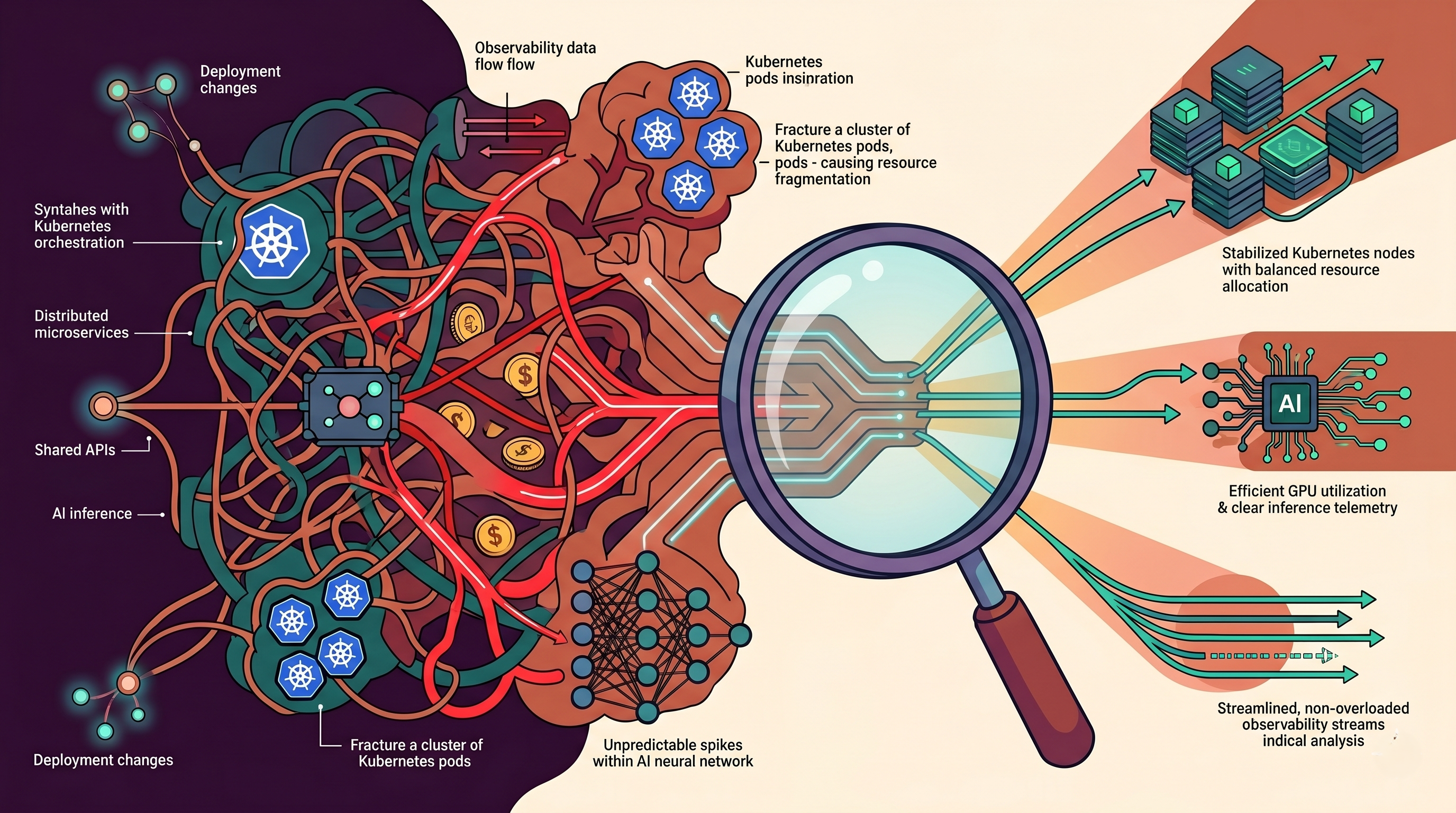
Modern DevOps environments are built around speed, scalability, and continuous delivery. Organizations now deploy code updates, infrastructure changes, Kubernetes configurations, AI models, API integrations, and cloud-native services at a pace that was unimaginable in traditional software delivery models.
Continuous integration and continuous deployment pipelines have enabled engineering teams to innovate rapidly, release features faster, and respond to business demands with far greater agility. Cloud-native infrastructure, Kubernetes orchestration, infrastructure-as-code, and automated deployment systems have further accelerated operational velocity across distributed environments.
But while DevOps has dramatically improved delivery speed, it has also introduced a major operational challenge that many organizations still underestimate: poor change impact analysis.
In highly distributed cloud-native ecosystems, even small infrastructure or application changes can trigger cascading operational consequences across Kubernetes clusters, APIs, AI workloads, observability systems, networking layers, and shared platform environments.
The problem is that many organizations continue deploying changes faster than they can fully understand their operational impact.
As a result, infrastructure instability, unexpected cloud cost spikes, degraded application performance, observability overload, deployment failures, AI workload disruption, and operational outages increasingly originate from insufficient visibility into how changes affect interconnected cloud-native systems.
Poor change impact analysis is no longer only a reliability issue. It has become a major operational efficiency and cloud governance problem across modern DevOps ecosystems.
The operational cost is often hidden at first. Systems continue functioning while inefficiencies accumulate gradually beneath distributed environments. But over time, weak impact analysis creates growing infrastructure instability, rising operational complexity, excessive cloud spending, and reduced engineering productivity.
In this blog, we will explore why change impact analysis has become increasingly difficult in modern DevOps environments, the hidden operational costs organizations experience when visibility remains limited, and the strategies enterprises can use to build more intelligent and context-aware infrastructure governance across cloud-native systems.
Modern Cloud-Native Systems are Highly Interconnected
Traditional application environments were relatively centralized and easier to analyze operationally. Infrastructure dependencies remained more predictable, application boundaries were clearer, and deployment changes typically affected a limited operational scope.
Modern DevOps ecosystems operate very differently.
Today’s cloud-native architectures involve:
Kubernetes orchestration
Distributed microservices
Shared APIs
AI inference systems
Event-driven platforms
Multi-cloud networking layers
Observability pipelines
Infrastructure-as-code automation
Every infrastructure or application change now interacts with highly interconnected operational systems across distributed environments.
A small deployment modification may indirectly affect autoscaling behavior, networking latency, AI inference workloads, observability telemetry generation, or Kubernetes resource allocation operationally across multiple environments simultaneously.
The challenge is that infrastructure complexity has grown faster than many organizations’ ability to understand operational dependencies comprehensively.
This makes modern change impact analysis significantly more difficult than traditional release validation approaches.
Kubernetes Complexity Amplifies Change Risk
Kubernetes has become foundational to modern DevOps scalability, but it has also dramatically increased operational dependency complexity.
Workloads inside Kubernetes environments continuously interact through shared clusters, networking layers, autoscaling systems, service meshes, observability pipelines, and distributed infrastructure orchestration.
The problem is that even relatively small Kubernetes changes can trigger broad operational consequences involving:
Autoscaling instability
Resource fragmentation
Node allocation imbalance
Networking overhead
Pod scheduling conflicts
Shared infrastructure contention
Because Kubernetes ecosystems behave dynamically, operational consequences are often difficult to predict through static testing alone.
For example, a deployment configuration update may appear operationally safe in isolation while indirectly increasing cluster scaling activity, observability load, or shared resource consumption across unrelated workloads.
Without workload-level visibility, organizations frequently underestimate how infrastructure changes affect Kubernetes ecosystems operationally at scale.
AI Workloads Make Change Analysis More Unpredictable
AI-powered systems are introducing entirely new complexity into DevOps operations.
Modern AI infrastructure environments include:
GPU orchestration systems
Distributed inference pipelines
Vector databases
AI observability platforms
Real-time model-serving systems
Dynamic AI scaling environments
The challenge is that AI workloads behave far more unpredictably than traditional application services operationally.
A seemingly minor infrastructure adjustment may influence:
GPU utilization efficiency
Inference latency
AI networking traffic
Distributed model synchronization
AI telemetry expansion
Because AI infrastructure is both highly resource-intensive and operationally dynamic, small changes can create disproportionately large operational consequences across cloud-native ecosystems.
Traditional change analysis models were not designed for environments where workload behavior changes continuously based on AI inference demand, model complexity, and real-time distributed operational activity.
As AI adoption scales, intelligent impact analysis is becoming increasingly essential for maintaining infrastructure stability and operational efficiency.
Poor Change Visibility Frequently Creates Hidden Cloud Costs
One of the most overlooked consequences of weak change impact analysis is rising cloud infrastructure costs.
Infrastructure changes often influence operational behavior in ways that remain financially invisible initially. For example:
Inefficient deployment configurations may trigger excessive autoscaling
New observability settings may generate massive telemetry growth
Poor workload allocation may increase idle infrastructure capacity
AI scaling changes may expand GPU utilization unexpectedly
The problem is that these operational inefficiencies frequently remain hidden because applications continue functioning after deployments.
Organizations may only notice the financial impact weeks later through delayed cloud billing analysis, by which point infrastructure inefficiencies are already deeply embedded across distributed environments.
Without real-time operational visibility, DevOps teams often optimize deployments primarily around application functionality rather than infrastructure efficiency and operational sustainability.
Poor change analysis therefore quietly increases operational overhead long before cloud spending anomalies become financially visible.
Observability Systems Often Become Overwhelmed After Changes
Modern cloud-native environments generate enormous telemetry volumes continuously across logs, traces, metrics, distributed monitoring systems, and AI observability pipelines.
Infrastructure or deployment changes frequently influence observability systems significantly, often in unexpected ways.
Organizations commonly experience:
Sudden telemetry spikes
High-cardinality metric expansion
Duplicate monitoring data
Increased distributed tracing overhead
AI observability growth
The challenge is that observability infrastructure itself consumes substantial cloud resources operationally.
Poor change impact analysis may therefore create cascading operational consequences where deployment changes unintentionally increase both infrastructure complexity and monitoring overhead simultaneously.
In many enterprises, observability systems themselves become operational bottlenecks because infrastructure changes continuously generate telemetry expansion faster than governance visibility can adapt.
Modern DevOps ecosystems increasingly require observability-aware change governance rather than treating monitoring systems as isolated operational layers.
Shared Platform Architectures Increase Blast Radius
Many organizations now centralize DevOps operations through shared Kubernetes platforms, internal developer environments, CI/CD systems, AI infrastructure platforms, and common observability ecosystems.
While shared platforms improve operational consistency and engineering agility, they also significantly increase change impact complexity.
A deployment change affecting one workload may indirectly influence:
Shared cluster resource allocation
Cross-service networking behavior
Shared observability systems
AI acceleration environments
Platform-wide autoscaling patterns
The problem is that operational dependencies inside shared environments are often difficult to visualize comprehensively.
Without deep workload-level visibility, organizations frequently underestimate how changes propagate operationally across interconnected cloud-native ecosystems.
This creates environments where relatively localized changes produce unexpectedly broad operational consequences across distributed infrastructure systems.
Multi-Cloud Environments Make Dependency Mapping Harder
Most modern DevOps ecosystems now operate across AWS, Azure, Google Cloud, Kubernetes environments, SaaS platforms, and hybrid infrastructure simultaneously.
This creates substantial operational fragmentation because infrastructure dependencies now span multiple providers with different:
APIs
Networking models
Scaling behaviors
Governance systems
Observability frameworks
Traditional change analysis approaches often evaluate environments independently rather than understanding operational dependencies holistically across distributed cloud-native ecosystems.
As a result, organizations frequently lack centralized visibility into how changes affect infrastructure behavior across multi-cloud environments operationally.
A deployment modification inside one environment may indirectly influence networking traffic, observability systems, AI inference scaling, or Kubernetes resource behavior across other interconnected platforms.
Modern change impact analysis increasingly requires unified operational intelligence capable of understanding distributed infrastructure relationships continuously in real time.
Delayed Operational Feedback Weakens DevOps Stability
One of the biggest challenges in modern DevOps operations is delayed visibility into operational consequences after deployments occur.
Traditional monitoring and incident analysis approaches often identify problems only after infrastructure instability, performance degradation, or cloud cost escalation already becomes operationally visible.
By the time engineering teams recognize deployment-related issues, infrastructure inefficiencies may already be deeply embedded operationally across Kubernetes ecosystems, AI systems, or shared platform environments.
Without real-time operational awareness, organizations frequently rely on reactive troubleshooting instead of predictive infrastructure governance.
This creates operational cycles where teams continuously respond to infrastructure instability rather than preventing issues proactively through intelligent impact analysis.
Modern DevOps ecosystems increasingly require operational feedback systems capable of understanding infrastructure behavior continuously as changes occur rather than retrospectively after incidents emerge.
Intelligent Change Analysis Requires Operational Context
The future of DevOps governance increasingly depends on operationally intelligent change analysis rather than static deployment validation alone.
Organizations now require systems capable of understanding:
Workload dependencies
Kubernetes resource behavior
AI infrastructure utilization
Observability expansion patterns
Shared platform interactions
Multi-cloud operational relationships
Real-time operational context allows organizations to predict how infrastructure changes may influence distributed cloud-native ecosystems before operational consequences escalate.
This represents a major shift from traditional DevOps monitoring toward continuous infrastructure intelligence integrated directly into deployment workflows.
The future of operational stability depends heavily on improving visibility into how infrastructure ecosystems behave operationally before, during, and after change events continuously.
Building Operational Visibility with Atler Pilot
As modern DevOps ecosystems become more distributed and operationally complex, maintaining visibility into workload behavior, Kubernetes utilization, AI infrastructure efficiency, observability growth, and infrastructure dependencies becomes increasingly important for intelligent change impact analysis. This is where Atler Pilot helps organizations gain deeper operational understanding across cloud-native environments through a unified operational view.
By connecting infrastructure insights, workload intelligence, operational visibility, utilization awareness, and governance context together, Atler Pilot helps organizations identify deployment risks, autoscaling anomalies, fragmented infrastructure behavior, hidden inefficiencies, and operational instability earlier across distributed ecosystems. Instead of relying solely on delayed monitoring analysis or fragmented infrastructure dashboards, engineering and platform teams gain more contextual operational awareness into how infrastructure changes influence workload behavior operationally across cloud-native environments.
This allows organizations to strengthen deployment governance, improve Kubernetes operational visibility, optimize AI infrastructure behavior, reduce hidden cloud inefficiencies, and build more resilient DevOps ecosystems without slowing engineering agility or innovation velocity.
Modern DevOps success depends on more than deployment speed alone. Atler Pilot helps organizations simplify infrastructure complexity, improve operational visibility, and make more informed decisions around Kubernetes optimization, AI infrastructure governance, workload scalability, and operational sustainability.
Sign up for Atler Pilot and explore how unified operational visibility can help your teams reduce the hidden operational costs created by poor change impact analysis in modern DevOps environments.
Conclusion
Modern DevOps environments have dramatically accelerated innovation and cloud-native scalability, but they have also introduced operational complexity far beyond what traditional change analysis models were designed to manage. Kubernetes ecosystems, AI infrastructure, observability systems, shared platforms, and distributed cloud-native architectures all create deeply interconnected operational dependencies that make infrastructure changes increasingly difficult to analyze predictively.
Organizations that succeed in modern DevOps operations will not rely solely on reactive monitoring or isolated deployment validation processes. They will build operational strategies centered around workload visibility, infrastructure intelligence, Kubernetes awareness, AI operational governance, and real-time dependency understanding across distributed cloud-native ecosystems.
Because the operational cost of poor change impact analysis is no longer limited to failed deployments alone. It increasingly affects infrastructure stability, cloud efficiency, operational scalability, engineering productivity, and the long-term sustainability of modern cloud-native operations.
All in One Place
Atler Pilot decodes your cloud spend story by bringing monitoring, automation, and intelligent insights together for faster and better cloud operations.