
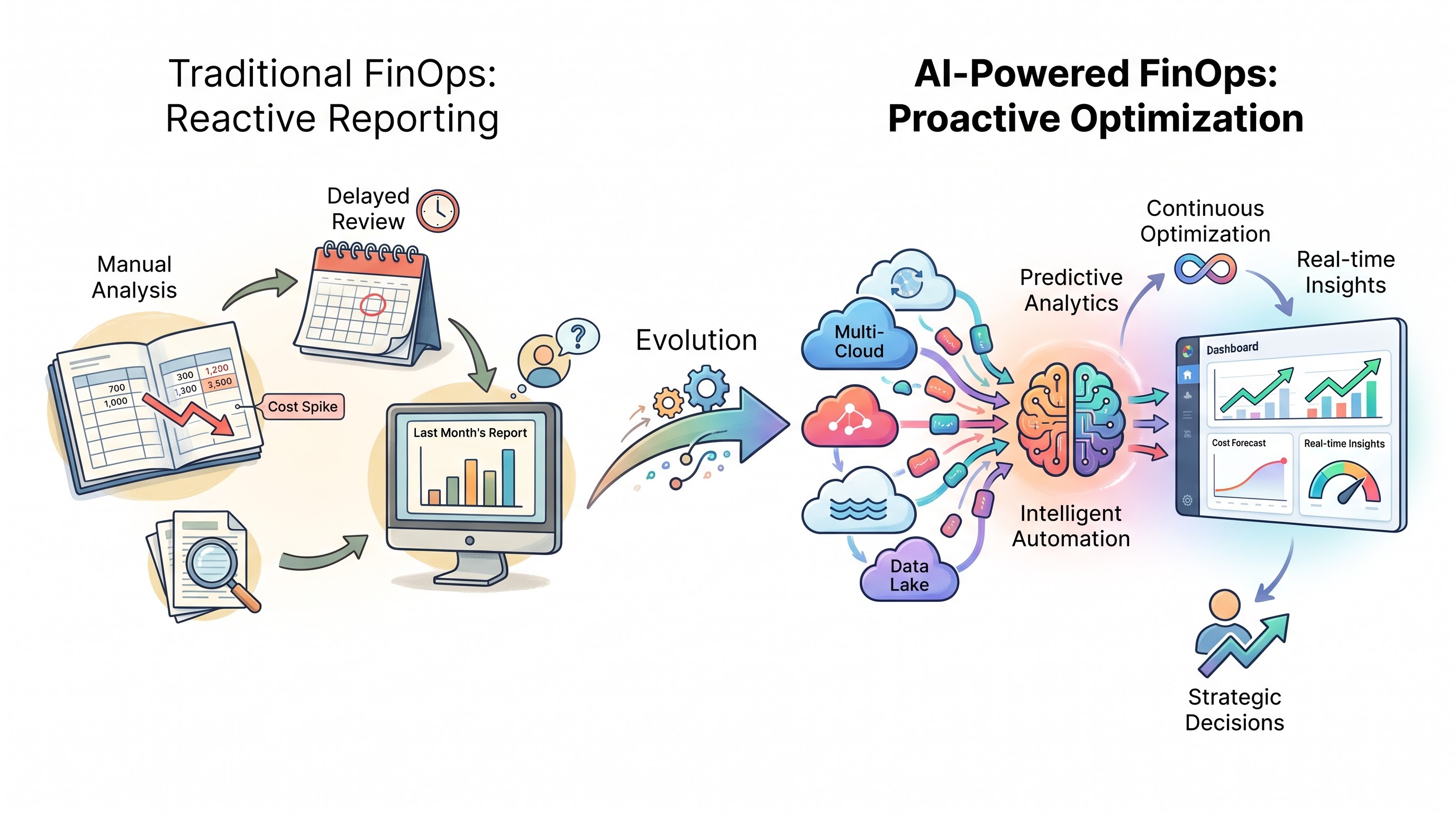
Not long ago, cloud cost management was largely a reporting exercise.
Organizations collected billing data from cloud providers, created dashboards, reviewed monthly spending trends, and looked for opportunities to reduce costs. FinOps teams worked closely with engineering and finance to understand where money was being spent and how resources could be optimized.
That approach worked when cloud infrastructure was relatively predictable.
Today's cloud environments are anything but predictable.
Kubernetes clusters scale automatically based on demand. Serverless applications spin up and disappear within seconds. AI workloads consume expensive GPU resources only when needed. Infrastructure is provisioned continuously through automated deployment pipelines, while engineering teams release new features multiple times a day.
Cloud spending now changes almost as quickly as the infrastructure itself.
At the same time, organizations are deploying more AI applications than ever before. Large language models, AI agents, retrieval systems, inference platforms, vector databases, and machine learning pipelines are introducing entirely new categories of cloud costs.
Managing this complexity with spreadsheets and static dashboards has become increasingly difficult.
Engineering teams often receive optimization recommendations days or weeks after infrastructure has already changed. Finance teams struggle to forecast AI spending accurately. Platform engineers spend valuable time investigating cloud cost anomalies instead of improving the systems that generate them.
This growing operational complexity is changing what organizations expect from FinOps platforms.
Instead of simply reporting cloud costs, businesses want platforms that understand infrastructure behavior, detect inefficiencies automatically, predict future spending, recommend optimization opportunities, and continuously help engineering teams make better decisions.
This is why AI-powered FinOps platforms are rapidly becoming the next evolution of cloud financial management.
In this article, we'll explore why AI-powered FinOps platforms are gaining momentum, the problems they solve, the technologies behind them, and how they are reshaping cloud cost optimization for modern enterprises.
What is an AI-Powered FinOps Platform?
An AI-powered FinOps platform combines cloud financial management with artificial intelligence, automation, infrastructure observability, and operational analytics.
Instead of functioning solely as a reporting system, it continuously evaluates cloud environments to identify optimization opportunities, explain spending behavior, and support faster decision-making.
Traditional FinOps platforms primarily answer questions about cost.
AI-powered FinOps platforms answer questions about behavior.
Why did spending increase?
Which deployment triggered the change?
Which Kubernetes workloads became underutilized?
Why are GPU costs rising despite stable traffic?
Which engineering teams consistently generate avoidable cloud waste?
By connecting financial information with infrastructure telemetry and workload intelligence, these platforms transform cloud cost management from historical reporting into continuous operational optimization.
Why AI Makes FinOps More Effective?
Artificial intelligence excels at identifying patterns across large volumes of data.
Modern cloud environments produce enormous amounts of operational information every minute.
Infrastructure metrics.
Application telemetry.
Logs.
Cloud billing records.
Deployment history.
Performance indicators.
Utilization trends.
Security events.
Analyzing these data sources manually requires significant engineering effort.
AI dramatically accelerates this process.
Machine learning models can identify relationships between infrastructure changes and spending patterns that might otherwise remain hidden.
For example, an AI-powered FinOps platform may detect that GPU costs consistently increase after specific deployment pipelines execute.
It may recognize that certain Kubernetes workloads remain oversized long after demand decreases.
Or it might identify recurring cloud cost anomalies associated with particular engineering teams, environments, or applications.
These insights help organizations optimize cloud resources much faster than manual analysis alone.
AI-Powered FinOps is More Than Automation
Automation has existed in cloud operations for years.
Organizations already automate infrastructure provisioning, deployments, scaling, backups, and monitoring.
AI-powered FinOps introduces a different type of automation.
Instead of simply executing predefined rules, AI systems continuously learn from historical infrastructure behavior and operational outcomes.
This allows recommendations to become increasingly intelligent over time.
Rather than generating static rightsizing suggestions, AI evaluates utilization trends.
Rather than flagging every spending increase as a potential issue, it distinguishes expected business growth from unusual infrastructure behavior.
Rather than applying identical optimization logic across every workload, it adapts recommendations based on application characteristics, historical demand, and organizational priorities.
This shift from rule-based automation to intelligent decision support represents one of the defining characteristics of AI-powered FinOps platforms.
Why are AI Workloads Driving the Need for Smarter FinOps?
Artificial intelligence is changing cloud spending in two important ways.
First, organizations are spending significantly more on AI infrastructure than traditional workloads.
GPU clusters, inference services, vector databases, retrieval pipelines, model training environments, and AI agents introduce entirely new categories of operational complexity.
Second, AI workloads behave differently from conventional applications.
Training jobs consume massive resources for short periods.
Inference traffic fluctuates continuously.
AI agents trigger unpredictable workflow execution.
GPU utilization changes rapidly throughout the day.
These dynamic workloads require optimization strategies that extend beyond traditional cloud reporting.
Organizations increasingly need FinOps platforms capable of understanding infrastructure behavior as it happens rather than analyzing billing information weeks later.
This is one of the strongest reasons AI-powered FinOps platforms are becoming essential for modern cloud operations.
The Core Capabilities of AI-Powered FinOps Platforms
The value of an AI-powered FinOps platform isn't determined by how many dashboards it offers. It's determined by how effectively it helps organizations make faster, smarter, and more informed cloud cost decisions.
One of its most important capabilities is continuous cost intelligence. Rather than waiting for end-of-month billing reports, the platform continuously evaluates cloud infrastructure, workload behavior, utilization trends, and spending patterns as they evolve. This enables engineering teams to identify optimization opportunities while they still matter, not weeks after the fact.
Another critical capability is intelligent anomaly detection. Traditional monitoring systems typically trigger alerts whenever spending exceeds predefined thresholds. AI-powered platforms take a more contextual approach. They distinguish between expected increases caused by business growth and unusual spikes resulting from inefficient infrastructure, configuration changes, or unexpected workload behavior. This significantly reduces alert fatigue while improving the quality of recommendations.
Modern platforms also provide optimization recommendations that go beyond generic rightsizing suggestions. Instead of simply recommending smaller virtual machines, they evaluate infrastructure utilization, Kubernetes resource allocation, GPU consumption, workload ownership, deployment history, and application behavior to recommend actions that balance performance with cost efficiency.
Together, these capabilities transform cloud cost management from a reporting exercise into an ongoing optimization process.
Predicting Cloud Costs Before They Become a Problem
One of the biggest advantages of artificial intelligence is its ability to identify patterns before they become obvious.
Traditional FinOps platforms explain what has already happened.
AI-powered platforms increasingly help organizations understand what is likely to happen next.
By analyzing historical spending, infrastructure growth, deployment frequency, utilization patterns, and seasonal business activity, machine learning models can forecast future cloud costs with greater accuracy.
Imagine a platform recognizing that GPU spending consistently increases before quarterly product launches because AI inference traffic rises dramatically. Rather than surprising finance teams with higher invoices, predictive analytics can forecast those increases weeks in advance, giving engineering teams time to optimize infrastructure or adjust budgets.
The same principle applies to Kubernetes clusters, storage growth, networking costs, and serverless workloads.
Forecasting doesn't eliminate cloud spending.
It eliminates unexpected cloud spending.
From Recommendations to Autonomous Optimization
One of the most exciting developments in AI-powered FinOps is the gradual shift toward autonomous optimization.
Today, many platforms generate recommendations for engineers to review.
Tomorrow's platforms will increasingly automate low-risk optimization tasks while keeping humans in control of strategic decisions.
For example, an AI-powered platform might automatically identify development environments that remain inactive for several days and recommend shutting them down. It could detect consistently underutilized GPU clusters, suggest rightsizing Kubernetes workloads, or recommend adjusting autoscaling policies based on historical demand.
Organizations maintain full control over whether these recommendations are approved manually or executed automatically.
This "human-in-the-loop" model combines automation with engineering oversight, reducing repetitive operational work without introducing unnecessary risk.
Rather than replacing engineers, autonomous optimization allows them to spend more time designing resilient architectures and less time performing repetitive infrastructure reviews.
AI-Powered FinOps and Kubernetes
Kubernetes has fundamentally changed the way cloud infrastructure is managed, but it has also made cloud cost optimization significantly more challenging.
Workloads are continuously scheduled, rescheduled, scaled, and terminated based on application demand. Resource requests often differ from actual utilization, while shared clusters make cost attribution increasingly difficult.
Traditional cloud billing reports struggle to capture this level of operational complexity.
AI-powered FinOps platforms address this by combining Kubernetes telemetry with financial data.
Instead of simply reporting cluster costs, they identify which namespaces consume the most resources, which workloads remain consistently overprovisioned, and how deployment changes influence overall infrastructure spending.
This deeper operational visibility enables engineering teams to optimize Kubernetes environments continuously instead of relying on periodic manual reviews.
Why AI FinOps is Becoming a Strategic Business Capability
For many organizations, FinOps was initially viewed as a cost-control function.
Today, its role is expanding.
Cloud spending increasingly influences product profitability, software delivery, AI adoption, customer experience, and long-term technology strategy.
As a result, AI-powered FinOps platforms are becoming strategic decision-support systems rather than operational reporting tools.
Product leaders can evaluate the financial impact of launching new AI features.
Platform engineers can prioritize infrastructure investments based on utilization trends.
Finance teams gain greater forecasting accuracy.
Executives receive a clearer understanding of how cloud investments support business growth.
When financial data and operational intelligence are connected, cloud optimization becomes a business capability rather than simply an engineering responsibility.
Best Practices for Adopting AI-Powered FinOps Platforms
Successfully implementing an AI-powered FinOps platform requires more than deploying new software.
Organizations should begin by improving the quality of their operational data. Consistent resource tagging, workload ownership, infrastructure telemetry, and cloud governance provide the foundation upon which intelligent recommendations are built.
It is equally important to integrate financial reporting with observability rather than treating them as separate disciplines. AI performs best when it has access to infrastructure metrics, deployment history, application telemetry, cloud billing information, and business context simultaneously.
Organizations should also introduce automation gradually. Rather than automating every optimization decision immediately, begin with recommendations, expand to low-risk operational tasks, and increase automation only after building confidence in the underlying intelligence.
Finally, optimization should always balance cost with reliability and performance. The objective is not simply to reduce cloud spending. It is to maximize the value generated by every cloud resource.
Build Intelligent FinOps with Atler Pilot
Modern cloud environments require more than billing dashboards.
Engineering teams need to understand how infrastructure behavior, Kubernetes workloads, GPU utilization, AI services, deployments, and cloud spending interact across the entire platform.
Atler Pilot helps organizations bridge this gap by combining infrastructure telemetry, workload intelligence, utilization analytics, cloud cost visibility, and operational context into a unified FinOps experience.
Instead of analyzing financial reports in isolation, engineering, platform, DevOps, AI, and FinOps teams gain continuous visibility into the operational factors driving cloud costs.
This broader perspective enables organizations to detect optimization opportunities earlier, improve infrastructure efficiency, understand AI workload behavior, strengthen governance, and make more informed cloud investment decisions.
As AI adoption accelerates and cloud environments become increasingly dynamic, this combination of operational intelligence and financial visibility provides the foundation for next-generation FinOps.
Conclusion
Cloud financial management is entering a new era.
Static reports, monthly reviews, and isolated dashboards are no longer sufficient for infrastructure that changes every second.
Modern organizations need systems capable of understanding not only how much they spend, but also why they spend it, how infrastructure behaves, and where optimization opportunities exist before unnecessary costs accumulate.
This is exactly where AI-powered FinOps platforms create value.
By combining artificial intelligence, infrastructure observability, operational analytics, cloud cost visibility, and automation, they help organizations move beyond reactive cost management toward continuous optimization.
Rather than replacing traditional FinOps principles, AI strengthens them.
It enables faster decision-making, improves forecasting, reduces operational complexity, and provides engineering teams with the context they need to optimize cloud environments confidently.
As enterprise infrastructure becomes increasingly cloud-native and AI-driven, organizations that embrace intelligent FinOps platforms will be better equipped to balance innovation, operational excellence, and financial efficiency.
Because the future of FinOps isn't simply about tracking cloud costs.
It's about understanding them, predicting them, and continuously improving them.
Frequently Asked Questions
How is an AI-powered FinOps platform different from a traditional FinOps platform?
Traditional FinOps platforms primarily focus on cloud cost reporting, budgeting, and visibility. AI-powered platforms extend these capabilities by identifying optimization opportunities, detecting anomalies, forecasting future spending, and providing intelligent recommendations based on operational context.
Can AI automate cloud cost optimization?
AI can automate many low-risk optimization tasks, such as identifying idle resources, recommending rightsizing opportunities, detecting cost anomalies, and improving resource utilization. Strategic decisions involving production infrastructure and business priorities typically continue to involve human oversight.
Why are AI-powered FinOps platforms becoming more important?
Cloud environments have become increasingly dynamic due to Kubernetes, serverless computing, AI workloads, and automated infrastructure. AI-powered FinOps platforms help organizations manage this complexity by providing continuous optimization instead of relying solely on periodic financial reviews.
All in One Place
Atler Pilot decodes your cloud spend story by bringing monitoring, automation, and intelligent insights together for faster and better cloud operations.