
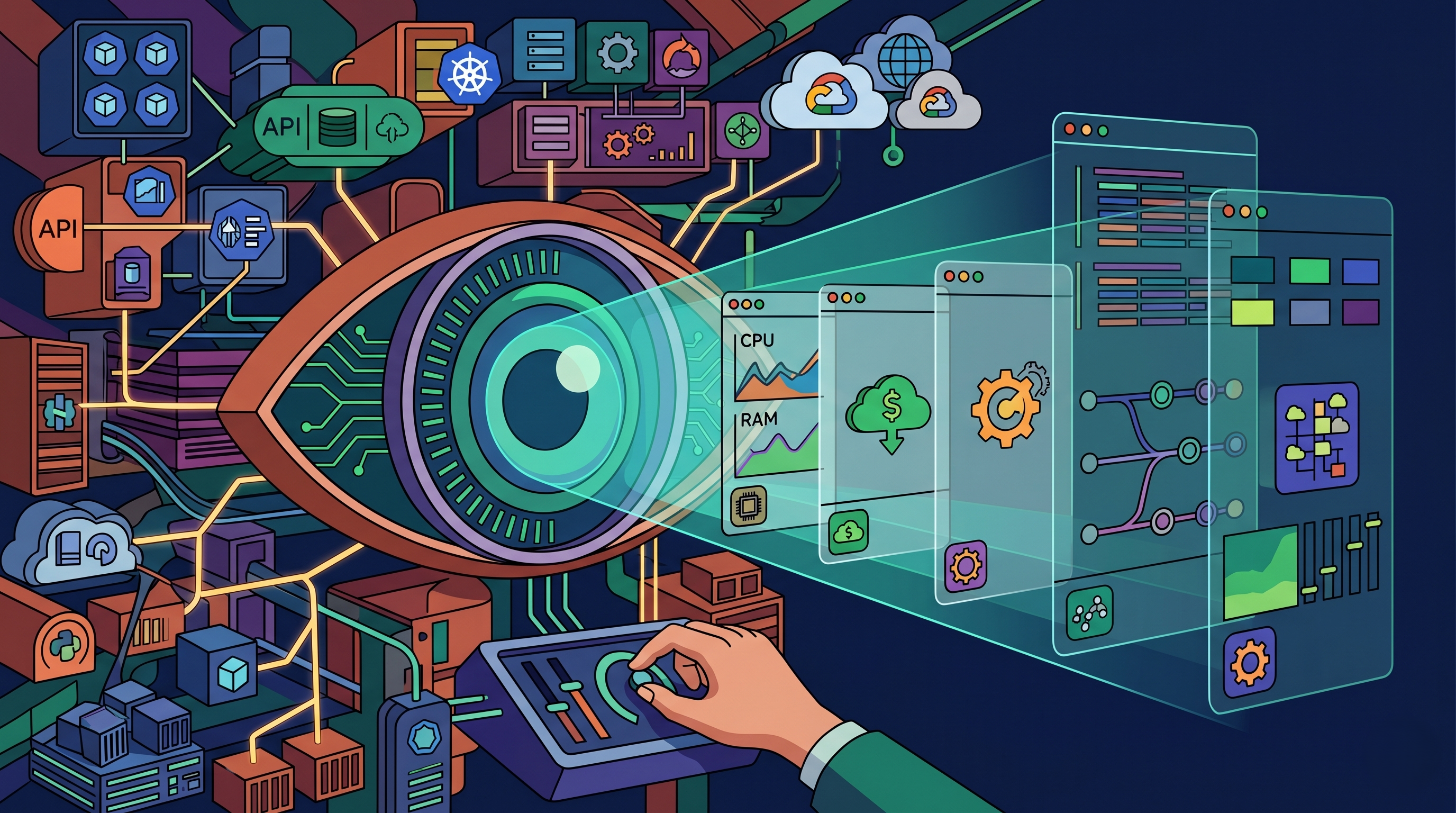
Modern cloud-native infrastructure environments have become extraordinarily dynamic and interconnected. Kubernetes ecosystems, AI-powered applications, distributed APIs, observability platforms, infrastructure-as-code systems, multi-cloud architectures, and automated deployment pipelines now operate continuously across highly distributed operational environments.
This complexity has fundamentally changed how infrastructure changes affect operational stability. Even relatively small modifications involving Kubernetes configurations, workload allocation, autoscaling policies, networking rules, observability settings, or AI systems can trigger cascading operational consequences across cloud-native ecosystems.
Traditional change management models were designed for relatively predictable infrastructure environments where operational dependencies remained easier to understand manually. Modern infrastructure systems behave very differently. Workloads scale continuously, dependencies evolve dynamically, AI systems consume unpredictable resources, and infrastructure interactions become increasingly difficult to visualize operationally in real time.
As a result, organizations are finding it increasingly difficult to predict the operational impact of infrastructure changes before those changes reach production environments.
This is where artificial intelligence is beginning to play a transformative role.
AI-driven infrastructure intelligence is enabling organizations to analyze workload behavior, identify hidden operational dependencies, detect anomaly patterns, forecast infrastructure instability, and predict potential operational risks before changes are deployed across cloud-native environments.
The future of infrastructure governance is no longer only about automating deployments. It is increasingly about intelligently understanding the operational consequences of infrastructure changes before they occur.
In this blog, we will explore why traditional change impact analysis is becoming insufficient, how AI improves infrastructure change prediction, and the growing role intelligent operational visibility will play in the future of cloud-native infrastructure management.
Traditional Change Analysis Struggles in Modern Environments
Traditional infrastructure change analysis was largely built around static environments, predictable deployment cycles, and relatively isolated application systems. Infrastructure dependencies were easier to map manually, operational changes evolved gradually, and deployment risks remained more contained operationally.
Modern cloud-native ecosystems behave very differently. Kubernetes workloads interact continuously across shared clusters, AI systems scale dynamically, observability pipelines generate massive telemetry streams, and distributed services communicate across multi-cloud environments in real time. In these highly interconnected systems, infrastructure changes rarely affect only a single component operationally. A small configuration update may indirectly influence autoscaling behavior, networking performance, GPU utilization, telemetry growth, or shared platform stability across multiple environments simultaneously.
The challenge is that infrastructure complexity now evolves faster than human operators can realistically analyze operational dependencies manually. Traditional change validation approaches often focus primarily on functional testing while missing broader infrastructure-level operational consequences. This creates environments where infrastructure instability, cloud inefficiency, and operational disruptions emerge only after deployment changes are already active across production systems.
AI Improves Visibility Into Hidden Infrastructure Dependencies
One of the biggest operational challenges in modern infrastructure management is identifying hidden dependencies between workloads, services, Kubernetes clusters, networking systems, AI environments, and observability platforms.
AI systems are increasingly capable of analyzing operational telemetry continuously to identify relationships that traditional monitoring tools may overlook. By processing infrastructure signals across logs, metrics, traces, workload behaviors, deployment patterns, and resource utilization trends, AI can uncover how seemingly independent infrastructure components actually influence one another operationally.
For example, AI may detect that changes to a specific Kubernetes workload frequently correlate with autoscaling instability in unrelated services, or that adjustments to observability configurations indirectly increase networking congestion across distributed environments. These dependency relationships are often too complex and dynamic for manual operational analysis alone.
By improving visibility into hidden infrastructure relationships, AI helps organizations understand how changes propagate operationally across cloud-native ecosystems before instability occurs. This significantly strengthens proactive infrastructure governance and reduces the likelihood of unintended operational consequences after deployments.
AI Enhances Kubernetes Change Risk Prediction
Kubernetes environments are among the most operationally dynamic systems in modern cloud-native infrastructure. Workloads scale continuously, clusters rebalance resources automatically, autoscaling systems react to operational demand in real time, and shared infrastructure dependencies evolve constantly across distributed ecosystems.
This makes Kubernetes change analysis extremely difficult through traditional static governance approaches alone. A seemingly small deployment adjustment involving resource limits, pod scheduling, autoscaling thresholds, or service mesh policies may trigger broad operational instability across shared clusters.
AI-driven infrastructure analysis helps organizations predict these risks more effectively by continuously learning from workload behavior patterns, historical deployment outcomes, resource utilization trends, and cluster operational signals. AI systems can identify anomalies, detect unusual workload behavior, forecast scaling instability, and recognize operational conditions likely to increase infrastructure risk before changes are deployed.
This allows engineering teams to evaluate Kubernetes changes with significantly greater operational context. Instead of reacting to infrastructure instability after deployments occur, organizations can increasingly identify operational risks proactively and strengthen Kubernetes stability management before changes affect production systems.
AI Helps Predict Cloud Cost Impact Before Deployments
Infrastructure changes frequently influence cloud spending in ways that remain operationally invisible during deployment planning. Adjustments to autoscaling behavior, workload allocation, AI inference systems, observability instrumentation, or distributed networking configurations may all create significant operational cost consequences over time.
Traditional cloud financial reporting typically identifies these inefficiencies only after infrastructure costs have already increased. AI is changing this by enabling organizations to analyze how infrastructure changes may influence operational resource consumption before deployments occur.
By continuously analyzing workload behavior, infrastructure utilization patterns, scaling activity, GPU allocation trends, and telemetry growth, AI systems can forecast how proposed changes may affect cloud economics operationally across Kubernetes environments and distributed infrastructure ecosystems.
For example, AI may predict that a deployment configuration adjustment is likely to trigger excessive autoscaling activity, increase observability overhead, or reduce GPU utilization efficiency operationally. This allows organizations to evaluate infrastructure changes not only from a functional perspective but also from an operational sustainability and cloud efficiency standpoint before deployment decisions are finalized.
AI Strengthens Observability-Aware Infrastructure Governance
Modern cloud-native ecosystems generate enormous amounts of telemetry continuously across logs, traces, metrics, distributed monitoring systems, and AI observability pipelines. Observability systems themselves now represent major operational infrastructure layers with significant influence over cloud performance, resource utilization, and infrastructure scalability.
Infrastructure changes frequently affect observability systems in unexpected ways. Adjustments involving instrumentation policies, distributed tracing, telemetry collection, or AI monitoring frameworks may unintentionally generate telemetry spikes, storage expansion, networking overhead, or operational instability.
AI improves observability-aware governance by continuously analyzing telemetry behavior and identifying patterns associated with operational risk. AI systems can recognize unusual observability growth trends, detect telemetry anomalies, and forecast how infrastructure changes may influence monitoring overhead operationally across cloud-native ecosystems.
This helps organizations prevent observability-related infrastructure inefficiencies before they become operationally disruptive or financially expensive. As observability environments continue scaling alongside Kubernetes ecosystems and AI infrastructure, AI-driven telemetry intelligence is becoming increasingly important for sustainable infrastructure governance.
AI Improves Multi-Cloud Infrastructure Awareness
Most modern enterprises now operate across AWS, Azure, Google Cloud, Kubernetes ecosystems, SaaS platforms, hybrid infrastructure, and edge environments simultaneously. This creates highly fragmented operational ecosystems where infrastructure dependencies extend across multiple providers, operational domains, and distributed networking layers.
Traditional infrastructure governance tools often analyze these environments independently rather than understanding workload relationships holistically across distributed cloud-native ecosystems. AI significantly improves this operational awareness by continuously correlating infrastructure behavior across multi-cloud environments in real time.
AI systems can identify how changes within one environment may indirectly affect networking traffic, Kubernetes resource allocation, AI inference scaling, observability systems, or operational performance across interconnected platforms. This allows organizations to evaluate infrastructure risk more comprehensively and reduce the likelihood of unintended multi-environment operational instability.
As cloud-native ecosystems become increasingly distributed, AI-driven infrastructure intelligence is becoming essential for maintaining unified operational visibility across fragmented operational environments.
AI Enables More Proactive Infrastructure Governance
Traditional infrastructure governance has often been reactive. Organizations identify deployment failures, operational instability, cloud inefficiencies, or observability overload only after those problems become operationally visible across production environments.
AI is shifting infrastructure governance toward proactive operational intelligence. By continuously analyzing workload behavior, deployment history, infrastructure telemetry, and operational trends, AI systems can forecast infrastructure risk before instability escalates operationally.
This allows organizations to move beyond static policy enforcement and delayed troubleshooting toward predictive operational governance capable of identifying:
Potential autoscaling instability
Resource allocation inefficiencies
AI infrastructure anomalies
Observability expansion risks
Kubernetes workload conflicts
Distributed operational dependencies
AI-driven prediction significantly improves operational resilience because organizations gain earlier visibility into infrastructure conditions likely to create instability after deployments.
The future of infrastructure governance increasingly depends on predictive intelligence rather than reactive incident response alone.
Human Oversight Still Remains Critical
While AI is transforming infrastructure change prediction, human operational expertise remains essential. AI systems excel at processing massive operational datasets, identifying patterns, and forecasting infrastructure behavior across highly dynamic cloud-native ecosystems. However, infrastructure governance still requires human understanding of business priorities, engineering tradeoffs, compliance requirements, operational strategy, and organizational context.
AI should therefore be viewed as an operational intelligence layer that augments engineering decision-making rather than fully replacing human oversight. The most effective infrastructure governance models will combine AI-driven operational visibility with experienced engineering judgment and workload-aware governance practices.
Organizations that rely entirely on automation without operational accountability may still encounter governance blind spots, especially in highly complex distributed environments. Sustainable infrastructure management increasingly depends on balancing intelligent automation with strong human operational awareness.
The future of AI-driven infrastructure governance is collaborative rather than fully autonomous.
Building Intelligent Infrastructure Visibility with Atler Pilot
As cloud-native ecosystems become more distributed and operationally complex, maintaining visibility into workload behavior, Kubernetes utilization, AI infrastructure efficiency, observability growth, and deployment risk becomes increasingly important for intelligent change impact prediction. This is where Atler Pilot helps organizations gain deeper operational understanding across modern cloud-native environments through a unified operational view.
By connecting infrastructure insights, workload intelligence, operational visibility, utilization awareness, and governance context together, Atler Pilot helps organizations identify deployment risks, autoscaling anomalies, fragmented infrastructure behavior, hidden inefficiencies, and operational instability patterns earlier across distributed ecosystems. Instead of relying solely on delayed monitoring analysis or fragmented infrastructure dashboards, engineering and platform teams gain more contextual operational awareness into how infrastructure changes influence workload behavior operationally across cloud-native environments.
This allows organizations to improve Kubernetes governance, strengthen AI infrastructure visibility, optimize workload scalability, reduce hidden operational risks, and build more resilient infrastructure management strategies without sacrificing engineering agility or innovation velocity.
Modern infrastructure governance requires more than deployment automation alone. Atler Pilot helps organizations simplify infrastructure complexity, improve operational visibility, and make more informed decisions around Kubernetes optimization, AI infrastructure governance, workload scalability, and operational sustainability. Sign up for Atler Pilot and explore how unified operational visibility can help your teams improve infrastructure change impact prediction across modern cloud-native ecosystems.
Conclusion
Modern cloud-native infrastructure has become too dynamic and interconnected for traditional change analysis approaches to remain sufficient on their own. Kubernetes ecosystems, AI workloads, observability systems, distributed services, and multi-cloud architectures all create operational dependencies that are increasingly difficult to understand manually across real-time infrastructure environments.
AI is transforming infrastructure governance by improving visibility into workload behavior, hidden dependencies, autoscaling risk, observability growth, and operational instability before changes affect production systems. Organizations that succeed in the future of cloud-native operations will increasingly rely on predictive operational intelligence rather than reactive troubleshooting alone.
Because the future of infrastructure stability is no longer only about deploying changes faster. It is about understanding the operational consequences of those changes intelligently before infrastructure ecosystems experience instability at cloud-native scale.
All in One Place
Atler Pilot decodes your cloud spend story by bringing monitoring, automation, and intelligent insights together for faster and better cloud operations.