
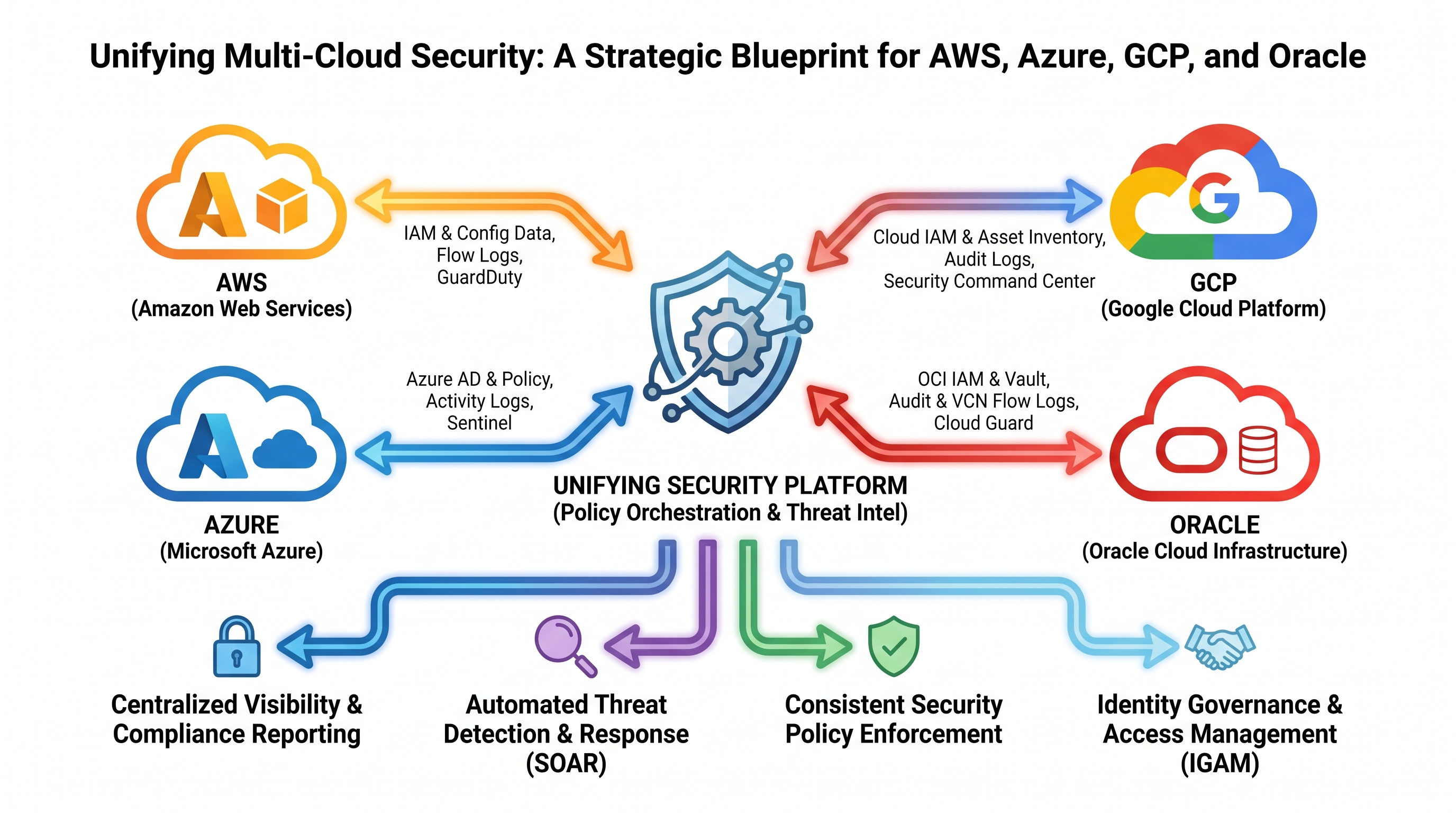
The enterprise cloud landscape is no longer a mono-cloud domain. Organizations are increasingly adopting multi-cloud strategies, leveraging the best-of-breed services from hyperscalers like AWS, Azure, Google Cloud Platform (GCP), and Oracle Cloud Infrastructure (OCI). While this approach offers unparalleled flexibility, resilience, and innovation potential, it simultaneously introduces a formidable challenge: unifying security across inherently disparate environments. The siloed management of security policies, identity, networks, and data across multiple providers creates significant operational overhead, increases the attack surface, complicates compliance, and often leads to unforeseen FinOps inefficiencies.
At CloudAtler, we understand that true multi-cloud mastery lies in seamless integration and centralized control. This strategic blueprint outlines a highly technical, actionable framework for achieving robust, unified multi-cloud security, ensuring that your enterprise remains secure, compliant, and cost-optimized across AWS, Azure, GCP, and Oracle environments. This isn't about theoretical concepts; it's about practical implementations that drive tangible security and financial benefits.
The Multi-Cloud Security Conundrum: Beyond Silos
The shared responsibility model, while fundamental, varies in its nuance across cloud providers. AWS, Azure, GCP, and OCI each offer powerful native security services, but their APIs, terminologies, and operational paradigms differ significantly. This divergence leads to:
Fragmented Visibility: Security teams struggle with a consolidated view of threats, vulnerabilities, and compliance status across all clouds.
Inconsistent Policies: Manually translating security policies from one cloud's constructs to another is error-prone and unsustainable, leading to security gaps.
Operational Overhead: Managing multiple security consoles, alert streams, and remediation workflows drains resources and slows response times.
Compliance Complexities: Demonstrating consistent adherence to regulatory frameworks (e.g., GDPR, HIPAA, PCI DSS) across diverse cloud footprints becomes a monumental task.
FinOps Inefficiencies: Unoptimized security configurations, redundant tooling, and lack of visibility into security-related spend can lead to significant cost overruns. For instance, over-provisioned security logging, unoptimized WAF rules, or misconfigured network egress policies can silently inflate cloud bills.
Addressing these challenges requires a strategic shift from individual cloud security management to a holistic, unified approach. This is where a platform like CloudAtler provides immense value, offering an AI-powered solution to unify FinOps, cloud security, and automated operations across your entire multi-cloud estate.
Pillar 1: Centralized Identity and Access Management (IAM) Across Clouds
Identity is the new perimeter. In a multi-cloud environment, managing user and programmatic access consistently is paramount. Each cloud provider has its own robust IAM system:
AWS IAM: Users, Groups, Roles, Policies (managed, inline, customer-managed), AWS Organizations for multi-account governance, AWS SSO for centralized access.
Azure AD: Users, Groups, Service Principals, Managed Identities, Conditional Access Policies, Role-Based Access Control (RBAC).
GCP Cloud IAM: Members (users, service accounts, groups), Roles (primitive, predefined, custom), Resource Hierarchy (organizations, folders, projects).
Oracle Cloud (OCI) IAM: Users, Groups, Dynamic Groups, Policies, Compartments for resource organization.
Unification Strategy: Federated Identity and Standardized RBAC
The goal is a single source of truth for identities and a consistent application of the principle of least privilege. This involves:
Federated Identity Provider (IdP): Implement a central IdP (e.g., Okta, Ping Identity, or Azure AD acting as the primary IdP) to manage all enterprise identities. This IdP federates access to each cloud environment.
Technical Implementation: Configure SAML 2.0 or OpenID Connect (OIDC) federation between your central IdP and AWS IAM (via Identity Providers), Azure AD (as the primary IdP or federating to another), GCP Cloud IAM (via Workforce Identity Federation), and OCI IAM (via Identity Providers).
Example: A user authenticates once with Okta. Okta then issues a SAML assertion that grants them a specific AWS IAM role, membership in an Azure AD group, access to a GCP project via a delegated role, and OCI group membership, all based on their enterprise group affiliations.
Standardized RBAC and Least Privilege: Define a consistent set of roles and permissions that map enterprise functions to cloud-specific roles. Automate the assignment and review of these permissions.
Technical Implementation: Create custom roles in each cloud that align with a common enterprise RBAC matrix. Use Infrastructure-as-Code (IaC) tools like Terraform to define and manage these roles and policies across environments. For instance, a "Cloud Security Analyst" role might map to an AWS IAM policy allowing read-only access to CloudTrail and GuardDuty, an Azure RBAC role for Defender for Cloud, a GCP custom role for Security Command Center, and an OCI policy for Cloud Guard.
FinOps Angle: Centralized IAM reduces the risk of orphaned credentials, over-privileged accounts, and shadow IT, which can lead to unauthorized resource creation and unmonitored spend. Automated access reviews ensure that access is right-sized, minimizing potential security breaches that result in costly remediation efforts.
Pillar 2: Unified Network Security and Segmentation
Network security forms the bedrock of cloud defense, controlling traffic flow and isolating workloads. Each cloud has its unique networking constructs:
AWS Networking: VPCs, Subnets, Security Groups (stateful), Network ACLs (stateless), Transit Gateway, VPC Flow Logs, Network Firewall.
Azure Networking: Virtual Networks (VNets), Subnets, Network Security Groups (NSGs), Application Security Groups (ASGs), Azure Firewall, Virtual WAN.
GCP Networking: VPC Networks (global), Subnets (regional), Firewall Rules, Shared VPC, Cloud VPN/Interconnect, Cloud Armor (DDoS/WAF).
OCI Networking: Virtual Cloud Networks (VCNs), Subnets, Security Lists (stateless), Network Security Groups (NSGs - stateful), FastConnect/IPSec VPN, Network Firewall.
Unification Strategy: Standardized Topologies and Centralized Firewall Management
The goal is consistent network segmentation, traffic inspection, and perimeter defense across all clouds.
Standardized Network Topology: Adopt a hub-and-spoke model consistently across all clouds. A central "hub" VNet/VPC/VCN handles ingress/egress, shared services, and inter-cloud connectivity, while "spoke" networks host applications.
Technical Implementation: Utilize AWS Transit Gateway, Azure Virtual WAN Hub, GCP Shared VPC with Cloud VPN/Interconnect, and OCI Transit Routing with FastConnect/IPSec VPN to create this hub-and-spoke architecture. All outbound internet traffic from spokes should route through the central hub for inspection.
Example: A central security VNet in Azure hosts Azure Firewall, which inspects all traffic to and from spoke VNets. Similarly, an AWS Transit Gateway routes all inter-VPC traffic through a dedicated "Inspection VPC" containing Network Firewalls or third-party NGFWs.
Centralized Firewall Management: Implement a strategy for managing firewall rules and policies from a single point of control.
Technical Implementation:
Native Approach: Leverage cloud-native firewalls (AWS Network Firewall, Azure Firewall, GCP Cloud Firewall, OCI Network Firewall) and manage their policies programmatically via IaC (Terraform, CloudFormation, ARM Templates, OCI Resource Manager) or a centralized Cloud Security Posture Management (CSPM) platform.
Third-Party NGFW: Deploy a Next-Generation Firewall (NGFW) from vendors like Palo Alto Networks (Cloud NGFW, VM-Series) or Fortinet (FortiGate-VM) in each cloud's hub network. Manage these from a central console (e.g., Panorama for Palo Alto, FortiManager for Fortinet). This provides consistent advanced threat protection capabilities.
Micro-segmentation: Implement fine-grained controls at the workload level using Security Groups (AWS), NSGs/ASGs (Azure), Firewall Rules with service accounts (GCP), and NSGs (OCI). Automate their deployment and auditing with IaC.
FinOps Angle: Optimized firewall rules and proper network segmentation can reduce data egress costs by preventing unauthorized data transfers. Centralized management reduces configuration errors that could lead to open ports and potential breaches, which are far more costly to remediate than proactive security.
Pillar 3: Consistent Data Protection and Encryption
Data is the most valuable asset, and its protection is non-negotiable. Encryption at rest and in transit, coupled with robust access controls, is critical. Each cloud offers key management and encryption services:
AWS Key Management Service (KMS): Manages cryptographic keys, integrates with S3, EBS, RDS, etc. S3 bucket policies, Macie for data discovery.
Azure Key Vault: Stores and manages cryptographic keys, secrets, and certificates. Azure Storage encryption, Azure SQL TDE, Azure Disk Encryption.
GCP Cloud Key Management Service (KMS): Manages cryptographic keys, integrates with Cloud Storage, Cloud SQL, Compute Engine. Data Loss Prevention (DLP) API.
OCI Vault: Manages master encryption keys and secrets. Object Storage encryption, Database TDE, Block Volume encryption.
Unification Strategy: Centralized Key Management and Data Classification
Ensure consistent encryption policies and data access controls across all environments.
Centralized Key Management Strategy: While each cloud has its native KMS, a multi-cloud strategy often involves a higher-level key management strategy.
Technical Implementation:
BYOK (Bring Your Own Key): Import keys from an on-premises Hardware Security Module (HSM) to cloud KMS services (e.g., AWS KMS, Azure Key Vault, GCP Cloud KMS, OCI Vault). This allows for central key generation and lifecycle management while utilizing native cloud encryption.
External Key Management: Use a third-party multi-cloud key management solution (e.g., Fortanix, HashiCorp Vault) that integrates with native KMS services or directly manages keys for applications across clouds.
Example: An enterprise uses an on-premises HSM to generate a master key. This key is then securely imported into AWS KMS, Azure Key Vault, GCP Cloud KMS, and OCI Vault. All data encryption operations within each cloud then use cryptographic keys derived from or protected by this imported key, ensuring central control over the root of trust.
Consistent Data Classification and DLP: Implement enterprise-wide data classification standards and enforce Data Loss Prevention (DLP) policies.
Technical Implementation: Utilize cloud-native DLP services (e.g., AWS Macie, GCP DLP API, Azure Purview for data governance) to discover, classify, and protect sensitive data across storage services. Supplement with third-party DLP solutions where cross-cloud visibility is needed.
FinOps Angle: Data breaches are incredibly costly. Consistent data protection policies minimize this risk. Furthermore, by identifying and classifying sensitive data, organizations can optimize storage tiers, apply appropriate lifecycle policies, and avoid unnecessary replication, directly impacting storage costs.
Pillar 4: Holistic Security Posture Management and Compliance
Understanding and continuously improving your security posture is vital. Each cloud provides services for security monitoring and compliance:
AWS: Security Hub, Config, GuardDuty, CloudTrail, Inspector, WAF, Shield.
Azure: Microsoft Defender for Cloud (formerly Azure Security Center), Azure Policy, Azure Sentinel, Azure Monitor, Azure WAF.
GCP: Security Command Center, Cloud Asset Inventory, Cloud Audit Logs, Policy Intelligence, Cloud Armor.
OCI: Cloud Guard, Security Advisor, Audit, Vulnerability Scanning Service, WAF.
Unification Strategy: Centralized CSPM and Automated Remediation
A single pane of glass for security posture and compliance across all clouds is the ultimate goal.
Unified Cloud Security Posture Management (CSPM): Integrate native cloud security tools into a centralized CSPM platform.
Technical Implementation: Leverage a multi-cloud CSPM solution (like CloudAtler's Cloud Security platform) that connects via APIs to AWS Security Hub/Config, Azure Defender for Cloud, GCP Security Command Center, and OCI Cloud Guard. This platform ingests security findings, assesses configurations against industry benchmarks (CIS, NIST), and provides a consolidated risk score.
Example: The CSPM platform identifies an unencrypted S3 bucket in AWS, an open NSG port in Azure, a publicly exposed VM in GCP, and an OCI Object Storage bucket lacking a replication policy. All these findings are correlated and presented in a single dashboard, prioritized by severity and potential impact.
Continuous Compliance Monitoring and Reporting: Automate the monitoring of compliance against regulatory frameworks.
Technical Implementation: Define compliance policies using cloud-native policy engines (AWS Config Rules, Azure Policy, GCP Organization Policies, OCI Policies) and enforce them through IaC. The unified CSPM platform should then audit these policies and generate compliance reports for frameworks like PCI DSS, HIPAA, GDPR, ISO 27001.
Automated Remediation Workflows: Implement automated actions to address security misconfigurations.
Technical Implementation: Integrate the CSPM platform with SOAR (Security Orchestration, Automation, and Response) tools or directly with cloud automation services (AWS Lambda, Azure Functions, GCP Cloud Functions, OCI Functions). When a critical misconfiguration is detected (e.g., an S3 bucket made public), an automated workflow is triggered to revert the configuration and notify the security team.
FinOps Angle: Proactive identification and automated remediation of security misconfigurations prevent costly data breaches and compliance fines. By continuously optimizing security posture, organizations avoid the reactive, expensive "firefighting" that often characterizes unmanaged multi-cloud environments.
Pillar 5: Automated Operations and FinOps for Security Optimization
Security and FinOps are inextricably linked. Inefficient security practices directly impact cloud costs, while cost-optimization efforts must not compromise security. This pillar focuses on leveraging automation to achieve both.
Unification Strategy: Policy-as-Code and AI-Driven Optimization
The convergence of security and FinOps drives operational efficiency and cost savings.
Policy-as-Code and Infrastructure-as-Code (IaC): Define and enforce security policies and infrastructure configurations programmatically.
Technical Implementation: Use tools like Terraform, CloudFormation (AWS), ARM Templates (Azure), Deployment Manager (GCP), and OCI Resource Manager to define and deploy security groups, network ACLs, IAM roles, KMS key policies, and security monitoring configurations across all clouds. Integrate these into CI/CD pipelines to ensure consistent, immutable infrastructure and security.
Example: A single Terraform module can define a standardized set of network security rules that are applied to new VPCs/VNets/VCNs in AWS, Azure, GCP, and OCI, ensuring immediate compliance from deployment.
Automated Remediation and Operational Workflows: Beyond simple configuration fixes, automate complex operational security tasks.
Technical Implementation: Develop serverless functions (e.g., AWS Lambda, Azure Functions, GCP Cloud Functions, OCI Functions) that respond to security events from native logging services (CloudTrail, Azure Monitor, Cloud Audit Logs, OCI Audit). For instance, a function could automatically quarantine a compromised EC2 instance, block a malicious IP in a WAF, or rotate credentials for a leaked service account. CloudAtler's automated operations capabilities are designed precisely for this, providing intelligent, cross-cloud orchestration.
AI-Driven FinOps for Security Optimization: Proactively identify and address security-related cost inefficiencies.
Technical Implementation: Analyze security service usage and costs across clouds. This includes right-sizing WAF rules, optimizing GuardDuty/Defender for Cloud/Cloud Guard configurations to reduce false positives (which consume analyst time), and ensuring efficient logging retention policies. CloudAtler's FinOps platform uses AI to analyze resource utilization, identify anomalies, and recommend cost-saving actions that don't compromise security.
Example: The platform might detect excessive data transfer costs due to unoptimized network security group rules or identify unused security logging services in a particular region. It could also highlight redundant security tools across clouds that can be consolidated.
Cost Attribution: Accurately attribute security costs to specific business units or applications using tagging strategies (e.g., AWS Tags, Azure Tags, GCP Labels, OCI Tags) and integrate with FinOps reporting tools. This transparency helps stakeholders understand the financial impact of security decisions.
CloudAtler: Unifying Your Multi-Cloud Security and FinOps Strategy
Implementing this strategic blueprint manually across AWS, Azure, GCP, and Oracle environments is a monumental task, requiring specialized expertise in each cloud provider and significant engineering effort. This is where CloudAtler steps in as your indispensable partner.
CloudAtler is an AI-powered platform specifically designed to unify FinOps, cloud security, and automated operations across your entire multi-cloud estate. We provide the single pane of glass you need to:
Centralize Security Posture Management: Gain real-time visibility into security configurations, compliance status, and threat landscape across AWS, Azure, GCP, and OCI.
Automate Remediation: Implement intelligent, automated workflows to detect and resolve misconfigurations, enforce policies, and respond to threats proactively.
Optimize FinOps for Security: Identify and eliminate security-related cost inefficiencies, right-size security services, and ensure that security investments deliver maximum value.
Standardize Operations: Apply consistent security policies and operational best practices across all your cloud providers, reducing complexity and human error.
Enhance Compliance: Streamline compliance reporting and maintain continuous adherence to industry standards and regulatory requirements.
Our platform abstracts away the complexities of disparate cloud APIs and security models, presenting a unified, actionable view that empowers your security, operations, and finance teams to collaborate effectively and drive secure, cost-efficient cloud adoption.
Conclusion
The journey to unified multi-cloud security is complex but imperative for any enterprise operating across AWS, Azure, GCP, and Oracle. By adopting a strategic blueprint that focuses on centralized IAM, unified network security, consistent data protection, holistic posture management, and automated FinOps-driven security operations, organizations can transform their multi-cloud challenge into a competitive advantage.
This blueprint provides a framework for robust defense, streamlined operations, and optimized cloud spend. However, the true power lies in its execution. Manual implementation is prone to error and scale limitations. Embrace an intelligent, AI-powered platform to bridge the gaps and deliver true multi-cloud mastery.
Ready to unify your multi-cloud security, streamline operations, and optimize your cloud spend across AWS, Azure, GCP, and Oracle environments? Discover how CloudAtler can transform your enterprise cloud strategy. Learn more about our AI-powered Cloud Security platform and start building a resilient, cost-effective multi-cloud future today.
All in One Place
Atler Pilot decodes your cloud spend story by bringing monitoring, automation, and intelligent insights together for faster and better cloud operations.