
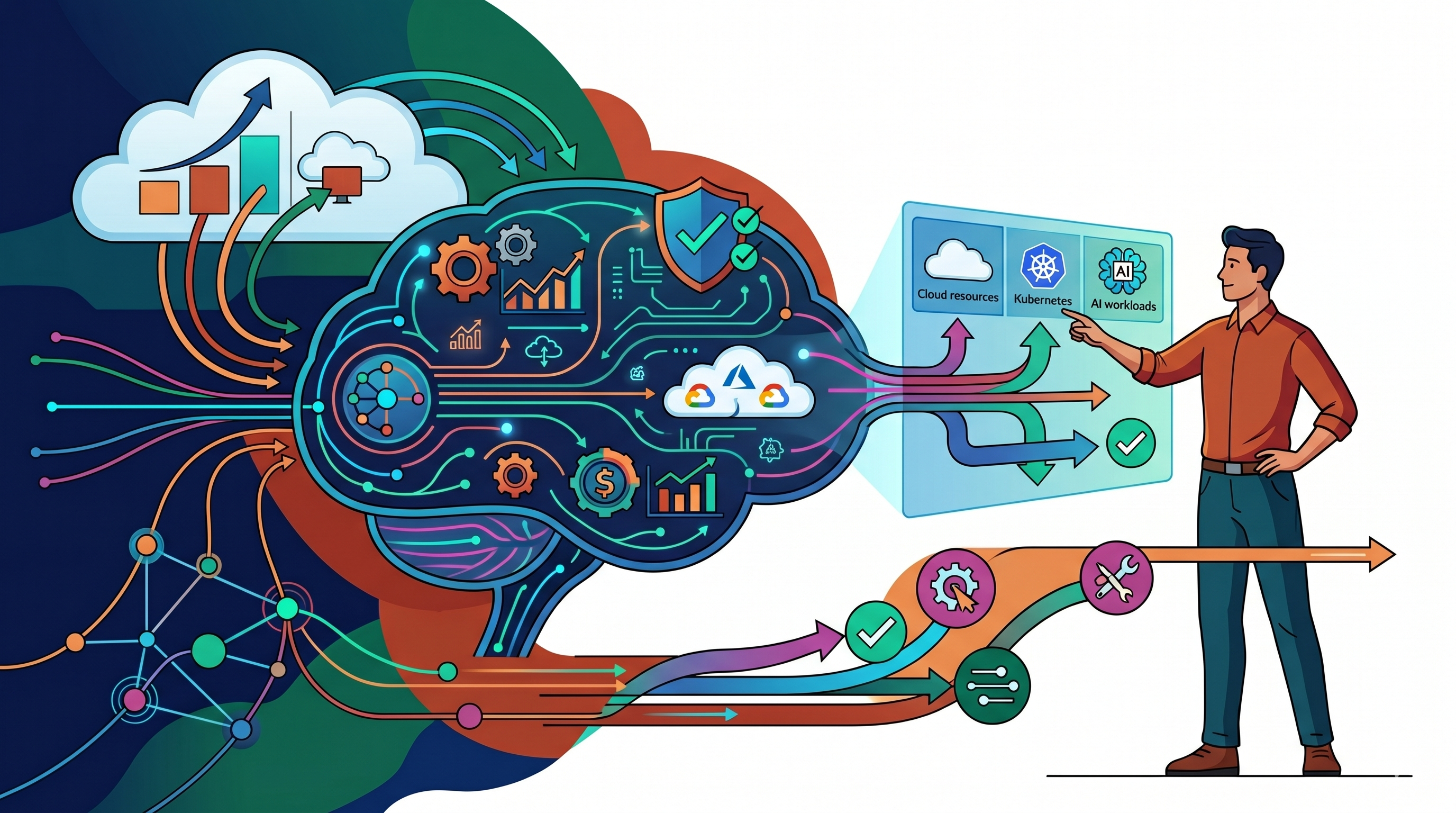
Cloud infrastructure was supposed to simplify operations. Organizations moved away from physical servers, manual provisioning, and hardware maintenance in exchange for scalable, flexible, on-demand infrastructure. And in many ways, the cloud delivered exactly that.
But as cloud environments expanded, something unexpected happened. Instead of reducing operational complexity completely, the cloud shifted complexity into new areas. Kubernetes clusters, multi-cloud environments, AI workloads, observability systems, CI/CD pipelines, infrastructure automation, security governance, and cost optimization all introduced layers of operational overhead that became difficult to manage manually.
Today, modern cloud environments change too quickly for traditional operational approaches to keep up. Infrastructure scales automatically, workloads move dynamically, deployments happen continuously, and operational signals flood teams from every direction. Manual processes that once worked in smaller environments are now becoming operational bottlenecks.
This is why intelligent automation is rapidly replacing manual cloud operations.
Organizations are no longer using automation only to save time. They are using it because the scale, speed, and complexity of modern cloud infrastructure increasingly exceed what humans can manage consistently through manual workflows alone.
In this blog, we will explore why intelligent automation is becoming essential in cloud operations, what challenges it solves, and how it is reshaping the future of infrastructure management.
Cloud Environments Evolve Faster Than Humans Can Manage Manually
Modern cloud infrastructures are highly dynamic systems. Resources scale automatically, Kubernetes workloads move continuously, APIs generate massive operational activity, and deployments occur dozens or hundreds of times per day in mature engineering environments.
In smaller infrastructures, manual operational processes may still be manageable. Teams can review dashboards manually, respond to alerts individually, and investigate infrastructure issues one at a time. But as environments scale, this approach breaks down quickly.
The volume of operational events becomes too large for humans to process consistently in real time. Engineers spend increasing amounts of time reacting to infrastructure changes instead of proactively improving systems.
Intelligent automation helps organizations handle operational scale by continuously monitoring, analyzing, and responding to infrastructure behavior faster than manual processes realistically can.
Manual Operations Create Inconsistency
Human-driven operational workflows are naturally inconsistent. Different engineers may follow different procedures, apply configurations differently, or respond to incidents using varying approaches.
As cloud environments become larger and more distributed, inconsistency creates serious operational risk. Misconfigurations, delayed responses, forgotten updates, and procedural drift become more common when operations depend heavily on manual intervention.
Automation improves consistency because operational workflows become standardized and repeatable. Infrastructure provisioning, scaling policies, patch management, security enforcement, and deployment pipelines can all operate according to clearly defined logic rather than individual human interpretation.
This consistency becomes increasingly important in environments where even small operational mistakes can affect large-scale systems.
Cloud Complexity Has Outgrown Traditional Operational Models
Cloud-native infrastructure is significantly more complex than traditional infrastructure environments. Organizations now manage:
Kubernetes clusters
Serverless architectures
AI infrastructure
Multi-cloud systems
Distributed APIs
Microservices ecosystems
Dynamic networking environments
Each layer generates operational dependencies, telemetry, and infrastructure changes continuously.
Traditional manual operations were designed for relatively static systems. Modern cloud environments are fluid and highly interconnected. A single deployment may affect networking, scaling behavior, observability pipelines, identity permissions, and workload placement simultaneously.
Humans alone cannot realistically track all these interactions consistently at scale. Intelligent automation helps organizations maintain operational control across increasingly dynamic infrastructures.
Incident Response Requires Faster Decision-Making
Cloud incidents evolve quickly. A performance issue in one service may cascade across APIs, databases, Kubernetes clusters, and customer-facing systems within minutes.
Manual troubleshooting often struggles because engineers must gather information across multiple dashboards, logs, alerts, and infrastructure layers before identifying root causes. During this time, outages may continue to spread operational impact.
Intelligent automation improves incident response by correlating operational signals automatically, identifying patterns faster, and helping prioritize the most relevant issues. In some cases, automated remediation workflows can resolve common operational problems before engineers even become involved.
The goal is not to eliminate human operators entirely. It is enabling faster and more informed operational response in environments where reaction speed matters increasingly.
Security Risks Demand Continuous Operational Awareness
Security in modern cloud infrastructure has become highly dynamic. New workloads appear continuously, permissions evolve rapidly, APIs expand attack surfaces, and infrastructure configurations change constantly through automation pipelines.
Manual security reviews cannot realistically keep pace with this level of operational change. A cloud environment may drift into risky configurations within hours of passing a compliance review.
Intelligent automation helps organizations continuously monitor infrastructure behavior, identify misconfigurations, detect unusual activity, and enforce security policies automatically across environments.
This is especially important in multi-cloud and Kubernetes ecosystems where operational complexity makes manual governance increasingly unsustainable.
Cost Optimization is Becoming Complex Manually
Cloud cost management has evolved into a major operational discipline.
Modern environments involve:
Dynamic autoscaling
Kubernetes resource allocation
AI infrastructure consumption
Serverless pricing models
Observability data growth
Multi-cloud resource usage
The challenge is that cloud spending patterns change constantly based on workload behavior and infrastructure decisions. Manual optimization reviews often happen too slowly to catch inefficiencies early.
Intelligent automation helps organizations identify underutilized resources, detect abnormal spending behavior, optimize workload placement, and maintain better infrastructure efficiency continuously rather than reactively.
As cloud environments grow, operational efficiency increasingly depends on automated visibility and optimization capabilities.
Engineers Need to Focus on Higher-Value Work
One of the biggest operational problems with manual cloud operations is that highly skilled engineers spend enormous amounts of time on repetitive infrastructure tasks.
Teams often handle:
Manual scaling adjustments
Resource cleanup
Alert triage
Configuration enforcement
Patch coordination
Deployment validation
While necessary, these repetitive activities reduce the time engineers can spend on strategic work such as improving architecture, optimizing reliability, enhancing security, or accelerating product delivery.
Intelligent automation reduces operational burden by handling repetitive infrastructure workflows more efficiently. This allows engineering teams to focus more on system improvement and innovation rather than continuous operational maintenance.
Multi-Cloud and Hybrid Infrastructure Increase Operational Pressure
Organizations increasingly operate across AWS, Azure, Google Cloud, Kubernetes environments, and private infrastructure simultaneously.
This creates operational fragmentation because each environment introduces different APIs, tooling systems, monitoring models, and governance approaches. Maintaining operational consistency manually across distributed infrastructures becomes extremely difficult.
Intelligent automation helps unify operational processes across environments by applying standardized workflows, monitoring logic, and policy enforcement more consistently.
As hybrid and multi-cloud architectures expand, automation becomes less optional and more operationally necessary.
AI Infrastructure is Accelerating the Need for Automation
AI workloads are placing additional operational pressure on cloud infrastructure. GPU clusters, training pipelines, inference systems, and distributed data environments require highly dynamic resource management and scheduling optimization.
These environments generate large-scale infrastructure activity that changes rapidly based on workload demand and model behavior. Manual optimization and monitoring become increasingly impractical at this scale.
Intelligent automation helps organizations manage AI infrastructure more efficiently by improving workload visibility, resource utilization, and operational responsiveness across distributed systems.
AI infrastructure growth is accelerating the broader shift toward automated cloud operations significantly.
Automation Is Evolving From Scripts to Operational Intelligence
Traditional automation focused primarily on predefined scripts and rule-based workflows. Modern intelligent automation is becoming far more context-aware.
Today’s operational automation increasingly includes:
Behavioral analysis
Predictive scaling
Automated anomaly detection
Contextual alert prioritization
Infrastructure optimization recommendations
Automated remediation workflows
The shift is no longer just about automating tasks. It is about improving operational decision-making itself.
As cloud environments continue growing in complexity, operational intelligence becomes just as important as operational execution.
Strengthening Operational Visibility with Atler Pilot
One of the biggest challenges in replacing manual cloud operations is maintaining enough visibility to automate infrastructure decisions confidently and safely.
This is where Atler Pilot helps organizations gain deeper operational understanding across cloud environments. By connecting infrastructure signals, workload behavior, utilization patterns, operational insights, and cloud visibility into a unified view, teams can better understand how environments behave and where operational inefficiencies or risks may be emerging.
Instead of relying solely on fragmented dashboards and reactive operational reviews, organizations gain more contextual operational awareness that supports faster and more informed decision-making.
As cloud infrastructures become more distributed, automated, and AI-driven, this kind of unified visibility becomes increasingly important for scaling operations efficiently without losing control.
Sign up for Atler Pilot and explore how deeper operational visibility can help your team modernize cloud operations, reduce manual overhead, and manage infrastructure with greater intelligence and confidence.
Conclusion
Manual cloud operations are becoming increasingly difficult to sustain because modern cloud environments evolve faster, scale larger, and generate more operational complexity than traditional workflows were designed to handle.
Intelligent automation is not replacing human engineers entirely. It is replacing repetitive, fragmented, and reactive operational processes that no longer scale effectively in cloud-native environments.
Organizations that succeed in the next generation of cloud operations will combine human expertise with intelligent operational systems that improve visibility, consistency, scalability, and responsiveness across infrastructure ecosystems.
Because in modern cloud infrastructure, the challenge is no longer simply managing systems manually.
It is building operational models capable of managing systems that never stop changing.
All in One Place
Atler Pilot decodes your cloud spend story by bringing monitoring, automation, and intelligent insights together for faster and better cloud operations.