
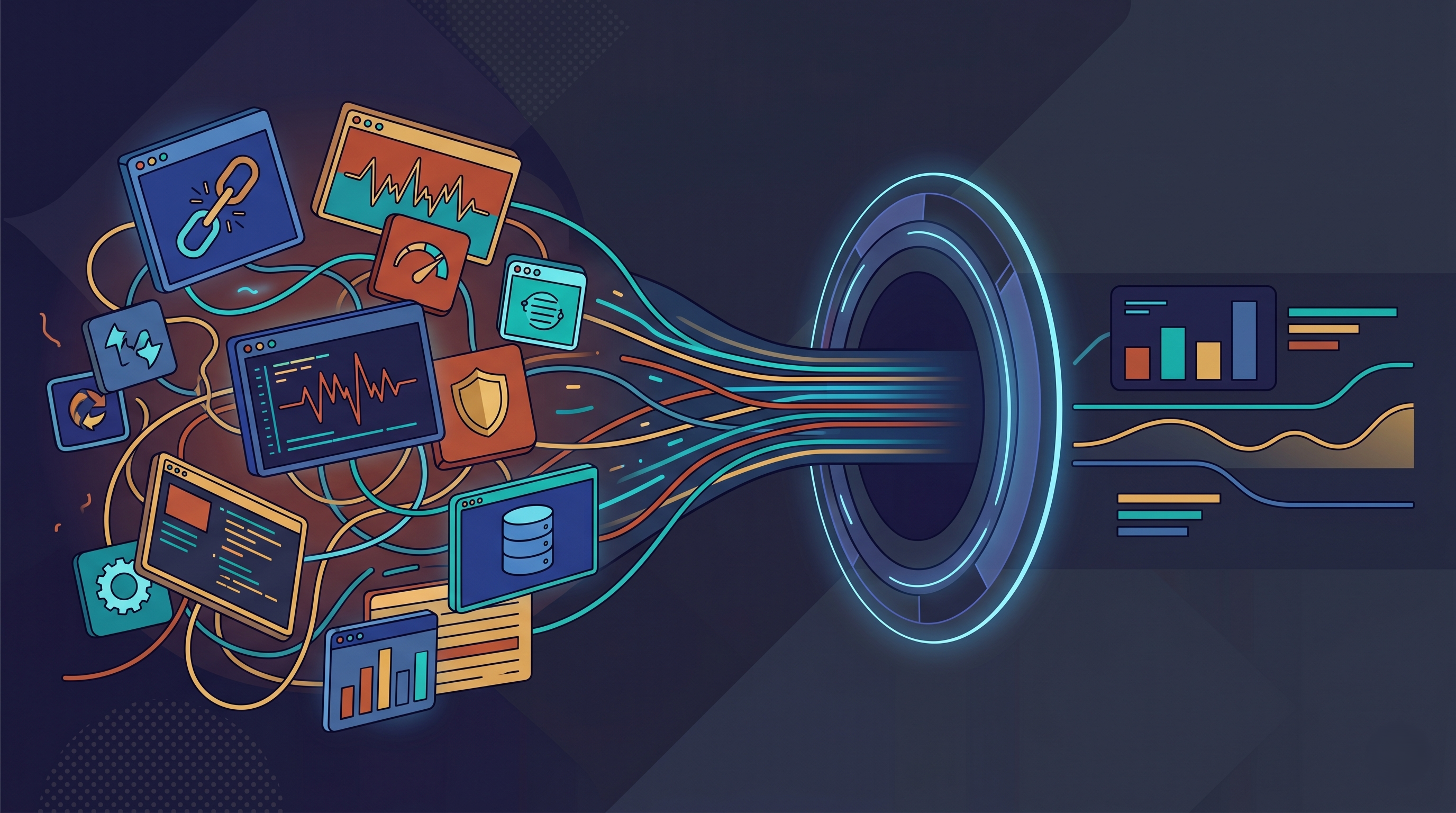
Modern DevOps teams rely on tools for almost everything. Monitoring, logging, CI/CD pipelines, infrastructure automation, security scanning, Kubernetes orchestration, incident response, observability, cost management, compliance tracking, and collaboration workflows are all powered by increasingly specialized platforms.
At first, every new tool feels like progress. A monitoring platform improves visibility. A security scanner strengthens governance. A deployment tool accelerates releases. An observability stack provides deeper operational insight. Individually, each tool solves a real problem.
But over time, many DevOps teams discover a different problem emerging beneath the surface: tool overload.
Instead of simplifying operations, the growing number of disconnected tools often creates fragmentation, operational noise, context switching, duplicated workflows, and reduced visibility across environments. Teams spend more time managing tooling ecosystems than solving infrastructure or application challenges directly.
In this blog, we will explore why modern DevOps teams struggle with tool overload, how this problem affects operational efficiency and engineering productivity, and why organizations are increasingly shifting toward more unified operational visibility strategies.
The DevOps Tool Ecosystem Expanded Too Quickly
The DevOps movement accelerated rapidly alongside cloud-native adoption, Kubernetes growth, microservices architectures, and distributed infrastructure. As complexity increased, specialized tooling emerged to address every operational challenge individually.
Today, organizations commonly use separate tools for:
CI/CD automation
Infrastructure as Code
Monitoring and observability
Logging and tracing
Kubernetes management
Security scanning
Compliance tracking
Incident response
Cloud cost optimization
AI infrastructure monitoring
While each tool may be valuable independently, the combined operational ecosystem becomes increasingly difficult to manage as environments scale.
The problem is not that the tools are ineffective. The problem is that the number of tools often grows faster than operational coordination itself.
Fragmented Visibility Creates Operational Blind Spots
One of the biggest consequences of tool overload is fragmented visibility.
Each platform provides insight into only a specific layer of the environment. Monitoring tools show infrastructure metrics. Logging platforms display application events. Security tools identify vulnerabilities. Cost tools analyze billing data. Kubernetes dashboards expose cluster activity.
The challenge is that real operational problems rarely stay confined to one layer. A single issue may involve infrastructure performance, deployment behavior, application latency, and cloud resource utilization simultaneously.
When visibility remains fragmented across separate tools, teams struggle to connect signals together quickly. Engineers spend valuable time switching between dashboards instead of understanding the full operational picture.
As systems become more distributed, fragmented visibility becomes one of the biggest barriers to efficient operations.
Context Switching Reduces Engineering Productivity
DevOps engineers today often work across dozens of platforms during normal operational workflows. Investigating a single incident may require checking:
Monitoring dashboards
Log aggregation tools
Kubernetes management consoles
CI/CD pipelines
Cloud provider dashboards
Security alerts
Incident management systems
This constant context switching creates cognitive overload. Engineers lose time moving between interfaces, correlating information manually, and reconstructing operational timelines across disconnected systems.
The issue is not just inefficiency. Context switching also increases the likelihood of missing critical signals during incidents or troubleshooting efforts.
As operational complexity grows, cognitive load becomes a serious productivity challenge for DevOps teams.
Tool Sprawl Creates Duplicate Functionality
Many DevOps organizations accumulate overlapping tools over time. Different teams adopt platforms independently to solve immediate operational problems, often without broader ecosystem planning. As a result, organizations frequently end up with:
Multiple monitoring systems
Several observability platforms
Duplicate security scanners
Redundant alerting systems
Overlapping infrastructure automation tools
This duplication increases operational complexity while also inflating infrastructure and licensing costs.
Teams may receive the same alert from multiple systems or maintain separate workflows for similar operational tasks. Instead of simplifying operations, tooling ecosystems become increasingly fragmented and difficult to maintain consistently.
Alert Fatigue Gets Worse With More Tools
Every operational tool generates its own alerts, notifications, dashboards, and telemetry streams. As organizations add more platforms, the volume of operational noise increases dramatically.
The problem is that most alerts lack sufficient operational context individually. Engineers receive fragmented signals without understanding how events connect across systems.
This contributes heavily to alert fatigue. Teams become overwhelmed by notifications, making it harder to identify genuinely important issues quickly.
In some cases, organizations respond by adding even more tooling for alert correlation, which often increases complexity further instead of solving the underlying visibility problem.
More tooling does not automatically create more operational clarity.
Integration Complexity Becomes Its Own Operational Burden
Modern DevOps tools rarely operate independently. Organizations must integrate them together across authentication systems, APIs, automation workflows, and operational pipelines.
As tooling ecosystems expand, maintaining these integrations becomes increasingly difficult.
APIs change, workflows evolve, permissions shift, and dependencies break unexpectedly. Teams spend significant time managing tooling interoperability rather than improving infrastructure directly.
The operational overhead of maintaining integrations quietly becomes a hidden cost of tool sprawl itself.
In large organizations, integration complexity can eventually rival infrastructure complexity.
Kubernetes and Cloud-Native Architectures Intensified the Problem
Kubernetes and cloud-native environments have accelerated tool proliferation significantly.
Distributed systems generate massive volumes of logs, metrics, traces, events, deployment artifacts, and security telemetry. Organizations adopted increasingly specialized tools to manage this complexity. For example:
Kubernetes monitoring tools
Service mesh observability
Container security platforms
Cluster optimization tools
Cloud-native tracing systems
GPU monitoring for AI workloads
Each new operational challenge introduced another specialized platform into the environment. While cloud-native architectures improved scalability, they also dramatically increased operational tooling complexity.
DevOps Teams Spend More Time Operating Toolchains
One of the most concerning consequences of tool overload is that DevOps teams increasingly spend their time operating tool ecosystems rather than improving infrastructure or developer productivity directly.
Teams maintain dashboards, tune alerts, manage integrations, update observability pipelines, optimize telemetry storage, and troubleshoot tooling itself.
This creates a paradox: tooling designed to simplify operations eventually becomes another major operational workload.
The more complex the tooling ecosystem becomes, the harder it is for teams to maintain focus on strategic infrastructure goals.
Financial Costs Increase Quietly
Tool overload also creates substantial financial overhead. Organizations often pay for:
Duplicate observability platforms
Excessive telemetry ingestion
Multiple monitoring systems
Redundant security tooling
Unused platform licenses
As telemetry volumes grow across cloud-native systems, observability and tooling costs increase rapidly. Many organizations underestimate how much operational tooling contributes to overall cloud spending.
The challenge is not only the licensing cost. Tool sprawl also increases infrastructure overhead, operational maintenance effort, and engineering time investment.
The financial impact of tooling fragmentation is often larger than organizations initially realize.
The Industry Is Shifting Toward Unified Operational Visibility
As operational complexity grows, organizations are increasingly recognizing that the solution is not necessarily adding more tools.
Instead, the focus is shifting toward unified operational visibility, bringing infrastructure behavior, observability signals, cost insights, security posture, and workload intelligence into more connected operational workflows.
The goal is not eliminating specialized tools entirely. It is reducing fragmentation and improving contextual understanding across environments.
Modern DevOps teams need operational clarity more than unlimited dashboards.
Improving Operational Visibility with Atler Pilot
One of the biggest challenges modern DevOps teams face is understanding how infrastructure, workloads, costs, and operational signals connect across increasingly fragmented environments.
This is where Atler Pilot helps organizations gain more unified operational visibility. By connecting infrastructure behavior, workload utilization, operational insights, and cloud environment signals into a centralized view, teams can better understand system behavior without relying solely on disconnected tooling layers.
Instead of constantly switching between fragmented dashboards, organizations gain more contextual operational awareness across cloud-native and distributed environments. This helps teams identify inefficiencies, operational risks, and infrastructure patterns more effectively while reducing unnecessary operational complexity.
As DevOps ecosystems continue growing more distributed in 2026, unified visibility becomes increasingly important for maintaining both operational efficiency and engineering focus.
Sign up for Atler Pilot and explore how unified operational visibility can help your team reduce tooling complexity, improve infrastructure awareness, and operate cloud environments with greater clarity and control.
Conclusion
Modern DevOps teams are not struggling because they lack tools. They are struggling because operational complexity is growing faster than tooling ecosystems can remain coordinated.
Fragmented visibility, context switching, duplicate workflows, alert fatigue, integration overhead, and rising operational noise are all symptoms of tool overload in cloud-native environments.
Organizations that succeed will not necessarily be the ones with the most operational platforms. They will be the ones who create the clearest operational understanding across increasingly complex infrastructures.
Because in modern DevOps, the challenge is no longer simply collecting operational data.
It is turning fragmented signals into meaningful operational clarity.
All in One Place
Atler Pilot decodes your cloud spend story by bringing monitoring, automation, and intelligent insights together for faster and better cloud operations.