
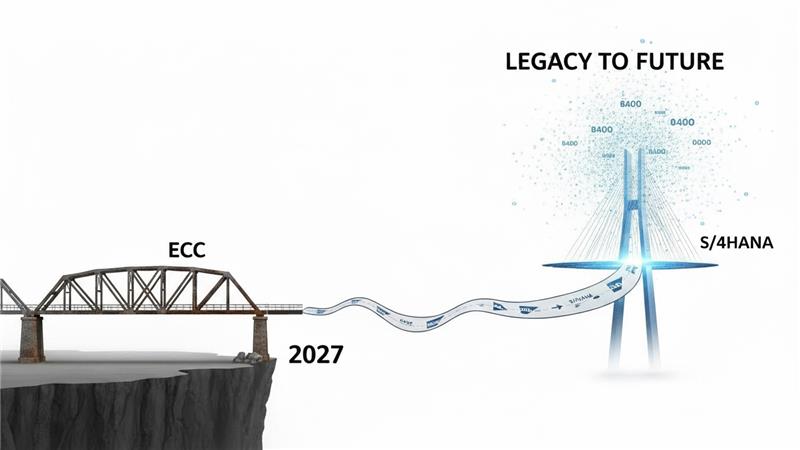
For more than two decades, SAP ECC has been the quiet engine running the world’s largest enterprises. From financial consolidation to supply-chain planning, ECC powered decisions behind global manufacturers, banks, retailers, and public-sector organizations. But in 2025, a long-anticipated turning point has arrived, and SAP is formally winding down mainstream support for ECC, pushing organizations toward its modern successor, SAP S/4HANA.
What is unfolding now is not just a product's transition, but it is one of the most significant enterprise-technology shifts of the decade. And as deadlines approach, companies are being forced to confront uncomfortable questions about technical debt, operational risk, and their readiness for a digital-first future
The Beginning of the End: What’s Changing with SAP ECC
SAP ECC (Enterprise Central Component) has long served as the backbone of SAP Business Suite. But as the digital demands of real-time analytics, cloud scalability, automation, and AI-driven decisions grew, ECC’s older architecture began limiting what businesses could achieve. SAP’s answer, launched several years ago, was S/4HANA: a faster, cloud-ready, data-optimized ERP built on the SAP HANA in-memory database.
However, the reality on the ground was different. Many enterprises remained deeply invested in highly customized ECC systems, making a migration complex, expensive, and in some cases overwhelming. For years, organizations delayed the shift, hoping SAP would extend its support window.
But now, the deadline is firm. According to SAP’s current roadmap, mainstream support for ECC 6.0 (EHP 0–5) ends in December 2025, and for ECC 6.0 (EHP 6–8), it ends in December 2027. After that, companies relying on ECC will lose official security updates, compliance patches, and standard maintenance, placing mission-critical systems at genuine risk.
SAP’s 2025 Move: The “Transition Option” That Changed the Conversation
In early 2025, SAP introduced a new offering that signaled recognition of customer concerns: the SAP ERP, private edition, transition option.
This cloud-subscription-based model gives large, complex ECC customers additional time to move to S/4HANA without forcing an immediate system overhaul. It allows organizations to host ECC in a supported environment while gradually modernizing their processes and preparing for a future migration.
However, this option is neither indefinite nor a replacement for S/4HANA adoption. It requires database upgrades, removal of outdated components, and adherence to strict support boundaries.
Complementing this, third-party providers like Rimini Street have stepped in, offering ECC support up to 2040. This provides an alternative path for companies that cannot migrate soon, but it also comes with trade-offs: lack of SAP-delivered innovation, limited compatibility assurances, and operational constraints that customers must evaluate carefully.
Why the Global Push Toward Migration is Now Picking Up Pace?
For years, many businesses argued that ECC “still works fine.” But as the technology landscape evolves, that argument is becoming harder to defend.
1. Security and compliance risks are rising.
Without regular updates from SAP after support ends, ECC systems become vulnerable to cyber threats and regulatory non-compliance. For industries like BFSI, telecom, healthcare, and logistics, this risk is too significant to ignore.
2. The skills gap is widening.
ECC experts are retiring or shifting to S/4HANA roles. The cost of finding or retaining ECC specialists is already climbing as demand shrinks.
3. Integrations are breaking faster.
Modern applications like AI platforms, analytics tools, and workflow engines are built for cloud-native ecosystems. ECC’s older architecture struggles to keep pace.
4. Competitors are modernizing.
S/4HANA offers real-time financial close, predictive insights, automated workflows, and faster processing. These are the advantages that create meaningful business value. Companies that remain on ECC risk falling behind operationally and strategically.
Why is Migration Still Slow for Many Enterprises?
Despite the urgency, the shift to S/4HANA is not easy. The typical migration may take 12 to 24 months, depending on:
Number of customizations
Integration with third-party apps
Data volume and quality
Regulatory constraints
Organizational readiness
For many IT leaders, fear is not the new system. It’s the risk of business disruption during the transition. This is why SAP’s transition option, hybrid models, selective transformation approaches, and third-party support have become part of the strategic conversation.
The Road Ahead: What Businesses Should Do Now?
Enterprises still on ECC face a critical window between 2025 and 2027. The next two years will determine whether the migration becomes a controlled transformation or a rushed, high-risk scramble.
1. Consider a Structured Path to Migration
Even if the move is planned for 2027, preparation must begin immediately: system audits, process mapping, data clean-up, and conversion strategy decisions.
Many enterprises evaluating ECC-to-S/4HANA transitions are also reassessing whether their current cloud strategy can support such a large shift. This is where specialized SAP cloud migration frameworks can reduce risk, improve predictability, and shorten timelines. Organizations exploring these options often lean on partners like Cloud Atler, who offer assessment, strategy design, PoCs, selective migration, and end-to-end execution across AWS, Azure, and GCP to ensure the transition aligns with business goals rather than just IT deadlines.
2. Evaluate all support options pragmatically
SAP’s transition offering, cloud migrations, on-premise upgrades, and third-party maintenance each have strengths and limitations. One size does not fit all.
3. Treat migration as a business transformation, not IT modernization.
S/4HANA is an opportunity to redesign workflows, automate operations, and improve decision-making and not just simply replicate ECC.
4. Secure executive alignment early.
The cost, time, and resource implications require sponsorship across finance, operations, and technology teams.
A Note for Organizations Beginning Their ECC Exit Strategy
With tightening of support windows and expansion of transformational timelines, more leaders are turning to specialized migration accelerators, structured methodologies, and multi-cloud expertise to de-risk their S/4HANA journey.
Cloud Atler supports this shift through SAP cloud strategy consulting, migration planning, security & compliance alignment, performance optimization, and fully managed post-migration support. Our SAP cloud migration services help enterprises move at the pace of their operations' demand, not the pace of the deadline.
Stop guessing where your Kubernetes budget is going. Schedule a demo here to explore Kubernetes cost monitoring with Cloud Atler.