
The Failure of Signatures
For two decades, cybersecurity relied on signatures. A firewall or antivirus agent worked by comparing incoming files and network packets against a massive database of known "bad" patterns. If a match was found, the attack was blocked.
In the modern cloud, the signature model is fundamentally broken. Advanced persistent threats (APTs) no longer use known malware; they use "living off the land" techniques, utilizing legitimate cloud administrative tools (like the AWS CLI) to slowly extract data. Furthermore, zero-day vulnerabilities (by definition) have no signature. If you rely solely on signature-based detection in 2026, you will only catch the lazy attackers.
To defend complex, highly distributed cloud environments, Security Operations (SecOps) teams have rapidly adopted Artificial Intelligence. This guide explores how Machine Learning has shifted cloud security from reactive defense to proactive, behavioral threat detection.
From Signatures to Behavioral Analytics (UEBA)
The foundation of AI in SecOps is User and Entity Behavior Analytics (UEBA).
Instead of looking for known bad code, the AI looks for abnormal behavior. A Machine Learning model ingests millions of events from AWS CloudTrail, Azure Activity Logs, and VPC Flow Logs. It learns the "normal" baseline for every user and every machine (entity).
The Scenario: A developer (Alice) normally logs in from London between 9 AM and 5 PM, and frequently uses the AWS CLI to deploy code to the staging EKS cluster.
The Anomaly: At 2:00 AM, Alice's credentials are used to log in from a VPN node in Eastern Europe, and those credentials immediately attempt to enumerate all the S3 buckets in the production account and execute a script to copy data.
None of those individual actions (logging in, listing buckets, copying data) match a malware signature; they are legitimate API calls. But the behavioral pattern deviates wildly from Alice's baseline. The AI detects this instantly and fires a high-confidence alert, flagging a likely credential compromise.
AI-Driven Threat Hunting
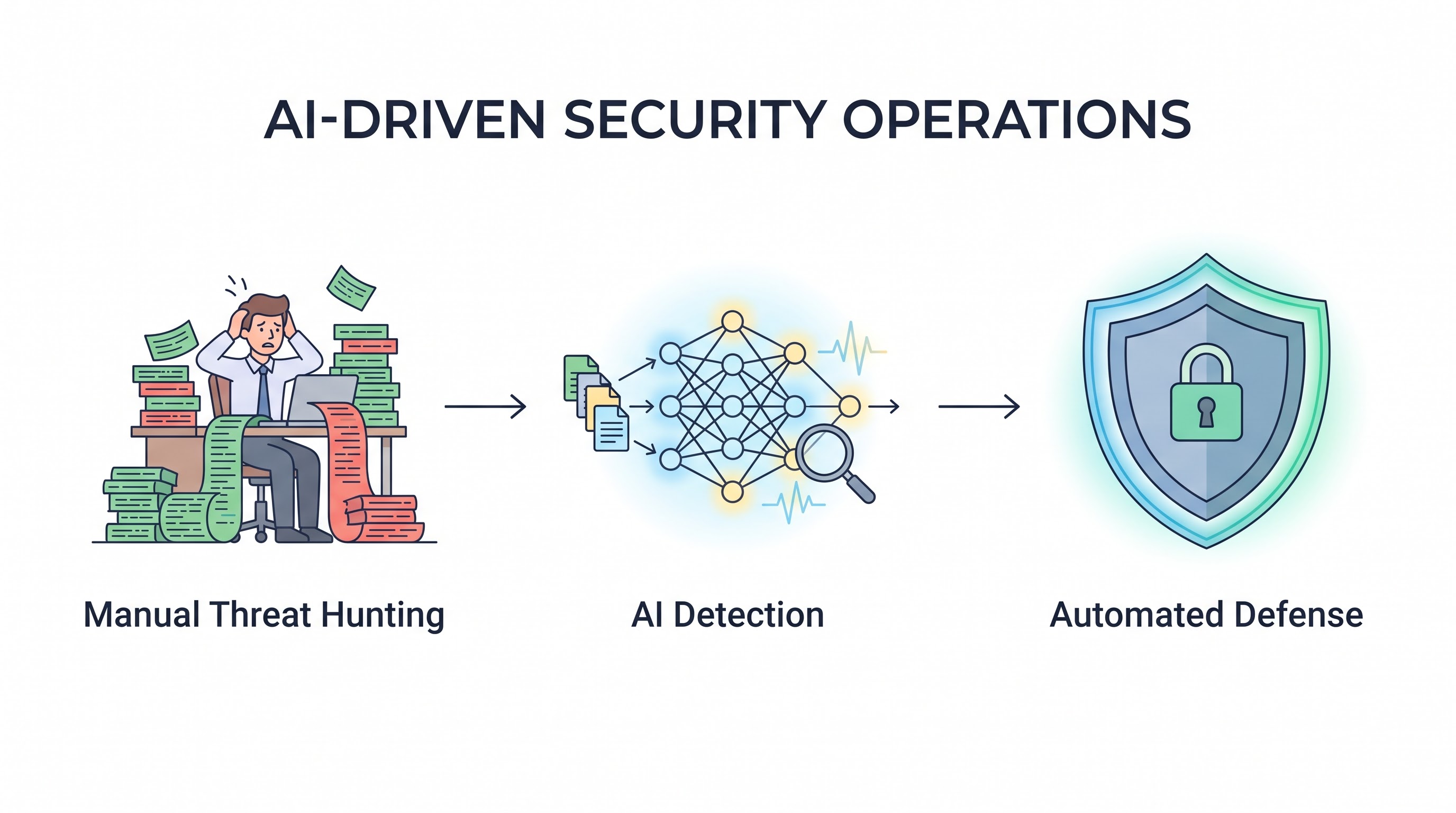
Historically, threat hunting was a highly manual, expert-driven task. Security analysts wrote complex queries in SIEMs (like Splunk) trying to find evidence of lateral movement.
Generative AI and specialized ML models automate this process. An AI agent continuously crawls the cloud telemetry data, looking for the faint, disparate signals that human analysts miss. If a specific EC2 instance connects to a newly registered, low-reputation domain for 3 seconds, and then an IAM role associated with that instance is used to query the AWS Secrets Manager 10 minutes later, the AI correlates those two seemingly unrelated events across thousands of logs and presents a synthesized attack narrative to the SecOps team.
Solving the Alert Fatigue Crisis
As discussed in the CSPM Guide, alert fatigue is the enemy of security. A traditional SIEM might generate 10,000 low-level alerts a day, burying the single critical alert indicating a breach.
AI acts as the ultimate triage engine. Before a human ever sees an alert, the AI analyzes it. It automatically gathers the context: What is the blast radius of this resource? Is it internet-facing? Has this IP address been flagged by threat intelligence feeds? The AI groups hundreds of low-level alerts into a single, high-fidelity "Incident." It closes the false positives automatically, ensuring the human analysts only spend their cognitive energy on genuine threats.
Automated Incident Response (SOAR)
Detection is only half the battle; response speed determines the outcome of a breach. Security Orchestration, Automation, and Response (SOAR) platforms heavily leverage AI to execute the First 60 Minutes of a response playbook.
When the UEBA model detects the anomalous behavior from Alice's credentials (mentioned above), it doesn't just alert the SecOps team. The AI triggers an automated SOAR playbook that instantly revokes Alice's active STS session tokens, attaches a "Deny All" policy to her IAM user, and changes the Security Group on the affected EC2 instance to isolate it from the internet—containing the breach in milliseconds, before the human analyst even wakes up to check their pager.
The Threat: Adversarial AI
The arms race is escalating. Attackers are also using AI. They use Generative AI to write highly convincing, personalized phishing emails at scale. They use ML to automate the discovery of cloud misconfigurations, and they use AI to mutate their malware payloads to evade detection models (Adversarial Machine Learning).
Defending against an AI-driven attack requires an AI-driven defense. Human reaction times are simply too slow to contain an automated, intelligent breach traversing a cloud network.
Key Takeaway
Signature-based security is obsolete in the cloud. Modern SecOps relies on Artificial Intelligence to establish behavioral baselines (UEBA) capable of detecting compromised credentials and lateral movement using legitimate API tools. By utilizing AI to triage alerts and trigger automated SOAR playbooks for instant containment, organizations can scale their security operations to defend against highly sophisticated, AI-augmented threat actors.
All in One Place
Atler Pilot decodes your cloud spend story by bringing monitoring, automation, and intelligent insights together for faster and better cloud operations.