
Here's a problem many AI teams don't notice until the cloud bill starts climbing.
Not every AI request needs the same amount of compute.
A simple question from a user might be sent to a large, expensive language model even though a smaller model could answer it just as well. A low-priority batch workload might consume the same GPU capacity as a latency-sensitive production request. An AI agent might repeatedly call a premium model for tasks that don't actually require advanced reasoning.
The infrastructure is working. The application is working. The users are getting responses. And yet, the organization is quietly paying far more for AI infrastructure than it needs to.
This is where AI routing becomes interesting.
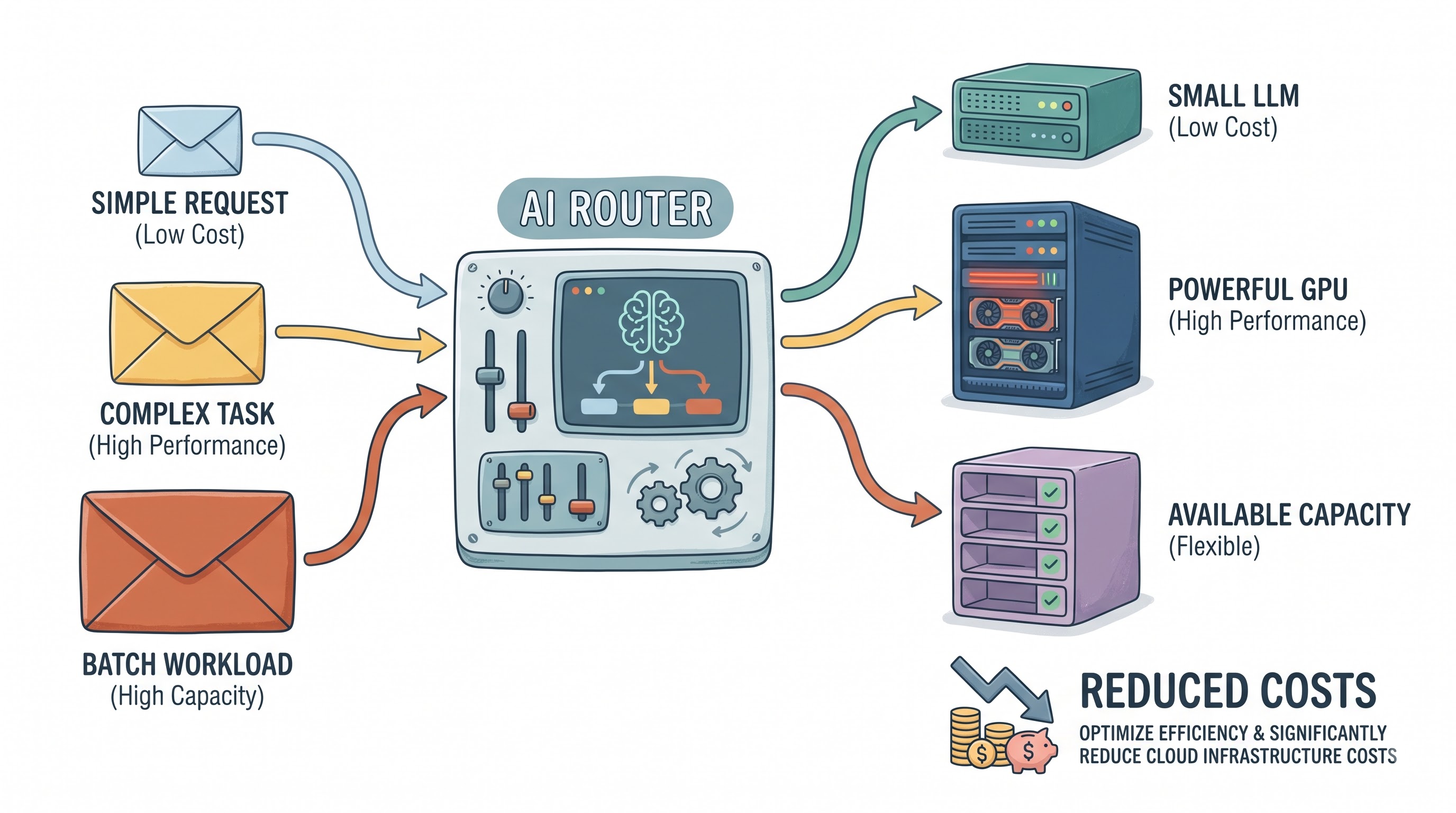
AI routing is the process of intelligently deciding where, how, and sometimes when an AI request should be processed. Instead of sending every workload through the same model, GPU cluster, inference endpoint, or cloud environment, routing logic evaluates the characteristics of the request and chooses an execution path that balances cost, performance, availability, and quality.
This might mean sending a simple request to a smaller LLM, routing a complex reasoning task to a more capable model, moving batch inference to lower-cost capacity, or directing workloads toward GPU infrastructure with available capacity.
The goal isn't simply to reduce infrastructure spending.
It's to make sure that the right amount of infrastructure is used for the right workload.
That distinction matters because AI infrastructure has become one of the fastest-growing areas of cloud spending. GPUs are expensive, inference workloads can be unpredictable, and modern AI applications increasingly depend on multiple models and services operating together.
If every request follows the same infrastructure path, organizations lose an enormous opportunity to optimize.
In this article, we'll explore how AI routing strategies work, where the biggest cost savings come from, and how organizations can use intelligent routing to reduce AI infrastructure costs without sacrificing performance or user experience.
What is AI Routing?
At its simplest, AI routing determines which model or infrastructure path should handle a particular AI request.
In a traditional application, a request might always go to the same backend service.
AI applications don't necessarily need to work this way.
A single application may have access to several LLMs, inference endpoints, GPU clusters, regions, or deployment environments. Routing logic can evaluate a request before execution and determine which option is most appropriate.
For example, a lightweight model could handle straightforward classification or summarization tasks, while a more capable reasoning model handles complex analysis.
Similarly, a production inference request could be routed toward a high-performance GPU cluster, while non-urgent batch processing could use less expensive capacity.
This creates a layer of intelligence between the application and the infrastructure.
Instead of infrastructure being selected once during deployment, the execution path can change dynamically according to workload requirements.
Why Sending Everything to the Largest Model Gets Expensive?
One of the easiest ways to increase AI infrastructure costs is to treat every request as equally demanding.
Consider an enterprise assistant that handles thousands of daily requests.
Some users ask simple questions such as, "What is our leave policy?"
Others ask the system to analyze a complex contract, summarize a long report, or reason across multiple internal documents.
These requests have very different computational requirements.
Yet many applications route them all through the same large model.
That's convenient from an engineering perspective.
It's not necessarily efficient from a FinOps perspective.
Large models typically require more compute and may carry higher inference costs. If a significant percentage of requests could be handled successfully by smaller or specialized models, routing everything to the most expensive option creates unnecessary spending.
Intelligent model routing changes this equation.
A routing layer can classify requests based on complexity, context length, required accuracy, latency requirements, or business priority and select an appropriate model accordingly.
The result is a more efficient distribution of compute.
Strategy 1: Route by Request Complexity
One of the most straightforward AI routing strategies is complexity-based routing.
Not every request requires advanced reasoning.
A simple request can be processed by a smaller model, while a complex request can be escalated to a more capable model.
For example, an enterprise AI assistant could initially send a request to a lightweight model. If the system determines that the question requires deeper reasoning, extensive context, or specialized capabilities, the request can be routed to a more powerful model.
This creates a tiered inference architecture.
The expensive model becomes the exception rather than the default.
From a cost perspective, this can be powerful because even a relatively small reduction in premium-model usage can have a meaningful impact when request volumes are large.
The key is ensuring that routing decisions maintain the required quality level.
The objective isn't to force every request onto the cheapest model.
It's to avoid paying premium inference costs when premium capabilities aren't necessary.
Strategy 2: Route Based on Latency Requirements
Cost isn't the only variable that matters.
Some AI requests require responses within milliseconds or seconds, while others can wait several minutes.
Treating both workloads identically can create unnecessary infrastructure costs.
A real-time customer-facing application may require high-performance inference capacity that remains readily available.
A nightly document-processing pipeline doesn't necessarily need the same level of responsiveness.
AI routing can separate these workloads.
Latency-sensitive requests can be directed toward fast inference infrastructure, while asynchronous or batch workloads can use more cost-efficient capacity.
This allows organizations to optimize infrastructure according to the actual service requirements of each workload rather than maintaining premium capacity for everything.
The result is a better balance between AI performance and infrastructure cost.
Strategy 3: Route According to GPU Availability
GPU infrastructure introduces another routing opportunity.
Suppose an organization operates multiple GPU clusters across regions or environments.
One cluster may be heavily utilized while another has significant available capacity.
If every workload is statically assigned to a particular cluster, the organization may end up adding new GPUs even though existing capacity elsewhere remains underutilized.
Intelligent routing can help distribute workloads according to real-time GPU availability.
Requests can be directed toward infrastructure with sufficient capacity, reducing unnecessary overprovisioning and improving overall GPU utilization.
This is particularly valuable for organizations running multiple AI applications on shared infrastructure.
Instead of asking only, "How many GPUs do we need?" teams can begin asking, "How effectively are our existing GPUs being used?"
That is a much more useful FinOps question.
Strategy 4: Route Batch Workloads to Lower-Cost Capacity
Not every AI workload needs immediate execution.
Batch inference, document processing, model evaluation, data enrichment, and experimentation can often tolerate longer execution times.
These workloads create an opportunity to use lower-cost infrastructure.
Instead of competing with production inference for premium capacity, batch workloads can be routed to less expensive or underutilized compute resources.
This improves infrastructure efficiency because available capacity is used more effectively.
It also prevents organizations from provisioning additional premium GPUs simply to handle workloads that don't actually require real-time performance.
The broader principle is simple:
Match infrastructure cost to workload urgency.
If a workload can wait, there is often no reason to process it using the most expensive capacity available.
Strategy 5: Route Across Multiple LLM Providers
Modern enterprises increasingly use multiple language models rather than relying on a single provider.
Different models offer different combinations of cost, latency, reasoning capability, context length, and reliability.
AI routing can use these differences to optimize infrastructure economics.
A simple request might be sent to a lower-cost model.
A complex reasoning task might use a premium model.
A coding workload could be routed to a model optimized for software development.
If one provider experiences increased latency or an outage, requests can be redirected to another provider.
This creates both cost optimization and resilience.
Instead of locking every application into one model or provider, organizations gain the flexibility to choose the most appropriate execution path for each request.
This is one of the key ideas behind the emerging multi-LLM control plane architecture.
Strategy 6: Route Based on Historical Workload Behavior
Static routing rules are useful, but AI infrastructure becomes significantly more efficient when routing decisions learn from historical behavior.
Suppose a particular application consistently experiences heavy traffic between 9 a.m. and 6 p.m. but very little demand overnight.
The routing system can learn this pattern.
During peak periods, it can prioritize capacity optimized for performance.
During low-demand periods, it can route workloads toward infrastructure designed for cost efficiency or scale down unnecessary capacity.
Historical utilization patterns can also reveal which models perform well for particular workload types.
Over time, routing becomes less about predefined rules and more about continuously adapting to actual application behavior.
This is where AI-powered FinOps and intelligent infrastructure management begin to overlap.
Strategy 7: Use Cost-Aware AI Routing
One of the most powerful developments in AI infrastructure management is the move toward cost-aware routing.
Traditional routing systems primarily consider technical factors such as latency, availability, and capacity. Cost-aware routing adds another dimension: the financial impact of each execution path.
Imagine an application with access to three models. One is extremely capable but expensive, another provides a strong balance between quality and cost, and a third is inexpensive but better suited to simple tasks.
A conventional routing system might select the model based primarily on performance.
A cost-aware routing system asks a different question:
Which model can complete this request successfully at the lowest reasonable cost?
That doesn't mean always choosing the cheapest model.
If a premium model has a much higher success rate for a particular task, using it may actually produce a lower cost per successful outcome because fewer retries and corrections are required.
This is where AI routing begins to connect directly with FinOps.
The routing decision becomes an economic decision.
Strategy 8: Route Based on Cost Per Outcome
Token cost and inference cost are useful metrics, but they don't necessarily represent the true economics of an AI application.
Suppose Model A costs ₹0.50 per request while Model B costs ₹1.00.
At first glance, Model A appears to be twice as efficient.
But imagine Model A successfully completes the task only 70% of the time, while Model B succeeds 95% of the time.
Users may need to retry requests handled by Model A, or the application may need to invoke another model to correct the response.
The apparent savings can disappear quickly.
This is why advanced routing systems should consider cost per outcome rather than simply cost per request.
If a model delivers a successful result more consistently, its higher individual inference price may be justified.
This approach changes routing from a simple infrastructure optimization problem into a value optimization problem.
The goal becomes finding the cheapest path to a successful result, not simply the cheapest path to an AI response.
Strategy 9: Dynamically Route Around GPU Congestion
GPU availability can change rapidly in shared AI environments.
One cluster may suddenly become saturated because a training job starts, while another has substantial unused capacity.
If routing remains static, new inference workloads may be sent toward overloaded infrastructure even though capacity is available elsewhere.
This creates unnecessary latency and can encourage teams to provision additional GPUs to compensate.
Dynamic GPU routing provides another option.
By monitoring real-time GPU utilization, memory availability, queue depth, and workload activity, routing systems can direct new workloads toward available capacity.
This can improve both performance and infrastructure utilization.
More importantly, it can reduce the need to maintain excessive spare capacity simply to handle occasional demand spikes.
Instead of provisioning for the worst case everywhere, organizations can use routing to move workloads toward capacity where it already exists.
Strategy 10: Route According to Business Priority
Not every AI workload has the same business importance.
A real-time customer support request may have a direct impact on customer experience.
An internal document summarization job may be useful but less urgent.
A model evaluation experiment may have no immediate business impact at all.
Routing infrastructure purely according to technical characteristics ignores this distinction.
A more mature AI architecture can assign different priorities to workloads.
High-value production requests receive access to premium capacity.
Lower-priority workloads can be routed to less expensive infrastructure or processed during periods of available capacity.
This creates a form of economic scheduling.
Instead of treating all AI requests equally, organizations allocate expensive compute according to business value.
This becomes increasingly important as AI workloads compete for limited GPU resources.
Strategy 11: Route Workloads Across Regions
Geographic routing can also influence AI infrastructure costs.
Organizations operating across multiple regions may have different infrastructure prices, availability levels, and capacity constraints in each location.
If an AI workload doesn't require strict geographic processing, routing requests toward regions with available capacity can improve overall economics.
However, regional routing needs to consider more than compute price.
Data transfer costs, latency, regulatory requirements, data residency policies, and availability all matter.
A region that offers cheaper GPU capacity may become more expensive if large amounts of data need to cross regions for every request.
The lesson is important:
Optimize the complete request path, not just the GPU price.
Strategy 12: Use Routing to Reduce Idle Capacity
One of the most expensive problems in AI infrastructure is capacity that has been provisioned but isn't being used effectively.
Organizations often maintain dedicated resources for different teams or applications. Over time, workloads fluctuate and utilization patterns change, leaving some infrastructure heavily utilized while other capacity remains almost idle.
Intelligent routing can help consolidate workloads onto available infrastructure.
Instead of immediately provisioning new GPUs when one application experiences increased demand, the routing layer can determine whether existing capacity elsewhere can handle the workload.
This creates higher overall utilization across the infrastructure fleet.
The economics can be substantial.
A GPU that was previously sitting idle becomes productive capacity without requiring the organization to purchase or provision additional resources.
Routing therefore becomes a mechanism for capacity optimization, not just request distribution.
AI Routing Needs Observability
Intelligent routing is only as good as the information available to make routing decisions.
If the system cannot see GPU utilization, latency, request volume, model performance, infrastructure cost, or workload behavior, it is effectively routing with incomplete information.
This is why AI routing and observability need to evolve together.
Organizations should monitor not only where requests are routed but also what happens after routing decisions are made.
Did latency improve?
Did GPU utilization increase?
Did cost per request decline?
Did model quality remain stable?
Did retries increase?
Did the routing decision actually improve cost per outcome?
These feedback loops allow routing strategies to become progressively more intelligent.
Instead of configuring a routing policy once and leaving it unchanged, organizations can continuously evaluate whether the policy is producing the intended economic and operational results.
The Biggest AI Routing Mistakes
One of the most common mistakes is optimizing exclusively for price.
Choosing the cheapest model or GPU doesn't automatically create the lowest total cost.
Quality degradation can lead to retries, human intervention, customer dissatisfaction, and additional processing.
Another mistake is using static routing rules for dynamic workloads.
Infrastructure changes continuously. A routing policy that worked well three months ago may be inefficient today because application traffic, model pricing, GPU capacity, or business requirements have changed.
Organizations also frequently overlook shared infrastructure.
Routing decisions may appear efficient at the application level while creating congestion elsewhere in the infrastructure stack.
Finally, teams sometimes optimize infrastructure costs without measuring business outcomes.
Saving 20% on inference isn't necessarily a success if application performance drops significantly.
The best routing strategies balance cost, performance, reliability, utilization, and business value.
How AI Routing Fits into AI FinOps
AI routing is becoming an increasingly important component of AI FinOps because it provides a mechanism for actively influencing infrastructure costs.
Traditional FinOps primarily identifies where money is being spent.
AI routing can help determine how future spending occurs.
This creates a direct connection between financial intelligence and runtime infrastructure decisions.
A FinOps system can identify that a particular model is becoming disproportionately expensive.
A routing layer can then redirect suitable workloads toward more cost-efficient alternatives.
Infrastructure telemetry can reveal that a GPU cluster is underutilized.
Routing can send additional workloads toward that capacity.
Historical data can reveal predictable periods of low demand.
Routing and autoscaling policies can adjust accordingly.
This creates a continuous optimization loop:
Observe → Analyze → Route → Measure → Optimize.
That loop is one of the foundations of modern autonomous cloud and AI operations.
Build Cost-Aware AI Routing with Atler Pilot
Implementing intelligent routing requires visibility across AI models, cloud infrastructure, workloads, utilization, and financial data.
This is where Atler Pilot can play an important role.
Atler Pilot brings together cloud cost visibility, infrastructure telemetry, workload intelligence, utilization analytics, and operational context, helping engineering, platform, DevOps, and FinOps teams understand how AI workloads consume infrastructure.
Instead of treating model usage and cloud infrastructure as separate problems, teams can correlate routing decisions with GPU utilization, workload behavior, infrastructure costs, and operational performance.
This creates the foundation for more intelligent AI routing strategies.
Teams can identify expensive execution paths, detect underutilized infrastructure, understand changing workload patterns, and use that information to make better decisions about where AI workloads should run.
The objective isn't simply to route requests more efficiently.
It's to create an AI infrastructure environment where cost, performance, and business value continuously influence routing decisions.
Building an AI Routing Strategy That Scales
Organizations looking to implement intelligent AI routing should begin with visibility.
Before introducing automated routing, establish a clear understanding of model usage, infrastructure utilization, request volumes, latency, cost, and workload ownership.
The next step is to identify workloads that can safely use alternative models or infrastructure.
Simple classification, summarization, and low-priority workloads are often good candidates for cost-aware routing because they typically have less demanding performance requirements.
From there, organizations can introduce more sophisticated strategies such as dynamic GPU routing, multi-LLM routing, business-priority routing, and cost-per-outcome optimization.
Automation should be introduced gradually.
Start with recommendations.
Measure the results.
Validate model quality and application performance.
Then allow the routing system to make increasingly dynamic decisions as confidence grows.
This approach minimizes risk while creating a path toward autonomous AI infrastructure optimization.
Conclusion
AI infrastructure costs aren't determined only by the models organizations choose.
They're also determined by how intelligently workloads are routed.
Sending every request to the same model, GPU cluster, region, or execution environment creates unnecessary rigidity in an environment that is inherently dynamic.
AI routing introduces flexibility.
Simple requests can use efficient models.
Complex tasks can access advanced reasoning capabilities.
Batch workloads can consume lower-cost capacity.
Production traffic can receive priority infrastructure.
Underutilized GPUs can be put to work.
And workloads can move between providers when economics, availability, or performance requirements change.
The most effective routing strategies don't optimize for one metric.
They balance cost, latency, quality, reliability, utilization, and business value.
That makes AI routing more than an application architecture technique.
It becomes a FinOps control mechanism.
As AI workloads continue to grow, organizations that can dynamically decide where and how every request should run will have a significant advantage over organizations that simply provision more infrastructure to keep up with demand.
Because the smartest way to reduce AI infrastructure costs isn't always to buy fewer GPUs.
Sometimes, it's to make the GPUs you already have work harder.
Frequently Asked Questions
What is AI routing?
AI routing is the process of dynamically deciding which AI model, inference endpoint, GPU cluster, provider, region, or execution environment should process a particular request based on factors such as cost, latency, quality, availability, and workload requirements.
How does AI routing reduce infrastructure costs?
AI routing reduces costs by preventing expensive infrastructure from being used unnecessarily. It can direct simple workloads to smaller models, move batch workloads to lower-cost capacity, improve GPU utilization, route requests toward available infrastructure, and reduce unnecessary use of premium AI services.
What is cost-aware AI routing?
Cost-aware AI routing incorporates infrastructure and model costs into routing decisions. Instead of selecting an execution path solely based on performance or availability, the system evaluates which option can deliver the required outcome at an acceptable cost.
Does AI routing work with multiple LLMs?
Yes. Multi-LLM routing allows organizations to dynamically select between different models based on task complexity, cost, latency, quality, availability, and other requirements. This is an increasingly important component of multi-LLM enterprise architectures.
Can AI routing improve GPU utilization?
Yes. Dynamic routing can direct workloads toward GPU clusters with available capacity, helping organizations distribute workloads more efficiently and reduce the need for additional GPUs when existing infrastructure is underutilized.
All in One Place
Atler Pilot decodes your cloud spend story by bringing monitoring, automation, and intelligent insights together for faster and better cloud operations.