
Code is Carbon
There is a direct, physical consequence to software architecture. When an inefficient SQL query scans a massive database, it forces a physical CPU in a remote data center to execute millions of unnecessary calculations. That CPU draws power from the electrical grid and generates heat, which requires water-intensive HVAC systems to cool. Poorly written code literally burns carbon.
As organizations operationalize GreenOps, the responsibility for energy efficiency shifts from the datacenter facility manager to the software architect. This guide explores the specific technical architectural decisions—from hardware selection to programming languages—that drastically reduce the energy consumption of cloud workloads.
The Hardware Layer: ARM and Custom Silicon
The single fastest way to improve energy efficiency without changing a single line of business logic is migrating the underlying compute architecture.
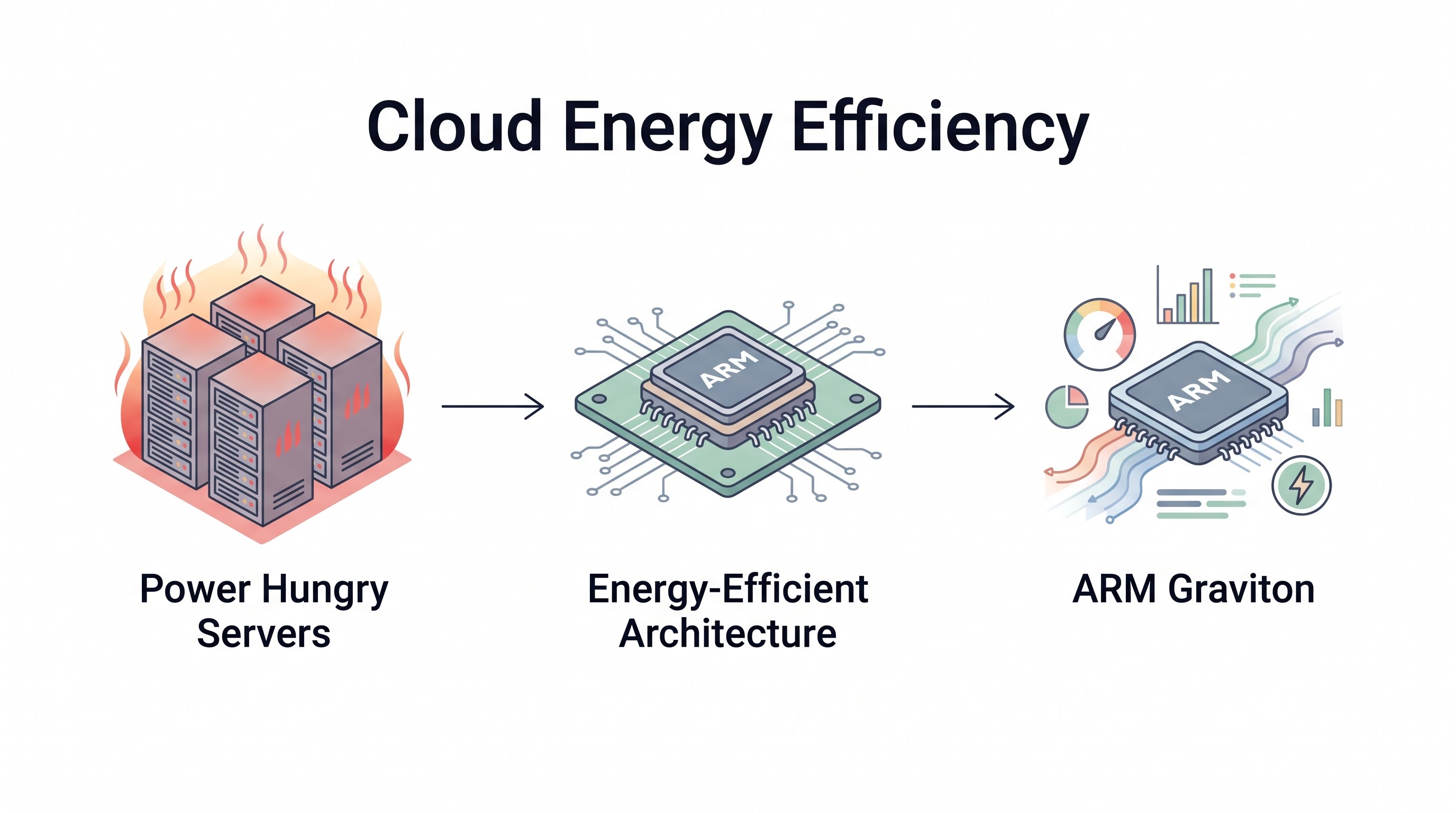
Legacy x86 processors (Intel/AMD) are power-hungry. Cloud providers have invested heavily in custom, ARM-based silicon (like AWS Graviton or Azure Cobalt). These chips use a Reduced Instruction Set Computer (RISC) architecture, allowing them to execute workloads using significantly less electricity and generating significantly less heat. A standard microservice running on a Graviton instance can achieve up to 60% better energy efficiency per watt compared to an identical x86 instance. ARM is the foundational hardware for sustainable cloud computing.
The Compute Model: The Serverless Advantage
Idle servers are an environmental disaster. If you run a cluster of EC2 instances 24/7 at 10% average CPU utilization, you are wasting 90% of the electricity required to power that hardware.
As detailed in the Serverless Cost Management Guide, technologies like AWS Lambda or Azure Functions scale dynamically based on exact request volume and scale to absolutely zero when idle. By adopting an event-driven, serverless architecture, an organization ensures it only consumes electricity (and pays money) when actual business value is being generated. From a macro-environmental perspective, hyper-dense, multi-tenant serverless environments are vastly more energy-efficient than single-tenant VMs.
Carbon-Aware Workload Scheduling
The carbon intensity of the electrical grid fluctuates constantly based on the time of day and the weather (e.g., solar power peaks at noon, wind power peaks at night).
Advanced GreenOps architectures utilize Carbon-Aware Computing. If an organization has a massive, asynchronous batch-processing job (like transcoding video or training a machine learning model), they do not run it immediately. Instead, an intelligent orchestrator monitors the real-time carbon intensity of various cloud regions. The orchestrator automatically schedules the massive compute job to execute in the specific cloud region, at the specific time, when the grid is powered by excess renewable energy, drastically reducing the total carbon emitted by the workload.
The Language Layer: Rust, Go, and Energy Efficiency
The programming language itself dictates energy consumption. Interpreted languages (like Python or Ruby) and heavily abstracted languages (like Java running on a JVM) require significant CPU overhead to translate the code into machine instructions.
Compiled, systems-level languages (like C, C++, and critically, Rust) interact directly with the hardware. Studies consistently show that a microservice written in Rust consumes a tiny fraction of the electricity and memory compared to the exact same logic written in Python. For hyper-scale, high-throughput microservices, rewriting the critical path in Rust or Go is a massive driver of both performance and environmental sustainability.
The Hidden Cost: Data Transfer Emissions
Moving data across the internet requires powering thousands of routers, switches, and undersea fiber-optic repeaters. As discussed in the Networking Cost Reduction Guide, massive data egress generates massive carbon emissions.
Sustainable architectures minimize data travel. They utilize Content Delivery Networks (CDNs) to cache heavy assets (images, video) at the Edge, physically close to the user, ensuring the data only travels a few miles rather than crossing the Atlantic Ocean for every request.
Key Takeaway
Cloud energy efficiency is determined during the system design phase. To build highly sustainable applications, architects must default to ARM-based processors and event-driven Serverless architectures to eliminate idle power draw. Furthermore, advanced teams should implement carbon-aware scheduling to run batch jobs on renewable grids, and strongly consider compiling high-throughput microservices in efficient languages like Rust to minimize CPU cycle waste.
All in One Place
Atler Pilot decodes your cloud spend story by bringing monitoring, automation, and intelligent insights together for faster and better cloud operations.