
The Great Migration Regret
The history of enterprise cloud computing is littered with failed migrations. Executives, driven by mandates to close physical datacenters and achieve elusive "cloud agility," force aggressive timelines upon their IT teams. The result is almost always the same: applications are forklifted into AWS or Azure exactly as they existed on-premises. Six months later, the CIO receives a cloud bill that is triple the cost of the old datacenter, the applications are no more resilient, and the engineering teams are overwhelmed by the complexity of managing legacy architectures in a modern environment.
This is the phenomenon of "Cloud Regret." A successful cloud migration is not a datacenter relocation project; it is an IT modernization project. The cloud does not magically fix bad architecture; it merely scales it and charges you for it by the second.
This guide outlines a mature, pragmatic cloud migration strategy, emphasizing the critical assessment phase and explaining why refactoring is often the only path to true ROI.
The Anti-Pattern: Lift and Shift (Rehosting)
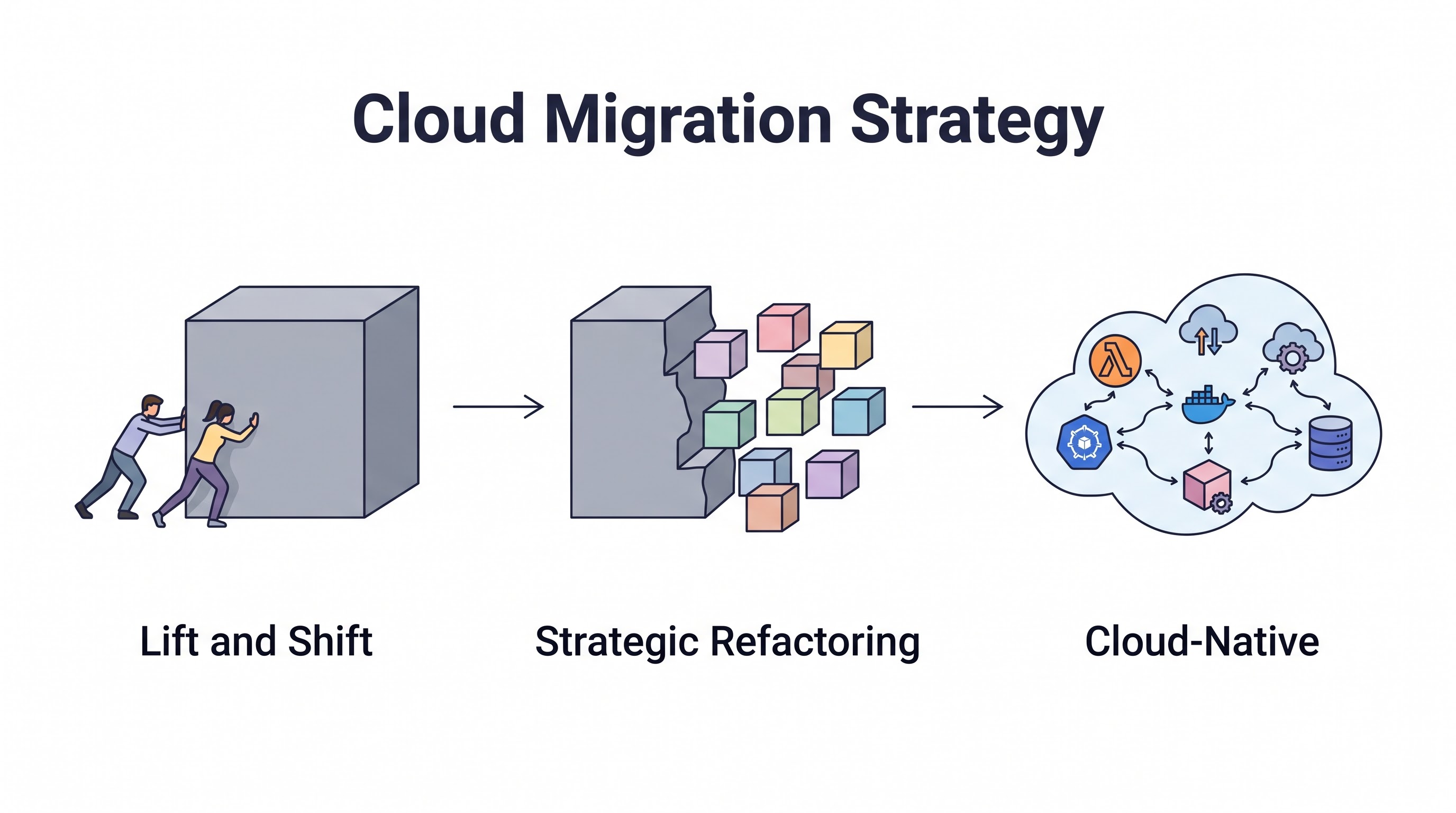
"Lift and Shift" (Rehosting) is the process of taking a virtual machine (VMware/Hyper-V) from an on-premises datacenter and migrating it byte-for-byte to an EC2 or Azure VM instance. No architectural changes are made.
While Rehosting is the fastest way to migrate, it is financially devastating. On-premises hardware is a sunk capital expenditure (CapEx); a VM running at 10% CPU utilization costs the same as one running at 90%. In the cloud, you pay for provisioned capacity. Lifting and shifting massive, underutilized, monolithic VMs results in paying premium hourly rates for idle capacity.
Furthermore, Rehosting offers none of the benefits of the cloud. You still have to manually patch the OS, manage the database backups, and deal with physical VM failures. The only time Lift and Shift is acceptable is under extreme duress (e.g., the datacenter lease expires next month).
The 6 R's of Cloud Migration
Every application in the portfolio must be analyzed and assigned one of the "6 R's":
Retain: Do nothing. The application is legacy, too fragile to move, or scheduled for retirement. Leave it on-premises.
Retire: Turn it off. You will find applications that have been running for years with zero active users. The easiest migration is deletion.
Repurchase: Drop the custom-built, legacy CRM system and migrate to a SaaS platform like Salesforce. Let someone else manage the infrastructure.
Rehost (Lift and Shift): Only use for commercial off-the-shelf (COTS) applications that cannot be modified, or as a temporary stepping stone before modernization.
Replatform (Lift, Tinker, and Shape): The sweet spot for quick wins. You move the VM, but swap out the underlying components for managed services. For example, moving an on-premises MySQL database VM to Amazon RDS. You eliminate database maintenance without rewriting the core application.
Refactor / Rearchitect: The hardest, most expensive, and most valuable path. You rewrite the monolithic application into microservices utilizing cloud-native technologies (Containers, Serverless, DynamoDB). This unlocks true elasticity, allowing the application to scale dynamically and cutting costs significantly.
Phase 1: The Assessment (The Hard Work)
A migration fails or succeeds during the assessment phase. You cannot migrate what you do not understand. You must deploy discovery tools to map the dependencies of every application.
If you migrate "Application A" to the cloud, but the discovery tool reveals it relies on an ancient mainframe database ("Application B") that must remain on-premises, you have just introduced massive latency into every transaction because data now has to travel across a VPN connection for every query. Applications with tight, latency-sensitive dependencies must be migrated together as "Move Groups."
Phase 2: The Pilot (Building Confidence)
Do not attempt a "Big Bang" migration. Select a low-risk, non-mission-critical application to migrate first.
The goal of the pilot is not just moving the application; it is building the foundational cloud infrastructure. During the pilot, the Cloud Operations team builds the Landing Zone: the core network architecture, the IAM policies, the security guardrails, and the Infrastructure as Code pipelines. If you rush the pilot and skip building the Landing Zone securely, every subsequent application you migrate will inherit those flaws.
Phase 3: The Migration Factory
Once the Landing Zone is solid and the pilot is successful, the migration enters the "Factory" phase. This requires highly repeatable, automated processes.
For Replatforming, utilize tools like AWS Application Migration Service or Azure Migrate to automate the block-level replication of VMs. For Refactoring, establish DevSecOps pipelines so that as developers rewrite code into microservices, the deployment to Kubernetes or Serverless is entirely automated.
The Role of FinOps in Migration
Before migrating, FinOps teams must be involved. Moving an un-optimized VM to the cloud is a mistake. Rightsizing must occur before the migration. Analyze the on-premises utilization metrics (CPU/RAM). If an on-premises VM has 16 vCPUs but averages 5% utilization, it should be migrated to a 2 vCPU cloud instance.
Furthermore, immediately after the migration is complete, the FinOps team should aggressively apply Reserved Instances or Savings Plans to the stable, migrated workloads to instantly slash the "sticker shock" of the new cloud bill.
Key Takeaway
Cloud migration is not an infrastructure project; it is an application modernization journey. Avoid the Lift-and-Shift trap, which inevitably leads to "Cloud Regret" and massive cost overruns. Invest heavily in the discovery phase to map dependencies, build a secure Landing Zone via IaC during the pilot, and prioritize Replatforming to managed services (like RDS) and Refactoring to cloud-native architectures to unlock the true value of the cloud.
All in One Place
Atler Pilot decodes your cloud spend story by bringing monitoring, automation, and intelligent insights together for faster and better cloud operations.