
AI agents are changing one very important assumption about cloud infrastructure:
Your application may no longer be the one deciding when it needs compute.
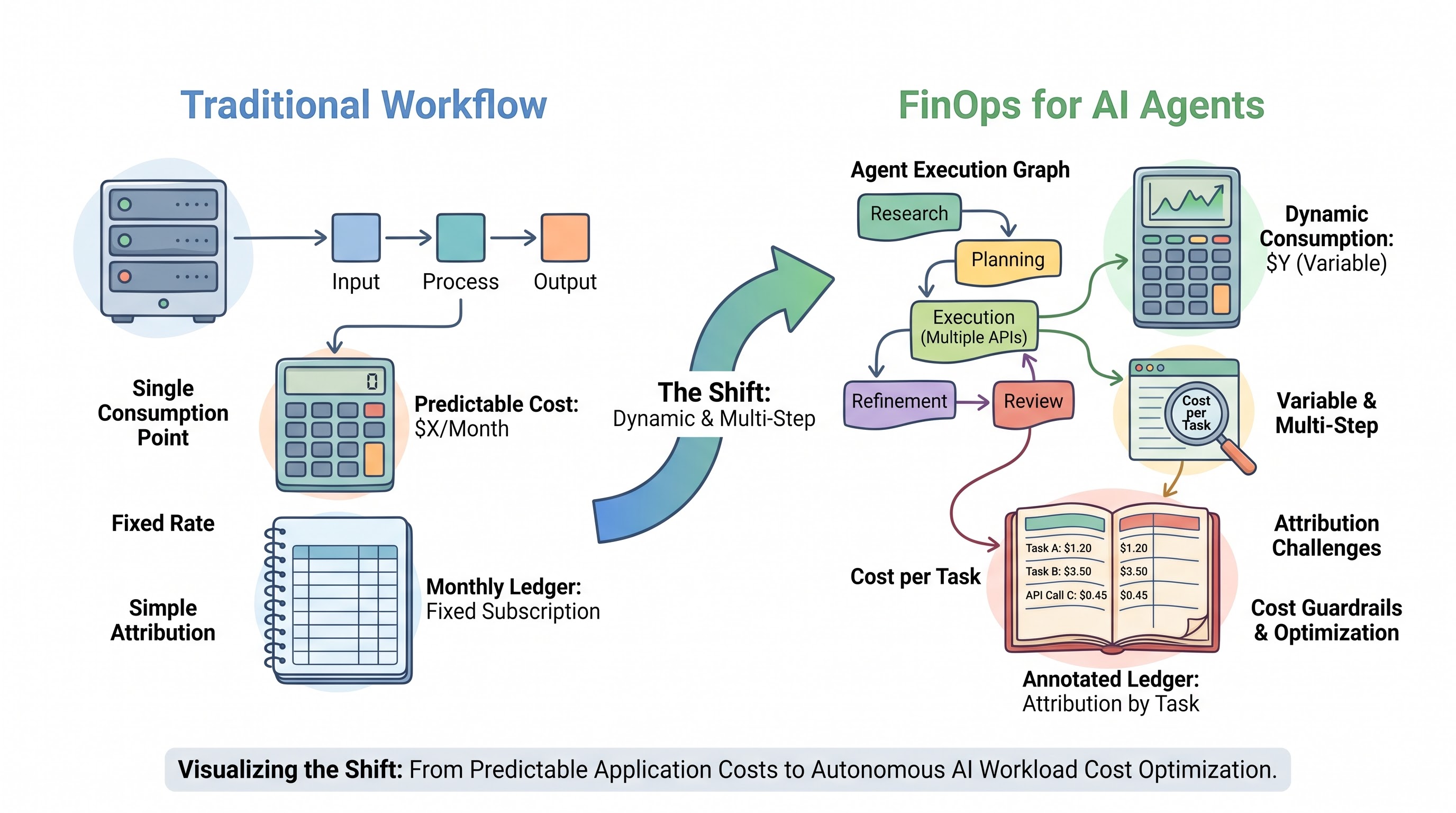
A traditional application generally follows a predictable pattern. A user clicks something, the application processes the request, a few services execute, and the interaction ends.
An AI agent can behave very differently.
Give an agent a goal and it may decide what needs to happen next.
It can call an LLM, search a knowledge base, invoke an API, write to a database, execute a tool, evaluate the result, change its approach, call another model, and repeat the process until it believes the task is complete.
From the user's perspective, that might look like one request.
From the infrastructure's perspective, it could be dozens of model calls, hundreds of API requests, several database operations, and a significant amount of compute.
And here's the part FinOps teams need to pay attention to:
The agent is making those infrastructure decisions dynamically.
That's a fundamentally different cost-management problem.
With traditional applications, teams can often estimate infrastructure requirements based on known request volumes and relatively predictable workflows. With autonomous AI agents, workload execution can vary depending on the complexity of the task, the agent's reasoning process, the number of tools it invokes, how many times it retries an operation, and even how successfully it completes the task.
This makes AI agent costs considerably harder to forecast, attribute, and optimize.
An agent that completes a task in five steps may be inexpensive.
Another agent working on a similar task might take thirty steps.
Both started with the same user request.
The cloud bill doesn't care why.
FinOps does.
As organizations move from AI copilots and chatbots toward autonomous agents capable of executing multi-step workflows, traditional cloud cost management practices will need to evolve.
This is where FinOps for AI agents becomes important.
It isn't simply about tracking tokens.
It is about understanding autonomous workload behavior, connecting infrastructure consumption to agent actions, and creating guardrails that allow AI systems to operate independently without allowing costs to become equally autonomous.
Let's get right into it.
Why AI Agents Create a New FinOps Problem?
The first generation of enterprise generative AI applications was relatively straightforward.
A user submitted a prompt.
The application sent it to an LLM.
The model generated a response.
The interaction ended.
That made cost estimation comparatively simple.
Teams could monitor input tokens, output tokens, model pricing, and request volumes to estimate AI spending.
AI agents introduce another layer of complexity.
An agent doesn't necessarily produce a response immediately.
It may reason about the task, determine what information it needs, call a search tool, retrieve documents, invoke another service, evaluate the result, ask an LLM another question, and repeat the process.
The resulting workload becomes dynamic.
The application isn't simply processing requests.
It is making decisions about what infrastructure and services it needs to complete a task.
This creates a fundamental challenge for FinOps.
Traditional cost allocation asks:
"Which application generated this cost?"
Agentic systems require more detailed questions:
Which agent generated it?
Which task triggered it?
Which tools did the agent invoke?
How many model calls were required?
How much compute did the entire workflow consume?
Was the outcome worth the cost?
Those questions require much deeper observability than a traditional cloud billing report can provide.
The Cost of an AI Agent Is More Than Its Tokens
One of the easiest mistakes in AI FinOps is treating token consumption as the complete cost of an agent.
Tokens certainly matter.
But they represent only one part of the economics.
An autonomous agent may interact with multiple components before completing a task.
It could use a large language model for reasoning, a smaller model for classification, an embedding model for retrieval, a vector database for search, cloud storage for documents, APIs for external information, Kubernetes workloads for orchestration, and GPU infrastructure for specialized processing.
Every step can generate costs.
Consider an AI research agent.
A user asks it to prepare a competitive analysis.
The agent might first interpret the request, search internal documents, retrieve information from a vector database, query external sources, summarize findings, identify missing information, perform additional searches, compare results, and generate a final report.
If the agent repeats a few steps because it isn't confident in the information it found, infrastructure consumption increases again.
The user still sees one final report.
FinOps sees an entire distributed workload.
This is why agent cost attribution needs to move beyond model usage and capture the complete execution graph.
Agent Cost Attribution is Becoming Essential
Traditional cloud cost allocation often relies on tags, accounts, subscriptions, projects, or Kubernetes namespaces.
These methods remain useful.
But autonomous workloads require another level of granularity.
Organizations need to associate infrastructure costs with individual agents, workflows, tasks, and sometimes even individual executions.
Imagine an enterprise operating three AI agents.
One handles customer support.
Another automates software development tasks.
A third performs financial research.
All three may use the same LLM provider, Kubernetes cluster, vector database, and cloud infrastructure.
A conventional billing system may simply report the combined cost.
That makes it difficult to determine which agent is actually responsible for spending.
An agent-aware FinOps model can attribute costs based on execution metadata, model calls, infrastructure usage, tool invocations, and workload ownership.
This creates a much clearer financial picture.
Instead of saying:
"Our AI platform cost ₹10 lakh this month."
The organization can begin asking:
"Which agents generated that ₹10 lakh, what were they doing, and what business value did they create?"
That is a much more useful conversation.
Why Agent Workloads Are Harder to Forecast
Cloud cost forecasting has always involved uncertainty.
AI agents increase that uncertainty because workload size depends not only on traffic but also on behavior.
Two requests can require completely different amounts of infrastructure.
A simple customer question might be resolved after one model call.
A complicated request may trigger multiple reasoning loops, tool calls, retrieval operations, and model invocations.
This creates a new variable in cost forecasting:
execution depth.
The number of steps required to complete a task can have a major impact on its cost.
An agent that normally completes tasks in six steps might suddenly begin averaging fifteen steps after a prompt or tool change.
Nothing about the application's request volume has changed.
But infrastructure spending can increase dramatically.
This is why AI agent FinOps needs to monitor not just how many tasks are executed, but how those tasks are executed.
The Hidden Cost of Agent Loops
One of the biggest risks in autonomous AI workloads is the possibility of inefficient execution loops.
An agent may repeatedly call a model because it hasn't achieved the desired result.
It might retry an API request several times.
It could retrieve additional information unnecessarily.
It may invoke tools in an inefficient sequence.
In extreme cases, an agent can continue executing until a predefined limit is reached.
Every additional step consumes resources.
This creates a new category of cloud waste that traditional FinOps systems may not detect easily.
The problem isn't necessarily an oversized VM or an idle GPU.
The problem is unnecessary computation caused by workload behavior.
That means cost optimization needs to move closer to the application and agent logic.
FinOps teams will increasingly need visibility into execution traces, reasoning loops, tool calls, retries, and workflow depth, not just infrastructure utilization.
Cost Per Agent Task May Matter More Than Cost Per Token
As agentic AI matures, organizations will increasingly need metrics that connect infrastructure spending to completed tasks.
Token consumption remains useful for understanding model economics.
But it doesn't necessarily tell you whether an agent is efficient.
Consider two agents performing the same business process.
Agent A consumes 20,000 tokens and successfully completes the task.
Agent B consumes 35,000 tokens but produces an incomplete result and requires human intervention.
Agent A is clearly more efficient even if both systems use the same underlying model.
This introduces a more meaningful metric:
cost per successful agent task.
Depending on the application, organizations may also track cost per completed workflow, cost per resolved ticket, cost per automated transaction, or cost per successful decision.
These metrics connect AI infrastructure spending with business outcomes.
And that connection is exactly where AI FinOps becomes more strategic.
AI Agents Make Runtime Routing More Important
Autonomous workloads also create new opportunities for intelligent routing.
Not every agent task requires the same model, GPU, or infrastructure environment.
A simple reasoning step might be handled by a smaller model.
A complex decision may require a more capable reasoning model.
A non-urgent batch task could be routed toward lower-cost infrastructure.
A latency-sensitive customer request might receive priority access to high-performance capacity.
This creates a dynamic infrastructure environment where routing decisions can directly influence cloud costs.
A multi-LLM control plane can become particularly valuable here because it provides a centralized layer for deciding which model should handle each agent action.
Instead of allowing every agent to independently choose expensive infrastructure, organizations can establish policies that balance cost, quality, latency, and business priority.
This is one of the ways FinOps principles can become embedded directly into autonomous AI execution.
The Goal Isn't to Make Agents Cheap
It's tempting to interpret AI agent FinOps as another cost-cutting exercise.
That's the wrong mindset.
The objective isn't to make every agent as inexpensive as possible.
The objective is to make autonomous workloads economically sustainable.
An agent that costs more but successfully automates a process worth ten times that amount may be an excellent investment.
An agent that costs very little but produces unreliable results may be a waste of money.
This is why mature AI FinOps needs to balance infrastructure cost with quality, reliability, productivity, and business value.
The question isn't:
"How do we minimize agent costs?"
It's:
"How do we maximize the value created by every unit of compute an agent consumes?"
That is the mindset shift organizations will need as autonomous workloads become a larger part of enterprise infrastructure.
Building an Agent-Aware FinOps Strategy
Managing AI agent costs effectively requires organizations to rethink what they consider a workload.
With traditional applications, a workload is often easy to identify. It might be a Kubernetes deployment, a VM, a serverless function, or a database.
An AI agent is different.
The workload is better understood as an execution graph.
A single agent task may involve multiple LLM calls, retrieval operations, tool executions, API requests, database queries, and infrastructure resources. To understand its true cost, FinOps teams need to follow the entire journey rather than assigning costs to whichever service appears on the cloud invoice.
This means agent-aware FinOps should connect financial data with execution traces, agent identity, task metadata, model usage, tool calls, infrastructure consumption, and business ownership.
Once these relationships are established, organizations can begin answering much more useful questions.
Which agent is becoming more expensive?
Which type of task consumes the most compute?
Which workflows require unusually large numbers of reasoning steps?
Which model generates the best results for its cost?
And perhaps most importantly, which autonomous workloads are actually creating measurable business value?
That level of visibility is the foundation for controlling autonomous infrastructure economics.
Set Cost Budgets at the Agent and Workflow Level
Traditional cloud budgets are often organized around accounts, subscriptions, departments, or applications.
Those structures remain useful, but they aren't granular enough for increasingly autonomous AI environments.
An organization might have a single AI platform running dozens of agents. If the entire platform receives one monthly budget, an inefficient agent can consume significantly more resources without immediately becoming visible.
Agent-level and workflow-level budgets create stronger guardrails.
For example, a customer-support agent could have an expected cost range based on the number of tickets it processes. A research agent could have a separate budget because its workflows require more extensive retrieval and reasoning. A software engineering agent could be measured against the number of successfully completed development tasks.
This doesn't mean every agent needs a rigid spending limit.
Instead, teams can establish expected cost ranges and detect meaningful deviations.
If an agent normally costs ₹5 per completed workflow and suddenly starts averaging ₹12, that change deserves investigation, even if the overall AI platform remains within budget.
This makes budgeting more closely aligned with actual workload behavior.
Monitor the Cost of Agentic Execution
Agent observability and FinOps are increasingly becoming connected disciplines.
A traditional application trace might show a request moving through several services.
An AI agent trace needs to reveal something more.
It should show what the agent decided to do.
Imagine an agent receiving a customer request and executing the following sequence:
It calls an LLM to understand the request.
It searches a knowledge base.
It retrieves documents.
It calls an internal customer API.
It invokes another model to evaluate the information.
It retries the API after a failed response.
It generates the final answer.
Each action has an operational and potentially financial cost.
When these actions are visible within a single execution trace, FinOps teams can identify exactly where resources are being consumed.
Perhaps retrieval accounts for a surprisingly large percentage of the total cost.
Perhaps a particular tool is being called unnecessarily.
Perhaps the agent repeatedly invokes a premium model during a step that could be handled by a smaller one.
Without execution-level observability, these inefficiencies remain hidden.
Create Guardrails for Autonomous Spending
Autonomous systems need boundaries.
Giving an AI agent unlimited access to expensive models, APIs, GPUs, or cloud services creates an obvious financial risk.
The solution isn't necessarily to prevent agents from acting autonomously.
It's to establish cost guardrails around their autonomy.
An organization might define maximum execution depth, spending thresholds, model-access policies, retry limits, or escalation rules.
For example, an agent could be permitted to perform several reasoning steps independently but required to request approval before initiating an unusually expensive workflow.
Similarly, a low-risk task could automatically use a cost-efficient model while a high-value task receives access to a more capable model.
These policies allow organizations to preserve the benefits of autonomous execution without giving workloads unlimited financial freedom.
This becomes particularly important as AI agents begin interacting with infrastructure directly.
Use Model Routing to Control Agent Costs
One of the strongest cost optimization opportunities in agentic AI is dynamic model routing.
Agents frequently perform different types of reasoning during a single task.
One step may involve simple classification.
Another may require summarization.
A later step may involve complex reasoning.
Using the same premium model for every stage is often unnecessary.
A routing layer can evaluate the purpose and complexity of each agent action and select an appropriate model.
A lightweight model can handle straightforward operations.
A specialized model can handle coding or structured extraction.
A more powerful reasoning model can be reserved for complex decisions.
This approach reduces unnecessary premium inference while maintaining quality where it matters.
Over thousands or millions of agent executions, these routing decisions can have a substantial impact on total AI infrastructure costs.
Control Agent Costs Through Execution Efficiency
Model selection isn't the only way to optimize autonomous workloads.
The workflow itself can often be improved.
Suppose an agent retrieves ten documents when three would have been sufficient.
Or perhaps it calls the same API multiple times because results aren't cached.
Maybe a workflow asks a language model to regenerate information that could have been stored from an earlier step.
Each of these behaviors increases infrastructure consumption.
This is why AI FinOps should work closely with AI engineering and platform teams.
Cost optimization can sometimes be achieved without changing cloud infrastructure at all.
Improving prompts, caching results, reducing unnecessary context, optimizing retrieval, limiting redundant tool calls, and restructuring agent workflows can reduce costs while potentially improving performance.
The most effective AI cost optimization often happens before the workload reaches the cloud infrastructure layer.
Watch for Cost Anomalies in Agent Behavior
Traditional cost anomaly detection usually focuses on spending.
Agent-aware anomaly detection needs to look at behavior.
Imagine an agent that normally completes a workflow in eight execution steps.
After a deployment, the average suddenly increases to twenty.
Cloud costs may not immediately appear abnormal because overall traffic remains stable.
But the change in execution behavior is an early warning signal.
Similarly, an agent might suddenly begin using a premium model for a much larger percentage of requests.
Or its retry rate could increase significantly.
Or the number of tool calls per task might double.
These behavioral changes can become cost anomalies before they become billing anomalies.
This is why the future of AI FinOps will increasingly depend on connecting workload behavior with financial outcomes.
Measure Cost Per Outcome, Not Just Cost Per Execution
An autonomous AI system should ultimately be evaluated according to what it accomplishes.
A workflow that costs ₹10 but successfully completes a task that would have required ₹500 of human effort may be highly efficient.
Another workflow that costs ₹2 but frequently fails and requires manual intervention may be considerably less valuable.
This is why organizations should establish outcome-based metrics alongside infrastructure metrics.
Depending on the use case, these could include cost per successfully resolved support case, cost per completed research workflow, cost per accepted code change, cost per automated transaction, or cost per successful business decision.
The specific metric will differ from one organization to another.
The principle remains the same:
Connect AI spending to the result that spending produced.
This prevents FinOps teams from optimizing for low infrastructure costs while overlooking whether the autonomous system is actually delivering value
The Role of Kubernetes and GPU FinOps
Many enterprise AI agents will eventually depend on infrastructure beyond external model APIs.
Organizations may run open-source models, private inference endpoints, embedding services, or specialized workloads on Kubernetes and GPU clusters.
This introduces another layer of complexity.
A single agent workflow may trigger workloads across shared Kubernetes infrastructure, making it difficult to determine how much GPU or compute capacity was actually consumed by a particular agent.
Traditional cluster-level cost reporting isn't enough.
FinOps teams need to connect Kubernetes namespaces, pods, GPU utilization, model-serving workloads, and agent execution metadata.
This makes GPU FinOps increasingly important for agentic systems.
An agent may technically be using an inference service, but the real infrastructure cost is being generated by GPUs underneath that service.
Understanding that relationship is essential for accurate cost attribution and optimization.
Preparing for Multi-Agent Systems
The challenge becomes even more interesting when organizations move from individual AI agents to multi-agent systems.
Instead of one autonomous agent performing an entire workflow, several specialized agents may collaborate.
One agent researches information.
Another evaluates it.
A third creates a response.
A fourth validates the result.
From a business perspective, this may appear as one automated process.
From a FinOps perspective, it is a distributed workload involving multiple autonomous actors.
Without detailed attribution, costs can become difficult to understand.
Organizations will need to track not only which application initiated a workflow but also which agents participated, what each agent consumed, and how much each contributed to the final outcome.
This creates a new form of cloud cost topology, one based on agent relationships and execution flows rather than simply infrastructure ownership.
Preparing for Autonomous Optimization
The ultimate goal of AI agent FinOps isn't simply to monitor autonomous workloads.
It is to eventually allow optimization systems to respond to them dynamically.
Imagine a system recognizing that an agent's average execution cost has increased significantly.
It identifies that the increase comes from unnecessary calls to a premium model.
The routing policy is automatically adjusted so suitable requests use a smaller model.
The system then measures whether cost declines without affecting task success.
If quality remains stable, the optimization is retained.
This creates a continuous loop:
Observe → Understand → Optimize → Measure → Learn.
This is the direction in which AI FinOps is moving.
The infrastructure doesn't simply report what happened.
It learns from workload behavior and continuously improves how resources are consumed.
Manage AI Agents with Atler Pilot
As autonomous workloads become more complex, organizations need a unified view connecting AI behavior with infrastructure and financial performance.
Atler Pilot can provide this broader operational perspective by bringing together cloud cost visibility, infrastructure telemetry, workload intelligence, utilization analytics, and operational context.
For AI agent environments, this type of visibility helps engineering and FinOps teams understand how workloads consume cloud resources, where expensive infrastructure is being used, how utilization changes over time, and which operational behaviors contribute to cost increases.
This is particularly valuable when agents interact with Kubernetes, GPUs, multiple LLM providers, databases, APIs, and other cloud services.
Instead of treating each component as a separate cost center, teams can begin understanding the complete execution path of an autonomous workload.
That makes it easier to identify waste, establish cost guardrails, improve resource allocation, and optimize AI workloads based on both infrastructure efficiency and business outcomes.
The Future of FinOps is Agent-Aware
AI agents are going to make cloud infrastructure more autonomous.
That doesn't mean cloud costs should become autonomous too.
Organizations need visibility and control over how agents consume models, compute, GPUs, databases, APIs, and other infrastructure.
The FinOps practices that worked for relatively predictable applications will need to evolve as workloads become increasingly dynamic and decision-driven.
Cost allocation will need to become more granular.
Observability will need to extend into agent execution.
Budgets will need to account for workflow behavior.
Routing will become an important cost-control mechanism.
And optimization will increasingly happen at runtime rather than after the monthly bill arrives.
The organizations that prepare for this shift early will have an advantage.
They won't simply know how much their AI agents cost.
They'll understand why those costs occur, what outcomes they produce, and how to continuously improve the economics of autonomous workloads.
Because the next generation of FinOps won't just manage infrastructure used by humans.
It will manage infrastructure increasingly operated by machines.
Frequently Asked Questions
What is FinOps for AI agents?
FinOps for AI agents is the practice of applying cloud financial management principles to autonomous AI workloads. It involves tracking agent costs, attributing infrastructure usage, monitoring execution behavior, establishing spending guardrails, optimizing model and infrastructure usage, and connecting AI spending with business outcomes.
Why are AI agents difficult to manage from a FinOps perspective?
AI agents dynamically decide which models, tools, APIs, and services to use. The same type of user request can therefore generate very different amounts of infrastructure consumption depending on execution depth, retries, tool calls, and reasoning complexity.
How can organizations reduce AI agent costs?
Organizations can reduce agent costs through intelligent model routing, execution limits, caching, efficient retrieval, reduced tool calls, prompt optimization, GPU utilization improvements, workload rightsizing, and outcome-based cost monitoring.
Should AI agents have spending limits?
For many enterprise use cases, financial guardrails are valuable. Organizations can establish execution limits, model-access policies, retry limits, workflow budgets, or escalation rules to prevent unexpected autonomous spending while still allowing agents to operate independently.
What metrics should be used to measure AI agent costs?
Useful metrics include cost per agent task, cost per successful outcome, token consumption, model calls per workflow, execution depth, tool calls per task, retry rate, GPU utilization, inference cost, and overall infrastructure cost. The right combination depends on the agent's business purpose.
All in One Place
Atler Pilot decodes your cloud spend story by bringing monitoring, automation, and intelligent insights together for faster and better cloud operations.