
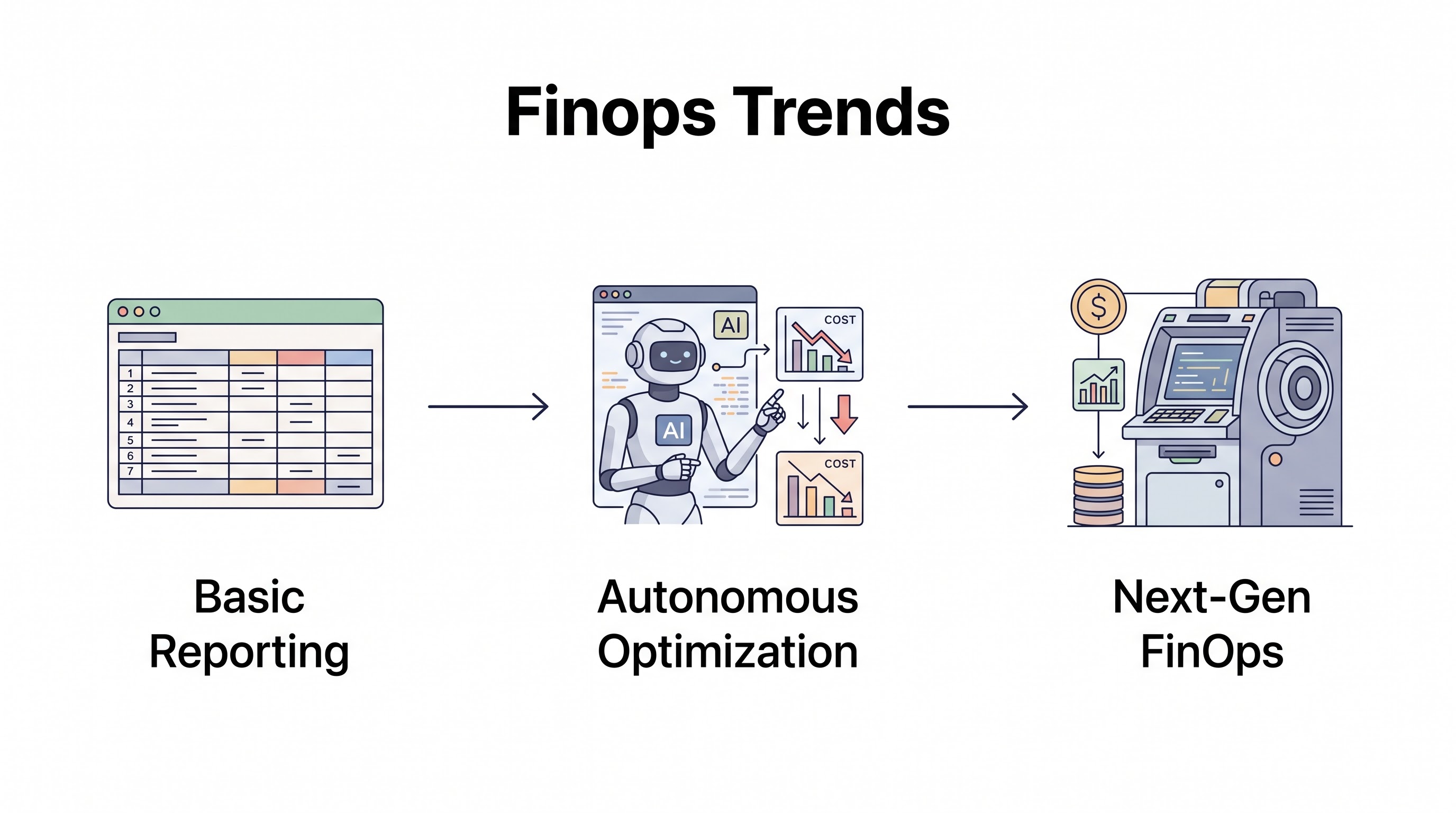
The Maturation of Cloud Finance
The discipline of Cloud Financial Operations (FinOps) has matured rapidly. Five years ago, FinOps was primarily a reactive accounting exercise—a centralized team attempting to decipher an incomprehensible AWS bill weeks after the money had already been spent. The primary output was a dashboard.
In 2026, the era of reactive dashboards is over. The scale of modern, ephemeral cloud infrastructure makes manual cost allocation impossible. The future of FinOps is proactive, deeply integrated into the engineering workflow, and heavily automated by Artificial Intelligence. This guide explores the five macro trends redefining cloud financial management.
1. The Death of the Dashboard (Autonomous Optimization)
As discussed in the AI FinOps Guide, human analysts can no longer keep up with the velocity of cloud changes. The most significant trend in 2026 is the shift from Visibility to Autonomous Action.
FinOps platforms are moving beyond merely recommending that an engineer downsize an EC2 instance. Modern tools integrate directly with the orchestration layer (Kubernetes, Terraform). When the system identifies waste, it autonomously generates the Pull Request to resize the instance. The FinOps practitioner’s role shifts from finding waste to defining the guardrails and risk parameters that allow the AI agents to optimize the infrastructure autonomously.
2. Governing the Generative AI Spend
The explosive adoption of Generative AI has introduced entirely new billing paradigms. You no longer just pay for servers by the hour; you pay for LLM inferences by the token.
Traditional FinOps practices (like buying Reserved Instances) are useless for controlling API-driven AI costs. The FinOps discipline is rapidly evolving to encompass AI Spend Governance. This involves tracking token consumption per application, implementing strict API rate limits to prevent "Denial of Wallet" attacks, and calculating the ROI of fine-tuning open-source models versus utilizing managed APIs like OpenAI or Anthropic.
3. Unit Economics Becomes the Standard
Executives no longer accept "The AWS bill went up by 10%" as a complete metric. They demand to know why. If the bill went up 10% because customer transactions increased by 50%, that is a massive business victory. If transactions stayed flat, it is a critical engineering failure.
In 2026, Cloud Unit Economics is the foundational metric of a mature organization. FinOps teams are deeply integrating their cloud billing data with external business telemetry (e.g., Salesforce data, Datadog application metrics) to provide real-time dashboards showing the "Cost per Transaction," "Cost per Tenant," or "Cost per API Call." This metric finally aligns engineering spend directly with business revenue.
4. "Shift-Left" FinOps via CI/CD Integration
Security successfully "shifted left" by integrating vulnerability scanning directly into the developer's Git workflow (DevSecOps). FinOps is executing the exact same playbook.
Organizations are implementing cost-estimation tools (like Infracost) directly into their CI/CD pipelines. When an engineer submits a Terraform Pull Request to deploy a new microservice, the pipeline automatically calculates the projected monthly cost of that architecture. If the projected cost exceeds the project's budget, the pipeline blocks the deployment. This forces engineers to consider cost at the architectural design phase, rather than discovering the cost at the end of the month.
5. The Convergence of FinOps and GreenOps
As corporate sustainability mandates and government carbon reporting regulations become strict legal requirements, the GreenOps discipline is merging entirely with FinOps.
The mechanisms for reducing carbon emissions (rightsizing compute, terminating zombie resources, shifting workloads to more efficient ARM processors) are the exact same mechanisms used to reduce the monthly bill. In 2026, FinOps platforms natively report on both "Dollars Saved" and "Metric Tons of CO2 Reduced," allowing organizations to achieve their financial and environmental goals through a single, unified operational motion.
Key Takeaway
The FinOps practitioner of 2026 is no longer a reactive dashboard builder. They are strategic enablers who deploy autonomous AI optimization engines, define strict governance policies for erratic Generative AI API costs, and implement "shift-left" CI/CD tooling to block expensive architectural mistakes before they are ever deployed to production. Success is defined entirely by improving business Unit Economics, not just lowering the absolute cloud bill.
All in One Place
Atler Pilot decodes your cloud spend story by bringing monitoring, automation, and intelligent insights together for faster and better cloud operations.