
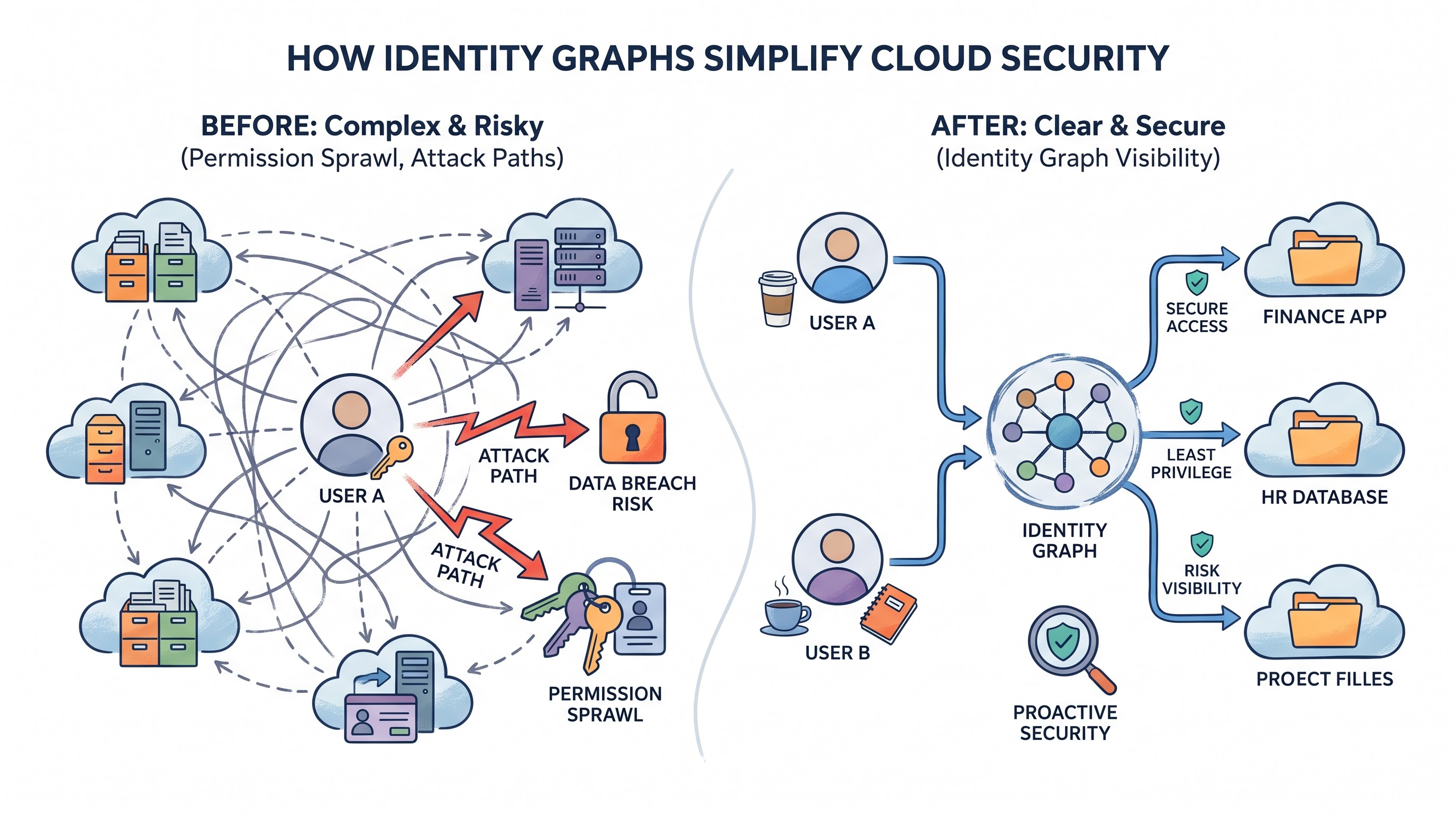
Cloud security used to be relatively easy to picture.
A user had an account. The account had permissions. Those permissions allowed access to specific resources.
Modern cloud environments don't work that simply anymore.
A single identity can have multiple roles, access tokens, service accounts, workload permissions, API credentials, and relationships with hundreds of cloud resources. Applications can also act as identities, and machine-to-machine access can create relationships that are difficult to understand from traditional IAM dashboards.
The result is a security environment where knowing who has access isn't enough.
Security teams increasingly need to understand how identities, permissions, workloads, resources, and relationships connect.
That's where identity graphs come in.
What Is an Identity Graph?
An identity graph is a connected representation of identities and their relationships with cloud resources, permissions, workloads, applications, and other identities.
Instead of viewing access as a simple list of permissions, an identity graph represents it as a network of relationships.
A human user may belong to a group.
That group may have a role.
The role may grant permissions.
Those permissions may provide access to a database.
A workload running inside Kubernetes may assume another identity.
That identity may access an object-storage bucket.
A service account may be allowed to invoke an API that can access additional resources.
Individually, each relationship might appear reasonable.
When they are connected, however, they can reveal a much larger access path.
This is the core value of identity graphs.
They provide context around access rather than simply showing individual permissions.
Why Traditional IAM Views Are No Longer Enough
Identity and Access Management systems remain essential to cloud security.
They define users, roles, policies, groups, authentication mechanisms, and permissions.
The challenge is that modern cloud environments can contain enormous numbers of identities and relationships.
A large organization may have thousands of human users, service accounts, applications, workloads, roles, policies, and temporary credentials.
Looking at each permission individually doesn't necessarily reveal the overall security posture.
A role might appear harmless when viewed alone.
But when combined with another permission and a service account, it could create a path toward a highly sensitive resource.
This is where traditional permission reviews struggle.
The problem isn't necessarily that security teams lack information.
They have too much information without enough relationship context.
Identity graphs address this by turning disconnected access information into a connected model.
The Rise of Machine Identities
One of the biggest reasons identity graphs are becoming more important is the growth of machine identities.
Cloud environments increasingly depend on identities that aren't human.
Applications need credentials.
Kubernetes workloads need service accounts.
CI/CD pipelines need permissions.
Cloud functions need roles.
AI agents may need access to APIs and databases.
Infrastructure automation needs credentials to create and modify resources.
These identities can sometimes outnumber human identities by a significant margin.
The challenge is that machine identities often operate automatically.
A human user may log in occasionally.
A workload can make thousands of API calls without direct human involvement.
That means a compromised machine identity can potentially have a large operational impact.
Security teams therefore need to understand not just who a machine identity belongs to, but what it can reach and what can reach it.
Identity Graphs Reveal Hidden Access Paths
The most valuable capability of an identity graph is its ability to expose indirect relationships.
Imagine a developer has access to a deployment system.
The deployment system can assume a cloud role.
That role can access a storage bucket.
The bucket contains sensitive data.
A traditional security review might evaluate each permission separately.
An identity graph can show the entire chain.
Developer → deployment system → role → storage → sensitive data.
This changes the security question.
Instead of asking:
"Does this identity have access to the database?"
Security teams can ask:
"What paths could allow this identity to eventually reach the database?"
That is a much more powerful way to understand cloud exposure.
Identity Graphs and Least Privilege
Least privilege is one of the foundational principles of cloud security.
Users and workloads should have only the permissions required to perform their intended functions.
In practice, however, implementing least privilege at cloud scale can be difficult.
Organizations often accumulate permissions over time.
A developer changes teams.
An application gets new functionality.
A service account receives additional access.
Temporary permissions become permanent.
Roles evolve.
The result can be permission sprawl.
Identity graphs can help identify these relationships by showing how identities actually connect to resources.
Security teams can identify excessive access, unused relationships, indirect access paths, and potentially risky combinations of permissions.
This makes least privilege more dynamic.
Instead of reviewing policies only when they are created, organizations can continuously evaluate how permissions contribute to actual access paths.
The Problem of Permission Sprawl
Permission sprawl is one of the biggest challenges in modern cloud security.
It happens gradually.
An identity receives permission for one task.
Later, another permission is added.
A third is introduced to support a new application.
Eventually, nobody remembers why the identity has all of those privileges.
The individual permissions may not look dangerous.
The combination can be.
Identity graphs make these relationships easier to visualize and analyze.
They can help security teams identify identities with unusually broad access, relationships that are no longer necessary, and paths that create excessive privilege.
This can reduce the attack surface without requiring organizations to manually review every policy.
Identity Graphs and Cloud Attack Paths
Security teams increasingly think in terms of attack paths rather than isolated vulnerabilities.
An attacker rarely needs a single permission that immediately provides access to everything.
They may start with a low-privilege identity and move through a sequence of permissions and resources.
Identity relationships are therefore part of the attack surface.
An identity graph can help security teams understand these paths.
If a compromised workload can assume another role, which can access a sensitive database, the graph makes that relationship visible.
This allows security teams to prioritize remediation based on potential impact.
A low-risk permission that creates a path toward a highly sensitive resource may deserve more attention than a standalone permission that has little practical consequence.
Identity Graphs in Kubernetes Environments
Kubernetes introduces additional identity complexity.
Pods, service accounts, namespaces, workloads, cloud roles, and applications can all interact with one another.
A workload might use a Kubernetes service account that is mapped to a cloud identity.
That identity may have access to cloud storage, databases, secrets, or other infrastructure.
Understanding these relationships is difficult when Kubernetes security and cloud IAM are managed separately.
Identity graphs can connect these layers.
Security teams can see how a Kubernetes workload maps to an identity and what that identity can access.
This provides a much clearer picture of workload-level access.
As organizations increasingly use Kubernetes as the foundation for cloud-native applications, this type of visibility becomes increasingly important.
Identity Graphs and AI Workloads
The rise of AI introduces another major identity challenge.
AI applications increasingly interact with cloud services, databases, APIs, internal systems, and external tools.
AI agents can make decisions about which tools to invoke and what information to retrieve.
That means the identity associated with an AI workload can become particularly important.
An AI agent with access to multiple enterprise systems may have a much broader effective reach than its initial application description suggests.
Identity graphs can help security teams understand these relationships.
They can map AI workloads to identities, identities to permissions, and permissions to the resources those workloads can reach.
This becomes especially valuable as organizations move from AI assistants toward autonomous agents.
From Static Identity Management to Continuous Identity Intelligence
Traditional IAM is often policy-centric.
Identity graphs introduce a more relationship-centric approach.
Instead of simply defining what an identity is allowed to do, organizations can continuously analyze how identities interact with the environment.
This makes identity security more dynamic.
A permission may be acceptable under one set of circumstances but risky after a workload changes.
A role may be appropriate for one application but excessive for another.
An identity that was previously low risk may gain access to additional systems.
Continuous identity intelligence allows security teams to detect these changes.
The graph becomes a living representation of the cloud environment rather than a static permission inventory.
Why Identity Context Matters for FinOps and Governance
Identity isn't only a security concern.
It also matters for cloud governance and FinOps.
Every cloud resource should ideally have clear ownership.
When identities, workloads, teams, and resources can be connected, organizations gain better visibility into who is responsible for infrastructure.
This can improve cost accountability.
If a particular workload generates unexpected cloud spending, teams can identify its owner.
If an unused resource remains active, governance systems can determine who should review it.
If an expensive AI workload is consuming shared GPU infrastructure, identity and ownership relationships can help establish accountability.
This creates an important connection between security, governance, and cloud economics.
The Role of Identity Graphs in Zero Trust
Zero Trust security assumes that access should not be trusted simply because an identity is inside a network or environment.
Access should be evaluated based on identity, context, permissions, and risk.
Identity graphs complement this approach by providing deeper visibility into relationships.
Instead of evaluating an identity in isolation, security systems can consider what the identity can access, how it obtained that access, which workloads it controls, and what sensitive resources exist along its access path.
This creates a more contextual approach to authorization.
Zero Trust therefore becomes less about simply verifying identity and more about understanding identity relationships and potential consequences.
Building an Identity-Aware Cloud Security Strategy
Organizations adopting identity graphs should begin by creating a complete inventory of identities.
This includes human users, service accounts, workloads, applications, automation systems, CI/CD pipelines, and other machine identities.
The next step is mapping relationships between those identities and the resources they can access.
From there, teams can identify excessive permissions, inactive identities, risky access paths, privilege escalation opportunities, and high-value resources.
The goal shouldn't be to build a graph simply because the technology is available.
The graph should answer practical security questions.
Who can access this resource?
How can they reach it?
Which workloads inherit this permission?
What happens if this identity is compromised?
Which access paths lead to sensitive resources?
Those questions turn identity graphs into an operational security capability.
Identity Graphs and the Future of Cloud Security
The future of cloud security will increasingly depend on understanding relationships.
Cloud environments are too distributed for security teams to rely solely on lists of users, roles, and permissions.
Applications are identities.
Workloads are identities.
Automation is an identity.
AI agents are becoming identities.
And all of these identities interact with resources through increasingly complex permission relationships.
Identity graphs provide a way to make that complexity understandable.
They help security teams move from permission visibility to relationship intelligence.
From asking who has access to understanding how access works.
From reviewing isolated policies to analyzing attack paths.
From static IAM management to continuous identity intelligence.
As cloud infrastructure becomes more autonomous, this shift will become even more important.
The security challenge of the future won't simply be controlling identities.
It will be understanding the constantly changing network of relationships those identities create.
Using Atler Pilot for Context-Rich Cloud Operations
Security decisions become more effective when identity context is connected with infrastructure and operational data.
Atler Pilot provides a unified view of cloud costs, infrastructure telemetry, workload intelligence, utilization analytics, and operational context.
For organizations managing complex cloud environments, this broader perspective can complement identity-focused security practices by helping teams understand which workloads consume infrastructure, how resources are connected to applications and owners, and where operational changes may affect cost or performance.
This becomes particularly useful for Kubernetes and AI environments, where workloads, infrastructure, identities, and services can interact across multiple layers.
The long-term opportunity is to move toward cloud operations where security, infrastructure, governance, and cost intelligence are not treated as isolated systems.
Instead, teams can work from a shared understanding of what exists, who controls it, how it is connected, what it costs, and what risks it creates.
Conclusion
Cloud security is becoming a relationship problem.
The number of identities, permissions, workloads, applications, and resources continues to grow, making traditional permission lists increasingly difficult to interpret.
Identity graphs provide a way to bring these relationships together.
They can expose hidden access paths, support least-privilege strategies, reduce permission sprawl, improve attack-path analysis, and provide greater visibility into machine identities, Kubernetes workloads, and emerging AI agents.
The biggest shift is conceptual.
Security teams are moving from asking:
"What permissions does this identity have?"
to asking:
"What can this identity ultimately reach, and through which relationships?"
That is a much more powerful security question.
As cloud infrastructure becomes more distributed and autonomous, identity graphs can become an important foundation for understanding and controlling the access relationships that hold the environment together.
The future of cloud security won't be built only around stronger authentication.
It will be built around better understanding of identity, relationships, context, and consequence.
Frequently Asked Questions
What is an identity graph in cloud security?
An identity graph is a connected representation of identities and their relationships with permissions, workloads, applications, cloud resources, and other identities. It helps security teams understand access paths rather than viewing permissions as isolated entries.
How do identity graphs improve cloud security?
Identity graphs can reveal indirect access paths, excessive permissions, privilege relationships, machine identities, and potential attack paths. This gives security teams more context when prioritizing risks and implementing least privilege.
What is the difference between IAM and an identity graph?
IAM systems primarily manage authentication, authorization, roles, policies, and permissions. An identity graph focuses on understanding the relationships between identities, permissions, workloads, and resources across the environment.
Why are identity graphs important for AI agents?
AI agents can interact dynamically with APIs, databases, cloud services, and other tools. Identity graphs can help organizations understand what an AI workload can access and identify potentially risky relationships before they become security problems.
Can identity graphs help with Zero Trust?
Yes. Identity graphs can provide the relationship and contextual information needed to evaluate access more dynamically, supporting Zero Trust principles such as continuous verification and least-privilege access.
All in One Place
Atler Pilot decodes your cloud spend story by bringing monitoring, automation, and intelligent insights together for faster and better cloud operations.