
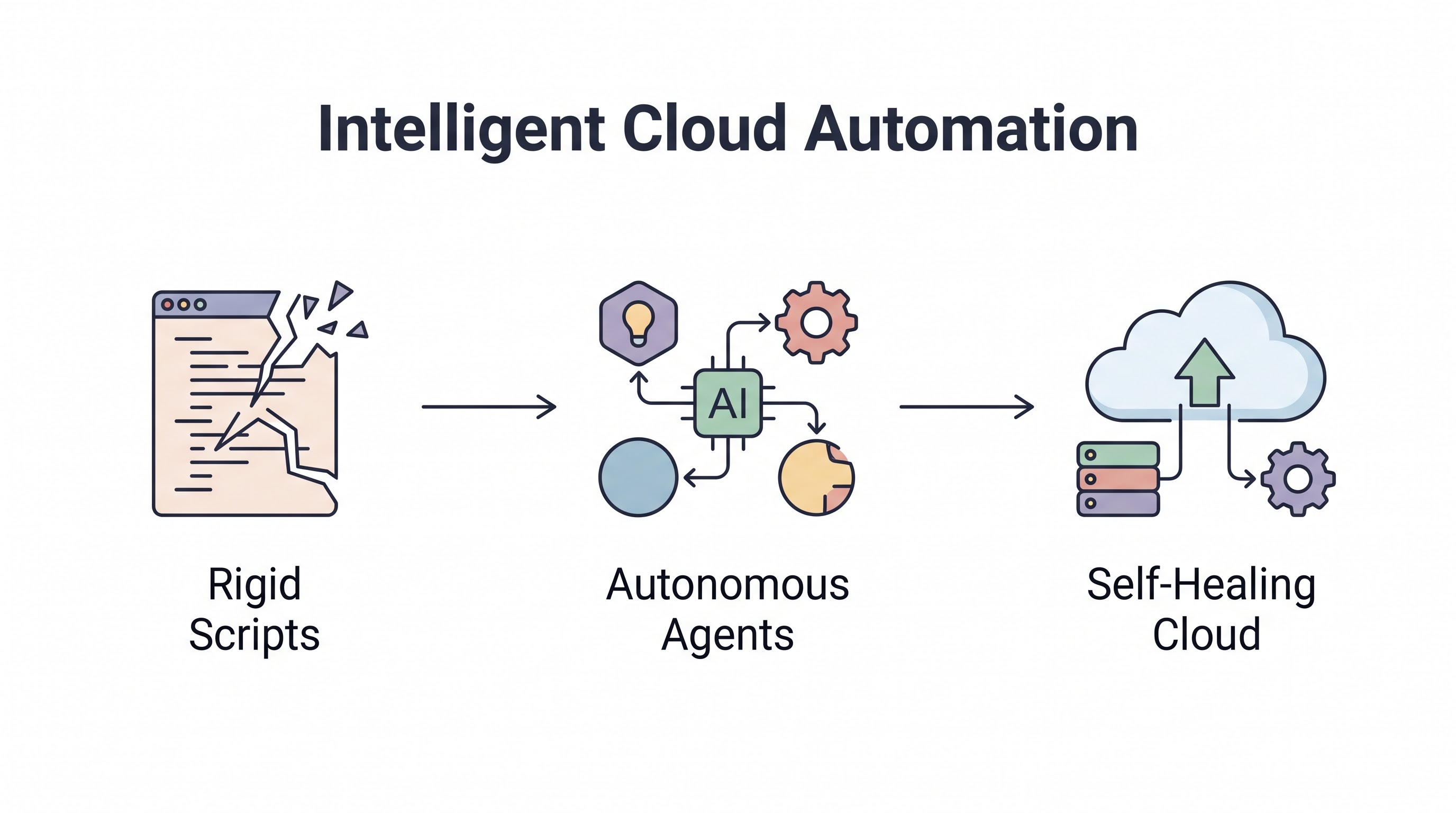
The Fragility of Scripts
For twenty years, systems administrators have automated their infrastructure using scripts. A Bash or Python script is entirely rigid. It executes a strict, linear sequence of commands. If an unexpected variable appears—a network timeout, a slightly altered API response—the script fails catastrophically.
As cloud architectures have grown into sprawling, ephemeral microservice meshes, managing them with thousands of brittle, imperative scripts has become impossible. The next evolution of cloud operations is the transition from rigid scripts to Intelligent Cloud Automation driven by autonomous AI agents.
The Imperative Model: Doing Exactly What You Say
The earliest form of automation was imperative. You wrote a script that said: 1. Spin up an EC2 instance. 2. Wait 30 seconds. 3. SSH into the instance. 4. Run apt-get install nginx. If the instance took 35 seconds to boot, the script crashed. It possessed zero contextual awareness.
The Declarative Model: Infrastructure as Code
The industry evolved to the declarative model via Infrastructure as Code (IaC) tools like Terraform and Kubernetes. Instead of writing the steps, you declare the desired end-state: "I want 5 Nginx servers running behind a load balancer." The tool calculates the necessary API calls to achieve that state. This was a massive leap forward, but it is still fundamentally static. It only changes when a human engineer merges a new Pull Request.
The Agentic Model: Intent-Based Automation
Intelligent Cloud Automation introduces the "Agentic" model. You do not define the steps, nor do you define the exact infrastructure state. You define the Business Intent and the Guardrails.
You tell the AI Agent: "Maintain the latency of the payment gateway below 50ms. Do not spend more than $5,000 per month. Stay within AWS eu-central-1 to maintain data residency."
The AI Agent continuously monitors the environment. It does not wait for a human to trigger a script. It autonomously decides how to achieve the intent. If traffic spikes, it might choose to scale up the EC2 instances. If the spot market price drops, it might autonomously migrate the workloads to Spot instances to save money while maintaining the latency goal.
Contextual Decision Making in Production
The true power of an intelligent agent is contextual decision-making. Rigid scripts cannot handle ambiguity. AI agents thrive on it.
If an AWS Availability Zone goes down, a traditional auto-scaling group might blindly try to provision more instances in the failing zone, triggering a cascade of failures. An intelligent agent ingests the global telemetry data, recognizes the AZ failure, and autonomously reroutes the DNS traffic to a secondary region, dynamically provisioning the required infrastructure on the fly to absorb the load.
Autonomous Incident Remediation
As discussed in the AI SecOps Guide, speed is critical during an incident. Intelligent automation platforms integrate deeply with Security Orchestration, Automation, and Response (SOAR) tools.
If the system detects a misconfiguration—for example, a developer accidentally makes an S3 bucket public—the AI agent does not just send a Slack alert to the security team. It autonomously executes the remediation: it immediately rewrites the bucket policy to private, revokes the STS tokens of the developer who made the change, and generates an incident report detailing the root cause, all in under three seconds.
The AI Control Plane
To safely implement agentic automation, organizations require a unified "AI Control Plane." This platform sits above the individual cloud providers (AWS, Azure, GCP). It ingests all telemetry, billing, and security data into a single data lake, providing the AI with the complete context required to make safe, accurate decisions across the entire multi-cloud architecture.
Key Takeaway
Cloud management is evolving from rigid, human-triggered scripts to autonomous, intent-based AI agents. By defining the high-level business goals (latency limits, budget caps, security guardrails) rather than the exact infrastructure configuration, organizations empower intelligent automation platforms to continuously, autonomously optimize the cloud environment, drastically reducing operational toil and accelerating incident remediation.
All in One Place
Atler Pilot decodes your cloud spend story by bringing monitoring, automation, and intelligent insights together for faster and better cloud operations.