
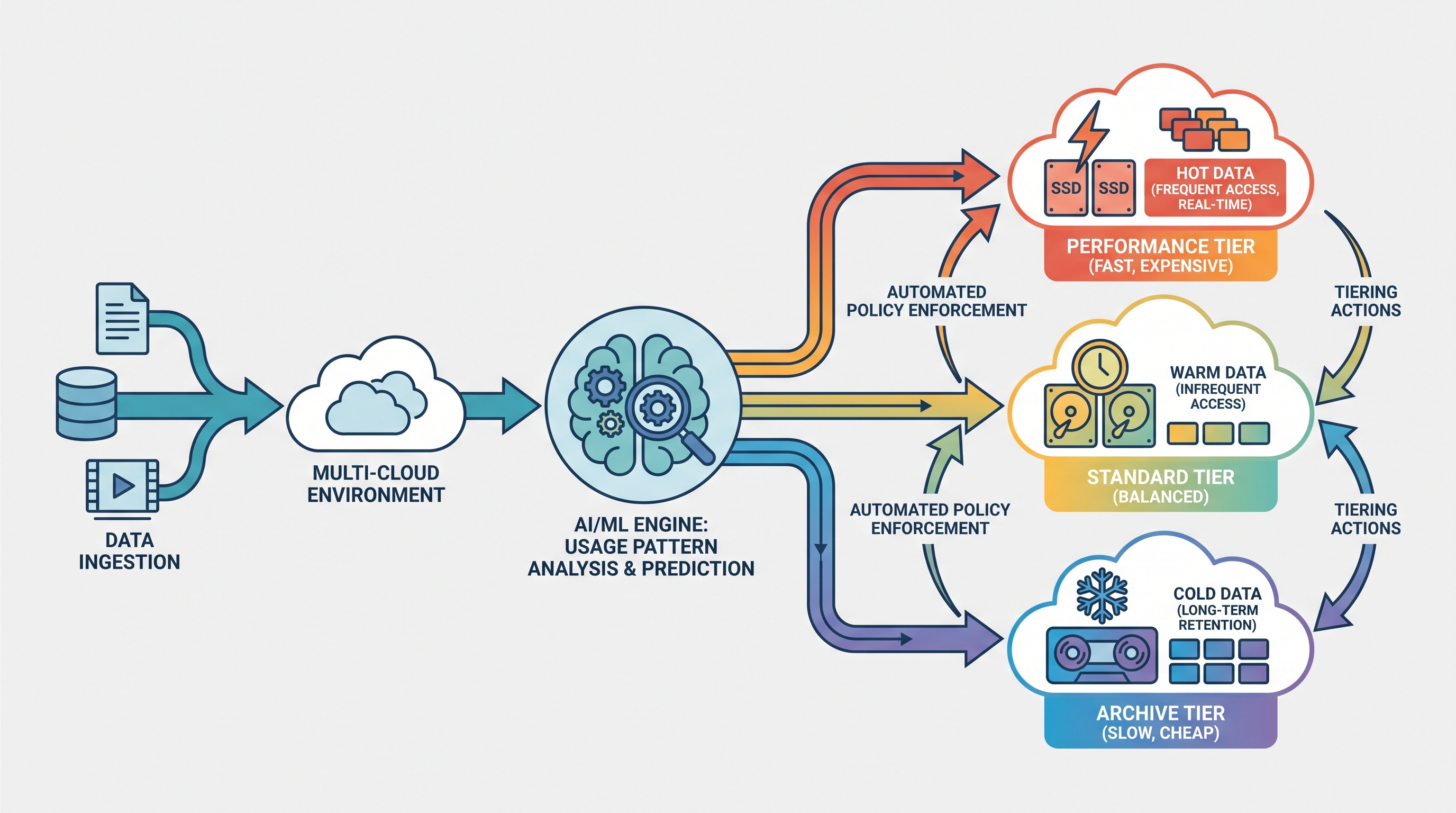
The Multi-Cloud Storage Dilemma: Why Static Lifecycles Fail
Enterprise data footprint is growing exponentially. As organizations distribute workloads across Amazon Web Services (AWS), Microsoft Azure, Google Cloud Platform (GCP), and Oracle Cloud Infrastructure (OCI), managing object storage becomes an administrative and financial nightmare. Modern cloud architectures often rely on simple, time-based lifecycle rules (e.g., "move objects in s3://production-logs/ to Glacier after 90 days"). While intuitive, these static rules are fundamentally broken for several reasons.
First, static rules assume linear data decay. In reality, data access patterns are highly non-linear and unpredictable. A dataset generated six months ago might suddenly become the target of an intensive machine learning training run, a compliance audit, or an unexpected debugging operation. If that dataset has already been transitioned to an archival tier like AWS Glacier Deep Archive or Azure Archive Blob, retrieving it triggers massive latency penalties (hours to days) and exorbitant retrieval fees.
Second, static rules operate in silos. Every cloud provider has its own APIs, lifecycle engines, and tiering behaviors. Managing these rules across thousands of buckets and containers requires writing and maintaining custom scripts, Terraform configurations, or CloudFormation templates. Without centralized oversight, configurations drift, leading to orphaned buckets, over-provisioned "Hot" tiers, and unmonitored storage costs. To combat these inefficiencies, organizations must transition to an intelligent, centralized financial operations platform that can dynamically assess data access patterns and enforce optimal tiering policies in real-time.
The Anatomy of Multi-Cloud Storage Tiers and Hidden Traps
To design an effective AI-driven tiering engine, we must first understand the complex landscape of cloud object storage tiers. Each provider offers distinct tiers, each with its own pricing structures, minimum storage durations, and retrieval penalties.
Provider & Tier | Optimal Access Frequency | Min. Storage Duration | Retrieval Cost / GB | Latency to First Byte |
|---|---|---|---|---|
AWS S3 Standard | Active, frequent access | None | None | Milliseconds |
AWS S3 Standard-IA | Infrequent (1-2x/month) | 30 days | ~$0.01 | Milliseconds |
AWS S3 Glacier Flexible | Rare (few times/year) | 90 days | ~$0.03 (Standard) | 1 to 5 hours |
Azure Blob Hot | Active, frequent access | None | None | Milliseconds |
Azure Blob Cool | Infrequent (30+ days) | 30 days | ~$0.01 | Milliseconds |
Azure Blob Archive | Rare (180+ days) | 180 days | ~$0.02 | Up to 15 hours |
GCP Standard | Highly active data | None | None | Milliseconds |
GCP Nearline | Infrequent (once/month) | 30 days | $0.01 | Milliseconds |
GCP Archive | Rare (less than once/year) | 365 days | $0.05 | Milliseconds |
These architectural differences present several financial and operational traps:
Minimum Storage Duration Penalties: If you upload a 10 TB dataset to AWS S3 Standard-IA and delete or transition it 5 days later, AWS will still bill you for the remaining 25 days at the IA rate. An automated script that aggressively transitions short-lived temporary files to colder tiers will actually increase your monthly bill.
Transition Fees: Moving data between tiers is not free. Cloud providers charge per 1,000 API requests (e.g.,
PUT/COPY/POST). Transitioning millions of tiny files (under 128 KB) can cost more in transition fees than you will ever save in storage reduction.Retrieval and Egress Fees: When data in cold or archive tiers is accessed, you are billed for both the data retrieval volume and the network egress if the data leaves the cloud region. A single query from an analytical tool like AWS Athena or Google BigQuery scanning an unoptimized archive tier can cost thousands of dollars.
Enter AI-Driven Intelligent Tiering
AI-driven storage optimization moves beyond static, rule-based systems by treating storage tiering as a continuous, dynamic optimization problem. By leveraging machine learning models, an intelligent system can analyze historical access logs, metadata, and cost metrics to predict the future utility of every object or prefix.
The core of this approach is the Atler AI engine, which processes multi-cloud telemetry to build predictive access profiles. Instead of relying solely on the "Last Modified" timestamp, the AI analyzes metrics such as access frequency, read-to-write ratios, access intervals, and user/role identity. For example, if a dataset is accessed frequently by a CI/CD pipeline but only during the first week of every quarter, the AI recognizes this cyclical pattern. Instead of archiving the data after 30 days of inactivity, it keeps the data in an intermediate tier, preventing a massive retrieval fee when the next quarter begins.
Furthermore, AI-driven automation utilizes automated metadata tagging to dynamically apply granular lifecycle policies. Rather than writing broad bucket-level rules, the AI tags individual objects or prefixes with precise lifecycle parameters based on their predicted access profiles. This ensures that high-priority datasets remain highly available, while redundant, obsolete, or trivial (ROT) data is systematically and safely archived or purged.
Architectural Blueprint: Building a Cross-Cloud Intelligent Tiering Engine
To implement an AI-driven storage tiering engine across AWS, Azure, and GCP, you need a highly scalable, event-driven architecture. The diagram below represents the conceptual flow of telemetry ingestion, model inference, and multi-cloud action execution.
[ Cloud Telemetry Sources ]
  ├── AWS CloudTrail / S3 Access Logs ──┐
  ├── Azure Monitor Diagnostic Logs ────┼──> [ Event Ingestion Pipeline ]
  └── GCP Cloud Logging ────────────────┘                 │
                                                          ▼
                                             [ Atler AI Analysis Engine ]
                                                          │
                                                          ▼
[ Multi-Cloud Action Orchestration ] <─────── [ Decision Matrix & Tags ]
  ├── AWS S3 API (PutBucketLifecycle)
  ├── Azure Blob REST API (SetTier)
  └── GCP Cloud Storage API (Patch)
Step 1: Telemetry Ingestion
The system must ingest access logs without introducing latency or performance overhead to the data path. This is achieved by enabling native access logging to dedicated telemetry buckets, which are then processed asynchronously.
AWS S3: Configure S3 Server Access Logging or AWS CloudTrail data events to write to an Amazon S3 log bucket. An AWS Lambda function is triggered by log creation events to parse and stream access metrics.
Azure Blob: Enable Azure Monitor diagnostic settings to send Resource Logs (specifically
StorageRead,StorageWrite, andStorageDeleteoperations) to an Event Hub.GCP Cloud Storage: Configure Cloud Storage Access Logs to export to Pub/Sub, which triggers a Cloud Function for processing.
Step 2: Feature Extraction and Machine Learning Model
The ingestion pipeline extracts key features for each object or logical prefix:
Access Density ($D_a$): The number of read requests divided by the object size over a sliding window $T$.
Recency ($R$): Time elapsed since the last read operation.
Write Frequency ($W$): Number of overwrite operations, indicating if the data is mutable.
Entropy ($E$): Randomness of access intervals, helping to differentiate between automated batch jobs and ad-hoc human queries.
A supervised machine learning classifier (such as a gradient-boosted decision tree) or a time-series forecasting model predicts the probability $P_{access}$ of an object being accessed in the next $N$ days. If $P_{access}$ falls below a dynamically computed cost threshold, the object is flagged for transition to a colder tier.
Step 3: Multi-Cloud Action Execution
Once the AI engine determines the optimal tier, it executes the transition using the target cloud's native APIs. Because security is paramount in enterprise environments, all API calls must go through a secure, audited broker. This is where centralized cloud security management plays a vital role, ensuring that the service principals and IAM roles executing these lifecycle changes adhere to the principle of least privilege.
Here is an example of a Python implementation using the boto3 library to dynamically update AWS S3 lifecycle configurations based on AI-driven recommendations:
import boto3

def apply_intelligent_lifecycle_policy(bucket_name, prefix, transition_days):
    s3_client = boto3.client('s3')

    # Define the lifecycle rule targeting a specific prefix
    lifecycle_rule = {
        'Rules': [
            {
                'ID': f'AI-Optimized-Transition-{prefix.replace("/", "-")}',
                'Status': 'Enabled',
                'Filter': {
                    'Prefix': prefix
                },
                'Transitions': [
                    {
                        'Days': transition_days,
                        'StorageClass': 'GLACIER_IR' # Glacier Instant Retrieval for fast access
                    }
                ],
                'NoncurrentVersionTransitions': [
                    {
                        'NoncurrentDays': 30,
                        'StorageClass': 'DEEP_ARCHIVE'
                    }
                ]
            }
        ]
    }

    try:
        s3_client.put_bucket_lifecycle_configuration(
            Bucket=bucket_name,
            LifecycleConfiguration=lifecycle_rule
        )
        print(f"Successfully applied AI-optimized lifecycle policy to {bucket_name}/{prefix}")
    except Exception as e:
        print(f"Error applying lifecycle configuration: {str(e)}")
        raise e
FinOps Tactics: Calculating True Cost Impact and Avoiding Retrieval Traps
Implementing an intelligent tiering strategy requires a strict mathematical approach to FinOps. Organizations often make the mistake of looking only at the raw storage cost per gigabyte, ignoring the operational costs of transitioning and retrieving data.
To calculate the true economic benefit of transitioning a dataset, FinOps teams must utilize a comprehensive cost impact calculation formula:
Net Savings Formula:
$S_{net} = (C_{hot} - C_{cold}) \times V \times T - (C_{trans} \times \frac{V}{S_{avg}} \times 10^{-3}) - (C_{retrieval} \times V_{retrieved})$
Where:
$S_{net}$ = Net savings ($)
$C_{hot}$ = Cost of hot storage ($/GB/month)
$C_{cold}$ = Cost of cold storage ($/GB/month)
$V$ = Volume of data (GB)
$T$ = Time duration in months
$C_{trans}$ = Cost per 1,000 transition API requests
$S_{avg}$ = Average size of objects in the dataset (GB)
$C_{retrieval}$ = Cost of data retrieval ($/GB)
$V_{retrieved}$ = Expected volume of retrieved data (GB)
Let's look at a concrete real-world scenario. Suppose you have 100 TB of log files consisting of 100 million small files (average size 1 MB) stored in AWS S3 Standard. You want to evaluate transitioning this dataset to S3 Glacier Flexible Archive.
S3 Standard Storage Cost: 100,000 GB * $0.023 = $2,300 / month
Glacier Flexible Storage Cost: 100,000 GB * $0.0036 = $360 / month
Raw Storage Savings: $1,940 / month
However, the transition cost is $0.03 per 1,000 LifecycleTransition requests. For 100 million files, the transition cost is:
(100,000,000 / 1,000) * $0.03 = $3,000 (one-time fee)
If your AI model predicts that a developer will need to run a log analysis tool that reads 20% of this dataset (20 TB) once within the next three months, the retrieval costs will be:
Glacier Retrieval Request Cost: 20,000,000 files * $0.05 per 1,000 = $1,000
Glacier Data Retrieval Cost: 20,000 GB * $0.01 = $200
Total Retrieval Cost: $1,200
In this scenario, the total cost for the first three months of transitioning to Glacier Flexible is:
Storage Cost (3 months) + Transition Cost + Retrieval Cost = $1,080 + $3,000 + $1,200 = $5,280
If you had left the data in S3 Standard, the cost would have been:
$2,300 * 3 = $6,900
While transitioning still yields a net saving of $1,620 over three months, the margins are significantly lower than the raw storage comparison suggested. If the retrieval volume had been slightly higher, or if the data was deleted before the 90-day minimum billing period, the transition would have resulted in a net financial loss. An AI-driven engine continuously runs these simulations, deciding to transition only when the math guarantees a positive return on investment.
Securing the Lifecycle: Compliance, Immutability, and Data Governance
Automating storage lifecycles is not merely a cost-saving exercise; it is a critical component of cloud data governance and security. Moving data across tiers can inadvertently violate compliance mandates or expose sensitive data if not handled properly.
1. Retaining Object Locks and WORM Compliance
In highly regulated industries (such as finance and healthcare), data must be kept in a Write-Once-Read-Many (WORM) state to comply with regulations like SEC Rule 17a-4 or HIPAA. When transitioning objects to colder tiers, the AI engine must ensure that Object Lock configurations (both Retention Periods and Legal Holds) are preserved. If an object is locked in Compliance Mode, any automated transition must respect the lock and must never attempt to delete or overwrite the object until the retention period expires.
2. Managing Encryption Keys Across Tiers
Data stored in object storage must be encrypted at rest. When data transitions from hot to cold storage, it must remain encrypted. If you are using Customer Managed Keys (CMK) via AWS KMS or Azure Key Vault, the transition engine must have the necessary cryptographic permissions to re-encrypt or read metadata during transitions. Furthermore, if a key is rotated or disabled, the archived data using that key becomes unrecoverable. CloudAtler's unified platform monitors key lifecycles alongside storage lifecycles to prevent this catastrophic data loss scenario.
3. Auditing and Compliance Reporting
Automated systems must leave a clear audit trail. Every time the AI engine modifies a lifecycle policy, moves a prefix, or purges expired data, the action must be logged centrally. This ensures that security teams can verify that data deletion policies align with corporate data retention mandates, and that no sensitive customer data is retained longer than legally permitted.
Why CloudAtler is the Ultimate Solution for Multi-Cloud Storage Optimization
Managing storage lifecycles natively across AWS, Azure, GCP, and OCI is complex, error-prone, and highly fragmented. CloudAtler solves this by providing a unified, AI-powered command center that bridges the gap between infrastructure engineering, cloud security, and FinOps.
With CloudAtler, you get:
Continuous AI-Driven Analysis: Our advanced ML models continuously evaluate your multi-cloud storage access patterns, automatically moving data to the most cost-effective tier while avoiding costly transition and retrieval traps.
Cross-Cloud Governance: Define storage policies once in CloudAtler and watch them deploy automatically across all cloud providers, eliminating configuration drift and manual scripting.
Deep Cost & Security Visibility: Calculate the exact financial impact of your lifecycle policies before they are applied, while maintaining strict compliance with built-in object locking, encryption, and audit logging features.
All in One Place
Atler Pilot decodes your cloud spend story by bringing monitoring, automation, and intelligent insights together for faster and better cloud operations.