
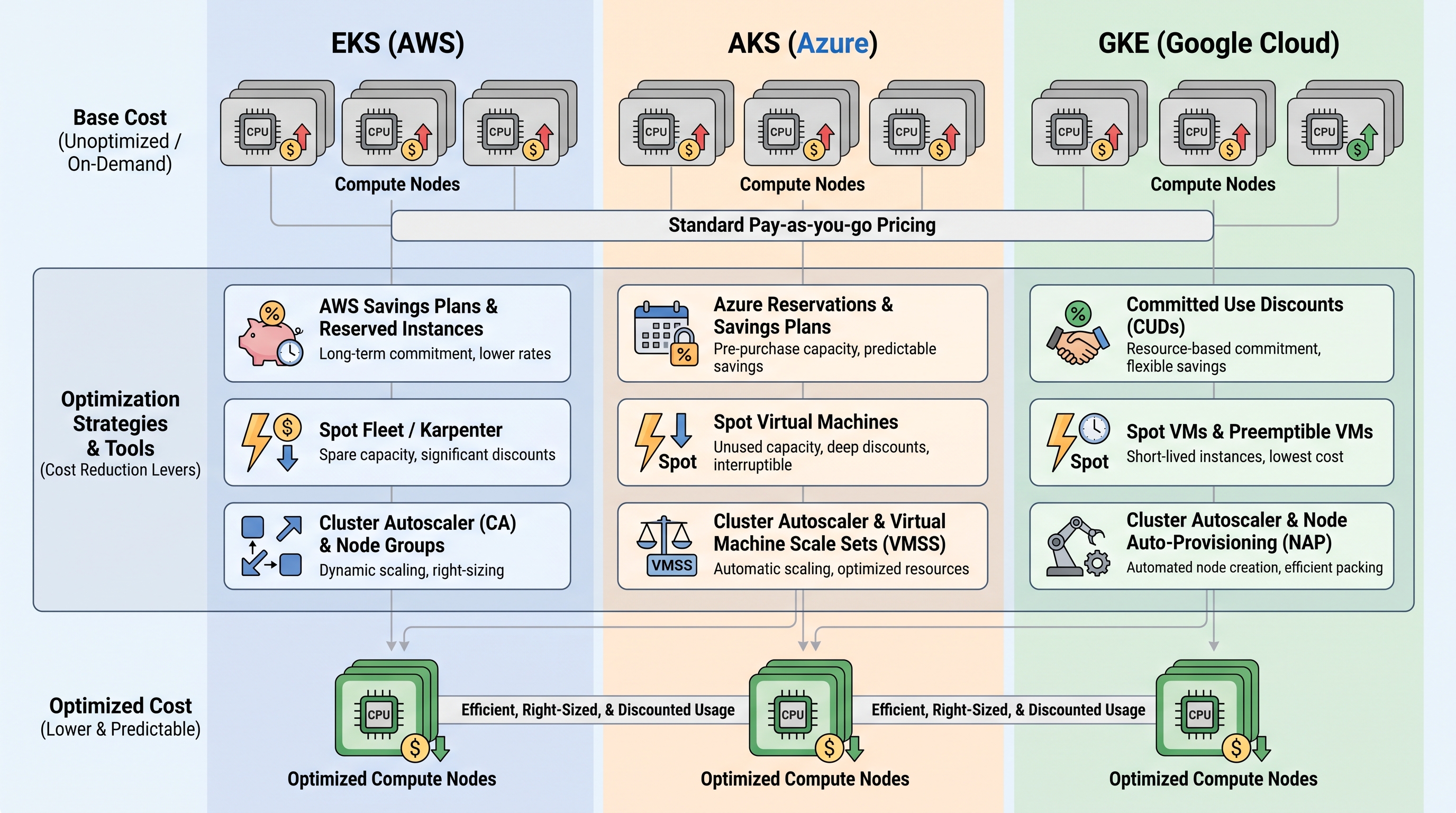
Introduction: The Multi-Cloud Kubernetes Cost Trap
Managed Kubernetes services—Amazon Elastic Kubernetes Service (EKS), Azure Kubernetes Service (AKS), and Google Kubernetes Engine (GKE)—have become the de facto operating systems of the modern cloud. By abstracting away the operational overhead of the control plane, these services allow engineering teams to deploy microservices at scale. However, this abstraction layer often masks the true cost of infrastructure, leading to severe cloud spend inefficiencies.
In a multi-cloud enterprise environment, Kubernetes costs are rarely transparent. Organizations frequently suffer from over-provisioned nodes, orphaned persistent volumes, inefficient autoscaling configurations, and unexpected inter-Availability Zone (AZ) data transfer charges. To master Kubernetes cost optimization, Cloud architects and FinOps practitioners must look beyond simple unit pricing and analyze the complex interplay between compute, networking, storage, and management overhead.
Unifying these disparate cost vectors requires a robust financial operations platform that provides real-time visibility and actionable recommendations across AWS, Azure, and GCP. In this comparative guide, we will dissect the architectural cost drivers of EKS, AKS, and GKE, providing concrete optimization strategies to maximize your return on investment.
1. Control Plane Pricing and Architecture
The first cost component of any managed Kubernetes service is the control plane (the master nodes, API server, etcd database, and controller manager). While the cloud providers handle the availability, backup, and scaling of these components, they charge differently for this management layer.
Amazon EKS Control Plane Costs
Amazon EKS charges a flat fee of $0.10 per hour per cluster. This equates to approximately $73 per month per cluster. Whether you run a small development cluster with two worker nodes or a massive production cluster with thousands of nodes, the control plane cost remains identical. While $73/month seems negligible for large-scale production clusters, it becomes a significant driver of waste in organizations that spin up dozens of isolated, short-lived development, testing, or staging clusters.
Azure AKS Control Plane Costs
Microsoft Azure offers a tiered approach to AKS control plane pricing:
Free Tier: AKS provides a free control plane with no uptime Service Level Agreement (SLA). The cluster is backed by a Service Level Objective (SLO) of 99.5%, which is sufficient for development, testing, and non-critical staging environments.
Standard Tier: For production workloads requiring high availability, Azure offers an financially backed Uptime SLA of 99.95% (or 99.9% if not using Availability Zones). This tier costs $0.10 per hour per cluster, matching the EKS pricing model.
Google GKE Control Plane Costs
Google Cloud charges $0.10 per hour per cluster for GKE control planes across both Standard and Autopilot modes. However, GKE provides a mitigation for smaller organizations: Google Cloud offers one free cluster per billing account per month (which equates to an automatic $73/month credit). This makes GKE highly cost-effective for startups or organizations operating a single, centralized multi-tenant cluster.
Architectural Impact: Multi-Cluster vs. Monolithic Multi-Tenancy
The control plane cost structures directly influence your cluster architecture strategy. In AWS, deploying 50 isolated development clusters to provide environment segregation for 50 engineers will cost $3,650 per month in control plane fees alone—before a single workload pod is scheduled. In Azure, utilizing the Free Tier for those 50 development clusters reduces control plane costs to $0.
To optimize control plane spend in EKS and GKE, enterprise architectures should shift from a "cluster-per-developer" model to a "monolithic multi-tenancy" model using Kubernetes Namespaces, Network Policies, and Hierarchical Namespaces (HNS) to securely isolate workloads on a single, shared cluster.
2. Compute Node Optimization: Standard vs. Serverless vs. Autoscaling
Compute resources (vCPU and Memory) consumed by worker nodes represent 70% to 80% of the total cost of any Kubernetes cluster. Each cloud provider offers distinct compute models: managed node groups (virtual machines), serverless container runtimes, and specialized autoscaling mechanisms.
AWS: Karpenter vs. Cluster Autoscaler and Fargate
In Amazon EKS, worker nodes are typically run on Amazon EC2 instances. Historically, the Kubernetes Cluster Autoscaler was used to scale EC2 Auto Scaling Groups (ASGs). However, Cluster Autoscaler is reactive and bound by the homogenous constraints of ASGs.
The modern standard for EKS compute optimization is Karpenter, an open-source, high-performance node provisioning engine. Karpenter bypasses EC2 ASGs entirely, communicating directly with the EC2 fleet API to provision the most cost-optimal instance type based on the exact resource requests of pending pods. It also actively consolidates workloads, terminating underutilized nodes and rescheduling pods onto smaller, cheaper instances.
apiVersion: karpenter.sh/v1beta1
kind: NodePool
metadata:
  name: default
spec:
  template:
    spec:
      requirements:
        - key: karpenter.sh/capacity-type
          operator: In
          values: ["spot", "on-demand"]
        - key: kubernetes.io/arch
          operator: In
          values: ["amd64", "arm64"]
        - key: karpenter.k8s.aws/instance-category
          operator: In
          values: ["c", "m", "r"]
      limits:
        cpu: 1000
      disruption:
        consolidationPolicy: WhenUnderutilized
        expireAfter: 720h
For workloads with highly unpredictable, bursty traffic patterns, AWS Fargate for EKS offers a serverless compute option where you pay only for the vCPU and memory requested by the pods. However, Fargate carries a premium of roughly 15% to 30% over equivalent EC2 On-Demand rates and does not support DaemonSets or privileged containers, making it less suitable for complex enterprise tooling.
Azure AKS: Virtual Machine Scale Sets (VMSS) and Spot Node Pools
AKS utilizes Azure Virtual Machine Scale Sets (VMSS) to manage worker nodes. AKS divides nodes into System Node Pools (which host critical system pods like CoreDNS and metrics-server) and User Node Pools (which host application workloads). To optimize costs, architects should run System Node Pools on cost-effective, general-purpose VM sizes (e.g., Standard_D2s_v5) and utilize Spot Node Pools for interruptible, stateless application workloads.
Azure Spot VMs offer discounts of up to 90% compared to On-Demand rates. When configuring Spot Node Pools in AKS, you must define eviction policies (Deallocate vs. Delete) and implement handling for the scheduled eviction notification event, which gives workloads a 30-second warning before termination.
GCP: GKE Autopilot vs. GKE Standard
Google Cloud revolutionized managed Kubernetes billing with GKE Autopilot. In Autopilot mode, Google manages the entire node infrastructure, scaling, and security. You are billed not for the underlying Compute Engine VMs, but for the vCPU, memory, and storage requested by your running pods, measured in per-second increments.
While GKE Autopilot simplifies operations, it requires careful resource configuration. If your developers do not specify precise resource limits, or if they over-provision requests (e.g., requesting 4 vCPUs for a pod that utilizes 0.1 vCPU), Autopilot will bill you for the entire 4 vCPUs. GKE Standard, by contrast, utilizes Node Auto-Provisioning (NAP), which dynamically creates and destroys node pools of varying VM sizes based on pod specifications, similar to Karpenter.
To successfully navigate these complex compute options and secure long-term discounts, enterprises must employ advanced commitment intelligence tools that analyze historical usage and automatically match workloads with AWS Savings Plans, Azure Reservations, or GCP Committed Use Discounts (CUDs).
3. The Silent Killer: Data Transfer and Networking Costs
While compute costs are highly visible on billing dashboards, networking costs—specifically inter-Availability Zone and egress data transfer—are frequently overlooked until they comprise a massive portion of the monthly cloud invoice. Kubernetes clusters are inherently dynamic, and without proper scheduling constraints, pods belonging to the same microservice application will be distributed randomly across multiple AZs.
Cross-AZ Traffic Costs
All three major cloud providers charge for data transfer across Availability Zones within the same region. As of 2024, the standard rate across AWS, Azure, and GCP is $0.01 per GB of data transferred in each direction (effectively costing $0.02 per GB for a complete round-trip request/response cycle between two pods in different AZs).
Consider a high-throughput microservices architecture where Service A calls Service B. If Service A transfers 100 TB of data to Service B over the course of a month, and the pods are randomly distributed across three AZs, approximately 66% of that traffic will cross AZ boundaries, resulting in $1,320 of unexpected networking costs for just one service-to-service relationship.
Mitigation Strategy: Topology-Aware Routing
To eliminate cross-AZ data transfer costs, cloud architects should implement Topology-Aware Hints (formerly Topology-Aware Routing) in Kubernetes. This feature instructs the kube-proxy to route traffic preferentially to endpoints (pods) within the same Availability Zone as the originating client pod.
apiVersion: v1
kind: Service
metadata:
  name: high-throughput-service
  annotations:
    service.kubernetes.io/topology-mode: Auto
spec:
  selector:
    app: backend-worker
  ports:
    - protocol: TCP
      port: 80
      targetPort: 8080
By adding the service.kubernetes.io/topology-mode: Auto annotation, the Kubernetes control plane monitors the distribution of endpoints across zones. If there are enough endpoints in each zone, it configures routing rules so that traffic remains local to the zone, driving cross-AZ data transfer costs down to near zero.
CNI Selection: eBPF and Performance Overheads
The choice of Container Network Interface (CNI) also impacts compute overhead and cost. Standard CNIs like AWS VPC CNI, Azure CNI, and Calico rely heavily on iptables or IPVS for routing. At enterprise scale, massive iptables rule sets consume significant CPU cycles on every worker node, driving up compute requirements.
Migrating to an eBPF-based CNI, such as Cilium, bypasses the Linux network stack and iptables entirely. This drastically reduces CPU utilization on worker nodes, freeing up compute capacity for actual workload containers and lowering overall instance requirements.
4. Storage Cost Optimization (Persistent Volumes)
Kubernetes workloads requiring stateful storage utilize Persistent Volumes (PVs) backed by cloud block storage: Amazon EBS, Azure Disk, or Google Cloud Persistent Disk. Unoptimized storage configurations lead to two primary sources of waste: over-provisioned volume sizes and orphaned persistent volumes.
Block Storage Pricing Comparison
Each cloud provider offers multiple tiers of block storage, with varying trade-offs between cost, IOPS, and throughput:
AWS (gp3 vs. io2): EKS default storage classes should utilize the
gp3volume type rather than the oldergp2.gp3is up to 20% cheaper per GB-month and allows independent scaling of IOPS and throughput, preventing the need to over-provision volume size just to get higher performance.Azure (Premium SSD v2 vs. Standard SSD): AKS environments should leverage Premium SSD v2 for performance-sensitive workloads, as it offers sub-millisecond latencies and independent IOPS/throughput configuration, similar to AWS gp3. For non-production workloads, Standard SSD provides a highly cost-effective alternative.
GCP (pd-balanced vs. pd-ssd): GKE defaults often point to
pd-standard(magnetic) orpd-ssd. Utilizingpd-balancedoffers a middle ground, providing SSD-like performance at a significantly lower cost point, making it the ideal default storage class for general-purpose stateful applications.
Orphaned Volumes and Reclaim Policies
When a stateful deployment or StatefulSet is scaled down or deleted, Kubernetes does not automatically delete the corresponding Persistent Volume Claim (PVC) or the underlying cloud block storage volume. This safety mechanism prevents accidental data loss, but it frequently results in hundreds of "orphaned" volumes that continue to incur charges indefinitely.
To prevent this, administrators should carefully configure the reclaimPolicy in their StorageClasses. Setting the policy to Delete ensures that when a PVC is deleted, the underlying cloud storage volume is automatically purged.
apiVersion: storage.k8s.io/v1
kind: StorageClass
metadata:
  name: dynamic-gp3
provisioner: ebs.csi.aws.com
volumeBindingMode: WaitForFirstConsumer
reclaimPolicy: Delete
parameters:
  type: gp3
  iops: "3000"
  throughput: "125"
5. Comparative Matrix: EKS vs. AKS vs. GKE
The following matrix summarizes the critical cost-related dimensions of the three major managed Kubernetes offerings:
Feature / Metric | Amazon EKS | Azure AKS | Google GKE |
|---|---|---|---|
Control Plane Cost | $0.10/hour per cluster | Free (no SLA) or $0.10/hour (99.95% SLA) | $0.10/hour per cluster (1 free cluster per billing account) |
Serverless Compute Option | AWS Fargate (high premium, cold starts) | Azure Container Apps / Virtual Nodes | GKE Autopilot (per-pod billing model) |
Autoscaling Engine | Karpenter (excellent, highly optimal) | Cluster Autoscaler (VMSS-based) | Node Auto-Provisioning (NAP) |
Spot Instance Integration | Native (Managed Node Groups / Karpenter) | Native (Spot Node Pools with eviction policy) | Native (Spot VMs with termination handler) |
Default Storage Efficiency | gp3 (excellent cost/performance tuning) | Premium SSD v2 (highly configurable) | pd-balanced (optimal cost-to-performance) |
6. Security-Aware FinOps: Aligning Cost and Compliance
A common mistake in Kubernetes cost optimization is treating cost management and security as separate, isolated practices. In reality, security configurations have direct financial implications. Unpatched vulnerabilities, bloated security sidecars, and misconfigured access controls can severely impact both your risk profile and your cloud spend.
For example, running unpatched or vulnerable software in your Kubernetes nodes increases the risk of container breakout and resource hijacking (e.g., unauthorized crypto-mining pods running silently on your nodes). Implementing robust security management capabilities ensures that vulnerability scanning and threat detection are integrated directly into your container deployment lifecycle, preventing malicious resource consumption.
Furthermore, many security and observability tools rely on agent containers deployed as DaemonSets across every node in a cluster. If your cluster is composed of many small nodes (e.g., 50 nodes with 2 vCPUs each) rather than fewer large nodes (e.g., 12 nodes with 8 vCPUs each), these DaemonSets will consume a massive percentage of your cluster's total CPU and memory. By consolidating workloads onto larger nodes, you reduce the total compute resources consumed by security agents, logging daemons, and system overhead, directly lowering your monthly cloud bill while maintaining an identical security posture.
For site reliability engineering teams, optimizing these resource trade-offs is critical. Utilizing specialized site reliability engineering (SRE) solutions allows teams to maintain strict Service Level Objectives (SLOs) and security guardrails without over-provisioning infrastructure.
Conclusion: Unifying Multi-Cloud Kubernetes Operations
Optimizing managed Kubernetes costs across EKS, AKS, and GKE is not a one-time exercise. It requires a continuous, multi-dimensional approach that spans control plane architecture, intelligent compute provisioning, topology-aware network routing, storage lifecycle management, and security integration. Trying to manage these vectors manually using native cloud tools results in fragmented visibility, operational fatigue, and persistent cost inefficiencies.
To truly master Kubernetes cost control and security governance at scale, enterprise organizations need a single pane of glass. By deploying CloudAtler's centralized unified dashboard, you gain real-time visibility into your entire multi-cloud estate. CloudAtler combines AI-driven FinOps recommendations, automated commitment management, and continuous security intelligence to ensure your Kubernetes clusters are running at peak efficiency and maximum profitability.
All in One Place
Atler Pilot decodes your cloud spend story by bringing monitoring, automation, and intelligent insights together for faster and better cloud operations.