
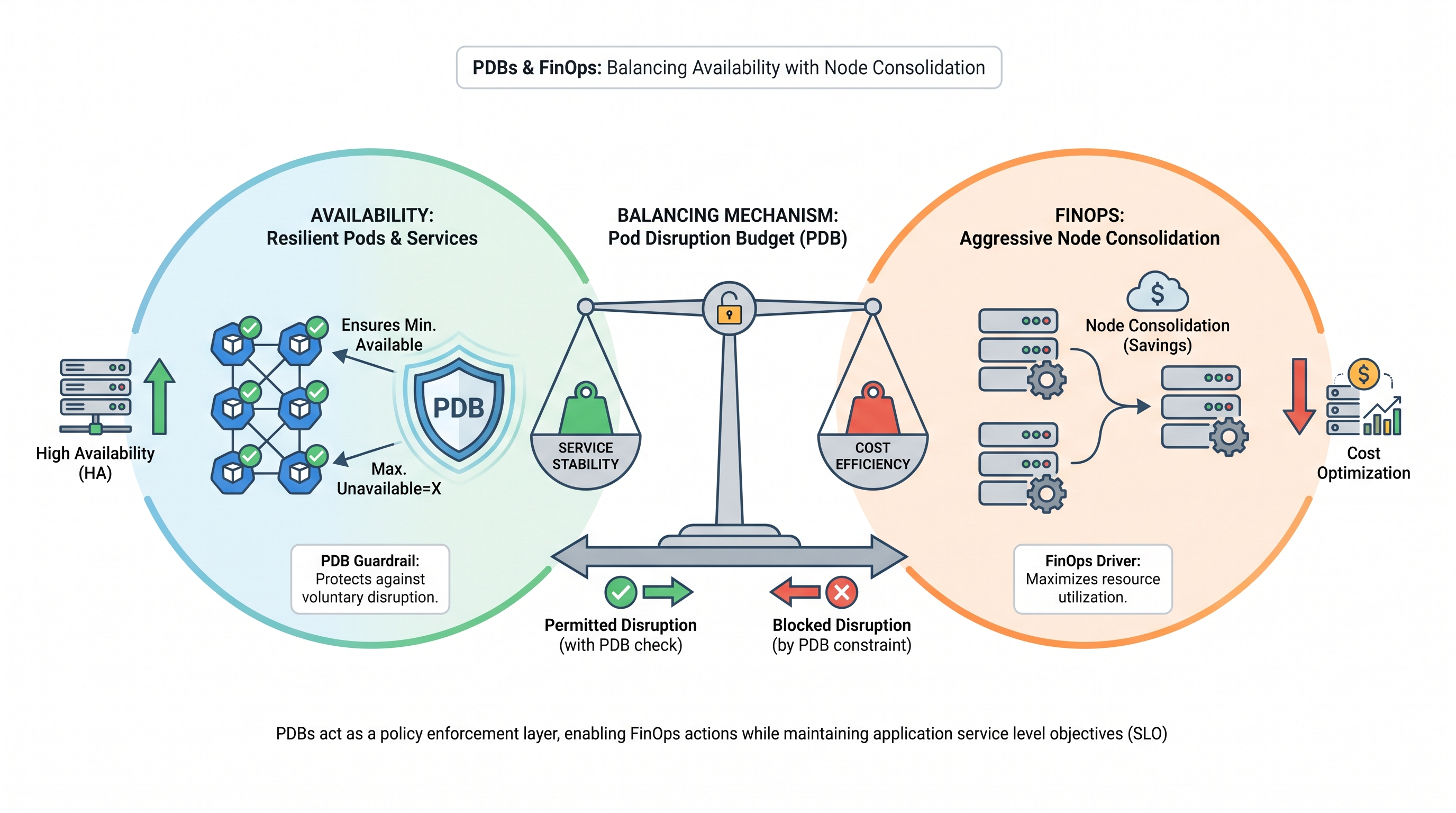
The FinOps and Kubernetes Scalability Paradox
In modern cloud-native architectures, the pursuit of infrastructure cost optimization has shifted from static, scheduled VM downsizing to dynamic, real-time compute consolidation. In Kubernetes environments, this is spearheaded by intelligent autoscalers such as Karpenter and Kubernetes Cluster Autoscaler (CA). These tools continuously analyze cluster state, bin-packing workloads onto the most cost-effective EC2, Azure VM, or Google Compute Engine instances, and terminating underutilized nodes to minimize waste.
However, this aggressive drive toward high-density bin-packing directly collides with the core objective of Site Reliability Engineering (SRE): maintaining high availability and honoring Service Level Agreements (SLAs). To prevent application downtime during routine cluster maintenance, node upgrades, or autoscaling events, platform engineers implement Pod Disruption Budgets (PDBs). PDBs limit the number of pods of a replicated application that can be down simultaneously from voluntary disruptions.
The friction between these two paradigms creates a classic engineering paradox. FinOps-driven autoscalers attempt to evict pods to consolidate nodes and slash compute spend, while strict, safety-first PDBs block those evictions to safeguard availability. When misconfigured, this tension results in "PDB deadlocks"—situations where highly underutilized, expensive nodes cannot be terminated because a single pod is locked in place by an overly restrictive disruption budget. To resolve this, modern enterprises require a unified financial operations platform that bridges the gap between raw compute lifecycle management and application-level availability constraints.
The Mechanics of Aggressive Node Consolidation
To understand why PDBs block cost optimization, we must first examine how modern Kubernetes autoscalers execute node consolidation. Legacy autoscalers relied purely on reactive metrics, scaling up when pods failed to schedule due to insufficient CPU or memory, and scaling down when node utilization fell below a static threshold (e.g., 50% utilization for over 10 minutes).
Modern declarative autoscalers, particularly Karpenter, operate on a highly proactive, multi-dimensional consolidation model. Karpenter continuously evaluates the cluster's active pods and nodes against two primary consolidation policies:
WhenEmpty: Identifies nodes that have zero daemonsets or non-daemonset pods running on them and terminates them immediately to eliminate idle compute overhead.
WhenUnderutilized: Identifies nodes where the aggregate resource requests of running pods can be consolidated onto a smaller number of highly-packed nodes, or onto a single, cheaper instance type.
Consider a scenario where three c5.xlarge instances (each costing ~$0.17/hr on AWS) are running at 25% utilization. Collectively, their workloads could easily fit onto a single c5.xlarge. Karpenter’s consolidation algorithm calculates this delta, provisions a single new node (or identifies an existing node with spare capacity), initiates the migration of the pods, and schedules the old, redundant nodes for termination. This process of continuous bin-packing is the cornerstone of cloud cost optimization, saving enterprises up to 40% on raw compute spend.
The Kubernetes Eviction API and the PDB Safeguard
When an autoscaler decides to terminate a node during consolidation, it does not simply call the cloud provider's API to delete the VM. Doing so would abruptly terminate running containers, causing dropped connections, database transaction failures, and severe user-impacting downtime. Instead, the autoscaler initiates a graceful shutdown sequence using the Kubernetes Eviction API.
The eviction process differs fundamentally from a standard pod deletion. While a deletion bypasses policy checks and immediately schedules a pod for termination, an eviction request (sent to the /eviction subresource of the pod) is a collaborative contract between the API server, the autoscaler, and the application controllers. The sequence operates as follows:
The autoscaler taints the target node with
key: node.kubernetes.io/unschedulableto prevent the scheduler from placing new workloads on it.The autoscaler calls the Eviction API for each non-daemonset pod running on the target node.
The API server intercepts the eviction request and queries the cluster's active
PodDisruptionBudgetresources to see if the eviction violates any defined availability constraints.If the eviction is safe (i.e., the number of active pods remains above
minAvailableor the number of offline pods remains belowmaxUnavailable), the API server approves the eviction, and the pod is gracefully terminated and rescheduled on a different node.If the eviction violates the PDB, the API server rejects the request with a
429 Too Many Requestsstatus code. The autoscaler must back off, and the node cannot be terminated.
This protection mechanism is critical for operational stability, but when infrastructure and SRE teams operate in silos, PDBs are often configured with zero visibility into the underlying compute costs, leading to severe architectural bottlenecks.
The Anatomy of a PDB Deadlock
A PDB deadlock occurs when a Pod Disruption Budget is configured in a way that makes it mathematically impossible for the API server to ever approve an eviction, effectively locking a pod—and its underlying host node—in place indefinitely. Let's look at the two most common manifests of this anti-pattern.
Anti-Pattern 1: The Single-Replica PDB Lock
SREs frequently deploy critical single-replica utility workloads (e.g., a lightweight internal proxy, a batch job coordinator, or a legacy monolithic service) and apply a safety-first PDB to ensure it never goes down. Consider the following YAML manifest:
apiVersion: policy/v1
kind: PodDisruptionBudget
metadata:
  name: single-replica-deadlock
  namespace: production
spec:
  minAvailable: 1
  selector:
    matchLabels:
      app: legacy-proxy
---
apiVersion: apps/v1
kind: Deployment
metadata:
  name: legacy-proxy
  namespace: production
spec:
  replicas: 1
  selector:
    matchLabels:
      app: legacy-proxy
  template:
    metadata:
      labels:
        app: legacy-proxy
    spec:
      containers:
      - name: proxy
        image: nginx:1.25
In this scenario, the deployment has exactly replicas: 1, and the PDB mandates that minAvailable: 1 pod must always be healthy. When Karpenter attempts to consolidate the node hosting this pod, it calls the Eviction API. The API server evaluates the request: if it evicts the single running pod, the number of healthy pods drops to 0, which violates the minAvailable: 1 rule. Consequently, the API server rejects the eviction request.
Because the pod cannot be evicted, the node cannot be drained. Karpenter is blocked from consolidating the node, and the enterprise continues to pay for a potentially massive, underutilized VM. If this node is an m5.4xlarge costing approximately $550/month, a single misconfigured PDB on a tiny 0.1 vCPU container wastes thousands of dollars annually.
Anti-Pattern 2: The 100% Availability Paradox
Another common mistake is defining PDBs using percentages that do not scale down gracefully, or specifying maxUnavailable: 0. SREs often configure manifests like this:
apiVersion: policy/v1
kind: PodDisruptionBudget
metadata:
  name: strict-availability
  namespace: payment-processing
spec:
  maxUnavailable: 0
  selector:
    matchLabels:
      app: checkout-api
By defining maxUnavailable: 0, the engineering team is declaring that zero pods can be unavailable at any given time. While this sounds ideal for high-availability payment gateways, it completely breaks the Eviction API. To evict a pod, it must temporarily become unavailable while its replacement schedules and passes readiness probes on another node. Under a maxUnavailable: 0 constraint, the eviction is instantly blocked, locking the entire deployment onto its current physical hardware and preventing any form of automated node rotation, OS patching, or cost consolidation.
The Financial Impact of PDB Lock-In
To quantify the financial damage of PDB deadlocks, let us examine a real-world scenario of a mid-sized enterprise cluster running on AWS. The cluster consists of 120 nodes running a mix of microservices. The average node type is an m6i.2xlarge ($0.384/hour, or ~$276/month per node).
Due to fluctuating traffic patterns, the actual CPU and memory utilization of the cluster hovers around 35%. Without constraints, an autoscaler like Karpenter could easily consolidate these workloads, reducing the node count from 120 to 65. This consolidation would slash the monthly compute bill from $33,120 to $17,940—a monthly savings of $15,180 (45.8%).
However, suppose that across these microservices, 15 different deployments have misconfigured PDBs (either minAvailable: 1 on single replicas, or maxUnavailable: 0). These 15 pods are scattered across 15 different m6i.2xlarge nodes. Because the Eviction API cannot touch these pods, Karpenter is legally blocked from consolidating those 15 nodes, even if they are running at 5% utilization.
The resulting financial reality is illustrated below:
Metric | Theoretical Optimal State | PDB-Blocked State | Financial Waste (Monthly) |
|---|---|---|---|
Active Nodes | 65 nodes | 80 nodes (65 + 15 blocked) | 15 unnecessary nodes |
Compute Cost | $17,940 / month | $22,080 / month | $4,140 / month |
Cluster Utilization | ~64% (Highly optimized) | ~52% (Sub-optimal) | N/A |
In this scenario, the enterprise is leaking $4,140 every single month—nearly $50,000 annually—not because of actual business traffic or resource demands, but purely due to logical configuration locks in their Kubernetes manifests. This highlights the critical need for continuous operational intelligence to detect and remediate configuration-driven cloud waste.
Architecting the Solution: Production-Grade PDB Patterns
To break the deadlock between availability and FinOps, platform architects must implement robust, programmatic patterns that allow autoscalers to do their job without compromising application SLAs. Below are the core architectural strategies to achieve this balance.
1. Transitioning to Percentage-Based PDBs
Instead of hardcoding absolute integers for minAvailable or maxUnavailable, teams should utilize percentages. Percentages scale dynamically as the Deployment or StatefulSet scales up and down via Horizontal Pod Autoscalers (HPAs). For example, a maxUnavailable: 25% ensures that regardless of whether you have 4 replicas or 40, the eviction API can always drain a subset of pods, allowing node consolidation to proceed incrementally.
apiVersion: policy/v1
kind: PodDisruptionBudget
metadata:
  name: dynamic-percentage-pdb
  namespace: production
spec:
  maxUnavailable: 25%
  selector:
    matchLabels:
      app: checkout-api
2. The Multi-Replica Minimum Rule
As a strict platform engineering standard, no application should be allowed to deploy a PDB unless its replica count is greater than or equal to 2. If an application is non-critical enough to run as a single replica, it does not warrant a PDB that blocks cluster-level cost optimization. You can enforce this standard globally using policy engines like OPA Gatekeeper or Kyverno, or through automated guardrails that prevent the deployment of PDBs on single-replica workloads.
3. Karpenter Disruption Controls and Expiration
When configuring Karpenter, platform teams can leverage advanced disruption controls to fine-tune how aggressively consolidation occurs. For example, Karpenter allows you to specify a node's maximum lifetime (preventing long-running, unpatched nodes) and configure specific consolidation policies that respect application workloads. Additionally, you can annotate specific pods to tell Karpenter to ignore them during consolidation, or conversely, bypass certain restrictions for non-production environments.
In non-production environments (development, testing, staging), cost optimization should almost always take precedence over absolute availability. You can programmatically strip PDBs from non-prod namespaces during off-hours, allowing Karpenter to aggressively bin-pack and downscale clusters to near-zero states overnight.
4. Leveraging Pod Priority and Preemption
To ensure that critical business workloads can always evict lower-priority utility workloads during node consolidation, implement Kubernetes PriorityClasses. By defining clear priority tiers, you allow the scheduler to preempt and evict non-essential pods to make room for high-priority workloads, even when nodes are heavily packed.
apiVersion: scheduling.k8s.io/v1
kind: PriorityClass
metadata:
  name: low-priority-utility
value: 10000
globalDefault: false
description: "Non-critical utility pods that can be preempted for cost consolidation."
Security and Patching Implications
The conflict between PDBs and node consolidation is not merely a financial concern; it is a critical security vulnerability. In the modern threat landscape, keeping node Operating Systems and container runtimes secure requires continuous, aggressive patching. Best practices dictate that nodes should be rotated frequently (e.g., every 7 to 30 days) to ingest the latest Amazon Linux, Ubuntu, or Bottlerocket AMIs containing critical security patches.
If a misconfigured PDB deadlocks an eviction, it doesn't just block Karpenter's cost-saving consolidation; it also blocks the automated security patching pipeline. The outdated, vulnerable node remains active in the cluster indefinitely because the automated patch coordinator cannot drain the node without violating the PDB.
By utilizing the Atler AI engine, organizations can gain deep, cross-layer visibility that correlates cloud security vulnerabilities with Kubernetes-level configuration blocks. This ensures that security teams, platform engineers, and FinOps analysts operate from a single, unified source of truth, allowing them to safely execute node rotations and patch applications without risking unplanned downtime.
Conclusion: Unify FinOps, Security, and Operations with CloudAtler
Achieving the perfect equilibrium between aggressive cloud cost optimization and rock-solid application availability is one of the most complex challenges in modern Kubernetes platform engineering. As we have explored, Pod Disruption Budgets are a vital tool for SREs, but without proper cross-layer visibility, they quickly morph into silent financial leaks and security vulnerabilities that block automated node consolidation and patching.
Solving this challenge requires moving away from fragmented, siloed tools and embracing a unified, intelligent approach to cloud operations. CloudAtler is the industry's premier AI-powered platform designed to unify FinOps, cloud security, and automated operations across AWS, Azure, GCP, and Oracle Cloud environments. By continuously analyzing your infrastructure's compute lifecycles, configuration states, and real-time utilization metrics, CloudAtler automatically identifies PDB deadlocks, highlights underutilized compute spend, and provides actionable, automated remediation paths to keep your clusters both secure and highly cost-optimized.
Don't let legacy configurations hold back your cloud efficiency. Explore CloudAtler today or schedule a personalized demo to see how our unified platform can transform your enterprise cloud operations.
All in One Place
Atler Pilot decodes your cloud spend story by bringing monitoring, automation, and intelligent insights together for faster and better cloud operations.