
It used to be that the most unpredictable line item on a Chief Technology Officer’s budget was "Data Transfer." You could generally predict compute spend based on user load, and storage costs grew linearly with data accumulation. But in 2026, that era of predictability seems quaint, almost nostalgic. Today, the most volatile, opaque, and rapidly expanding cost center in the modern enterprise is "Intelligence."
We are firmly witnessing the second phase of the Generative AI revolution. The first phase, which dominated the headlines of 2023 and 2024, was "Make it work." It was a time of frenetic experimentation, where engineering teams were given blank checks to integrate Large Language Models (LLMs) into products, regardless of the backend inefficiencies. The mandate was simply to ship features that dazzled stakeholders.
The current phase, however, is "Make it profitable." As enterprises graduate from cool internal demos to production-grade AI Agents and customer-facing chatbots, they are colliding with a harsh economic reality: intelligence is expensive, and it scales differently than any software we have built before. A traditional SaaS application scales with users; an AI application scales with complexity.
A single runaway agent loop, a poorly optimized RAG pipeline, or a "zombie" inference endpoint can burn through a quarterly budget in a single weekend. The sheer variance in pricing is staggering, where a highly efficient model like DeepSeek R1 might cost 1/27th the price of OpenAI o1 for a similar reasoning task. This means that architectural decisions are no longer just technical choices; they are high-stakes financial decisions that directly impact gross margins.
This is the era of AI FinOps. It is no longer enough to just monitor cloud spend, and you must manage the unit economics of thought. This guide serves as your strategic pillar for navigating the complex financial landscape of Generative AI FinOps, creating a bridge between the engineering reality of LLM pricing and the financial discipline required by the boardroom.
The AI FinOps Framework
To control the costs of Generative AI, we must first acknowledge why they are so difficult to manage compared to traditional cloud spend. Traditional Cloud FinOps focuses on three predictable resources: Compute, Storage, and Networking. AI FinOps adds a fourth, chaotic dimension: Stochasticity.
Unlike a traditional database query that costs roughly the same amount of CPU cycles every time it runs, an LLM’s cost varies wildly based on the "verbosity" of its answer, the complexity of the prompt, and the number of "reasoning steps" it takes to conclude. Two users asking the same question might trigger costs that differ by 300% depending on how the model "decides" to answer or how many tools it calls in the process.
To tame this, we must adapt to the standard FinOps lifecycle that is Inform, Optimize, and Operate, specifically for the cost of Generative AI.
The Inform Phase: Visibility into "Cost Per Thought"
You cannot optimize what you cannot measure, and in the AI world, a monthly bill for "Amazon SageMaker" or "Azure OpenAI Service" is woefully insufficient. You need granular attribution. In 2026, a mature AI FinOps practice requires visibility into Cost Per Token and, more importantly, Cost Per Conversation.
You must be able to trace a spike in spending back to a specific prompt version or a specific agentic workflow. This requires a fundamental shift in tagging strategy. It is not enough to tag resources by "Team"; you must tag individual inference calls with metadata regarding the specific model version, the intent of the user, and the outcome of the transaction. Without this, you are merely observing the bill, not understanding it. You need to answer: Which internal app is driving the surge? Is it the Marketing Copy Generator or the Customer Support Bot?
The Optimize Phase: The Architecture of Affordability
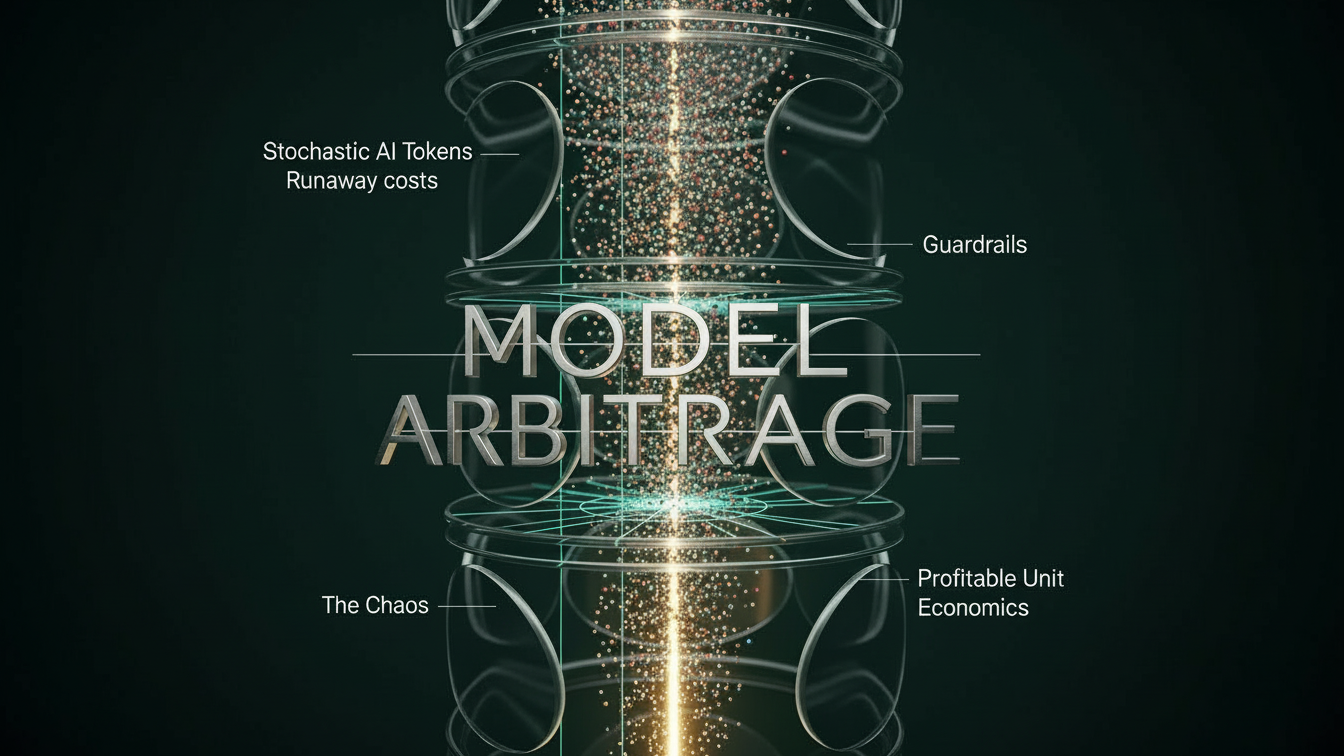
This involves making high-stakes trade-offs between performance and price. This is where the concept of "Model Arbitrage" comes into play. Does your internal knowledge base really need the "PhD-level" reasoning of GPT-4 to summarize a 200-word email? Likely not. A smaller, quantized model like Llama 3 (8B) could perform that task for 99% less cost.
Optimization in 2026 is about right-sizing intelligence to the problem. It involves techniques like semantic caching, where you store the answers to common questions in a cheap database (Redis) to avoid calling the expensive LLM entirely for repeat queries. It involves pruning your prompts to remove unnecessary tokens that inflate the bill.
The Operate Phase: Automated Governance
The goal here is to move from "Gatekeeping" (where finance approves every new model deployment) to "Guardrails" (where budget caps are enforced by code). This includes setting up "Circuit Breakers" at the application layer. If an autonomous agent enters a logic loop and begins calling an API 100 times a minute, your governance system should detect the anomaly and kill the process before it generates a $10,000 bill. It is about implementing AI cost management policies that are proactive, not reactive.
The Model War: Selecting Your "Intelligence Provider"
The most immediate and impactful lever for AI cost management is model selection. The gap between proprietary "frontier" models and open-source models has narrowed significantly in performance, but the price delta remains massive. We are currently living through a "Model War" where providers are racing to the bottom on price while racing to the top on capability.
Proprietary Models: The Premium Tier
Models like OpenAI o1 represent the cutting edge of reasoning. They are capable of "Chain of Thought" processing, where the model spends time "thinking" before it answers. This capability is revolutionary for complex coding tasks, medical diagnosis, or legal analysis, but it comes at a premium price point, often exceeding $15.00 per 1 million input tokens.
These models are priced for "heavy lifting." They are the Ferraris of the AI world, which provide incredible performance, but you do not want to use them to drive to the grocery store. Using these models for simple tasks like sentiment analysis or entity extraction is a massive allocation error that bleeds the budget. The key is to identify which 5% of your queries actually require this level of intelligence.
The Commodity Tier and Open Source
In early 2025, the market saw a fierce price shock with the rise of efficient models like DeepSeek R1 and the continued dominance of the Llama family. These models offer "good enough" performance for 80% of enterprise use cases at roughly 1/30th the cost of the frontier models. For example, DeepSeek R1 might cost as little as $0.55 per million tokens.
This price difference changes the fundamental unit economics of your application. If you can achieve 95% of the accuracy using a model that costs 96% less, the business case for the cheaper model is undeniable. However, relying on open source brings its own hidden costs, primarily the cost of hosting.
We crunch the numbers in our head-to-head battle: DeepSeek R1 vs. OpenAI o1: A Cost-Per-Token Analysis.
Managed API vs. Self-Hosted
The other major decision is where the model runs. Do you use a managed service like Amazon Bedrock, where you pay a premium for convenience, or do you spin up your own instances? Managed services are excellent for spiky workloads because you don't pay for idle time.
Infrastructure & Hardware: The Silicon Economics
If your organization chooses to self-host models or fine-tune them on your own data, your choice of silicon becomes the single biggest determinant of LLM pricing. The default choice for years has been Nvidia GPUs, but the monopoly is cracking, and the cloud providers are offering compelling alternatives.
The Rise of ASIC Inference
For pure inference (running the model to generate answers, not training it), general-purpose GPUs like the Nvidia H100 are often overkill. They are designed for the massive matrix multiplications required for training. AWS has introduced chips like AWS Inferentia2, which are Application-Specific Integrated Circuits (ASICs) designed specifically for low-cost inference. These chips strip away the unnecessary versatility of a GPU to focus entirely on running models efficiently.
Think of the Nvidia H100 as a sports car: incredible top speed, high versatility, and a high cost of ownership. It is necessary if you are training models from scratch. Think of AWS Inferentia2 as an electric city bus: it is highly efficient, designed for a specific route, and has a much lower "cost per mile." Benchmarks in 2026 suggest that for Llama-family models, Inferentia2 can deliver up to 40% better price-performance than comparable GPU instances. However, there is a catch: you cannot just "drop in" your code. You must compile your models using the AWS Neuron SDK. This engineering friction is the price you pay for the long-term operational savings.
Inference Architectures: Serverless vs. Dedicated
Another critical decision is the hosting model. Do you need a GPU waiting 24/7? With Dedicated Instances, you pay for the GPU every second it is running, regardless of whether anyone is using it. This is the "Data Center" model. It is best for steady, high-volume traffic where you can keep the GPU utilized at above 80%.
For most internal enterprise apps, however, usage is sporadic. Employees use the tool during the day, but it sits idle at night and on weekends. For these use cases, Serverless GPUs (like Amazon Bedrock or serverless endpoints on SageMaker) are superior. You pay a higher rate per minute, but you pay zero when the model is idle. A classic FinOps mistake is spinning up a dedicated g5.12xlarge instance for a chatbot that gets five queries an hour. That idle time is pure financial waste.
The Hidden Costs: Data, RAG, and Vectors
Generative AI FinOps isn't just about the model; it is about the context you feed it. Retrieval Augmented Generation (RAG) has become the standard architecture for enterprise AI, allowing models to chat with your private data. However, RAG introduces a new stack of hidden costs that often catch finance teams by surprise.
Vector Database Pricing and Optimization
To give an LLM "memory," you turn your text documents into numbers (vectors) and store them in a Vector Database like Pinecone, Milvus, or Weaviate. The trap here is that high-dimensional vectors are heavy. Storing millions of embeddings in RAM (Random Access Memory) is incredibly expensive. In the early days, engineers would load the entire database into memory for speed.
In 2026, FinOps for Vectors focuses on tiring. You do not need all your vectors in hot memory. Technologies like "Disk-ANN" (Approximate Nearest Neighbor on Disk) allow you to store the vast majority of your vector index on cheaper SSD storage while keeping only a small map in RAM. This can reduce your database infrastructure costs by 90% with only a negligible impact on retrieval latency. Additionally, "Quantization" allows you to compress the vectors themselves, reducing their size by 4x or 8x, which linearly reduces your storage bill.
Optimize your retrieval stack: FinOps for Vectors: Optimizing Database Costs in the Age of RAG.
Token Bloat and the Reranker Strategy
Every time you send a prompt to an LLM, you pay for the context. If your RAG system retrieves 10 irrelevant documents and feeds them to GPT-4 "just in case," you are paying for "digital garbage." This is called Token Bloat. It inflates your RAG pipeline TCO (Total Cost of Ownership) and degrades the model's performance because it gets confused by the irrelevant noise.
The tactical fix here is to implement a "Reranker" model. This is a small, cheap, and fast model that sits between your database and your LLM. It scans the 50 documents retrieved by the database, scores them for relevance, and only passes the top 3 most relevant documents to the expensive LLM. This extra step costs fractions of a penny but saves dollars in LLM tokens by keeping the context window tight and focused.
Learn how to identify and cut this waste: Understanding "Token Bloat": How Poor Prompts Increase Bills.
Development Strategy: The "Sandbox" & The "Loop"
How you build is just as expensive as what you build. The development phase of AI products is a notorious source of "Shadow IT" spending.
The ROI of Fine-Tuning vs. Prompt Engineering
There is a constant debate in engineering circles: should we train our own model (Fine-Tuning) or just ask the generic model nicely (Prompt Engineering)? The financial implications are distinct. Prompt Engineering allows for fast iteration but carries a high variable cost because you have to feed the model a long list of instructions (the "system prompt") with every single query.
Fine-Tuning (LoRA), on the other hand, requires a high upfront cost to rent GPUs for training time. However, the resulting model is "smarter" and requires fewer instructions. This lowers your variable cost per query because the prompts can be shorter. The AI FinOps decision here is a break-even calculation. You should start with prompt engineering. Only when your volume reaches a critical mass (often millions of requests per month) does the ROI of fine-tuning justify the upfront capital and ongoing maintenance burden.
The "Sandbox" Strategy for R&D
Developers love to experiment. If you give every developer access to GPT-4 with no limits, they will burn through the budget rapidly. The solution is the "Sandbox Strategy." This involves creating specific cloud accounts or API keys for R&D with hard, non-negotiable budget caps. When the $500 monthly limit is hit, the API keys stop working. It forces developers to be efficient with their tests and encourages them to use smaller models for debugging code before switching to the large model for the final run.
To go deeper into how organizations design these environments in practice, explore this guide on the sandbox strategy for AI R&D cost control.
The $50,000 Loop: Managing Autonomous Agents
Autonomous AI Agents are designed to "think, plan, and act." They are given a goal (e.g., "Book a flight"), and they autonomously call APIs until the goal is achieved. This creates a terrifying financial risk: The Infinite Loop. An agent might get stuck trying to solve a problem, encountering an error, and retrying endlessly. If it is calling a paid API or using an expensive model for reasoning, it can rack up thousands of dollars in fees in a matter of hours.
The defense against this is not just monitoring; it is hard limits. You need to implement "Budget Caps" and "Step Limits" at the application layer. An agent should never be allowed to run for more than N steps or spend more than $X without human intervention. This is the AI equivalent of a fuse box.
Measuring Success: AI Unit Economics & The Platform Decision
Ultimately, the goal of this guide is to help you define the AI unit economics of your business. You must move from tracking "Cloud Spend" to tracking "Margin Per AI Action."
Calculating Cost Per Autonomous Action
If your AI customer support agent costs $0.50 per resolution, and a human agent costs $6.00 per resolution, you have highly positive unit economics. In this scenario, a high cloud bill is actually a sign of success. It means you are saving money on labor. However, if you are building an internal "AI Writing Assistant" that costs $0.10 to generate a summary that the user never reads, you have 100% waste.
You must instrument your applications to track the "Utility" of the generation. Did the user copy the text? Did they rate it? Did it lead to a successful transaction? By dividing the cost of the generation by the value of the outcome, you can calculate the Cost Per Successful Action. This metric is the North Star of AI for cost management.
Deep dive into the metrics: AI Agent Unit Economics: Calculating Cost Per Autonomous Action.
Comparison: Vertex AI vs. SageMaker Pricing
For many executives, the platform choice is the first fork in the road. In 2026, the battle between Vertex AI vs. SageMaker is less about features and more about ecosystem lock-in and pricing philosophy.
Google Vertex AI often wins simplicity and pricing for startups. Its "Model Garden" makes it incredibly easy to deploy open-source models with one click, and its pricing for managed endpoints is often slightly more aggressive, especially for the Gemini family of models. Google's integration with BigQuery also allows for cheaper data preparation costs.
AWS SageMaker, conversely, offers deeper granularity and control, which is prized by large enterprises. Its "Savings Plans" for Compute apply to SageMaker instances, allowing you to bundle your AI spend with your general EC2 spend for larger discounts. However, SageMaker’s complexity can lead to higher "human costs" in terms of DevOps hours required to manage it.
Conclusion: The Price of Intelligence is Manageable
The "Intelligence Bill" will likely become one of the top three-line items in your IT budget by 2030. The companies that win in this new era will not be the ones who refuse to spend, but they will be the ones who spend efficiently.
They will be the organizations that successfully arbitrage models, finding the cheapest possible intelligence for each specific task. They will be the ones who optimize their hardware, moving away from generic GPUs to specialized ASICs. And they will be the ones who govern ruthlessly, stopping runaway agents before they can print a bill.
Next Step: Don't wait for the finance team to audit your AI initiatives. Start by auditing your Model Monitoring today. If you want to take complete control of your “intelligence bill,” you don’t need more spreadsheets, but you need real visibility.
Atler Pilot gives you a unified view of AI costs across models, vector stores, agents, and RAG pipelines. It shows you cost per conversation, detects token bloat, flags inefficient prompts, and prevents runaway agents before they burn a hole in your budget. Try Atler Pilot free and see how modern AI FinOps actually works.
All in One Place
Atler Pilot decodes your cloud spend story by bringing monitoring, automation, and intelligent insights together for faster and better cloud operations.