
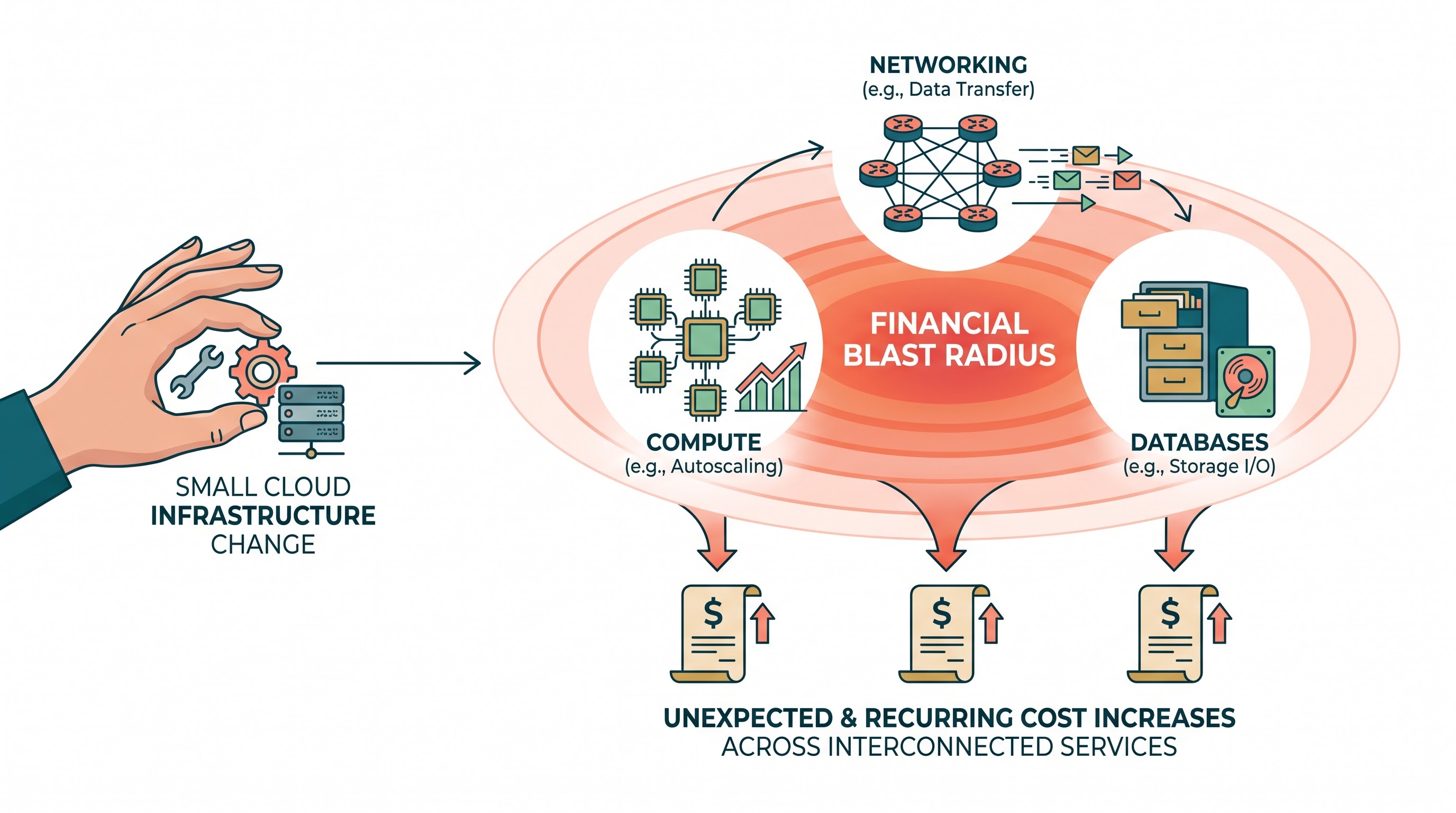
A small infrastructure change can have a surprisingly large effect on your cloud bill.
Increase a resource limit. Change an autoscaling policy. Deploy a new service. Move workloads to GPUs. Change a database configuration.
The change itself may take minutes.
The financial impact can continue for weeks.
This is the financial blast radius of infrastructure changes—the wider cloud cost impact created by a technical decision.
Understanding it is becoming increasingly important as cloud environments become more distributed, automated, and dynamic.
What Is the Financial Blast Radius?
The term "blast radius" is commonly used in engineering to describe how far the consequences of a failure can spread.
A small configuration error might affect one service.
A shared infrastructure change could affect hundreds of workloads.
The same idea applies to cloud economics.
An infrastructure change can affect more than the resource being modified. It can influence compute consumption, storage, networking, database usage, Kubernetes capacity, GPU utilization, observability costs, and even other dependent services.
For example, increasing the CPU allocation for a single Kubernetes workload may appear insignificant. But if that workload is deployed across dozens of pods and multiple clusters, the resulting increase in infrastructure consumption can become substantial.
The technical change is small.
The financial blast radius isn't.
Why Infrastructure Changes Affect More Than One Resource
Modern cloud applications are deeply interconnected.
A single application may depend on compute instances, Kubernetes clusters, databases, object storage, queues, APIs, monitoring systems, and networking services.
Changing one component can therefore influence several others.
Suppose an application deployment increases traffic to a database. Database capacity may need to increase. Additional compute could be required. More logs may be generated. Network traffic may rise. Caching behavior may change.
The original infrastructure change was a deployment.
The financial impact extends across the entire application architecture.
This is why looking only at the cost of the resource being changed can be misleading.
FinOps teams need to understand the cost propagation that occurs after infrastructure changes.
The Most Common Changes With a Large Financial Impact
Not every infrastructure change creates a significant cost increase.
However, certain categories deserve particular attention because their effects can scale quickly.
Autoscaling configuration is one example. A small change to minimum or maximum capacity can significantly increase the number of compute resources running during periods of demand.
Kubernetes resource requests are another. Increasing CPU or memory requests can influence scheduling and cluster capacity, potentially requiring additional nodes.
Database configuration changes can also have a substantial effect. Increasing storage, compute capacity, replicas, or retention periods may create recurring costs that continue long after the original change.
AI infrastructure presents an even more obvious example. Moving an inference workload onto larger GPUs can dramatically change the cost profile of an application.
The common factor is that these changes don't simply affect infrastructure once.
They can change how infrastructure is consumed continuously.
The Difference Between One-Time and Recurring Cost Impact
One of the most important aspects of a financial blast radius is whether the resulting cost is temporary or recurring.
A deployment that temporarily increases compute usage for a few hours has a very different financial impact from a configuration change that permanently increases baseline capacity.
This distinction can easily be overlooked during infrastructure reviews.
A team may approve a change because the immediate cost appears small.
But if the new configuration remains active indefinitely, that small increase becomes a recurring expense.
For example, adding two additional compute nodes might appear inexpensive when viewed as a single change. Over a year, however, those nodes represent a continuous infrastructure commitment.
This is why FinOps teams should consider the lifetime financial impact of infrastructure decisions rather than only their immediate cost.
Autoscaling Can Create a Financial Blast Radius
Autoscaling is designed to make cloud infrastructure more efficient.
But poorly configured autoscaling can produce the opposite result.
Suppose an application has a minimum capacity of two instances and a maximum capacity of twenty.
A configuration change increases the minimum to ten.
The application may still operate perfectly.
But the organization is now paying for eight additional instances even when demand is low.
A different change could modify scaling thresholds so that workloads scale out earlier or remain active longer.
Again, the infrastructure isn't necessarily broken.
The financial behavior has changed.
This is why autoscaling policies should be treated as financial controls as well as reliability mechanisms.
The objective is to maintain sufficient capacity without creating unnecessary baseline spending.
Kubernetes Makes Cost Propagation More Complex
Kubernetes environments are particularly susceptible to financial blast radius because infrastructure is shared across many workloads.
A small change to resource requests can affect scheduling decisions across an entire cluster.
If several deployments increase their CPU or memory requests simultaneously, the cluster may require additional nodes.
Those nodes then create additional compute costs.
The individual application teams may not realize that their resource changes contributed to the infrastructure expansion.
This is where Kubernetes cost allocation becomes important.
Teams need to understand how workload-level configuration changes influence node-level infrastructure spending.
Without that visibility, organizations may blame the platform team for rising cluster costs when the underlying cause is actually a series of workload-level changes.
A shared cost and infrastructure view makes this relationship much easier to identify.
AI Infrastructure Has an Especially Large Blast Radius
AI workloads can amplify the financial impact of infrastructure decisions.
A change from CPU-based processing to GPU-based inference can create a dramatic difference in infrastructure cost.
Similarly, increasing GPU memory capacity, changing model-serving architecture, adding replicas, or keeping inference endpoints continuously warm can substantially change spending.
AI workloads also tend to be highly dynamic.
A model deployment may increase inference volume.
An agentic workflow may generate additional model calls.
A larger context window may increase token consumption.
A routing change may send more requests toward premium models.
These changes can interact with underlying infrastructure costs.
As AI adoption grows, FinOps teams need to understand not only the cost of GPUs but also the workload decisions that determine how those GPUs are consumed.
The Hidden Blast Radius of Networking
Infrastructure changes can also create unexpected networking costs.
Moving a workload between regions, changing service architecture, introducing additional microservices, or modifying data pipelines can increase network traffic.
A change that appears to optimize compute might therefore increase data transfer costs.
For example, moving a compute workload to a cheaper region may reduce compute spending while increasing the cost of transferring data between regions.
The net financial impact could be negative.
This demonstrates why infrastructure changes should be evaluated across the complete architecture.
Optimizing one resource without considering its dependencies can simply move the cost somewhere else.
Why Microservices Increase Financial Complexity
Microservices create flexibility, but they also create more relationships between infrastructure components.
A single application transaction can pass through multiple services.
A deployment affecting one service can therefore influence downstream services.
If a new service increases request volume, other components may scale automatically.
Database queries may increase.
Caching layers may consume more resources.
Logging volume may grow.
Network traffic can rise.
This creates a chain reaction.
The initial infrastructure change is only the beginning.
The financial blast radius extends through the dependency graph.
This is one reason modern FinOps needs to move beyond resource-level cost reporting toward application and architecture-level cost intelligence.
How to Measure the Financial Blast Radius
Measuring financial blast radius requires connecting infrastructure changes with subsequent cost behavior.
Start by identifying the change itself.
What was modified?
Which resource, application, service, or deployment was affected?
Then examine what changed afterward.
Did compute consumption increase?
Did additional nodes appear?
Did network traffic rise?
Did database utilization change?
Did GPU usage increase?
Did the application's cost per request change?
The most useful analysis compares the environment before and after the infrastructure change.
Historical baselines can help identify whether the resulting cost movement is normal or unusual.
This creates a direct connection between engineering activity and financial impact.
Cost Attribution Makes the Blast Radius Visible
Accurate cost attribution is essential because infrastructure changes frequently affect shared resources.
If a platform team owns an entire Kubernetes cluster, it may be difficult to determine which application changes caused the cluster to scale.
Similarly, a centralized AI platform may host models for several products.
Without workload-level attribution, the financial impact of individual changes remains hidden inside shared infrastructure costs.
Tagging, namespaces, workload metadata, resource ownership, and application-level cost allocation can help connect spending to the teams and systems responsible for it.
This doesn't mean every cost needs to be perfectly allocated.
The objective is to create enough financial context to understand where changes are influencing spending.
Infrastructure Changes Should Include Cost Impact Analysis
Architecture reviews and deployment processes often focus on reliability, security, and performance.
Cost should become another dimension.
Before making a significant infrastructure change, teams should ask how it could affect cloud spending.
Will it increase baseline capacity?
Could it trigger autoscaling?
Will it increase data transfer?
Could it increase database consumption?
Will it require more GPUs?
Does it introduce additional logging or observability costs?
Is the cost increase temporary or recurring?
These questions don't need to slow down engineering.
They simply make financial impact part of the technical decision.
Use Atler Pilot to Trace Infrastructure Cost Impact
Understanding the financial blast radius requires more than a cloud billing report.
Teams need to connect infrastructure changes with workload behavior, utilization, cost, and operational context.
Atler Pilot brings these dimensions together through cloud cost visibility, infrastructure telemetry, workload intelligence, utilization analytics, and operational context.
This helps engineering, DevOps, SRE, platform, and FinOps teams investigate how infrastructure changes affect cloud spending.
A deployment that increases compute consumption can be analyzed alongside workload behavior.
A Kubernetes configuration change can be evaluated against cluster utilization.
An AI workload change can be connected with GPU usage and inference activity.
A sudden cost increase can be investigated alongside recent infrastructure changes.
This type of connected visibility makes it easier to understand not just what became more expensive, but what caused it.
Building a Financially Aware Infrastructure Culture
The long-term solution isn't to prevent engineers from making infrastructure changes.
Cloud environments need to evolve constantly.
The goal is to make financial impact part of normal engineering thinking.
When developers understand that a configuration change can influence cloud costs, they can make more informed decisions.
When FinOps teams understand the technical reason behind cost changes, they can provide more useful recommendations.
When platform teams can see how workload decisions influence shared infrastructure, they can improve capacity planning.
This creates a culture where cost becomes another engineering signal.
Just as teams monitor latency, availability, and performance, they begin monitoring financial impact.
From Cost Reporting to Change Intelligence
Traditional FinOps often answers a backward-looking question:
"Where did we spend money?"
Financial blast radius analysis asks a more useful question:
"Which changes caused our spending to move?"
That shift is significant.
It connects cloud economics with engineering activity.
A cost increase is no longer simply a number on a dashboard.
It becomes a traceable event.
A deployment happened.
A resource configuration changed.
A workload scaled.
Infrastructure consumption increased.
Cloud spending followed.
When organizations can see this chain, cost optimization becomes much more proactive.
Teams can identify expensive changes earlier, understand their impact, and decide whether the additional cost is justified.
Conclusion
Infrastructure changes rarely stay isolated.
A seemingly small configuration update can influence autoscaling, compute capacity, databases, networking, Kubernetes clusters, GPUs, and downstream services.
That's the financial blast radius.
The challenge isn't stopping these changes.
It's understanding their consequences.
As cloud environments become more distributed and AI workloads become more dynamic, organizations need to connect engineering decisions with financial outcomes.
That means monitoring cost alongside infrastructure behavior, improving workload-level attribution, analyzing changes against historical baselines, and making financial impact part of architecture and deployment decisions.
The most mature FinOps teams won't simply tell engineers that cloud spending increased.
They'll be able to explain which change caused it, how far its impact spread, and whether the additional cost created enough value to justify it.
That's the difference between monitoring cloud costs and actually understanding cloud economics.
Frequently Asked Questions
What is the financial blast radius of an infrastructure change?
The financial blast radius is the broader cloud cost impact created by an infrastructure change. A change to one resource can affect dependent services, scaling behavior, network traffic, databases, Kubernetes capacity, GPUs, and other infrastructure, creating costs beyond the original resource.
Why is financial blast radius important in FinOps?
It helps FinOps and engineering teams understand the relationship between technical decisions and cloud spending. Instead of simply identifying that costs increased, teams can investigate which infrastructure changes caused the increase and how widely the impact spread.
Which infrastructure changes can have the largest financial impact?
Autoscaling configuration, Kubernetes resource requests, GPU deployments, database capacity changes, architectural changes, regional migrations, and changes that increase network traffic can all create significant recurring or indirect cloud costs.
How can teams reduce the financial impact of infrastructure changes?
Teams can include cost impact in architecture reviews, monitor utilization after deployments, establish clear resource ownership, analyze cost changes against historical baselines, and use workload-level cost attribution to identify the financial consequences of technical decisions.
How does infrastructure observability help FinOps?
Infrastructure observability provides the operational context needed to understand cloud spending. By correlating deployments, resource changes, utilization, workloads, and costs, teams can identify the causes of financial changes rather than simply reporting the resulting bill.
All in One Place
Atler Pilot decodes your cloud spend story by bringing monitoring, automation, and intelligent insights together for faster and better cloud operations.