
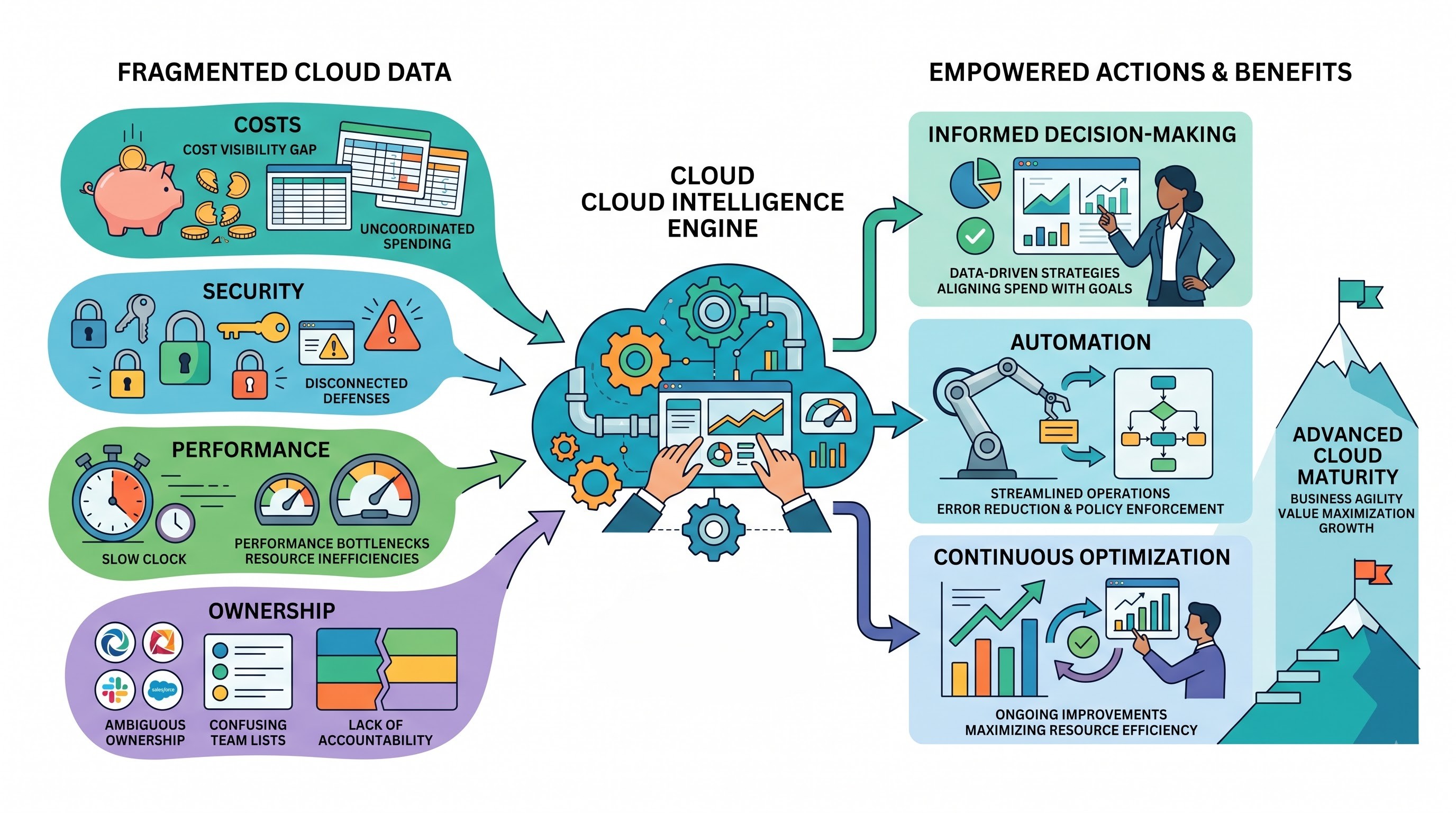
Most organizations don't struggle with the cloud because they lack infrastructure.
They struggle because they don't always know what is happening across that infrastructure, why it is happening, and what they should do about it next.
As cloud environments grow across accounts, regions, Kubernetes clusters, AI workloads, and multiple services, simply moving more workloads to the cloud doesn't necessarily make an organization more mature.
Cloud maturity is about how effectively an organization can understand, operate, optimize, govern, and continuously improve its cloud environment.
That is where cloud intelligence becomes important.
The next stage of cloud maturity isn't just about having more automation or adopting more cloud services. It is about turning the enormous amount of infrastructure data already being generated into better decisions.
What Is Cloud Maturity?
Cloud maturity refers to an organization's ability to use cloud infrastructure effectively, consistently, securely, and economically as its environment grows.
A mature cloud organization isn't necessarily the one with the most advanced architecture.
It is the organization that has a clear understanding of its infrastructure and can make informed decisions about it.
This includes knowing which resources exist, who owns them, how they are being used, what they cost, how they perform, what risks they create, and how they contribute to business objectives.
Cloud maturity therefore spans multiple disciplines.
It includes infrastructure operations, FinOps, security, governance, observability, automation, architecture, and increasingly AI infrastructure management.
As these areas become more interconnected, intelligence becomes a critical component of maturity.
The Difference Between Cloud Adoption and Cloud Maturity
Cloud adoption and cloud maturity are often treated as if they mean the same thing.
They don't.
Cloud adoption is about moving workloads and capabilities into cloud environments.
Cloud maturity is about how effectively the organization operates those environments after adoption.
An organization can have hundreds of cloud workloads and still have poor visibility into costs, unclear resource ownership, inconsistent security controls, and manual operational processes.
That organization is using the cloud.
It isn't necessarily operating it maturely.
Maturity comes from building repeatable processes and continuously improving them.
Intelligence helps accelerate that progression by providing the information required to understand where the environment currently stands and what needs to change.
Why Visibility Is the First Step Toward Maturity
An organization cannot effectively manage infrastructure it cannot see.
Cloud environments generate enormous amounts of information.
Billing systems provide cost data.
Monitoring platforms provide performance metrics.
Security systems provide risk information.
Cloud providers provide infrastructure telemetry.
Kubernetes generates workload and resource information.
CI/CD systems record deployments and infrastructure changes.
The challenge is not necessarily a lack of data.
It is the fragmentation of that data.
When each team sees only part of the environment, important relationships remain hidden.
Cloud intelligence helps bring these signals together so teams can understand infrastructure as a connected system rather than a collection of isolated metrics.
From Visibility to Understanding
Visibility tells you what exists.
Intelligence helps explain what it means.
Consider a cloud resource with low utilization.
A traditional monitoring system may flag it as underutilized.
But intelligence requires additional context.
Is it a development resource?
Is it part of disaster recovery?
Does it support a critical application?
Does it intentionally maintain capacity for traffic spikes?
Is it generating significant cost?
Who owns it?
What would happen if it were removed?
These questions require relationships between infrastructure, workloads, cost, ownership, and operational behavior.
This is why cloud intelligence is more than monitoring.
It provides the context needed to turn raw data into actionable understanding.
Intelligence Makes FinOps More Mature
FinOps maturity is often measured by how well an organization can allocate, understand, forecast, and optimize cloud spending.
But mature FinOps needs to go beyond billing reports.
A cloud cost increase is not automatically a problem.
It could represent business growth.
It could come from a new product launch.
It could be caused by an infrastructure change.
It could indicate inefficient resource usage.
It could even be a security incident.
Intelligence helps distinguish between these possibilities.
By connecting cost data with infrastructure behavior, deployments, workload utilization, and ownership, teams can move from cost reporting to cost intelligence.
That makes FinOps more proactive and more useful to engineering teams.
Cloud Intelligence and Infrastructure Observability
Observability is another important component of cloud maturity.
Traditional monitoring answers questions about system health.
Observability goes deeper by helping teams understand why systems behave the way they do.
Cloud intelligence builds on this concept by connecting operational behavior with financial and business context.
For example, a sudden increase in compute utilization can be evaluated alongside a deployment.
A cost anomaly can be examined alongside a workload change.
A performance problem can be analyzed alongside infrastructure capacity.
This creates a more complete understanding of cloud behavior.
Instead of investigating cost, performance, and infrastructure separately, teams can investigate them as connected dimensions of the same event.
Why Context Is the Missing Layer
Cloud environments produce massive amounts of telemetry.
But data without context can still leave teams guessing.
A dashboard might show that GPU utilization is low.
It doesn't necessarily explain whether the capacity is unnecessary.
A billing system might show that a service became more expensive.
It doesn't explain whether the increase is justified.
A security tool might identify an excessive permission.
It doesn't necessarily show the business importance of the workload using it.
Context connects these signals.
Cloud intelligence creates that context by relating resources to workloads, owners, applications, dependencies, costs, and operational events.
This is what turns data into decision support.
Automation Is the Next Stage of Maturity
Once organizations have visibility and intelligence, they can begin automating decisions.
Automation is an important indicator of cloud maturity.
Organizations can automatically shut down eligible development resources, apply lifecycle policies, scale infrastructure, detect anomalies, or enforce security controls.
But automation without intelligence can be dangerous.
An automated system that doesn't understand context may optimize the wrong resource.
For example, automatically shutting down an underutilized database could create availability problems if the database is part of a disaster recovery architecture.
The progression therefore looks like this:
Visibility → Understanding → Intelligence → Automation → Continuous optimization
Each stage builds on the previous one.
The Role of AI in Cloud Intelligence
Artificial intelligence is changing what cloud intelligence platforms can do.
Traditional cloud management often requires engineers to interpret dashboards and decide what action to take.
AI can help analyze large volumes of infrastructure information and identify patterns humans may struggle to see manually.
An AI-powered system could identify a workload that is consistently overprovisioned, compare its utilization with similar workloads, evaluate its cost impact, and recommend a rightsizing opportunity.
It could also identify relationships between infrastructure changes and cost anomalies.
This doesn't eliminate the need for human expertise.
It gives experts better information with which to make decisions.
AI Infrastructure Is Creating a New Maturity Challenge
The rise of AI is also changing what cloud maturity means.
Organizations now need to manage GPUs, model APIs, inference infrastructure, vector databases, AI agents, and increasingly autonomous workloads.
Traditional cloud maturity frameworks don't always capture these requirements.
AI infrastructure introduces new questions.
How efficiently are GPUs being used?
Which models are generating the most cost?
How much does an AI workflow cost per successful outcome?
Which agents have access to sensitive infrastructure?
How much infrastructure does an AI application create dynamically?
What happens when an AI workload behaves differently from its historical pattern?
Cloud intelligence becomes increasingly important because these questions require information across infrastructure, cost, security, and workload behavior.
Intelligence Helps Connect Security and FinOps
Cloud maturity also depends on breaking down operational silos.
Security teams care about risk.
FinOps teams care about economics.
Engineering teams care about performance and reliability.
Governance teams care about policy.
These teams often work with overlapping infrastructure but different datasets.
Cloud intelligence can provide a shared operational context.
A cost anomaly may require security investigation.
A security control may influence cloud spending.
A resource optimization recommendation may need to consider compliance requirements.
A shared view makes these relationships visible.
This supports the convergence of FinOps, security, governance, and infrastructure operations.
Cloud Governance Becomes More Effective With Intelligence
Governance traditionally relies on policies.
For example, an organization might require all production resources to have owners or prohibit certain configurations.
But policies are only useful if organizations can continuously determine whether they are being followed.
Cloud intelligence provides the visibility required for this.
It can help identify resources without ownership, unusual infrastructure changes, excessive utilization, unexpected cost growth, or configurations that fall outside organizational standards.
This shifts governance from periodic compliance checks toward continuous operational control.
Intelligence Helps Organizations Manage Cloud Complexity
Complexity is one of the biggest barriers to cloud maturity.
As organizations scale, they often accumulate multiple cloud accounts, regions, services, teams, clusters, applications, and environments.
The number of relationships between these components can grow extremely quickly.
Humans cannot manually understand every dependency.
Cloud intelligence helps simplify that complexity by creating higher-level views.
Instead of looking at individual resources, teams can analyze applications, workloads, services, and business functions.
This abstraction makes large environments easier to manage.
Measuring Cloud Maturity Through Decision Quality
Cloud maturity should ultimately be measured by more than infrastructure adoption.
One useful indicator is decision quality.
Can the organization explain why cloud costs changed?
Can engineering teams understand the financial impact of infrastructure changes?
Can security teams identify which identities create the greatest risk?
Can platform teams identify underutilized infrastructure?
Can leadership understand whether cloud spending is generating business value?
Can teams respond quickly when infrastructure behavior changes?
The ability to answer these questions demonstrates a higher level of cloud maturity.
Intelligence improves decision quality because it reduces uncertainty.
The Importance of Continuous Learning
Cloud environments don't remain static.
Applications change.
Traffic changes.
Teams change.
Cloud pricing changes.
Architectures evolve.
AI workloads introduce new behavior.
A mature organization therefore needs continuous learning.
Optimization recommendations that were appropriate six months ago may no longer be relevant.
A workload that was previously efficient may become oversized as usage changes.
A security policy may need to evolve as architecture changes.
Cloud intelligence provides the feedback loop required for continuous improvement.
The organization can observe what happened, understand why it happened, make a change, and measure the result.
That creates a cycle of continuous cloud maturity.
Using Atler Pilot to Advance Cloud Maturity
Advancing cloud maturity requires a connected view of cost, infrastructure, utilization, workload behavior, and operational context.
Atler Pilot brings these dimensions together to help organizations understand how their cloud environment behaves both technically and financially.
Teams can use this broader context to investigate cost changes, understand workload utilization, identify optimization opportunities, and connect infrastructure behavior with operational decisions.
For organizations managing Kubernetes, AI workloads, multi-cloud environments, or highly dynamic infrastructure, this connected intelligence becomes particularly valuable.
The goal isn't simply to provide another layer of reporting.
It is to help teams move through the maturity curve from seeing infrastructure to understanding it, optimizing it, and eventually automating decisions around it.
A Practical Cloud Maturity Model
Organizations can think about cloud maturity as a progression.
At the earliest stage, teams have limited visibility and manage infrastructure reactively.
The next stage introduces centralized monitoring and basic cost reporting.
More mature organizations establish ownership, governance, FinOps practices, observability, and automated optimization.
Advanced organizations connect these capabilities and use intelligence to understand relationships across infrastructure.
The highest level of maturity involves continuous, policy-driven automation where systems can detect changes, evaluate their impact, and take appropriate action while maintaining human oversight for important decisions.
The important point is that maturity isn't about reaching a particular technology milestone.
It is about continuously improving the organization's ability to understand and control its cloud environment.
What Cloud Leaders Should Prioritize
Organizations looking to improve cloud maturity should begin with visibility.
They need an accurate understanding of infrastructure, workloads, ownership, costs, and utilization.
The next priority should be context.
Teams need to understand how these elements relate to one another.
Governance and accountability should then be strengthened so that resources have clear owners and policies can be enforced consistently.
Automation can follow once organizations have enough intelligence to make automated actions safe.
Finally, organizations should establish continuous feedback loops that measure whether optimization and governance decisions are producing the desired results.
This approach avoids trying to automate a cloud environment that the organization doesn't yet understand.
Conclusion
Cloud maturity is no longer simply about how much infrastructure an organization has moved to the cloud.
It is about how intelligently that infrastructure is operated.
As environments become more distributed, the challenge shifts from provisioning resources to understanding relationships.
Which workloads consume resources?
Who owns them?
Why are costs changing?
Which infrastructure is underutilized?
What security risks exist?
How do infrastructure changes affect performance?
Which AI workloads are creating value?
And what should happen next?
Cloud intelligence helps answer these questions by connecting fragmented infrastructure, financial, operational, and business signals.
That creates a progression from visibility to understanding, from understanding to optimization, and from optimization to intelligent automation.
The organizations that reach higher levels of cloud maturity won't necessarily be those with the most sophisticated infrastructure.
They'll be the ones that can understand their infrastructure quickly, make better decisions with that understanding, and continuously improve as the environment changes.
In that sense, intelligence isn't simply another capability added to cloud operations.
It is becoming the layer that makes cloud maturity possible.
Frequently Asked Questions
What is cloud maturity?
Cloud maturity describes an organization's ability to effectively manage, optimize, secure, govern, and continuously improve its cloud environment. It goes beyond cloud adoption and focuses on operational effectiveness and decision quality.
Why is intelligence important for cloud maturity?
Cloud environments generate enormous amounts of cost, infrastructure, security, and performance data. Intelligence connects these signals and provides the context needed to turn data into informed decisions.
How does cloud intelligence support FinOps?
Cloud intelligence connects cloud spending with workloads, utilization, deployments, ownership, and infrastructure behavior. This helps FinOps teams understand why costs change and identify more relevant optimization opportunities.
What role does AI play in cloud maturity?
AI can help analyze complex infrastructure data, identify patterns, recommend optimization opportunities, and automate selected operational decisions. It can accelerate cloud maturity when supported by appropriate governance and human oversight.
How can organizations improve cloud maturity?
Organizations can improve cloud maturity by establishing infrastructure visibility, clear ownership, FinOps practices, observability, security governance, workload-level cost attribution, automation, and continuous feedback loops.
All in One Place
Atler Pilot decodes your cloud spend story by bringing monitoring, automation, and intelligent insights together for faster and better cloud operations.