
Cloud costs have a funny way of creeping up on you.
One month, you're reviewing EC2, EKS, or Amazon RDS costs. The next, you're trying to figure out why a service you barely thought about has become a noticeable line item on your AWS bill. For many DevOps teams, that service is AWS CloudTrail.
CloudTrail is one of the most important services in AWS. Whether someone modifies an IAM policy, creates an Amazon S3 bucket, launches an EC2 instance, or updates an Amazon EKS cluster, AWS CloudTrail captures the event.
Because of this, many organizations simply enable CloudTrail and leave it running.
That approach works until the environment starts growing.
As companies adopt Kubernetes, serverless applications, Infrastructure as Code (IaC), AI workloads, multi-account AWS Organizations, and automated CI/CD pipelines, API activity increases exponentially. Every deployment, every Lambda invocation, every object uploaded to Amazon S3, every Kubernetes automation, and every infrastructure change generates more audit events.
This results in millions or even billions of CloudTrail event every month.
At that scale, AWS CloudTrail pricing becomes much more than a small operational expense. It becomes an important part of your overall cloud bill.
The instinctive response is often to reduce logging. But that's rarely the right approach.
Disabling logs may reduce costs temporarily, but it also weakens security visibility, limits forensic investigations, and creates compliance risks that are far more expensive than the logs themselves.
The better approach is AWS CloudTrail cost optimization.
Therefore, in this guide, we'll walk through a practical AWS CloudTrail cost optimization checklist, explain the biggest contributors to CloudTrail costs, and share proven AWS CloudTrail best practices that help engineering teams reduce unnecessary spending while maintaining strong security and compliance. So, let's get into it.
AWS CloudTrail Pricing
One of the biggest misconceptions about CloudTrail is that all logs cost the same. They don't. Understanding AWS CloudTrail pricing is the first step toward effective optimization. CloudTrail records two primary categories of events:
Management Events
Management events capture control-plane operations such as:
Creating resources
Updating configurations
Changing IAM permissions
Modifying networking
Infrastructure deployments
Administrative actions
These events are generally lower in volume and form the foundation of AWS audit logging. For most organizations, they should almost always remain enabled.
Data Events
Data events capture activity occurring inside AWS resources. Examples include:
Amazon S3 object reads and writes
AWS Lambda function invocations
Amazon DynamoDB table operations
Unlike management events, data events can generate enormous volumes of logs.
A busy application writing millions of objects to Amazon S3 every day may also generate millions of CloudTrail data events.
This is where many organizations unknowingly increase their AWS CloudTrail costs. Enabling data events across every workload without understanding actual auditing requirements is one of the most common causes of excessive CloudTrail spending.
Why Should DevOps Own AWS CloudTrail Cost Optimization?
Traditionally, CloudTrail was viewed as a security service. Security teams enabled logging, compliance teams reviewed reports, and operations teams stored the logs.
Today's cloud environments have changed that model. Modern DevOps teams are responsible for the infrastructure that generates CloudTrail activity.
Every automated deployment, every Infrastructure as Code execution, every Kubernetes controller, every GitHub Actions workflow, every Amazon EKS autoscaling event, every serverless deployment.
These engineering decisions directly influence the volume of CloudTrail events being generated. As a result, AWS CloudTrail cost optimization has become a shared responsibility between DevOps, platform engineering, security, and FinOps teams.
Here, the goal is to ensure every logged event delivers operational, security, or compliance value.
AWS CloudTrail Cost Optimization Checklist
Rather than waiting for unexpectedly high AWS invoices, mature engineering teams continuously review their CloudTrail configuration as part of regular infrastructure governance.
The following checklist provides a practical framework for reducing unnecessary AWS CloudTrail costs while maintaining strong AWS audit logging.
1. Audit Every CloudTrail Trail
One of the easiest ways to reduce unnecessary AWS CloudTrail costs is to review existing trail configurations.
Over time, organizations often create additional trails for:
Development environments
Compliance initiatives
Individual business units
Testing projects
Temporary migrations
Months later, many of these trails continue collecting identical events.
This duplication increases storage requirements, management overhead, and overall AWS logging cost optimization becomes much more difficult.
During every infrastructure review, ask:
Does this trail still serve a purpose?
Is another organization trail already collecting these events?
Can multiple account-specific trails be consolidated?
Are duplicate management events being captured?
A simple trail audit often identifies opportunities to reduce CloudTrail event duplication without affecting visibility.
2. Review CloudTrail Data Events Carefully
If there's one area where organizations can significantly improve AWS CloudTrail cost optimization, it's CloudTrail data events.
Unlike management events, data events should never be enabled by default across every resource.
Instead, evaluate whether detailed auditing is actually required.
Ask questions such as:
Do we need object-level logging for every Amazon S3 bucket?
Which Lambda functions require detailed auditing?
Are development workloads generating production-level logs?
Which DynamoDB tables are subject to compliance requirements?
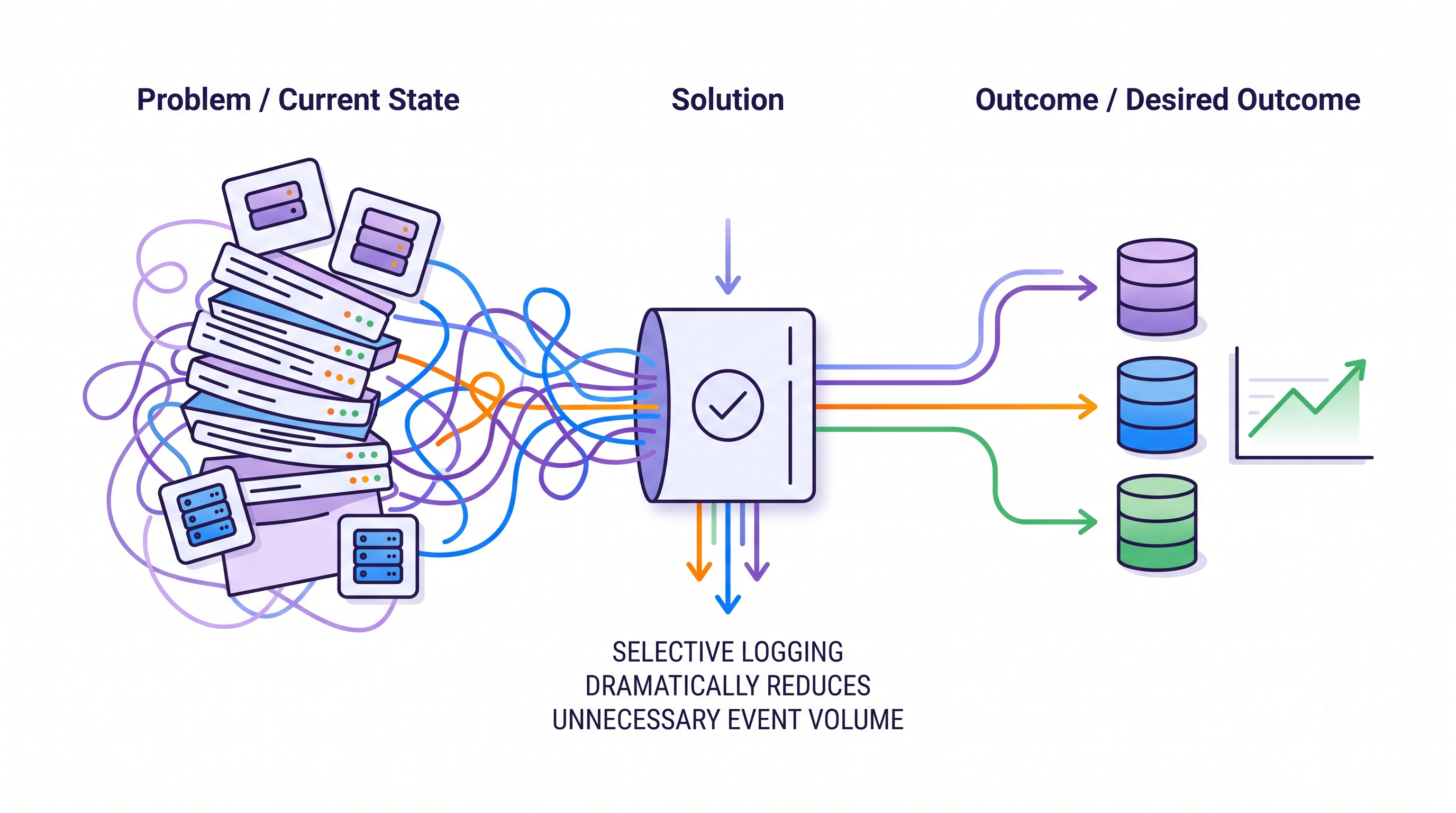
Selective logging dramatically reduces unnecessary event volume while preserving the visibility required for governance and security.
One of the biggest AWS CloudTrail best practices is understanding that not every workload requires the same level of audit logging.
3. Identify the AWS Services Generating the Most CloudTrail Events
CloudTrail costs rarely increase evenly across an environment.
In most organizations, a relatively small number of services generate the majority of events.
Common examples include:
Amazon S3
AWS Lambda
Amazon DynamoDB
Amazon EKS
AWS IAM
AWS Secrets Manager
Amazon ECS
Instead of reviewing CloudTrail as a single service, investigate which AWS resources contribute most to event growth.
This allows DevOps teams to prioritize optimization efforts where they will have the greatest impact.
For example, reducing unnecessary CloudTrail data events for a high-traffic Amazon S3 bucket often delivers greater savings than making small configuration changes across dozens of lower-volume services.
4. Separate Production and Development Logging Strategies
A common mistake is applying identical CloudTrail configurations across every AWS account.
Development environments typically have very different auditing requirements from production systems.
Development workloads often generate:
Frequent deployments
Infrastructure testing
Temporary resources
Experimental automation
Short-lived services
Capturing detailed AWS audit logging for every development activity may significantly increase CloudTrail costs without providing long-term operational value.
Instead, create logging policies based on workload criticality.
Production environments may require comprehensive logging for security and compliance, while development environments can often use a more targeted approach.
This improves both governance and AWS CloudTrail cost optimization without reducing visibility where it matters most.
5. Optimize Amazon S3 Storage for CloudTrail Logs
Collecting CloudTrail logs is only one part of the cost equation.
Storing those logs for months or even years can become equally expensive.
Many organizations enable CloudTrail, configure Amazon S3 as the destination, and never revisit their storage strategy. As log volumes grow into terabytes, storage costs continue increasing, even though older logs may rarely be accessed.
One of the most effective AWS CloudTrail cost optimization strategies is implementing intelligent Amazon S3 lifecycle policies.
Instead of keeping every log in the Standard storage class indefinitely, organizations should create automated lifecycle rules that:
Transition older logs to Amazon S3 Standard-IA for infrequently accessed data.
Move long-term audit logs to Amazon S3 Glacier Flexible Retrieval or Glacier Deep Archive where compliance allows.
Delete logs automatically after regulatory retention periods expire.
Separate frequently accessed operational logs from compliance archives.
This approach reduces storage costs while maintaining the audit history required for governance.
For DevOps teams, storage optimization should be reviewed alongside infrastructure optimization, not months later during a billing review.
6. Monitor CloudTrail Event Growth Continuously
One of the biggest mistakes organizations make is reviewing CloudTrail costs only after receiving their monthly AWS invoice.
By then, the increase has already occurred. Instead, treat CloudTrail activity as an operational metric. Track trends such as:
Daily event volume
Weekly API growth
New AWS services generating audit events
Changes after major deployments
Event growth following Kubernetes or serverless adoption
API activity during AI workload expansion
Monitoring event growth allows engineering teams to identify unexpected changes before they become expensive.
For example, a new application release might unintentionally generate millions of additional Amazon S3 object-level events. Detecting that increase early is much easier than investigating a billing anomaly weeks later.
7. Eliminate Duplicate Logging Across AWS Accounts
As organizations adopt AWS Organizations, centralized governance becomes increasingly important.
However, many enterprises still operate with multiple CloudTrail trails across different accounts, regions, and business units. The result is often duplicate audit logging.
For example:
An organization trail records management events.
Individual account trails record the same management events.
Regional trails duplicate activity across multiple Regions.
While redundancy may seem harmless, duplicate trails increase AWS CloudTrail costs, storage requirements, and operational complexity.
A regular review of trail architecture helps answer questions such as:
Are multiple trails collecting identical events?
Can organization-level trails replace account-specific configurations?
Which trails are no longer actively used?
Reducing duplicate logging is one of the simplest forms of AWS logging cost optimization.
How to Reduce AWS CloudTrail Cost?
This is one of the most common questions DevOps engineers search for and fortunately, there are several proven ways to reduce AWS CloudTrail costs without sacrificing security or compliance.
Prioritize Management Events
Management events provide visibility into administrative actions such as IAM changes, resource creation, networking updates, and infrastructure modifications.
These events are relatively low in volume and are essential for AWS audit logging.
Keep them enabled unless there is a very specific reason not to.
Enable Data Events Selectively
CloudTrail data events generate significantly more logs than management events.
Instead of enabling them for every resource:
Audit only sensitive Amazon S3 buckets.
Monitor critical AWS Lambda functions.
Enable detailed logging for regulated workloads.
Exclude temporary, backup, and development resources where appropriate.
Selective logging is often the single biggest contributor to AWS CloudTrail cost optimization.
Optimize CloudTrail Log Retention
Not every log needs to remain in hot storage forever. Review retention policies regularly and align them with:
Internal governance policies
Industry regulations
Security investigation requirements
Moving older logs into lower-cost storage classes helps reduce long-term AWS logging costs while maintaining compliance.
Remove Unused Trails
Temporary migration projects, proof-of-concept environments, and retired AWS accounts frequently leave behind CloudTrail trails that continue collecting events.
Regularly auditing trail configurations ensures that unused logging does not continue generating unnecessary costs.
Review High-Volume Workloads
Large-scale services such as Amazon S3, AWS Lambda, Amazon DynamoDB, and Amazon EKS often contribute the majority of CloudTrail event volume.
Optimizing these workloads usually provides far greater savings than making minor adjustments elsewhere.
Include CloudTrail in Monthly FinOps Reviews
CloudTrail should be reviewed alongside:
EC2 costs
Amazon EKS costs
Storage growth
Network transfer
AI infrastructure
Observability spending
Making CloudTrail part of regular FinOps for AWS discussions helps identify optimization opportunities before costs escalate.
What is the Best Practice for AWS CloudTrail?
There is no single configuration that works for every organization.
However, mature DevOps and platform engineering teams consistently follow several AWS CloudTrail best practices.
Centralize Logging Across AWS Organizations
Managing separate logging strategies across dozens of AWS accounts quickly becomes difficult.
Using AWS Organizations to centralize audit logging improves governance, simplifies administration, and reduces duplicate trails.
Follow the Principle of Least Logging
Security teams often discuss least privilege. CloudTrail benefits from a similar philosophy.
Rather than collecting every possible event, collect the events that provide meaningful operational, security, or compliance value.
Protect CloudTrail Logs
CloudTrail logs should always be treated as security-sensitive assets.
Organizations should:
Encrypt logs using AWS Key Management Service (KMS).
Restrict access through IAM policies.
Enable log file validation where appropriate.
Protect log buckets against accidental deletion.
Optimization should never compromise audit integrity.
Regularly Review CloudTrail Configurations
Cloud infrastructure changes constantly.
New AWS services, AI workloads, Kubernetes clusters, and deployment pipelines all influence audit activity.
Review CloudTrail configurations periodically to ensure they continue reflecting current infrastructure rather than historical assumptions.
Combine Security with Cost Governance
Historically, CloudTrail was managed primarily by security teams.
Today, engineering, FinOps, platform engineering, and DevOps all have a role to play.
The most successful organizations view AWS CloudTrail cost optimization as both a governance initiative and a financial optimization effort.
Don't Overlook CloudTrail Lake Costs
As organizations increasingly adopt AWS CloudTrail Lake for centralized log analysis, they often focus on its analytical capabilities while overlooking associated costs.
CloudTrail Lake offers powerful search and investigation features, but costs can grow depending on:
Data ingestion volume
Retention periods
Query frequency
Long-term storage requirements
Before sending every audit event to CloudTrail Lake, evaluate:
Which logs require interactive analysis?
Which logs are only needed for compliance?
How frequently do security teams query historical events?
Keeping only operationally valuable logs in CloudTrail Lake while archiving others to Amazon S3 can significantly improve cost efficiency.
Include AWS CloudTrail Cost Optimization in Your DevOps Pipeline
CloudTrail optimization should not be treated as a once-a-year exercise.
Modern DevOps teams increasingly integrate cost governance directly into engineering workflows.
For example:
Review CloudTrail configurations during Infrastructure as Code changes.
Validate trail settings during CI/CD deployments.
Include logging policies in architecture reviews.
Monitor API activity after every major release.
Evaluate new AWS services before enabling detailed audit logging.
Embedding DevOps cloud cost optimization into everyday engineering processes prevents unnecessary logging from becoming a long-term operational burden.
Common AWS CloudTrail Cost Optimization Mistakes
Even mature organizations make mistakes that gradually increase CloudTrail costs.
Some of the most common include:
Enabling CloudTrail data events across every Amazon S3 bucket.
Creating duplicate organization and account trails.
Keeping every log in Amazon S3 Standard indefinitely.
Ignoring CloudTrail Lake query and retention costs.
Applying identical logging policies to production and development.
Never reviewing trail configurations after infrastructure changes.
Treating CloudTrail purely as a compliance service instead of an operational resource.
Avoiding these mistakes can substantially improve both governance and cloud cost efficiency.
Advanced AWS CloudTrail Cost Optimization Strategies for Large Enterprises
As organizations mature their cloud operations, optimizing AWS CloudTrail is no longer just about reducing storage or disabling unnecessary logs. It becomes part of a broader cloud governance strategy that balances security, operational visibility, compliance, and cloud financial management.
The most mature DevOps and FinOps teams move beyond reactive cost reduction and continuously optimize how audit logging supports the business.
Some advanced strategies include:
Build Environment-Specific Logging Policies
Not every AWS environment requires the same level of audit logging.
Production workloads that process customer data typically require comprehensive CloudTrail logging to satisfy security and compliance requirements. Development, sandbox, and proof-of-concept environments, on the other hand, often generate a high volume of API activity without the same regulatory obligations.
Creating environment-specific logging policies helps reduce unnecessary CloudTrail costs while preserving the visibility that matters most.
Track CloudTrail Growth as a Cloud KPI
Many organizations monitor CPU utilization, Kubernetes costs, cloud spend, and application performance.
Very few monitor audit log growth.
CloudTrail event volume should become a cloud operational KPI because sudden increases often indicate:
Infrastructure expansion
New deployment pipelines
Changes in application architecture
Increased automation
New AWS service adoption
AI or machine learning workloads generating additional API activity
Reviewing CloudTrail event trends regularly helps teams identify operational changes before they become financial problems.
Align DevOps, Security, and FinOps Teams
CloudTrail sits at the intersection of multiple teams.
Security teams need complete audit visibility.
DevOps teams need operational insights.
FinOps teams need predictable cloud costs.
When these teams work independently, CloudTrail configurations often become inconsistent.
The most successful organizations establish shared ownership, in which logging decisions consider security requirements, operational value, and financial impact together.
This collaborative approach improves governance while supporting long-term FinOps for AWS initiatives.
Optimize AWS CloudTrail with Atler Pilot
Reducing AWS CloudTrail costs requires more than reviewing billing reports. DevOps teams need to understand why audit event volumes are increasing, which workloads generate the most API activity, and how infrastructure changes influence long-term cloud spending.
This is where infrastructure intelligence becomes invaluable.
Atler Pilot helps engineering, platform, DevOps, and FinOps teams connect infrastructure telemetry, workload intelligence, utilization trends, cloud cost visibility, and operational context into a unified view of AWS environments.
Instead of analyzing CloudTrail costs in isolation, teams can understand how Kubernetes clusters, Amazon EKS workloads, serverless applications, Infrastructure as Code deployments, CI/CD pipelines, AI workloads, and cloud resource utilization contribute to audit activity and operational spending.
This broader visibility enables organizations to:
Detect infrastructure changes that increase CloudTrail event volume.
Identify workloads generating excessive audit logs.
Improve AWS logging cost optimization without reducing compliance.
Correlate infrastructure activity with cloud costs.
Strengthen governance across multi-account AWS environments.
Support proactive FinOps for AWS initiatives.
By combining cloud cost intelligence with infrastructure observability, Atler Pilot helps organizations optimize cloud operations while maintaining security, reliability, and compliance.
CloudTrail should provide clarity, not unexpected cloud costs. Sign up for Atler Pilot and discover how infrastructure intelligence can help your teams optimize AWS environments with great clarity and intelligence.
Conclusion
AWS CloudTrail is one of the most valuable services in the AWS ecosystem. It records the events that help organizations investigate security incidents, satisfy compliance requirements, troubleshoot infrastructure changes, and maintain operational visibility across increasingly complex cloud environments.
But as cloud-native architectures continue to evolve with Kubernetes, serverless applications, Amazon EKS, Infrastructure as Code, AI-powered workloads, and multi-account AWS Organizations generating millions of API calls, CloudTrail can also become a significant contributor to overall cloud spending.
The good news is that reducing AWS CloudTrail costs doesn't require sacrificing visibility.
By following proven AWS CloudTrail cost optimization strategies, reviewing trail configurations, selectively enabling CloudTrail data events, optimizing Amazon S3 storage, monitoring CloudTrail Lake usage, eliminating duplicate trails, and embedding DevOps cloud cost optimization into everyday engineering practices, organizations can control costs while strengthening governance.
All in One Place
Atler Pilot decodes your cloud spend story by bringing monitoring, automation, and intelligent insights together for faster and better cloud operations.