
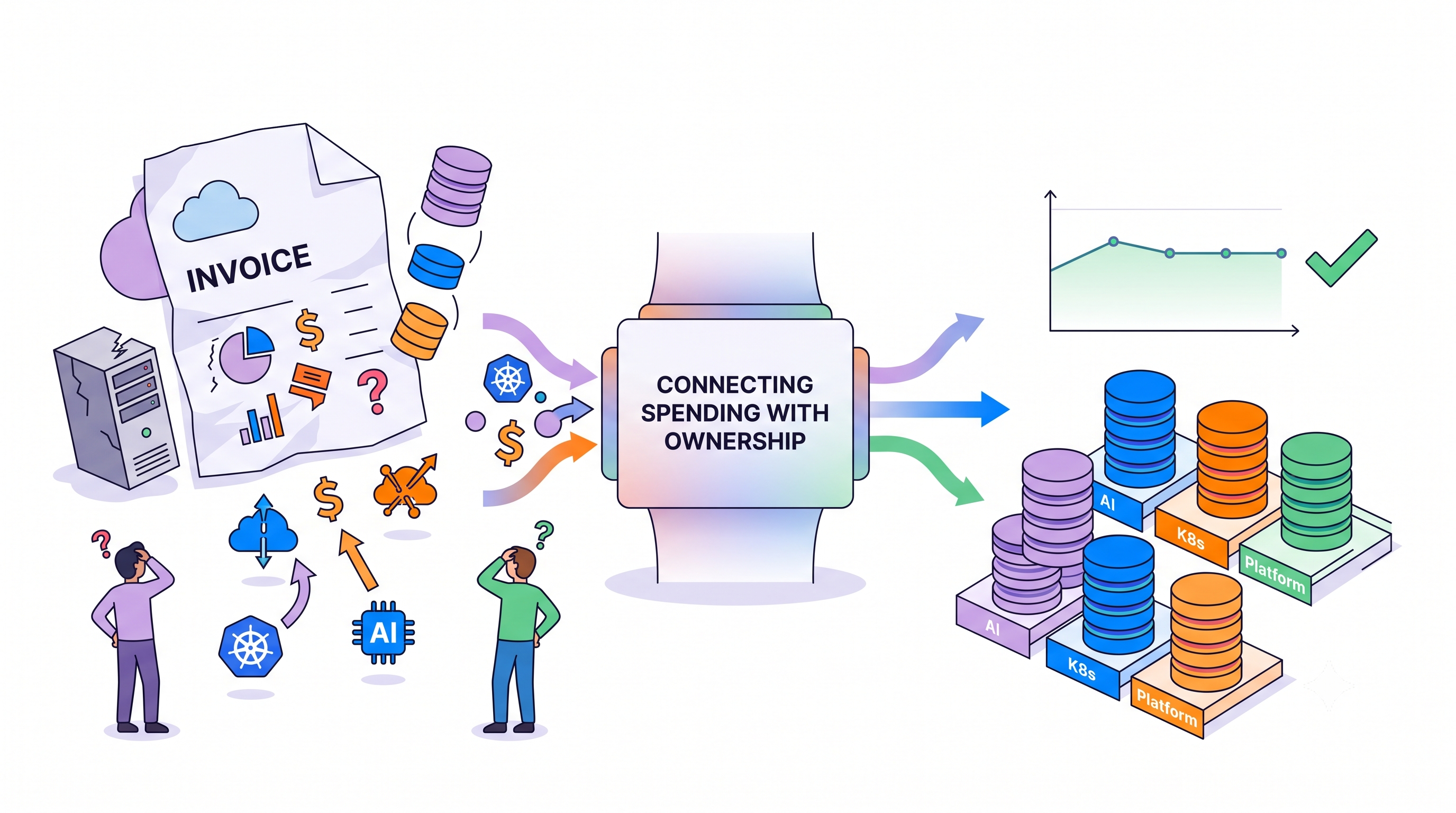
Cloud adoption has made it easier than ever for teams to build, deploy, and scale applications. Spinning up Kubernetes clusters, provisioning databases, deploying serverless functions, or launching AI workloads can now be done in minutes instead of weeks.
But while provisioning infrastructure has become effortless, understanding who is paying for it has become much more complicated.
It's a familiar scenario for many organizations.
The monthly cloud invoice arrives, and finance wants to know why costs increased by 30%. Engineering leaders insist they didn't significantly change anything. Platform teams point to increased Kubernetes activity, while product teams highlight new AI features that required additional infrastructure. Before long, everyone agrees the cloud bill is too high, but no one can clearly explain who owns the increase.
The problem isn't always cloud spending itself.
More often, it's the lack of accountability.
When infrastructure costs are shared across dozens of teams, applications, business units, and cloud services, organizations struggle to connect spending with ownership. Without clear accountability, optimization becomes reactive, budgets become harder to manage, and cloud costs continue to grow.
This is why cloud cost accountability has become a core principle of modern FinOps. Organizations typically adopt one of two financial models:
Chargeback or Showback.
While both improve cloud cost visibility, they encourage accountability in different ways and are suited to different stages of FinOps maturity.
So which approach is right for your organization?
Let's get right into the blog and explore the differences between chargeback and showback, their advantages, challenges, and how to choose the cloud cost accountability model that best supports your engineering and business goals.
What is Cloud Cost Accountability?
Cloud cost accountability is the practice of assigning ownership for cloud spending to the teams, departments, products, or business units responsible for consuming cloud resources.
Instead of treating cloud infrastructure as a shared organizational expense, accountability connects spending directly to the people making infrastructure decisions.
This creates greater transparency around:
Cloud resource usage
Infrastructure ownership
Budget planning
Engineering decisions
Resource optimization
Financial forecasting
Without accountability, cloud optimization becomes extremely difficult because teams lack visibility into the financial impact of their workloads.
What is Showback?
Showback is an internal reporting model that provides teams with visibility into the cloud costs they generate without actually charging those costs to their budgets.
In a showback model, finance or FinOps teams allocate cloud costs across engineering teams, products, or business units and regularly share detailed reports showing:
Monthly cloud spend
Resource utilization
Kubernetes costs
AI infrastructure costs
Storage consumption
Networking expenses
Shared platform costs
The key difference is that no money changes hands. Teams receive visibility, not invoices.
The objective is education rather than enforcement.
Showback helps engineering teams understand how their infrastructure decisions affect cloud spending while giving organizations time to build a culture of cost awareness
Benefits of Showback
Showback is often the first step in a FinOps journey because it encourages transparency without creating financial friction.
Some of its key benefits include:
Encourages Cost Awareness
Many developers have never seen the financial impact of the infrastructure they deploy.
Showback helps bridge that gap by making cloud costs visible.
Promotes Collaboration
Because teams are not directly billed, discussions remain collaborative rather than adversarial.
Engineering, finance, and platform teams can work together to identify optimization opportunities.
Supports FinOps Adoption
Organizations new to FinOps often find showback easier to implement because it introduces accountability gradually without disrupting budgeting processes.
Improves Tagging and Cost Allocation
Accurate showback depends on proper resource tagging and ownership. As a result, organizations often improve governance while implementing showback.
What is Chargeback?
Chargeback takes accountability one step further.
Instead of simply reporting cloud costs, organizations allocate those costs directly to the budgets of the teams, departments, or business units consuming the resources.
If a product team provisions GPU clusters for AI workloads or scales Kubernetes infrastructure during a product launch, those cloud costs are charged directly to that team's budget.
Chargeback transforms cloud spending from a centralized IT expense into a business responsibility.
This financial ownership encourages teams to evaluate infrastructure decisions more carefully because every deployment has a measurable budget impact.
Benefits of Chargeback
Organizations with mature cloud operations often adopt chargeback because it strengthens financial discipline.
Stronger Financial Accountability
Teams become directly responsible for the cloud resources they consume. This encourages more thoughtful infrastructure planning.
Better Budget Forecasting
When costs are allocated to individual business units, financial planning becomes more accurate.
Leaders gain better visibility into product profitability and operational expenses.
Encourages Optimization
Teams naturally begin asking:
Can we right-size this workload?
Do we need this Kubernetes cluster?
Are these GPUs fully utilized?
Can we optimize storage costs?
Chargeback encourages continuous optimization because savings directly benefit the team's budget.
Aligns Cloud Costs with Business Value
Organizations gain a clearer understanding of which products generate value relative to the infrastructure they consume. This supports better strategic investment decisions.
Why Many Organizations Start with Showback?
Jumping directly into chargeback can create resistance. Engineering teams may question cost allocation methods. Finance teams may struggle with shared infrastructure. Platform teams may lack accurate tagging.
Starting with showback allows organizations to build trust.
Teams become familiar with cloud spending patterns before budgets are directly affected. This gradual approach improves adoption while giving organizations time to refine cost allocation processes.
When Chargeback Makes Sense?
Chargeback becomes increasingly valuable when organizations have:
Mature tagging strategies
Clear workload ownership
Accurate cost allocation
Established FinOps practices
Multiple business units
Product-level profitability tracking
At this stage, financial accountability helps drive continuous cloud optimization across the organization.
Shared Infrastructure Makes Both Models Challenging
One of the biggest challenges in both showback and chargeback is allocating shared infrastructure.
Examples include:
Amazon EKS clusters
Shared Kubernetes platforms
Networking
Central observability tools
CI/CD platforms
Identity services
AI inference platforms
These resources support multiple teams simultaneously.
Allocating their costs fairly requires accurate tagging, workload attribution, and sophisticated cost allocation methodologies. This is why cloud visibility has become just as important as cloud billing.
AI and Kubernetes are Changing Cost Accountability
Traditional virtual machines were relatively straightforward to allocate.
Modern cloud-native infrastructure is much more dynamic.
Organizations now need to account for:
Kubernetes namespaces
Ephemeral workloads
GPU utilization
AI agents
Shared inference services
Autoscaling clusters
Multi-cloud environments
These workloads continuously change ownership and resource consumption. Static spreadsheets are no longer sufficient. Cloud cost accountability increasingly depends on real-time infrastructure intelligence.
The Role of FinOps in Building Accountability
Whether an organization chooses chargeback or showback, the ultimate goal remains the same: Creating a culture where engineering decisions consider financial impact alongside performance, scalability, and reliability.
Successful FinOps programs encourage teams to ask:
Who owns this infrastructure?
Is this workload delivering business value?
Can we optimize utilization?
Are cloud resources being used efficiently?
These conversations create long-term financial discipline without slowing innovation.
Chargeback or Showback: Which Model Should You Choose?
The answer depends on your organization's cloud maturity.
If your organization is beginning its FinOps journey, lacks consistent tagging, or wants to build cost awareness gradually, showback is usually the better starting point.
If your organization has mature governance, reliable cost allocation, and business units capable of managing infrastructure budgets, chargeback can provide stronger financial accountability.
Many leading organizations don't choose one or the other forever.
They begin with showback, improve tagging, establish ownership, refine allocation models, and eventually transition to chargeback as their cloud operations mature.
The objective isn't choosing the stricter model.
It's choosing the model that best supports your organization's culture, governance, and operational maturity.
Build Cloud Cost Accountability with Atler Pilot
Effective chargeback and showback rely on one critical capability: accurate visibility into cloud resource ownership.
Without understanding which workloads, Kubernetes namespaces, AI infrastructure, or cloud services consume resources, allocating costs fairly becomes nearly impossible.
Atler Pilot helps engineering, platform, DevOps, and FinOps teams connect workload intelligence, infrastructure telemetry, cloud cost visibility, utilization insights, and business context into a unified view of cloud-native environments.
By correlating cloud spending with infrastructure behavior, resource ownership, Kubernetes workloads, AI infrastructure, and operational activity, Atler Pilot enables organizations to build accurate cost allocation models, improve governance, and strengthen cloud cost accountability across teams.
Whether you're implementing showback, transitioning to chargeback, or maturing your overall FinOps practice, deeper infrastructure intelligence helps ensure cloud costs are transparent, explainable, and actionable.
The goal isn't just to know what the cloud costs. It's to know who created those costs and how to optimize them. Sign up for Atler Pilot and discover how infrastructure intelligence can help you build smarter cloud cost accountability.
Conclusion
As cloud environments become larger, more distributed, and increasingly powered by Kubernetes and AI, cloud cost accountability is no longer optional.
Organizations need a clear understanding of who owns cloud resources, how infrastructure supports business value, and where optimization opportunities exist.
Showback builds awareness.
Chargeback builds accountability.
Neither model is universally better. The right choice depends on your organization's FinOps maturity, governance, and operational goals.
For many businesses, the journey begins with visibility, evolves into ownership, and ultimately creates a culture where engineering and financial decisions work together.
Because the most effective cloud cost strategy isn't simply reducing spending.
It's ensuring every dollar spent on the cloud has a clear owner and a measurable purpose.
All in One Place
Atler Pilot decodes your cloud spend story by bringing monitoring, automation, and intelligent insights together for faster and better cloud operations.