
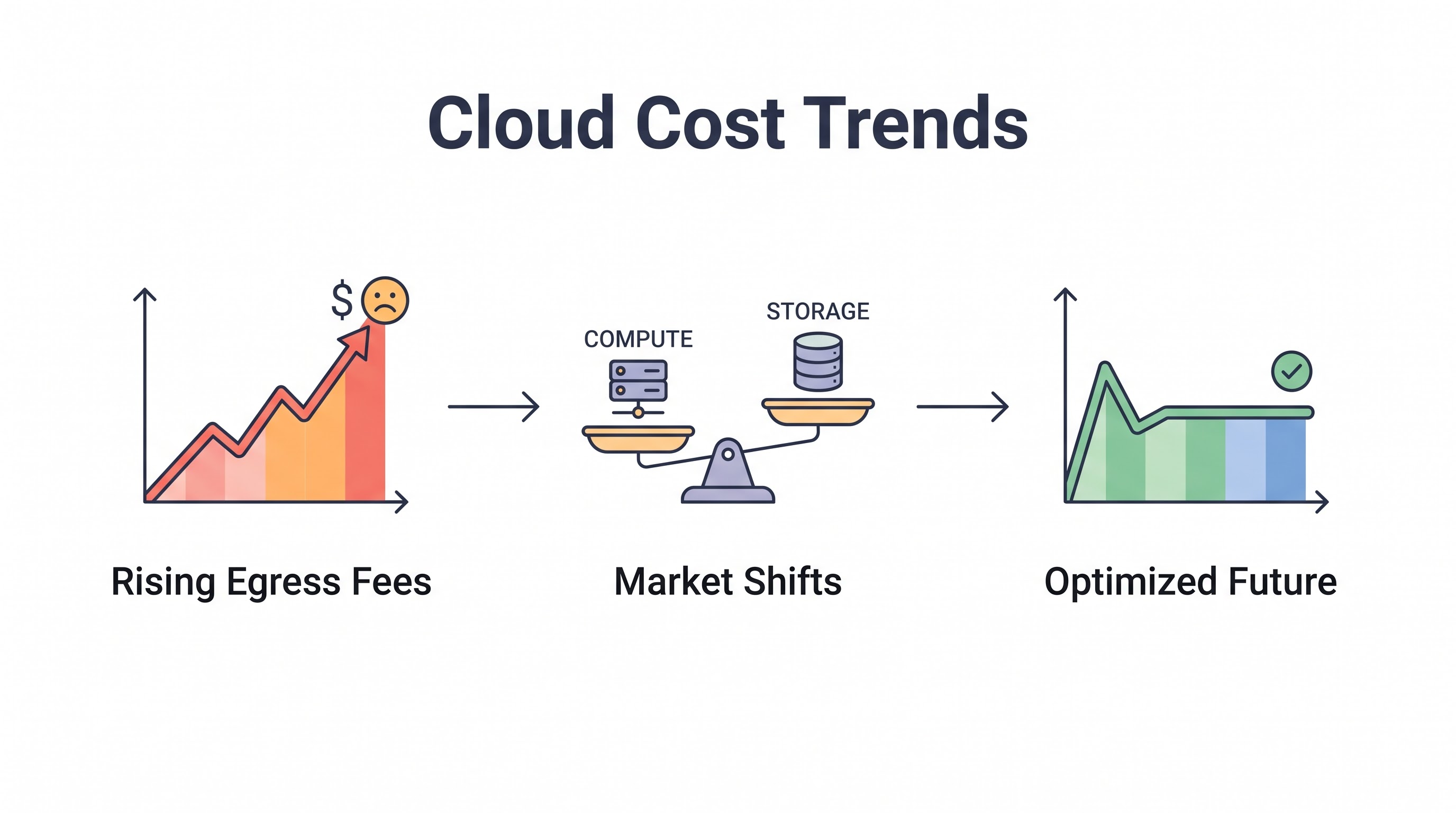
The Shifting Economics of the Cloud
The hyper-scalers (AWS, Azure, GCP) are engaged in a complex, multi-front price war. While the marketing narrative frequently touts "continuous price reductions," the reality of a modern cloud bill is far more nuanced. Prices are indeed falling rapidly in certain commoditized areas, but they are skyrocketing in sectors driven by artificial intelligence and data gravity.
Understanding these macro pricing trends is critical for FinOps practitioners and Cloud Architects. You cannot build a cost-effective system in 2026 using architectural assumptions from 2022. This guide breaks down exactly where cloud prices are compressing and where the hyper-scalers are extracting their highest margins.
1. Standard Compute (x86) is Commoditized
Traditional x86 virtual machines (running Intel or AMD processors) are a completely commoditized utility. The price per vCPU hour for a standard general-purpose instance (like an AWS m5) has stagnated or slightly decreased as the providers attempt to undercut each other to win massive enterprise migrations.
There is no longer a significant strategic advantage to building on standard x86 instances. Furthermore, the discount mechanisms for these instances (like 3-Year Savings Plans) have plateaued. The hyper-scalers view x86 as legacy infrastructure; they want you to move off it.
2. The ARM Architecture Discount
The most aggressive price cuts in the cloud are targeted entirely at custom, ARM-based silicon (e.g., AWS Graviton, Azure Cobalt, Google Axion).
The hyper-scalers design and manufacture these chips themselves, bypassing Intel and AMD entirely. Because these chips are massively more power-efficient, they cost the cloud provider significantly less in electricity and cooling. They pass a portion of these savings to the customer. Migrating a standard containerized workload from x86 to an ARM-based instance frequently yields an immediate 20-40% price-performance improvement. In 2026, ARM is the default compute architecture for cost-optimized fleets.
3. The Massive Premium on AI and GPUs
While standard compute is cheap, specialized AI compute is astronomically expensive. As covered in the AI Cloud Cost Guide, the global scarcity of high-end NVIDIA GPUs (H100s, B200s) has given cloud providers immense pricing power.
There is zero price compression in the GPU market. Cloud providers charge severe premiums for p4d and p5 instances. Furthermore, to secure this hardware, providers frequently force organizations into long-term reserved commitments or require them to utilize their higher-margin managed ML platforms (like SageMaker) rather than offering raw GPU instances on demand.
4. Storage Costs Flatten (But Tiers Matter)
The raw cost of SSD block storage (EBS) and standard object storage (S3) has largely flattened. We are no longer seeing the massive year-over-year price cuts in storage that defined the early 2010s.
However, the hyper-scalers have aggressively expanded their "cold" storage tiers. The cost of S3 Glacier Deep Archive (or Azure Archive Storage) continues to approach zero. The cost trend for storage dictates that organizations must implement aggressive, automated Lifecycle Policies. Keeping petabytes of data in Standard storage is a massive financial failure; the savings exist entirely in the lower tiers.
5. Data Egress: The Undefeated Tax
Data egress (the cost of transferring data out of the cloud provider's network to the internet or another cloud provider) remains the most heavily guarded, high-margin revenue stream for AWS, Azure, and GCP.
While regulatory pressure in the EU (like the Data Act) has forced providers to drop egress fees if a customer is entirely migrating away and closing their account, the day-to-day operational egress fees remain incredibly high. This pricing dynamic is specifically designed to punish Multi-Cloud architectures. If you run your application in AWS but your database in GCP, the inter-cloud data transfer fees will frequently eclipse the cost of the database itself. Architecting to minimize egress (via CDNs or localized edge computing) is a paramount FinOps priority.
Key Takeaway
Cloud pricing is no longer a uniform downward trend. To optimize spend in 2026, organizations must aggressively migrate workloads from commoditized x86 instances to highly discounted, custom ARM silicon (like AWS Graviton). Furthermore, architects must defend their budgets against the massive premiums associated with GPU instances and the punitive, persistent data egress fees that penalize multi-cloud networking.
All in One Place
Atler Pilot decodes your cloud spend story by bringing monitoring, automation, and intelligent insights together for faster and better cloud operations.