
The Legacy Lift-and-Shift Trap
When organizations first migrate to the cloud, they naturally attempt to replicate the security architectures that kept them safe in their on-premises datacenters. They purchase expensive, virtualized Next-Generation Firewalls (NGFWs), route all cloud traffic through centralized inspection bottlenecks, and attempt to install traditional endpoint antivirus agents on auto-scaling EC2 instances.
This "lift-and-shift" approach to security inevitably fails. It destroys the primary benefits of the cloud: agility and elasticity. Traditional firewalls become massive performance bottlenecks and cost centers. Legacy agents crash or overwhelm ephemeral containers. More importantly, these legacy tools are completely blind to the configuration of cloud APIs and serverless functions.
Securing modern infrastructure requires a paradigm shift. This guide explores the principles of Cloud-Native Security, abandoning the perimeter mindset in favor of identity, code-driven policies, and unified platforms.
Defining Cloud-Native Security
Cloud-native security is not just about securing cloud resources; it is about using the native characteristics of the cloud (automation, APIs, elasticity, microservices) to implement security. It recognizes that the environment is highly distributed, constantly changing, and heavily reliant on third-party managed services where you have no access to the underlying operating system.
Principle 1: Identity over Network
In a datacenter, the IP address and the network segment dictated trust. If a server was in the "Internal DB" VLAN, it was trusted. In the cloud, IP addresses are ephemeral and meaningless.
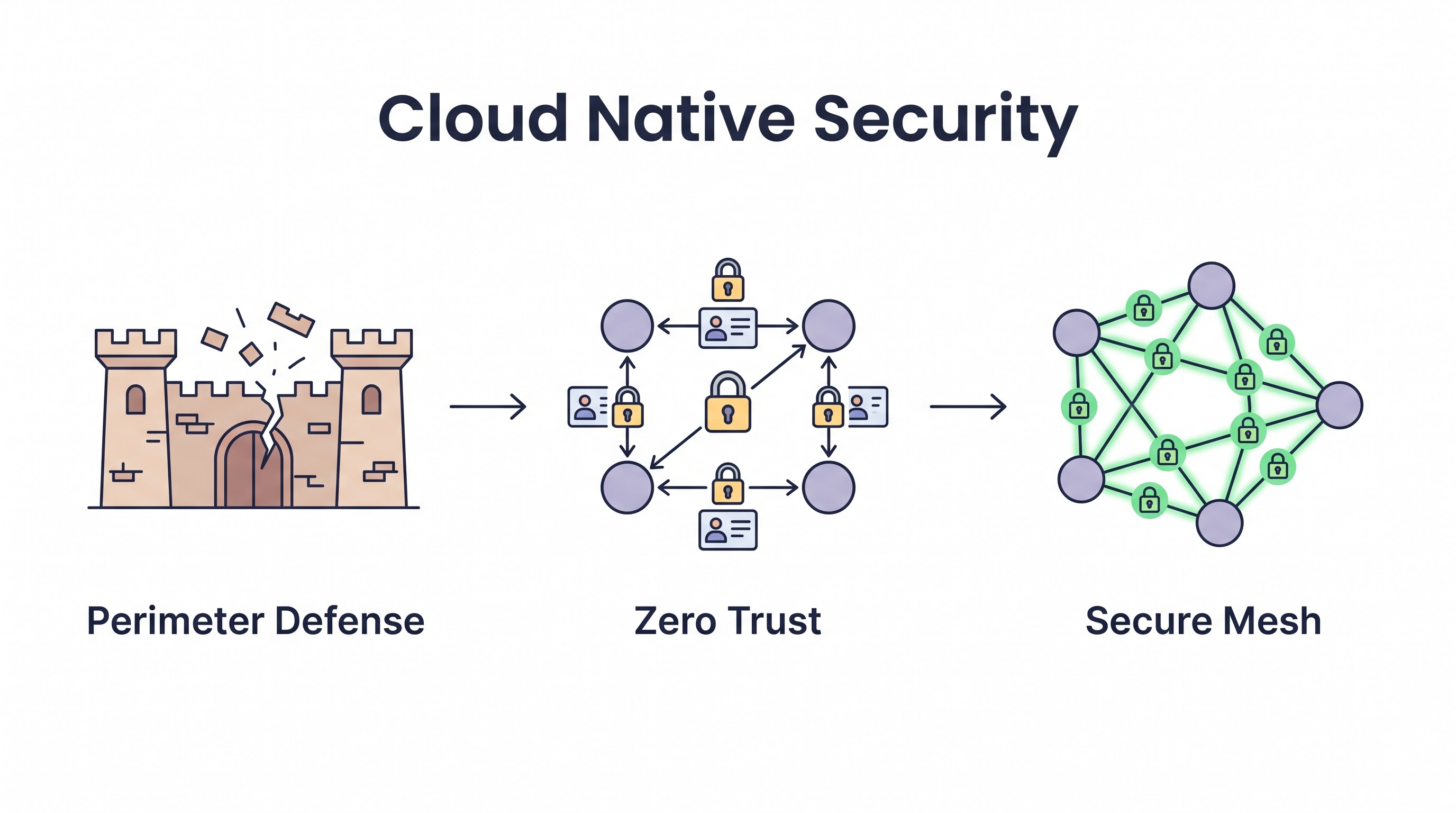
Cloud-native security operates on a Zero Trust model where Identity and Access Management (IAM) is the primary perimeter. A microservice in an AWS VPC does not implicitly trust another microservice just because they share a subnet. Every interaction must be explicitly authenticated and authorized using short-lived tokens or mutual TLS (mTLS) provided by a service mesh.
Mastering Cloud IAM is vastly more important to cloud-native security than configuring firewall rules.
Principle 2: Embracing Ephemerality
Legacy security focused on patching and repairing long-lived servers. Cloud-native security assumes that infrastructure is immutable and disposable.
If a vulnerability is discovered in a containerized application running in Kubernetes, you do not SSH into the pod to apply a patch. You update the base image in the source code repository, rebuild the container, and deploy the new, secure version, destroying the old one. Cloud-native patch management is a function of the CI/CD pipeline, not an operational maintenance task.
The Rise of the CNAPP
Because the attack surface has fractured across APIs, containers, and serverless functions, the security tooling market has responded by consolidating.
The industry is rapidly standardizing on the Cloud-Native Application Protection Platform (CNAPP). A CNAPP replaces fragmented legacy tools by combining several critical disciplines into a single unified platform:
CSPM (Posture Management): Detecting cloud misconfigurations in the control plane APIs.
CWPP (Workload Protection): Providing runtime threat detection for VMs, containers, and serverless functions.
CIEM (Cloud Infrastructure Entitlement Management): Analyzing and right-sizing overly permissive IAM roles.
Shift-Left Scanning: Integrating into the CI/CD pipeline to scan Infrastructure as Code (IaC) and container images before deployment.
Platforms like CloudAtler provide this CNAPP functionality, allowing security teams to correlate a misconfigured S3 bucket (CSPM) with a vulnerable container (CWPP) that possesses the IAM rights to access it (CIEM), calculating the true attack path risk.
Principle 3: Security as Code
In the cloud, infrastructure is code. Therefore, security must also be code.
Security policies cannot exist as PDF documents requiring manual verification. They must be codified. If an organization's policy dictates that all databases must be encrypted, that policy must be implemented as a programmatic guardrail (e.g., an AWS Service Control Policy or Azure Policy) that mathematically prevents the creation of an unencrypted database.
Similarly, incident response must shift from manual runbooks to automated, event-driven remediation, where a high-confidence threat alert automatically triggers a serverless function to isolate the compromised resource.
A New Operating Model
Cloud-native security is a cultural and architectural evolution. Security teams must transition from acting as gatekeepers who manage firewalls to platform engineers who provide paved, secure roads for developers. By embracing identity as the perimeter, immutability over patching, and unified CNAPP visibility over fragmented agents, organizations can achieve a security posture that is actually enhanced by the speed and scale of the cloud.
Key Takeaway
Stop trying to force legacy datacenter security concepts into the cloud. Cloud-native security abandons the perimeter in favor of Zero Trust identity. It replaces manual server patching with immutable infrastructure deployments via CI/CD. To manage the complexity of this highly distributed environment, organizations must adopt unified Cloud-Native Application Protection Platforms (CNAPPs) to gain comprehensive visibility from the developer's code commit through to runtime execution.
All in One Place
Atler Pilot decodes your cloud spend story by bringing monitoring, automation, and intelligent insights together for faster and better cloud operations.