
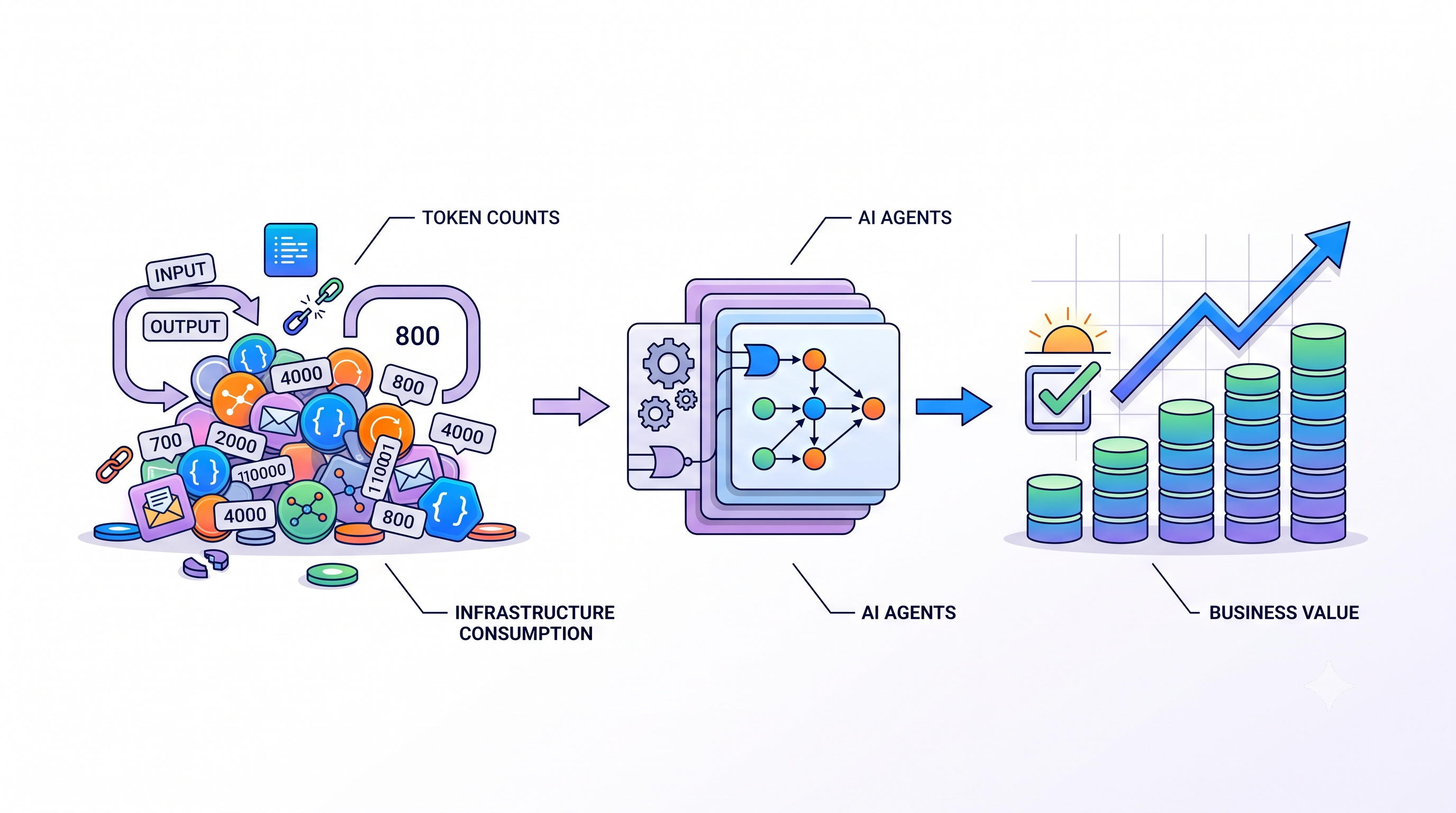
Cost Per Token vs. Cost Per Outcome: Which Metric Actually Matters?
Ask almost any engineering team how they measure the cost of running AI, and you'll probably hear the same answer:
"We know exactly how much we're spending per token."
That makes sense. Nearly every major AI provider prices models based on tokens, and dashboards are filled with token counts, input costs, output costs, context lengths, and usage trends. It's an easy metric to track, compare, and optimize.
But here's the bigger question:
Does a lower cost per token actually mean you're operating AI efficiently? Not necessarily.
Imagine two customer support chatbots. One uses an inexpensive model that costs very little per token but frequently misunderstands user requests, forcing customers to ask the same question multiple times or escalate to a human agent. The other uses a more capable model with a higher cost per token but resolves nearly every issue in a single interaction.
Which one is actually cheaper?
When you measure only the cost of generating text, the first chatbot appears more efficient. When you measure the cost of solving customer problems, the second often delivers far greater value.
This is why many organizations are beginning to rethink how they evaluate AI economics.
Instead of focusing exclusively on infrastructure consumption, they're asking a much more meaningful question:
How much does it cost to achieve the outcome that the business actually cares about?
That shift from measuring cost per token to measuring cost per outcome, is changing the way engineering teams design AI applications, optimize infrastructure, and evaluate return on investment.
Let's get right into the blog and explore why this distinction matters and how leading organizations are building AI systems that optimize for value, not just usage.
What is Cost Per Token
Cost per token is one of the simplest ways to measure AI infrastructure spending.
Since most large language models charge based on the number of input and output tokens processed, organizations can directly calculate how much each interaction costs.
For infrastructure teams, this metric is incredibly useful because it provides immediate visibility into model consumption.
Teams can quickly compare:
Different foundation models
Prompt sizes
Context window usage
Token generation patterns
Inference costs across applications
Because the metric is standardized across many AI platforms, it has naturally become the default financial indicator for AI operations.
However, while cost per token explains how much compute is being consumed, it says very little about whether that compute is producing meaningful results.
The Problem with Optimizing for Tokens
Reducing token usage sounds like an obvious way to lower AI costs.
Shorter prompts, smaller responses, fewer model calls, and lower inference expenses.
From a billing perspective, these improvements look impressive. But AI applications rarely exist to generate inexpensive text. They exist to solve problems, for example a customer support assistant exists to resolve customer issues and an AI coding assistant exists to help developers write better software.
If reducing token usage causes users to ask the same question multiple times, receive incomplete answers, or abandon the application entirely, overall operational costs may actually increase.
In other words, lower token costs do not automatically translate into higher business efficiency.
What is Cost Per Outcome?
Cost per outcome measures something far more valuable.
Instead of asking: "How much did this inference cost?"
It asks: "How much did it cost to successfully achieve the desired business result?"
The definition of an "outcome" varies across organizations. For example:
Successfully resolving a customer support ticket
Completing an insurance claim review
Generating production-ready code
Detecting fraud
Producing an accurate legal summary
Completing a sales recommendation
Answering a healthcare query correctly
Each represents a measurable business objective. The infrastructure cost only becomes meaningful when evaluated against that objective.
Business Value Doesn't Scale Linearly with Token Usage
One of the biggest misconceptions in AI economics is assuming that more tokens always mean higher value or that fewer tokens always mean greater efficiency.
Neither assumption is true.
Consider two AI interactions.
The first generates 4,000 tokens, answers every question accurately, and resolves the user's problem in one conversation.
The second generates only 800 tokens but produces vague responses that require four follow-up interactions before the issue is resolved.
The second interaction uses fewer tokens. The first delivers the better outcome.
When organizations optimize only for token efficiency, they risk sacrificing the very business value AI is supposed to create.
Why are Outcome-Based Metrics Becoming Essential?
As AI applications mature, executives increasingly want answers to questions that infrastructure metrics alone cannot provide.
They want to know:
Which AI products generate measurable business value?
Which models deliver the highest return on investment?
How much does it cost to resolve a customer issue?
Which AI features justify their infrastructure costs?
Where should future AI investments be directed?
None of these questions can be answered by token counts alone.
Outcome-based metrics connect infrastructure spending with business performance, making them far more useful for strategic decision-making.
AI Agents Make a Significant Difference
The rise of AI agents adds another layer of complexity.
Unlike traditional chatbots, agents often:
Retrieve information from multiple systems
Execute workflows
Call external APIs
Coordinate with other agents
Perform reasoning across several steps
A single user request may trigger dozens of model calls and thousands of tokens.
Looking only at token costs could make the workflow appear inefficient.
However, if that workflow completes an hour-long manual process in under a minute, the business value may far exceed the infrastructure expense.
This is why organizations deploying AI agents increasingly evaluate complete workflow outcomes rather than individual inference costs.
Cost Per Outcome Encourages Better Engineering Decisions
Engineering teams naturally optimize whatever they measure. If token reduction becomes the primary success metric, developers may:
Aggressively shorten prompts
Choose smaller models regardless of quality
Limit reasoning steps
Reduce contextual information
These changes lower infrastructure costs but may reduce accuracy and user satisfaction.
When success is measured by outcomes instead, teams begin making different decisions.
They evaluate:
Model quality
Workflow completion rates
User success
Operational efficiency
Customer experience
This creates healthier optimization goals that align technical improvements with business priorities.
The Best AI Organizations Measure Both
This isn't an argument against cost per token. It's still an important operational metric. Engineering teams need visibility into:
Token consumption
Prompt efficiency
Context utilization
Model pricing
Inference trends
These indicators help control infrastructure spending. However, they should exist alongside outcome-focused metrics. The most mature AI organizations evaluate both.
Cost per token explains operational efficiency. Cost per outcome explains business efficiency. Together, they provide a far more complete picture of AI performance.
Building Outcome-Aware AI FinOps
AI FinOps is evolving beyond cloud invoices and usage reports.
Organizations increasingly combine:
Infrastructure utilization
GPU consumption
Token usage
Model performance
Workflow success
Customer outcomes
Business value
This integrated perspective enables engineering, product, platform, and FinOps teams to optimize AI systems without losing sight of the results those systems are meant to deliver.
The conversation shifts from "How do we reduce AI costs?" to "How do we maximize value for every dollar we spend on AI?"
That is a much more strategic question.
Measure AI Value with Atler Pilot
Understanding AI economics requires more than tracking token usage or monitoring cloud invoices. Organizations need visibility into how AI workloads consume infrastructure, how models behave under real workloads, and how operational decisions influence both cost and business outcomes.
Atler Pilot helps engineering, platform, AI, and FinOps teams connect workload intelligence, infrastructure telemetry, GPU utilization, cloud cost visibility, and operational context into a unified view of AI environments.
By bringing together infrastructure behavior, utilization trends, resource consumption, and cloud economics, Atler Pilot enables organizations to understand not just how much AI costs to run, but how efficiently those resources support business-critical workloads. This broader perspective helps teams optimize AI infrastructure while maintaining performance, scalability, and long-term value.
The most successful AI organizations don't optimize for the cheapest tokens. They optimize for the most valuable outcomes. Sign up for Atler Pilot and discover how deeper infrastructure intelligence can help you achieve both.
Conclusion
Cost per token has become one of the defining metrics of the AI era, and for good reason. It provides a clear, measurable way to understand how much infrastructure AI applications consume.
But infrastructure consumption is only one part of the story.
Businesses invest in AI to improve customer experiences, automate work, accelerate decision-making, and create measurable value. Those objectives are not captured by token counts alone.
As AI systems become more sophisticated and as AI agents, multi-model workflows, and enterprise automation continue to grow, organizations will increasingly judge success by outcomes rather than usage.
Because in the long run, the AI application with the lowest cost per token won't necessarily be the most successful.
The one that delivers the greatest business outcome for every dollar spent will.
All in One Place
Atler Pilot decodes your cloud spend story by bringing monitoring, automation, and intelligent insights together for faster and better cloud operations.