
The Dashboard Fatigue
In mature cloud organizations, the FinOps team spends a disproportionate amount of their time acting as human report generators. Every week, engineering managers request custom dashboards: "Show me the DynamoDB costs for the checkout service in Europe, but exclude the staging environment, and compare it to last month."
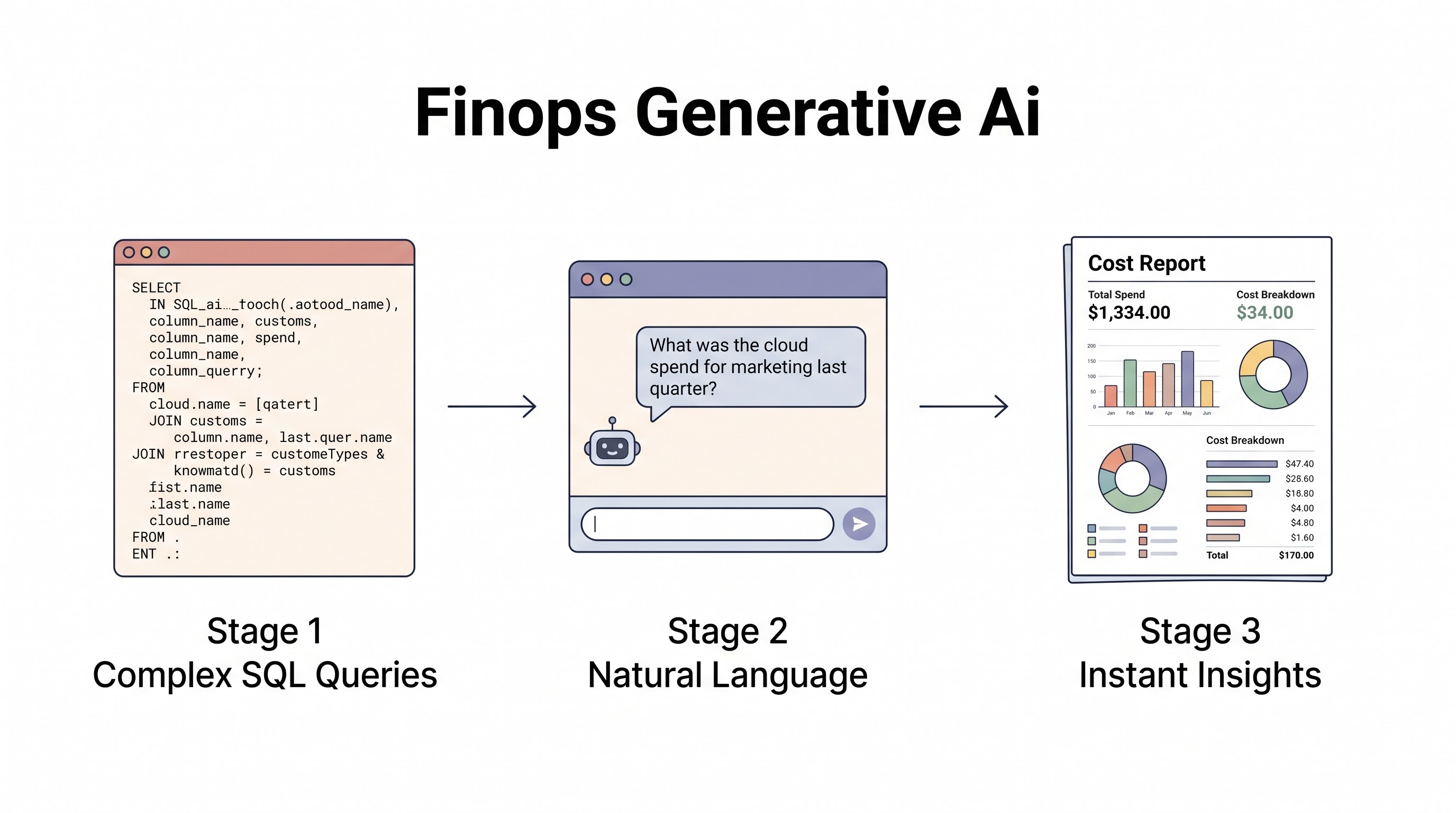
Building these reports requires deep knowledge of the cloud provider's Cost and Usage Report (CUR) schema and complex SQL queries in tools like AWS Athena or Google BigQuery. This creates a massive bottleneck. The data exists, but the people who need it (engineers and product managers) cannot access it without filing a Jira ticket.
Generative AI is obliterating this bottleneck. By integrating Large Language Models (LLMs) directly into FinOps platforms, organizations are democratizing cost data through Natural Language Queries.
The SQL Bottleneck in Cloud Billing
Cloud billing data is notoriously complex. The AWS CUR file contains hundreds of columns. To simply calculate the cost of a specific EC2 instance, an analyst must understand how to join the compute cost with the EBS volume cost, filter by specific resource tags, and account for the amortized value of a Reserved Instance.
Expecting a software engineer to learn this schema just to check their project budget is unrealistic. Therefore, engineers remain blind to their costs until the central FinOps team builds them a dashboard, resulting in slow feedback loops and missed cost anomalies.
The Generative AI Solution: Natural Language Queries
Generative AI acts as the ultimate translation layer. In a modern FinOps platform, an engineer no longer writes SQL. They type a prompt into a chat interface:
"Why did the cost of the Recommendation Engine spike yesterday?"
The LLM analyzes the prompt, understands the intent, and dynamically translates that natural language into the complex SQL query required to extract the data from the billing engine. It executes the query, reads the results, and returns a plain-English answer:
"The cost of the Recommendation Engine increased by $450 yesterday. This was primarily driven by a 300% increase in Amazon SageMaker inference costs within the us-east-1 region."
Practical Use Cases for Engineering Teams
This natural language interface fundamentally changes how engineering teams interact with cloud finance.
Instant Triage: When a budget alert fires, engineers can ask the AI, "Show me the top 3 resources driving the cost increase in the staging account this week."
Right-Sizing Exploration: An engineer can ask, "If I downsize all non-production RDS instances to
t4g.medium, how much money will we save per month?" The AI instantly calculates the projection based on historical utilization data.
Executive Reporting and Unit Economics
Generative AI is equally transformative for product managers and executives focused on Cloud Unit Economics.
A Product Manager can ask: "What was the cloud cost per transaction for the payment gateway in Q3 compared to Q2?" The AI seamlessly blends the infrastructure billing data with the external business metrics (transaction volume) ingested into the platform, providing the exact unit cost instantly, bypassing the need for a week-long financial analysis project.
The Underlying Technology (Text-to-SQL)
Under the hood, these systems rely on a technique known as Retrieval-Augmented Generation (RAG) combined with Text-to-SQL capabilities.
The FinOps platform provides the LLM with the strict schema of the billing database and a library of "golden queries" (known, highly accurate SQL queries for common metrics). When the user asks a question, the LLM uses this context to generate syntactically correct SQL. Crucially, enterprise-grade tools will also show the user the SQL query it generated, allowing data analysts to verify the math and ensuring absolute trust in the financial data.
Key Takeaway
Generative AI is eliminating the reporting bottleneck in cloud financial operations. By allowing engineers and executives to query complex, multi-terabyte billing datasets using natural language, organizations can instantly democratize cost visibility. This empowers engineers to take immediate ownership of their cloud spend without requiring the central FinOps team to spend countless hours building and maintaining custom dashboards.
All in One Place
Atler Pilot decodes your cloud spend story by bringing monitoring, automation, and intelligent insights together for faster and better cloud operations.