
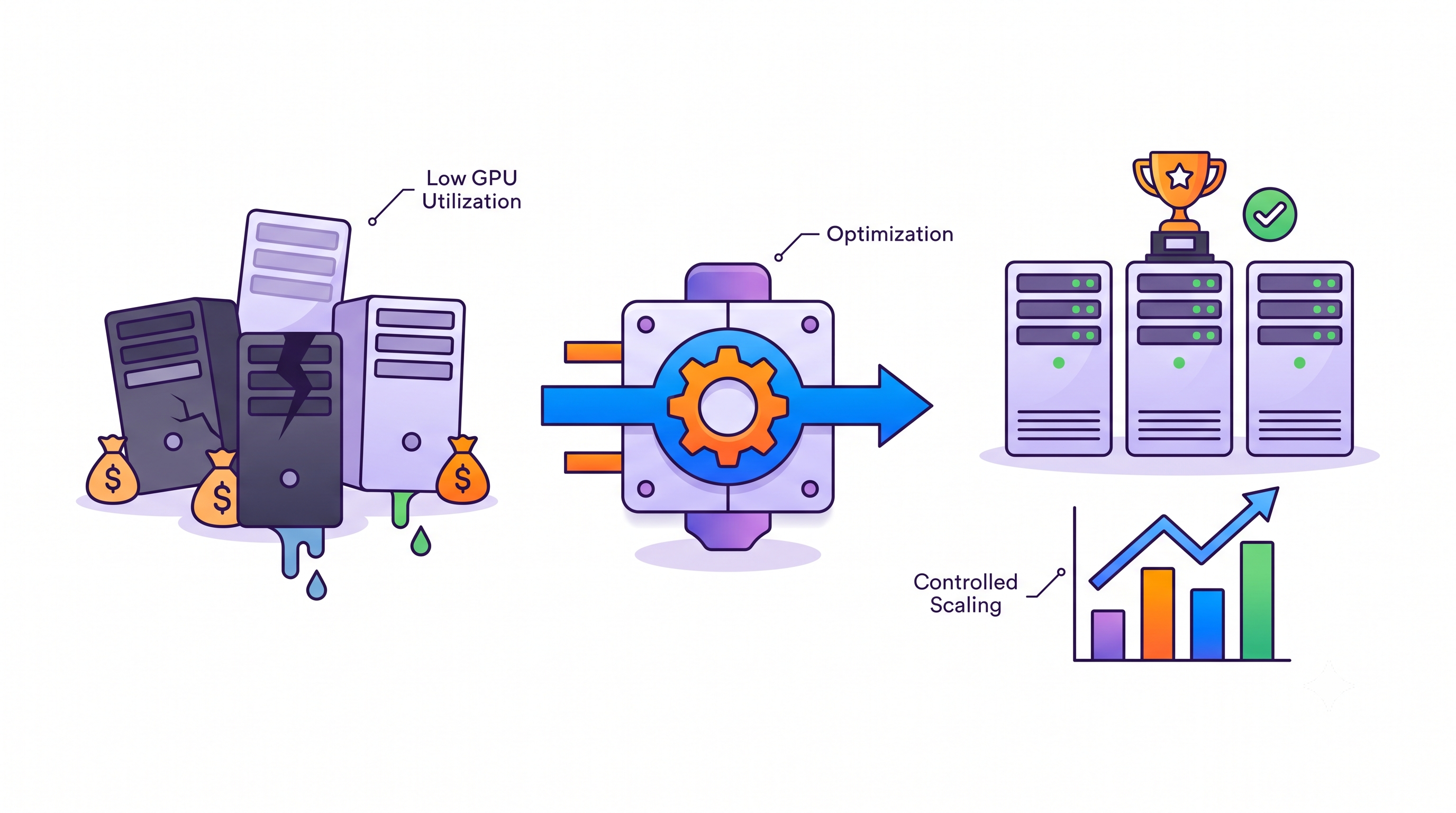
If you're building anything with AI today, chances are you've already discovered one uncomfortable truth.
The GPU bill arrives much faster than the business value.
It usually starts innocently enough. A team launches a proof of concept using a few GPUs. Another team begins training custom models. Developers experiment with AI agents. Product teams integrate LLM-powered features. Before long, what began as a small AI initiative has evolved into dozens of GPU-powered workloads running across multiple cloud environments.
Then the monthly cloud invoice arrives.
Suddenly everyone is asking the same questions:
Why are GPU costs increasing so quickly?
Which teams are consuming the most expensive resources?
Are these GPUs actually being utilized?
Could we deliver the same AI performance at a much lower cost?
How do we scale AI without letting infrastructure spending spiral out of control?
These questions are becoming increasingly common because GPUs have fundamentally changed cloud economics.
Unlike traditional compute resources, GPUs are significantly more expensive, often limited in availability, and shared across multiple teams, models, and workloads. A single poorly optimized AI pipeline can consume thousands or even millions of dollars in cloud resources over the course of a year.
The challenge isn't simply that GPUs cost more.
It's that most organizations still manage GPU infrastructure using practices originally designed for CPUs and traditional cloud workloads. Those approaches no longer work in an AI-first world.
This is where GPU FinOps comes in.
GPU FinOps combines cloud financial management with AI infrastructure operations, helping engineering, platform, AI, and FinOps teams understand not only where GPU spending occurs but also whether every expensive compute cycle is creating meaningful business value.
In this guide, we'll explore what GPU FinOps really means, why it's becoming one of the fastest-growing disciplines in cloud operations, the biggest cost drivers behind AI infrastructure, and the practical strategies organizations are using in 2026 to optimize GPU spending without slowing innovation.
What is GPU FinOps?
GPU FinOps is the practice of managing GPU infrastructure through a combination of engineering, financial governance, operational visibility, and continuous optimization.
Traditional FinOps focuses on cloud resources such as virtual machines, storage, networking, and managed services. GPU FinOps extends these principles to AI infrastructure, where resource economics are fundamentally different.
Instead of asking, "How much are we spending on compute?" GPU FinOps asks questions like:
Which AI workloads consume the most GPU time?
Are expensive GPUs actually busy or mostly idle?
Which models deliver the greatest business value per dollar spent?
Can inference be delivered using smaller or more efficient hardware?
Which teams are responsible for GPU demand?
How can GPU capacity be shared more effectively?
The objective isn't simply to reduce costs. It's to maximize the value generated by every GPU hour.
Why have GPUs become the Most Expensive Cloud Resource?
For many organizations, AI infrastructure now represents one of the largest contributors to cloud spending. Below are several factors that explain why.
High hourly pricing
Modern GPUs designed for AI training and inference cost significantly more than traditional CPU instances. Premium GPU instances can cost many times the hourly rate of general-purpose compute, making inefficient usage especially expensive.
Constant infrastructure demand
Unlike many applications that experience predictable daily traffic, AI workloads often run continuously.
Model training, batch inference, embeddings, recommendation systems, fine-tuning, retrieval pipelines, and autonomous agents all compete for GPU resources.
The result is sustained infrastructure demand rather than occasional bursts.
Limited supply
GPU availability remains constrained in many regions.
Organizations frequently reserve capacity months in advance or commit to long-term usage agreements.
This makes every idle GPU particularly costly.
The New AI Cost Equation
Traditional cloud applications generally consume resources based on user activity. AI applications behave differently. One customer interaction may trigger:
Retrieval-Augmented Generation (RAG)
Embedding creation
Vector database queries
Multiple model inference requests
AI agent collaboration
Tool execution
Observability pipelines
Each stage consumes compute. The true cost of AI extends far beyond running a model.
GPU FinOps therefore evaluates complete AI workflows instead of isolated infrastructure resources.
The Biggest GPU Cost Drivers
1. Low GPU Utilization
Low utilization remains one of the largest sources of waste.
Many organizations provision dedicated GPU instances that remain active long after training jobs finish.
Others allocate GPUs to individual teams that use them only intermittently.
Improving utilization often produces greater savings than negotiating lower cloud pricing.
2. Oversized Models
Bigger models aren't always better.
Organizations frequently deploy models significantly larger than necessary for the task being performed.
Smaller open-source models or optimized versions often achieve comparable results while consuming substantially fewer GPU resources.
GPU FinOps encourages selecting models based on business outcomes rather than parameter count.
3. Inefficient Inference Pipelines
Inference often becomes more expensive than training over time.
As products gain users, inference requests increase continuously.
Cost drivers include:
Large context windows
Redundant prompt processing
Excessive token generation
Inefficient batching
Multiple model calls per request
Small improvements across millions of requests can generate significant savings.
4. Idle Development Environments
AI experimentation is essential, but development environments frequently remain active overnight, on weekends, or after projects conclude.
Automated scheduling, lifecycle policies, and idle shutdown mechanisms can dramatically reduce unnecessary GPU consumption.
5. AI Agents Competing for Compute
Multi-agent systems introduce a new challenge. Multiple autonomous agents may simultaneously compete for:
GPU inference
Memory
Vector search
Networking
Storage
Without intelligent scheduling, infrastructure becomes inefficient while costs continue rising.
The Three Pillars of GPU FinOps
Visibility
You cannot optimize what you cannot see. Organizations need visibility into:
GPU utilization
Model usage
Team ownership
Job duration
Cost allocation
Resource contention
Capacity trends
Visibility creates accountability.
Optimization
Once workloads become visible, optimization opportunities emerge. Common improvements include:
Right-sizing workloads
Auto-shutdown policies
Mixed precision inference
Model quantization
Dynamic batching
Efficient scheduling
Spot GPU usage where appropriate
Better workload placement
Optimization should be continuous rather than periodic.
Governance
As AI adoption grows, governance becomes increasingly important. Organizations need policies covering:
GPU allocation
Team quotas
Chargeback models
Budget controls
Experiment lifecycle management
Production resource approval
Governance ensures GPU investments remain aligned with business priorities.
GPU Utilization is not Enough
Historically, infrastructure teams focused heavily on utilization percentages. For GPUs, utilization alone can be misleading.
A GPU running at 95% utilization may still represent poor efficiency if it spends most of its time processing low-value workloads.
Instead, organizations increasingly evaluate:
Cost per inference
Cost per trained model
GPU hours per customer transaction
GPU hours per business outcome
Revenue generated per GPU dollar
This shifts optimization from hardware efficiency to business efficiency.
Kubernetes and GPU FinOps
Most enterprise AI workloads now run on Kubernetes.
While Kubernetes provides flexibility, it also introduces new financial challenges.
Organizations must manage:
GPU scheduling
Node autoscaling
Resource fragmentation
Namespace allocation
Multi-tenant clusters
Poor scheduling can leave expensive GPUs underutilized even when demand exists elsewhere in the cluster.
GPU-aware scheduling and intelligent workload placement are becoming essential FinOps capabilities.
The Rise of Cost-Aware AI Engineering
AI engineering is evolving. Developers increasingly evaluate features based not only on accuracy but also on infrastructure economics.
Questions now include:
Does this model justify its GPU cost?
Could inference run on CPUs during low demand?
Should workloads be processed in batches?
Can requests be cached?
Is every inference necessary?
Cost awareness is becoming part of software engineering itself.
AI Observability Meets GPU FinOps
Traditional monitoring focuses on:
CPU
Memory
Latency
Network throughput
GPU FinOps expands observability to include:
GPU memory utilization
Queue depth
Model response times
Cost anomalies
Inference efficiency
Token consumption
Agent resource usage
These insights help engineering teams understand where GPU investments generate value and where they don't.
Best Practices for Implementing GPU FinOps
Organizations building mature GPU FinOps programs generally follow several principles:
Establish clear ownership for GPU resources across engineering and AI teams.
Continuously monitor GPU utilization, not just allocation.
Track AI costs by workload, model, application, and business unit.
Automate idle resource cleanup.
Right-size models based on business requirements.
Introduce cost reviews alongside architecture and deployment reviews.
Forecast GPU demand before scaling AI initiatives.
Align engineering, AI, platform, and FinOps teams around shared optimization goals.
GPU FinOps is most effective when it becomes an ongoing operational practice rather than a quarterly cost-cutting exercise.
Common Mistakes Organizations Make
Several recurring mistakes slow GPU optimization efforts:
Treating GPUs like traditional compute resources.
Optimizing only cloud invoices instead of workload behavior.
Ignoring inference costs while focusing solely on training.
Measuring utilization without measuring business value.
Allowing unrestricted experimentation without lifecycle policies.
Separating AI engineering from FinOps discussions.
Waiting until cloud bills become unmanageable before taking action.
Avoiding these pitfalls can significantly improve both operational efficiency and financial outcomes.
How Atler Pilot Helps Build GPU FinOps?
As GPU infrastructure becomes one of the most valuable assets in modern cloud environments, organizations need more than billing reports to understand where costs originate.
Atler Pilot helps engineering, platform, AI, and FinOps teams connect GPU utilization, workload behavior, Kubernetes operations, infrastructure telemetry, and cloud cost intelligence into a unified operational view.
Instead of simply showing where GPU spending occurs, Atler Pilot provides the operational context behind that spending to help teams understand which workloads consume expensive compute, how infrastructure utilization changes over time, where inefficiencies emerge, and how AI operations influence overall cloud economics.
By combining infrastructure intelligence with cost visibility, organizations can optimize GPU investments while maintaining performance, scalability, and innovation.
Conclusion
GPUs have become the engine powering modern AI, but they have also become one of the largest and fastest-growing expenses in the cloud.
Managing them effectively requires more than tracking invoices or monitoring utilization. It demands a deeper understanding of how AI workloads consume compute, how infrastructure supports business outcomes, and where optimization opportunities truly exist.
GPU FinOps provides that framework. By combining engineering practices, financial governance, infrastructure intelligence, and continuous optimization, organizations can control AI cloud costs without limiting innovation.
In 2026, the companies that succeed with AI won't necessarily be the ones with the biggest GPU clusters. They'll be the ones that extract the greatest business value from every GPU hour they pay for.
All in One Place
Atler Pilot decodes your cloud spend story by bringing monitoring, automation, and intelligent insights together for faster and better cloud operations.