
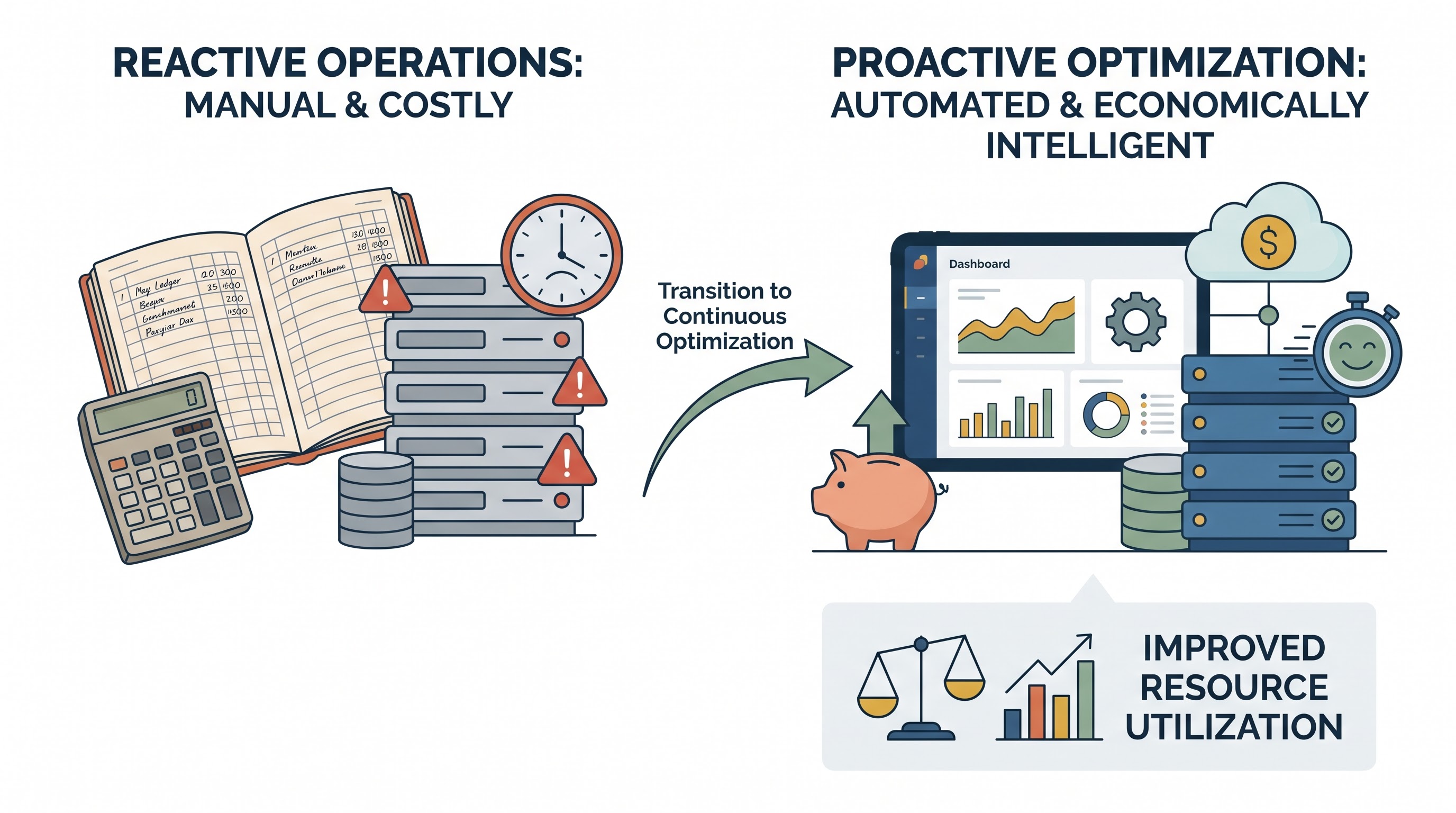
Cloud automation used to be viewed primarily as a productivity tool.
It helped engineers provision infrastructure faster, deploy applications more consistently, and eliminate repetitive manual tasks. Automation made cloud operations more efficient, but the conversation rarely went beyond speed and convenience.
That is no longer the case.
Today, automation is fundamentally changing the economics of cloud operations.
Modern cloud environments operate at a scale that would have been difficult to imagine just a few years ago. Organizations manage thousands of Kubernetes workloads, multi-cloud deployments, AI infrastructure, serverless applications, continuously running CI/CD pipelines, and dynamic cloud-native services that change every minute.
Managing this complexity manually isn't simply inefficient.
It's economically unsustainable.
Every manual approval, delayed optimization, oversized Kubernetes cluster, idle GPU, forgotten storage volume, or unnecessary compute instance has a direct financial impact. As cloud environments become increasingly dynamic, operational decisions and financial outcomes become tightly connected.
This means automation is no longer just about doing things faster.
In this article, we'll explore how automation is changing the economics of cloud operations, why traditional operational models are becoming less effective, and how intelligent automation is helping organizations improve both engineering productivity and financial performance.
The Traditional Economics of Cloud Operations
For many years, cloud operations followed a relatively straightforward model.
Infrastructure was provisioned.
Applications were deployed.
Engineers monitored performance.
When utilization changed, teams manually adjusted resources.
Cloud bills were reviewed monthly, optimization opportunities were identified, and infrastructure was gradually improved over time.
This process worked because infrastructure changed relatively slowly.
Virtual machines often remained online for months. Applications followed predictable traffic patterns. Engineering teams could review dashboards, analyze reports, and make optimization decisions without falling behind.
Operational costs were largely determined by engineering effort.
The more manual work required, the more expensive cloud operations became.
Automation improved productivity by reducing repetitive operational tasks.
But today's cloud environments have fundamentally changed that equation.
Cloud Infrastructure has Become Dynamic for Manual Operations
Modern cloud infrastructure rarely remains static for long.
Kubernetes continuously schedules and reschedules workloads based on resource availability. Autoscaling policies expand and shrink infrastructure throughout the day. Serverless functions execute for only a few seconds before disappearing. AI training environments consume massive GPU resources temporarily before shutting down. Deployment pipelines introduce new infrastructure dozens or even hundreds of times every day.
These changes occur continuously.
Human operators simply cannot evaluate every infrastructure event, utilization change, or optimization opportunity as it happens.
By the time a manual review identifies inefficient resource usage, the workload responsible may already have been replaced.
The challenge is no longer managing infrastructure.
It is managing the speed at which infrastructure changes.
Automation enables organizations to keep pace with that speed.
Why are Operational Decisions Now Financial Decisions?
In traditional IT environments, operational efficiency and financial management often existed as separate disciplines.
Operations teams focused on uptime.
Finance teams focused on budgets.
Engineering teams focused on delivering software.
Cloud computing has blurred these boundaries.
Every infrastructure decision now has a measurable financial consequence.
Choosing larger Kubernetes resource requests increases cloud spending.
Leaving development environments running overnight increases infrastructure costs.
Overprovisioning GPUs for AI workloads reduces resource efficiency.
Poor autoscaling configurations consume unnecessary compute capacity.
Even small operational decisions, when repeated across hundreds or thousands of workloads, can influence cloud spending significantly.
Automation changes this relationship by embedding financial awareness directly into operational processes.
Instead of optimizing cloud resources after costs appear, organizations increasingly optimize infrastructure as workloads evolve.
Cloud operations become financially intelligent rather than simply operationally efficient.
Why has Speed Become an Economic Advantage?
Cloud economics is no longer determined solely by how much infrastructure an organization consumes.
It is increasingly influenced by how quickly organizations respond to changing conditions.
Consider two engineering teams operating nearly identical cloud environments.
The first identifies idle Kubernetes workloads during a monthly infrastructure review.
The second automatically detects those workloads within hours and either rightsizes or decommissions them.
Both teams eventually optimize their infrastructure.
The difference lies in timing.
The second organization avoids weeks of unnecessary spending simply because automation enables faster decision-making.
This principle applies across many areas of cloud operations.
Automatically identifying abandoned storage resources.
Adjusting autoscaling policies based on demand.
Detecting cost anomalies immediately after deployments.
Optimizing GPU utilization during AI training.
The faster organizations recognize operational inefficiencies, the smaller their financial impact becomes.
Speed itself becomes an economic advantage.
Automation is Moving Beyond Repetitive Tasks
When people think about automation, they often imagine scripts performing repetitive operational work.
Provisioning infrastructure.
Running deployments.
Creating backups.
Restarting services.
While these remain important, modern cloud automation has evolved considerably.
Today's automation increasingly supports decision-making.
Instead of simply executing predefined instructions, modern platforms analyze infrastructure telemetry, workload behavior, utilization trends, deployment history, and cloud costs to recommend—or in some cases perform—optimization actions.
For example, rather than merely creating a Kubernetes cluster automatically, an intelligent platform might also identify that the cluster consistently operates below expected utilization and recommend reducing node capacity.
Instead of simply deploying AI workloads, automation can identify idle GPU clusters after training jobs complete and suggest reclaiming expensive compute resources.
Automation is becoming analytical rather than procedural.
This evolution is changing the role automation plays within cloud operations.
The Growing Role of Intelligent Automation
Artificial intelligence is accelerating this transformation even further.
Modern cloud environments generate enormous volumes of operational data.
Infrastructure telemetry.
Application logs.
Performance metrics.
Deployment history.
Cloud billing information.
Utilization statistics.
Engineering teams cannot manually analyze all of this information in real time.
Intelligent automation helps bridge that gap.
Machine learning algorithms identify infrastructure patterns, detect cost anomalies, recognize inefficient resource allocation, and recommend optimization opportunities long before they appear in monthly cloud reports.
Rather than replacing engineering expertise, intelligent automation enables engineers to focus on architecture, reliability, and innovation while routine optimization becomes increasingly data-driven.
This shift represents one of the biggest economic changes in modern cloud operations.
Instead of scaling operational teams at the same rate as infrastructure, organizations scale operational intelligence through automation.
Automation is Redefining Cloud Cost Optimization
For a long time, cloud cost optimization was treated as a separate activity from cloud operations.
Engineering teams built and operated infrastructure, while FinOps teams analyzed spending reports and recommended ways to reduce costs. Although both groups worked toward the same objective, their workflows were often disconnected.
Automation is bringing these disciplines much closer together.
Instead of waiting for cloud invoices to highlight inefficiencies, automated systems continuously evaluate infrastructure behavior, workload utilization, application performance, and resource allocation. As cloud environments evolve throughout the day, optimization opportunities are identified almost immediately.
This changes the role of cloud cost optimization.
Rather than being an activity performed after infrastructure has already generated unnecessary spending, optimization becomes part of everyday operations.
The result is a cloud environment that continuously adapts to changing demand instead of relying on periodic manual improvements.
From Reactive Operations to Continuous Optimization
One of the biggest economic advantages of automation is that it shortens the time between identifying a problem and acting on it.
Imagine a development environment that remains active after a project has ended.
In a traditional operational model, that infrastructure might continue running until someone notices it during a weekly review or monthly cost analysis.
With automation, the same environment can be identified within hours based on utilization patterns, workload activity, or predefined governance policies.
The sooner unnecessary resources are identified, the less money is wasted.
The same principle applies across cloud operations.
Oversized Kubernetes workloads can be flagged before they consume weeks of excess compute resources.
Idle GPU clusters can be detected immediately after training jobs finish.
Unused storage volumes can be identified automatically instead of accumulating silently over several months.
This continuous optimization model fundamentally changes the economics of cloud operations because it reduces the lifetime cost of inefficiencies rather than simply reporting them later.
Automation Creates Better Resource Utilization
One of the largest contributors to cloud waste isn't the absence of infrastructure.
It's infrastructure that exists but isn't being used effectively.
Organizations frequently overprovision compute resources to prepare for future growth, reserve GPU capacity for anticipated AI workloads, or allocate Kubernetes resources based on theoretical peak demand.
While these decisions often simplify operational planning, they also reduce overall resource efficiency.
Automation helps close this gap.
By continuously analyzing utilization patterns, intelligent platforms can recommend adjustments that align infrastructure more closely with actual demand.
Instead of treating cloud capacity as a fixed allocation, organizations begin managing it as a dynamic resource that expands and contracts alongside business activity.
This leads to higher utilization rates without compromising application performance.
Automation Makes AI Infrastructure Economically Sustainable
Artificial intelligence is dramatically increasing cloud infrastructure costs.
Training foundation models, serving AI inference, operating vector databases, and running GPU-intensive workloads require significantly more compute resources than many traditional applications.
Managing these environments manually becomes increasingly difficult as AI adoption grows.
Automation helps organizations maintain economic efficiency by continuously monitoring GPU utilization, workload behavior, infrastructure allocation, and operational demand.
For example, an automated system can identify inference services that remain overprovisioned during periods of low traffic or detect GPU clusters that continue running after machine learning experiments have finished.
Instead of waiting for engineers to manually investigate these environments, automation surfaces optimization opportunities continuously.
This capability becomes especially valuable as AI infrastructure grows into one of the largest categories of enterprise cloud spending.
Human Expertise Still Matters
Although automation is becoming more intelligent, successful cloud operations continue to depend on experienced engineers.
Automation excels at identifying patterns, detecting anomalies, and performing repetitive optimization tasks.
Humans remain responsible for understanding business priorities, architectural trade-offs, compliance requirements, and operational risk.
For example, an automated recommendation to reduce Kubernetes node capacity may appear technically correct based on utilization metrics.
An experienced platform engineer may know that a major product launch is scheduled for the following day, making that recommendation inappropriate.
This illustrates why the future of cloud operations isn't fully autonomous.
It is collaborative.
Automation handles repetitive analysis and operational intelligence.
Engineers apply context, judgment, and strategic decision-making.
Together, they create a much more effective operating model than either could achieve independently.
Best Practices for Building an Automation-First Cloud Operations Strategy
Organizations adopting automation-first cloud operations should begin by identifying repetitive operational tasks that consume engineering time without requiring complex business decisions.
These often include identifying idle infrastructure, monitoring utilization trends, detecting cost anomalies, validating resource allocation, and reviewing rightsizing opportunities.
Standardizing infrastructure tagging and workload ownership is equally important. Automation depends on high-quality operational data, and consistent metadata enables optimization recommendations to be associated with the correct teams, applications, and business units.
Continuous observability should also become a core operational capability. Infrastructure telemetry, cloud costs, workload behavior, deployment activity, and application performance should be analyzed together rather than through isolated monitoring tools.
Finally, organizations should introduce automation incrementally.
Starting with recommendations before progressing toward automated execution allows engineering teams to build confidence while minimizing operational risk.
The objective isn't simply to automate more tasks.
It's to automate the right tasks.
The Future of Cloud Operations is Economically Intelligent
Cloud operations are no longer measured solely by uptime, reliability, or deployment speed.
Economic efficiency has become an equally important success metric.
Engineering teams are increasingly expected to understand not only how infrastructure performs, but also how operational decisions influence cloud spending, AI costs, and business outcomes.
Automation makes this possible.
By continuously connecting infrastructure behavior with financial impact, organizations gain the ability to optimize cloud environments proactively instead of reacting after inefficiencies have already generated unnecessary costs.
This shift represents more than a technological improvement.
It represents a new operating model where operational excellence and financial efficiency become inseparable.
Perform Intelligent Cloud Operations with Atler Pilot
Modern cloud operations require visibility that extends beyond infrastructure monitoring alone.
Engineering teams need to understand how workloads behave, how cloud resources are utilized, how deployments influence infrastructure, and how every operational decision affects cloud spending.
Atler Pilot brings these perspectives together by combining infrastructure telemetry, workload intelligence, utilization analytics, cloud cost visibility, and operational context into a unified platform.
Rather than relying on isolated monitoring dashboards or monthly cost reports, engineering, platform, DevOps, SRE, and FinOps teams gain continuous insight into how infrastructure behavior influences operational efficiency and cloud economics.
By correlating utilization trends, Kubernetes activity, AI workloads, deployment history, and cloud costs, Atler Pilot helps organizations identify optimization opportunities earlier, improve resource efficiency, strengthen governance, and support automation-first cloud operations.
As cloud environments continue becoming more dynamic, this operational intelligence becomes the foundation for making automation economically effective rather than simply operationally convenient.
Conclusion
Automation has evolved far beyond scripting repetitive operational tasks.
It is now transforming the economics of cloud operations by changing how organizations manage infrastructure, optimize resources, and respond to constantly changing cloud environments.
Instead of waiting for monthly reports to reveal inefficiencies, automated systems continuously evaluate infrastructure behavior, utilization patterns, workload performance, and cloud costs as they occur.
This enables engineering teams to identify waste earlier, optimize resources faster, and make better-informed operational decisions without increasing manual effort.
The organizations that gain the greatest advantage from automation won't simply be those deploying the most scripts.
They will be the ones using automation to build cloud environments that continuously adapt to business demand, infrastructure behavior, and financial objectives.
Because the future of cloud operations isn't defined by how much infrastructure you manage.
It's defined by how intelligently that infrastructure manages itself—with engineers providing the strategic direction that automation cannot replace.
Frequently Asked Questions
How does automation reduce cloud costs?
Automation reduces cloud costs by continuously identifying inefficient resource usage, detecting idle infrastructure, recommending rightsizing opportunities, optimizing autoscaling policies, and helping organizations respond to changing workloads much faster than manual processes.
Why is automation becoming more important in cloud operations?
Modern cloud environments are highly dynamic, with Kubernetes workloads, serverless applications, AI infrastructure, and automated deployments constantly changing. Automation enables engineering teams to keep pace with this complexity while maintaining operational efficiency.
Does automation replace cloud engineers?
No. Automation handles repetitive operational analysis and routine optimization tasks, while engineers continue making strategic decisions involving architecture, performance, security, compliance, and business priorities.
What role does AI play in cloud automation?
Artificial intelligence enhances cloud automation by identifying infrastructure patterns, detecting cost anomalies, forecasting cloud spending, recognizing inefficient resource utilization, and providing intelligent optimization recommendations based on operational context.
All in One Place
Atler Pilot decodes your cloud spend story by bringing monitoring, automation, and intelligent insights together for faster and better cloud operations.