
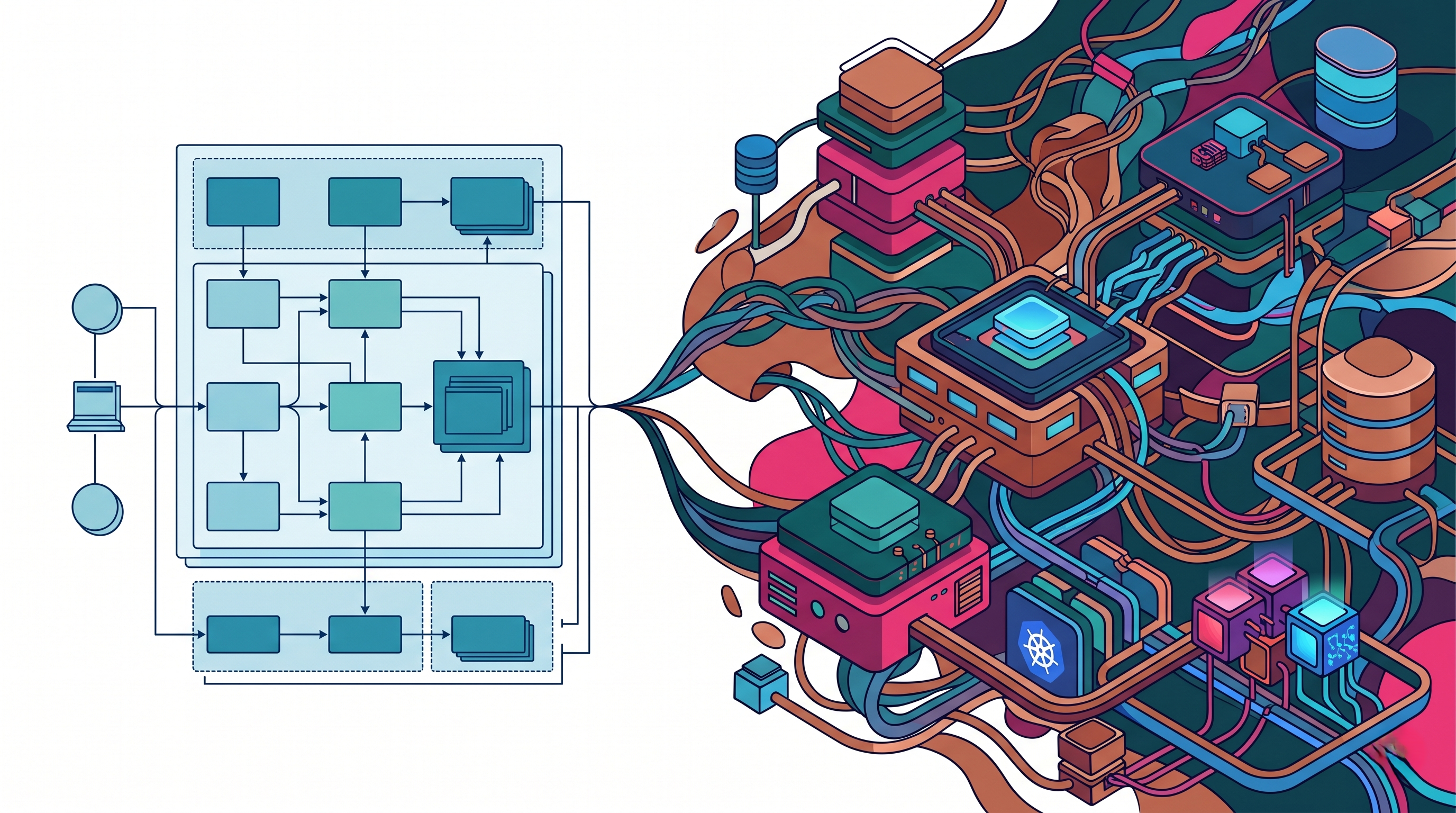
Every architecture begins with a vision.
Teams design service boundaries, define infrastructure standards, document dependencies, and create diagrams that represent how applications should operate in production. During planning and implementation, the architecture is usually well understood, carefully reviewed, and aligned with business requirements.
But architecture does not stop evolving after deployment.
As systems grow, new features are introduced, workloads scale, teams expand, cloud environments become more complex, and operational demands increase. Over time, the architecture running in production begins to diverge from the architecture that was originally designed.
This creates a challenge that many organizations underestimate: the architecture you built is often very different from the architecture you actually operate.
The difference may seem subtle at first, but it can significantly impact reliability, cloud costs, security, governance, scalability, and operational efficiency. In many cases, teams continue making decisions based on architectural assumptions that no longer reflect reality.
Understanding this gap is becoming increasingly important as Kubernetes environments, distributed applications, AI workloads, and cloud-native ecosystems continue growing in complexity.
Let's get right into the blog and explore why the architecture you operate often differs from the architecture you built and why that difference matters.
Architecture Starts as a Blueprint
Every technology system begins with an intended design.
Architects and engineering teams define how services should communicate, where workloads should run, how infrastructure should scale, and how operational responsibilities should be distributed. The resulting architecture reflects a combination of technical best practices, business requirements, and future growth expectations.
At this stage, the environment is relatively easy to understand because it exists largely as a controlled implementation of a well-defined plan.
The challenge is that architecture diagrams represent a moment in time. They capture intentions, not future evolution.
Once systems enter production, operational realities begin influencing the architecture in ways that are difficult to predict during the design phase.
Business Growth Continuously Changes Infrastructure
Few systems remain static after deployment.
Organizations launch new products, enter new markets, support additional customers, adopt new technologies, and respond to changing business priorities. Each of these changes introduces new infrastructure requirements.
To meet evolving demands, teams add services, expand Kubernetes environments, deploy new APIs, integrate external platforms, and create additional operational workflows.
Individually, these changes may appear minor. Collectively, they gradually reshape the architecture.
The environment adapts to support business growth, often without formal architectural redesign. As a result, production systems evolve far beyond the original blueprint that guided their implementation.
Kubernetes Accelerates Architectural Evolution
Kubernetes has transformed the speed at which infrastructure can evolve.
Teams can deploy workloads quickly, scale services dynamically, introduce new namespaces, adopt service meshes, and provision supporting infrastructure with minimal operational friction.
This flexibility delivers tremendous benefits, but it also accelerates architectural change.
New workloads appear frequently. Existing services are modified continuously. Resource allocation policies evolve. Infrastructure dependencies grow. Communication patterns shift as applications scale.
Over time, the operational environment becomes significantly more complex than the architecture initially documented during deployment.
The architecture remains functional, but it no longer looks exactly as intended.
Temporary Solutions Become Permanent Components
One of the biggest contributors to architectural divergence is the persistence of temporary decisions.
Engineering teams often implement short-term solutions to address immediate requirements. A service may be deployed quickly to meet a deadline. An integration may be added to support a specific project. Additional infrastructure may be provisioned to avoid performance risks.
At the time, these decisions are usually reasonable.
The challenge is that temporary solutions often remain in place long after their original purpose has passed. They become integrated into workflows, relied upon by other systems, and eventually viewed as permanent parts of the architecture.
Years later, critical production processes may depend on infrastructure that was never intended to become a long-term architectural component.
Service Dependencies Grow Beyond Original Intentions
Modern cloud-native environments are built around interconnected services.
Applications communicate with APIs, databases, messaging systems, authentication platforms, observability tools, AI services, and external providers. As systems evolve, these relationships multiply.
The original architecture may have defined a manageable set of dependencies. However, operational requirements often introduce many more.
New integrations are added. Shared services become central infrastructure components. Teams reuse existing platforms to accelerate development. Over time, dependency networks become increasingly dense.
The architecture you operate reflects years of accumulated decisions rather than the simplicity of the original design.
Understanding these relationships becomes essential for maintaining reliability and operational control.
AI Workloads are Creating New Architectural Layers
The rapid adoption of AI technologies is introducing entirely new infrastructure components into modern environments.
Organizations are deploying vector databases, model-serving platforms, inference services, GPU clusters, retrieval systems, and AI observability tools alongside traditional applications.
These systems introduce new dependencies, resource requirements, and operational workflows that were rarely considered in earlier architectural plans.
As AI capabilities become integrated into products and internal operations, the architecture continues expanding beyond its original boundaries.
What was once a conventional cloud-native environment increasingly becomes a hybrid ecosystem that combines traditional services with AI-driven infrastructure.
This evolution creates both opportunities and visibility challenges for engineering teams.
The Architecture You Operate Influences Cloud Costs
Cloud spending is often shaped more by operational architecture than by intended architecture.
A design diagram may show a streamlined system with clearly defined services and efficient resource utilization. The production environment, however, may contain duplicate workloads, underutilized resources, overlapping platforms, and legacy infrastructure components that accumulated over time.
These operational realities consume resources regardless of whether they were part of the original design.
As architectural complexity grows, cloud costs often increase because infrastructure is supporting relationships, dependencies, and services that evolved organically rather than strategically.
Organizations that focus only on usage metrics frequently overlook the architectural factors influencing infrastructure spending.
Reliability Depends on Operational Reality
Reliability is influenced by how systems actually behave, not by how they were originally designed.
A well-documented architecture may appear resilient on paper. However, hidden dependencies, evolving communication patterns, undocumented integrations, and operational shortcuts can introduce risks that are not visible in architectural diagrams.
When incidents occur, teams often discover that the production environment contains relationships they did not fully understand.
Troubleshooting becomes more difficult because engineers are working with an incomplete view of the systems they operate.
The architecture that matters during an incident is the one running in production, not the one documented during planning.
This is why operational visibility has become such a critical component of modern reliability engineering.
Governance Becomes Harder as the Gap Widens
Strong governance depends on understanding the environment being governed.
Organizations need visibility into workloads, dependencies, resource ownership, communication paths, infrastructure utilization, and operational changes.
As the gap between intended architecture and operational architecture grows, governance becomes increasingly difficult.
Security policies may not reflect current service relationships. Compliance controls may not account for new dependencies. Resource ownership may become unclear. Infrastructure standards may be applied inconsistently across evolving environments.
Without continuous visibility, governance efforts are often based on assumptions rather than actual operational conditions.
Continuous Architectural Awareness is the New Requirement
The solution is not to prevent architectural evolution.
Modern cloud-native systems must adapt continuously to changing business requirements, technology shifts, and growth opportunities. Architectural change is inevitable and often beneficial.
The challenge is maintaining awareness as that change occurs.
Organizations increasingly need visibility into workload behavior, Kubernetes environments, AI infrastructure, service dependencies, resource utilization, and operational relationships as they evolve in real time.
Rather than relying solely on static architecture diagrams, teams need a living understanding of the systems they operate.
This continuous awareness helps ensure that decisions are based on operational reality rather than historical assumptions.
Understand Operational Architecture with Atler Pilot
As cloud-native environments become more dynamic, maintaining visibility into actual infrastructure behavior becomes essential. Organizations need to understand how workloads interact, how dependencies evolve, how resources are consumed, and how operational changes shape the architecture over time.
Atler Pilot helps organizations gain a unified view of cloud-native environments by connecting infrastructure telemetry, workload intelligence, utilization insights, and operational context. This enables teams to understand the architecture they are actually operating rather than relying solely on static documentation and assumptions.
By improving visibility into Kubernetes workloads, infrastructure dependencies, AI systems, and resource utilization patterns, Atler Pilot helps engineering teams strengthen governance, improve reliability, optimize cloud resources, and make more informed architectural decisions.
You cannot effectively manage the architecture you intended if you cannot see the architecture you operate. Sign up for Atler Pilot and discover how deeper operational visibility can help your teams understand, govern, and optimize modern cloud-native environments with confidence.
Conclusion
Every architecture evolves after deployment.
New services, business requirements, Kubernetes workloads, AI systems, integrations, and operational decisions gradually reshape the environment over time. As a result, the architecture running in production often differs significantly from the architecture originally designed.
This gap influences reliability, cloud spending, governance, scalability, and operational efficiency in ways that are not always immediately visible.
Organizations that develop continuous visibility into operational architecture are better positioned to manage complexity, reduce risk, and make decisions based on reality rather than assumptions.
Because the most important architecture is not the one you designed years ago. It is the one your infrastructure is running today.
All in One Place
Atler Pilot decodes your cloud spend story by bringing monitoring, automation, and intelligent insights together for faster and better cloud operations.