
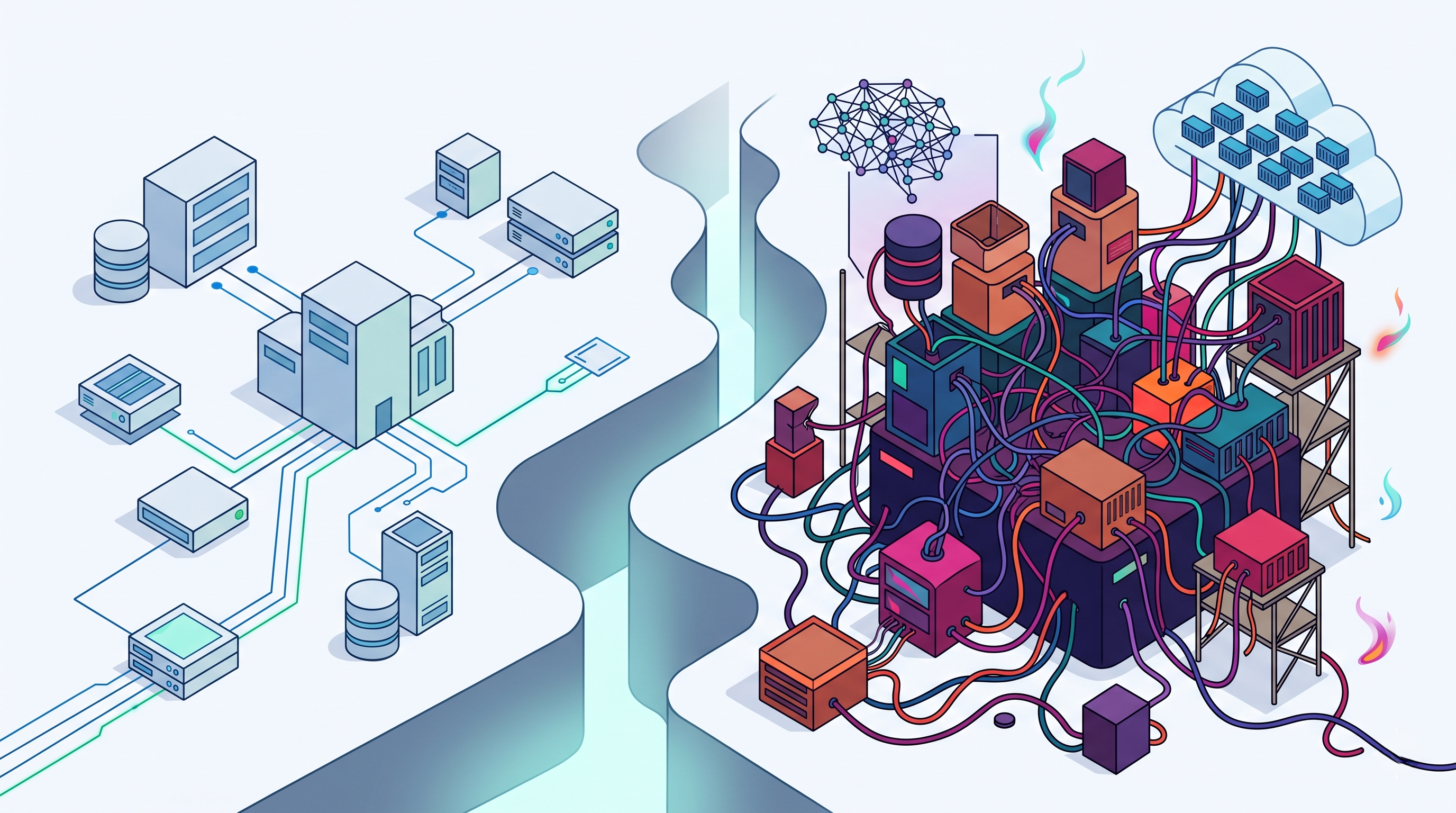
Every system starts with a plan. Architects design clean diagrams, engineering teams define service boundaries, infrastructure standards are documented, and deployment strategies are carefully reviewed before implementation begins. At this stage, the architecture is usually well understood, aligned with business goals, and designed to support future growth.
But as systems evolve, something interesting happens.
New features are added. Urgent fixes are deployed. Teams scale. Services multiply. Cloud environments expand. Kubernetes clusters grow. AI workloads are introduced. Over time, the architecture running in production begins to look very different from the architecture that was originally intended.
This gap between intended architecture and actual architecture is becoming one of the most significant operational challenges in modern cloud-native environments. It affects reliability, security, scalability, governance, cloud spending, and engineering productivity, often without organizations realizing how large the gap has become.
Let's get right into the blog and understand why this architectural drift occurs, why it matters, and how organizations can regain visibility into the systems they actually operate.
Architecture Evolves Faster Than Documentation
Most organizations document architecture during planning and implementation phases. Diagrams are created, service relationships are mapped, and operational standards are defined.
However, modern infrastructure changes continuously.
Engineering teams deploy new services, introduce integrations, modify APIs, update networking policies, add observability tooling, and adjust infrastructure configurations on a regular basis. While the environment evolves daily, documentation often evolves much more slowly.
Over time, the documented architecture begins representing what the system was supposed to look like rather than what actually exists.
The result is that teams make decisions based on outdated assumptions while production environments continue evolving independently.
Business Requirements Continuously Reshape Systems
Few architectures remain unchanged after deployment.
As organizations grow, business priorities shift. New products are launched, customer demands change, compliance requirements emerge, and performance expectations increase.
To support these changes, engineering teams modify existing systems rather than redesigning entire architectures from scratch. New services are introduced, integrations are added, temporary solutions become permanent, and infrastructure expands to accommodate new workloads.
Each change may be justified individually, but collectively they gradually alter the architecture.
What was originally designed as a simple and elegant system can evolve into a highly interconnected environment that looks very different from the original architectural vision.
Kubernetes Accelerates Architectural Drift
Kubernetes provides extraordinary flexibility, but that flexibility can also accelerate the divergence between intended and actual architecture.
Teams can deploy workloads rapidly, scale services dynamically, create new namespaces, introduce sidecars, adopt service meshes, and provision infrastructure with minimal friction.
While this agility improves delivery speed, it also makes architectural changes easier to introduce without broad visibility across the organization.
As clusters grow, services become increasingly distributed, dependencies multiply, and infrastructure relationships become more difficult to track.
Eventually, understanding how applications interact across the environment becomes significantly harder than understanding the original architecture diagram.
The architecture continues evolving even when nobody is actively redesigning it.
Temporary Decisions Often Become Permanent Infrastructure
Many architecture changes begin as short-term solutions.
A service may be deployed quickly to meet a deadline. A networking rule may be added to solve an urgent issue. A duplicate component may be introduced to avoid delaying a release.
At the time, these decisions often seem reasonable because they address immediate operational needs.
The challenge is that temporary solutions frequently outlive their intended lifespan.
As new projects emerge and priorities shift, teams move on to other work. The temporary change remains in place, becomes integrated into daily operations, and eventually turns into a permanent architectural component.
Years later, organizations may find critical production workflows depending on infrastructure that was never intended to exist long-term.
Dependency Growth Creates Invisible Complexity
One of the clearest signs of architectural divergence is the growth of hidden dependencies.
Modern cloud-native environments rely on APIs, databases, messaging systems, observability platforms, AI services, identity providers, shared infrastructure, and external integrations.
As services evolve, these dependencies multiply.
The challenge is that dependency growth often occurs gradually. Individual teams understand the systems they manage, but few people maintain visibility across the entire ecosystem.
Over time, architectures become increasingly interconnected, making it difficult to predict how changes will affect downstream services.
What appears to be a simple modification may trigger consequences across multiple applications, clusters, or cloud environments because the actual architecture contains relationships that were never captured in the original design.
AI Adoption is Creating New Architectural Layers
Generative AI and machine learning systems are introducing entirely new architectural components into modern environments.
Organizations are deploying inference services, vector databases, model-serving platforms, retrieval systems, AI observability pipelines, and GPU infrastructure alongside existing applications.
These additions often integrate with customer-facing systems, internal platforms, analytics services, and operational workflows.
The result is a rapidly expanding architecture that includes dependencies and resource flows that did not exist when the original environment was designed.
Without visibility into these evolving relationships, organizations may underestimate the complexity being introduced by AI adoption and struggle to govern AI infrastructure effectively as it scales.
Cloud Costs Often Reflect Architectural Reality
Cloud spending frequently reveals the difference between intended and actual architecture.
An architecture diagram may suggest a streamlined environment with efficient resource utilization and clearly defined services. However, actual infrastructure often includes duplicate workloads, underutilized resources, overlapping platforms, abandoned services, and excessive operational overhead.
These architectural realities influence cloud spending far more than the original design ever intended.
Organizations may focus on cost optimization initiatives without realizing that the underlying issue is architectural complexity itself.
As the gap between intended and actual architecture grows, infrastructure becomes more expensive to operate because resources are supporting systems, dependencies, and workflows that were never part of the original plan.
Reliability Challenges Increase as Architectural Visibility Decreases
Reliability depends on understanding how systems interact.
When architectural visibility declines, teams struggle to predict the impact of infrastructure changes, deployment decisions, workload scaling, or dependency failures.
Incidents become more difficult to troubleshoot because engineers are working from an incomplete understanding of the environment. Unexpected service interactions, hidden dependencies, and undocumented infrastructure relationships increase operational uncertainty.
The issue is not necessarily that the architecture is poorly designed. The issue is that the architecture teams believe they operate may no longer match the architecture running in production.
This disconnect makes reliability management significantly more challenging.
Governance Becomes Harder as Architecture Expands
Strong governance depends on visibility.
Organizations need to understand where workloads run, how services communicate, which resources are being consumed, and how infrastructure aligns with operational standards.
As actual architecture diverges from intended architecture, governance becomes increasingly difficult. Security policies may not account for new dependencies. Resource ownership may become unclear. Compliance requirements may be harder to enforce consistently.
The larger the architectural gap becomes, the harder it becomes to maintain control over infrastructure behavior.
Without visibility into actual architecture, governance efforts often focus on assumptions rather than operational reality.
Continuous Architectural Awareness is Becoming Essential
The solution is not to prevent architecture from evolving.
Modern businesses require flexibility, and cloud-native environments must adapt continuously to changing demands. Architectural evolution is both inevitable and necessary.
The challenge is maintaining awareness as that evolution occurs.
Organizations need visibility into workload behavior, infrastructure relationships, service dependencies, Kubernetes environments, AI systems, and operational changes as they happen.
Rather than relying solely on static documentation, teams increasingly require continuous architectural awareness that reflects the current state of production environments.
This allows engineering leaders to make decisions based on reality rather than assumptions and helps organizations maintain alignment between architectural intent and operational execution.
Close the Visibility Gap with Atler Pilot
As cloud-native environments become more distributed and complex, maintaining visibility into actual infrastructure behavior becomes increasingly important. Organizations need to understand how workloads interact, how dependencies evolve, how resources are consumed, and how operational changes influence the broader architecture.
Atler Pilot helps organizations gain a unified operational view of cloud-native environments by connecting infrastructure telemetry, workload intelligence, utilization insights, and operational context. This enables teams to understand how their environments are evolving in real time and identify gaps between architectural assumptions and operational reality.
By improving visibility into Kubernetes workloads, infrastructure dependencies, resource allocation patterns, and operational behavior, Atler Pilot helps engineering teams strengthen governance, improve reliability, optimize cloud resources, and make more informed architectural decisions.
Modern architecture is no longer defined solely by diagrams and documentation, it is defined by how systems actually behave.
Sign up for Atler Pilot and discover how deeper operational visibility can help your teams understand, govern, and optimize the architecture they truly operate.
Conclusion
Every architecture evolves. The challenge is that most architectures evolve faster than organizations can track them.
Over time, new services, changing business requirements, Kubernetes growth, AI adoption, operational shortcuts, and expanding dependencies create a widening gap between intended architecture and actual architecture.
This gap influences reliability, cloud spending, governance, scalability, and engineering productivity in ways that are often difficult to detect until problems emerge.
Organizations that develop continuous visibility into infrastructure behavior and architectural evolution will be better positioned to manage complexity, maintain operational control, and scale confidently in increasingly dynamic cloud-native environments.
Because the architecture that matters most is not the one documented during planning, it is the one running in production today.
All in One Place
Atler Pilot decodes your cloud spend story by bringing monitoring, automation, and intelligent insights together for faster and better cloud operations.