
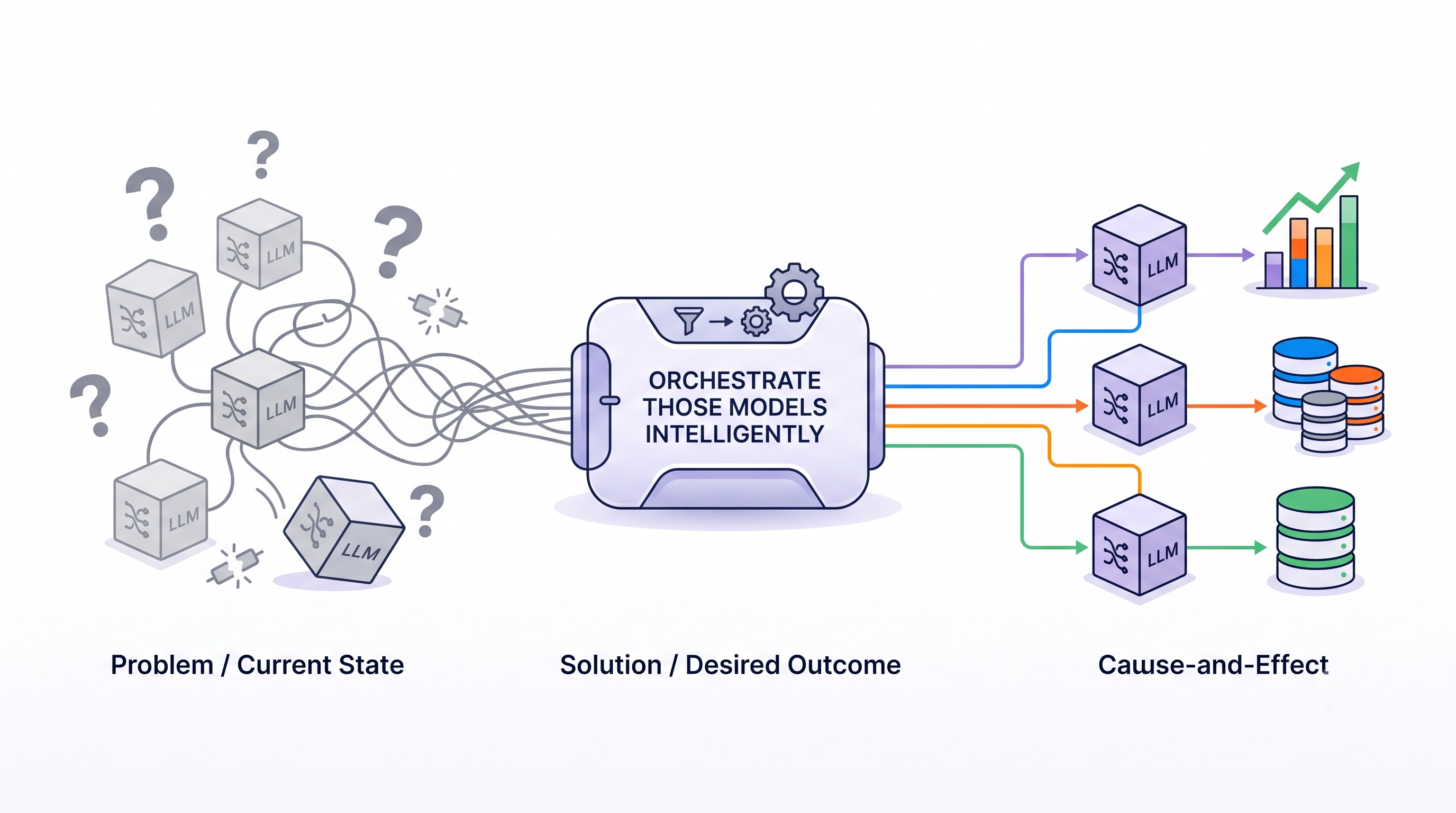
Just a year ago, most enterprise AI strategies revolved around a single question that is "Which large language model should we use?"
Today, the conversation has changed completely.
Instead of relying on one foundation model, enterprises are building applications that use multiple LLMs simultaneously. A customer support chatbot may use one model for natural conversations, another for document summarization, and a third for code generation. An AI research assistant might rely on different models for reasoning, translation, retrieval, and structured data extraction, all within a single workflow.
This shift isn't happening because organizations enjoy managing complexity.
It's happening because no single LLM is the best at everything.
Some models excel at long-context reasoning, while others are faster, more affordable, or better suited for coding, multilingual conversations, or domain-specific tasks. As AI adoption matures, engineering teams are realizing that choosing a single "best" model often means compromising performance, cost, or reliability.
The result is a new architectural pattern: multi-LLM systems.
Instead of depending on one provider, enterprises are orchestrating multiple models across different vendors, deployment environments, and workloads.
However, adopting multiple LLMs introduces a new challenge. And managing multiple LLMs without a centralized strategy quickly becomes operationally complex.
This is why forward-looking organizations are investing in a multi-LLM control plane.
Rather than treating language models as isolated APIs, a control plane provides a centralized layer that governs how AI models are selected, monitored, secured, and optimized across the enterprise.
As AI becomes business-critical, this architectural shift is rapidly moving from an advanced capability to a foundational requirement.
In this article, we'll explore what a multi-LLM control plane is, why enterprises are adopting it, the challenges it solves, and how it is reshaping the future of enterprise AI.
Why are Enterprises Moving Beyond a Single LLM?
When generative AI first entered the enterprise, using a single language model made perfect sense.
Applications were relatively simple. Most involved straightforward chat interfaces, content generation, or document summarization. Managing one provider meant fewer integrations, consistent APIs, and simpler operational processes.
But enterprise AI has evolved.
Modern AI applications perform much more than text generation. They automate customer support, analyze financial documents, assist software developers, process legal contracts, retrieve enterprise knowledge, coordinate AI agents, and execute complex business workflows.
Each of these tasks has different technical requirements.
A legal document review system might prioritize reasoning accuracy over speed. A customer support assistant needs low latency to deliver real-time responses. A coding assistant benefits from models trained specifically for software development, while an internal knowledge assistant may require models optimized for retrieval-augmented generation.
Expecting one model to excel across every workload is increasingly unrealistic.
As a result, organizations are beginning to treat LLMs like any other infrastructure component. Just as different databases serve different use cases, different language models are selected based on their strengths rather than forcing a single solution to handle every scenario.
This shift improves flexibility, but it also creates an operational challenge that many organizations underestimate.
The Hidden Complexity of Multi-LLM Environments
Using two or three language models may seem manageable at first.
However, enterprise AI environments rarely stop there.
Large organizations often experiment with commercial APIs, open-source models, self-hosted inference platforms, domain-specific models, and internally fine-tuned foundation models simultaneously.
Suddenly, engineering teams are managing different authentication methods, pricing models, latency profiles, rate limits, model versions, deployment environments, and governance requirements.
Even simple questions become difficult to answer.
Which model handled this request?
Why did latency increase this morning?
Which team generated the highest AI costs this month?
Which model produces the best outcomes for customer support?
How many applications are still using an outdated model version?
Without centralized visibility, answering these questions requires engineers to manually combine logs, dashboards, billing reports, and provider-specific monitoring tools.
As the number of models grows, this fragmented approach becomes increasingly difficult to sustain.
What initially looked like flexibility gradually turns into operational complexity.
What is a Multi-LLM Control Plane?
A multi-LLM control plane is a centralized management layer that sits between enterprise applications and the language models they use.
Instead of applications communicating directly with individual AI providers, requests flow through the control plane.
This intermediary layer is responsible for making intelligent decisions before a request reaches a model.
It can determine which model is most appropriate for a specific task, route traffic based on predefined policies, enforce governance controls, monitor performance, collect telemetry, optimize costs, and maintain a consistent operational view across the entire AI ecosystem.
Rather than requiring every application to implement its own routing logic, authentication, monitoring, and policy enforcement, the control plane provides these capabilities as shared enterprise services.
The result is an architecture that is easier to manage, scale, and secure.
Instead of managing ten independent model integrations, organizations manage a single control layer that coordinates interactions with every model behind the scenes.
Core Capabilities of a Multi-LLM Control Plane
Although implementations vary, most enterprise-grade control planes provide several common capabilities.
One of the most important is intelligent model routing. Rather than sending every request to the same model, the control plane evaluates the characteristics of each request and directs it to the model best suited for the task. A simple customer query might be handled by a fast, cost-effective model, while a complex legal analysis could be routed to a more capable reasoning model.
Another essential capability is policy enforcement. Enterprises often need to ensure that sensitive data is processed only by approved models or within specific geographic regions. A centralized control plane makes these governance policies consistent across every application instead of relying on individual development teams to implement them independently.
Cost optimization is equally important. Different language models have different pricing structures, response speeds, and infrastructure requirements. A control plane enables organizations to balance quality, latency, and cost by selecting the most appropriate model rather than always defaulting to the most powerful—or most expensive—option.
Observability also becomes significantly stronger. Instead of reviewing separate dashboards for each provider, engineering teams gain a unified view of request volumes, latency, token consumption, failure rates, and operational performance across their entire AI ecosystem.
These capabilities transform language models from isolated services into managed enterprise infrastructure.
Why AI Governance Becomes Easier?
Governance is one of the biggest challenges facing enterprise AI adoption.
As more business units deploy AI independently, organizations often lose visibility into where models are being used, what data is being processed, and whether security policies are being followed consistently.
A multi-LLM control plane addresses this by introducing centralized governance.
Every request passes through the same operational layer, making it possible to enforce authentication standards, validate prompts, apply content filtering, redact sensitive information, maintain audit logs, and ensure compliance with internal policies before requests ever reach an external model.
This consistency is difficult to achieve when every application integrates directly with different AI providers.
By centralizing governance, organizations reduce operational risk while simplifying compliance across increasingly complex AI environments.
Intelligent Model Routing: Sending Every Request to the Right LLM
One of the biggest advantages of a multi-LLM control plane is that it removes the assumption that every request should be handled by the same language model.
In reality, enterprise workloads vary enormously.
A customer asking for a password reset doesn't require the same level of reasoning as a legal team reviewing a hundred-page contract. Similarly, an AI coding assistant, a multilingual translation service, and an enterprise search application all have different priorities in terms of accuracy, latency, and cost.
A control plane evaluates these differences before routing a request.
Instead of hardcoding model selection inside every application, routing decisions become dynamic. Simple requests can be directed to lightweight, lower-cost models, while more complex tasks are automatically sent to models optimized for advanced reasoning or domain-specific expertise.
This approach improves efficiency because organizations stop treating every AI interaction as though it requires the most powerful and most expensive model available.
Over time, intelligent routing becomes one of the most effective ways to balance performance, user experience, and AI infrastructure costs.
Optimizing AI Costs Across Multiple LLMs
Managing AI costs becomes significantly more challenging once organizations begin using multiple language models.
Every provider has its own pricing structure. Some charge different rates for input and output tokens, while others price premium reasoning capabilities separately. Self-hosted models introduce infrastructure expenses such as GPU utilization, storage, networking, and operational maintenance.
Without centralized visibility, it becomes difficult to understand the true cost of serving AI applications.
A multi-LLM control plane addresses this by correlating requests, workloads, model selection, and infrastructure utilization.
Instead of simply tracking token consumption, organizations begin asking more meaningful questions.
Which models provide the best results for their cost?
Which applications consistently use premium models when lower-cost alternatives would perform equally well?
Which teams are driving the largest AI infrastructure expenses?
These insights allow engineering and FinOps teams to optimize AI spending without reducing application quality.
The goal is not to choose the cheapest model.
It is to choose the model that delivers the greatest business value for every request.
Improving Reliability Through Intelligent Failover
Enterprise applications cannot afford to become unavailable simply because one AI provider experiences increased latency or temporary outages.
As organizations depend more heavily on AI for customer support, software development, internal knowledge management, and operational automation, resilience becomes just as important as model quality.
A multi-LLM control plane improves reliability by introducing intelligent failover.
If one provider becomes unavailable or response times exceed acceptable thresholds, requests can automatically be redirected to another approved model without requiring application-level changes.
Users continue receiving responses while engineering teams investigate the underlying issue.
This architecture reduces vendor dependency and minimizes operational disruptions.
Instead of building applications around a single provider, enterprises build applications around capabilities, allowing the control plane to determine the most appropriate execution path at runtime.
Unified Observability Across Every AI Model
Managing multiple LLMs without centralized observability often leads to fragmented operations.
Each provider exposes different dashboards, monitoring tools, billing reports, and performance metrics.
As more models are introduced, engineering teams spend increasing amounts of time switching between platforms simply to understand what is happening.
A multi-LLM control plane consolidates this information into a single operational view.
Rather than monitoring providers individually, teams gain visibility into request volumes, latency trends, model utilization, error rates, token consumption, infrastructure usage, and workload behaviour across the entire AI ecosystem.
This unified observability simplifies troubleshooting while making it easier to identify optimization opportunities.
If a particular model consistently produces higher latency, increased costs, or lower response quality, engineering teams can detect those trends quickly and adjust routing policies accordingly.
Instead of reacting to isolated metrics, organizations begin optimizing AI systems as a connected platform.
Supporting AI Agents and Complex Workflows
The rise of AI agents is changing enterprise architecture once again.
Unlike traditional chatbots, AI agents rarely depend on a single language model.
They retrieve information from enterprise knowledge bases, invoke external APIs, execute business workflows, coordinate with other agents, and often use different LLMs during various stages of task execution.
For example, an enterprise procurement agent may begin by using one model to understand a user's request, another model to summarize supplier contracts, and a third specialized model to generate a compliance report.
Managing these interactions independently inside every application quickly becomes difficult.
A multi-LLM control plane simplifies orchestration by providing a consistent layer for routing requests, enforcing policies, monitoring execution, and maintaining operational visibility across every stage of an AI workflow.
As agentic AI becomes more common, centralized orchestration will become a foundational requirement rather than an optional enhancement.
Building an Enterprise AI Architecture That Can Evolve
The AI ecosystem is evolving faster than almost any other area of enterprise technology.
New foundation models appear every few months. Existing models improve rapidly. Open-source alternatives continue gaining momentum, while organizations increasingly deploy private models for sensitive workloads.
In such a rapidly changing environment, tightly coupling applications to individual providers creates unnecessary technical debt.
A multi-LLM control plane provides architectural flexibility.
Applications communicate with the control layer rather than directly integrating with every provider. This separation allows organizations to evaluate new models, replace existing providers, or adopt emerging technologies with significantly less disruption.
Instead of rebuilding applications every time the AI landscape changes, enterprises update routing policies and governance rules within the control plane.
This decoupled architecture improves long-term maintainability while protecting investments in AI applications.
Why is the Multi-LLM Control Plane Becoming a Strategic Platform?
Initially, many organizations viewed AI infrastructure primarily as a collection of APIs.
Today, that perspective is changing.
Language models are becoming core enterprise infrastructure, supporting customer engagement, internal productivity, software engineering, compliance, analytics, and business automation.
As their importance grows, so does the need for centralized operational management.
The multi-LLM control plane represents this next stage of enterprise AI maturity.
It provides a consistent framework for governance, routing, observability, reliability, and optimization while allowing organizations to remain flexible as the AI ecosystem continues evolving.
Rather than managing models individually, enterprises begin managing AI as a strategic platform.
Enable Multi-LLM Operations with Atler Pilot
Managing multiple language models successfully requires more than selecting the right provider.
Engineering teams need visibility into how AI workloads interact with cloud infrastructure, Kubernetes clusters, GPU resources, orchestration frameworks, and business applications.
Atler Pilot helps platform engineering, DevOps, AI engineering, and FinOps teams bring these operational layers together.
By combining infrastructure telemetry, workload intelligence, cloud cost visibility, utilization analytics, and operational context, Atler Pilot enables organizations to understand how AI systems perform across increasingly complex multi-LLM environments.
Instead of monitoring individual providers in isolation, teams can correlate AI workloads with infrastructure behaviour, identify cost optimization opportunities, detect operational bottlenecks, and improve governance across their enterprise AI platform.
As organizations scale from isolated AI experiments to business-critical AI systems, this broader operational visibility becomes essential for delivering reliable, cost-efficient, and well-governed AI services.
Conclusion
Enterprise AI is no longer defined by choosing a single language model.
It is defined by managing an ecosystem of models, providers, infrastructure, and intelligent workflows that continuously evolve alongside business requirements.
This shift makes the multi-LLM control plane far more than a routing layer.
It becomes the operational foundation that enables organizations to govern AI consistently, optimize costs intelligently, improve reliability, and maintain flexibility in a rapidly changing technology landscape.
By separating applications from individual model providers, enterprises gain the freedom to adopt new models, balance cost with performance, strengthen security, and scale AI initiatives without increasing operational complexity.
The future of enterprise AI will not belong to organizations using the largest number of language models.
It will belong to organizations that can orchestrate those models intelligently, observe them comprehensively, and govern them consistently.
Because in the next generation of enterprise AI, competitive advantage won't come from having access to more models.
It will come from having complete control over how those models are used.
Frequently Asked Questions
What is a multi-LLM control plane?
A multi-LLM control plane is a centralized management layer that sits between enterprise applications and multiple language models. It handles model routing, governance, observability, security, policy enforcement, cost optimization, and operational management across different AI providers.
Why are enterprises adopting multiple LLMs?
No single language model performs best for every task. Different models excel in areas such as reasoning, coding, multilingual communication, speed, latency, or cost efficiency. Using multiple models allows organizations to match workloads with the most appropriate capabilities.
How does a multi-LLM control plane reduce AI costs?
By intelligently routing requests to the most suitable model, monitoring usage patterns, and providing visibility into infrastructure and model performance, organizations can avoid unnecessary use of premium models and improve overall AI resource efficiency.
Is a multi-LLM control plane only useful for large enterprises?
Large enterprises gain the greatest benefits because they typically manage multiple AI providers and complex governance requirements. However, fast-growing organizations can also benefit by establishing a scalable architecture before operational complexity increases.
All in One Place
Atler Pilot decodes your cloud spend story by bringing monitoring, automation, and intelligent insights together for faster and better cloud operations.