
Beyond the Hype Cycle
The initial explosion of Generative AI in 2023 and 2024 was characterized by massive foundational models and staggering cloud compute bills. Organizations raced to integrate "chatbots" into every product, often without a clear path to profitability.
By 2026, the AI hype cycle has matured into a focused engineering discipline. Cloud AI is no longer a novelty; it is a core infrastructure requirement subject to strict FinOps governance and security protocols. This guide explores the five macro trends defining how organizations are deploying and managing AI workloads in the cloud today.
1. The Shift to Edge Inference
As detailed in the Edge Computing Guide, sending every user prompt to a central cloud hyper-scaler for processing introduces unacceptable latency and massive data transfer costs.
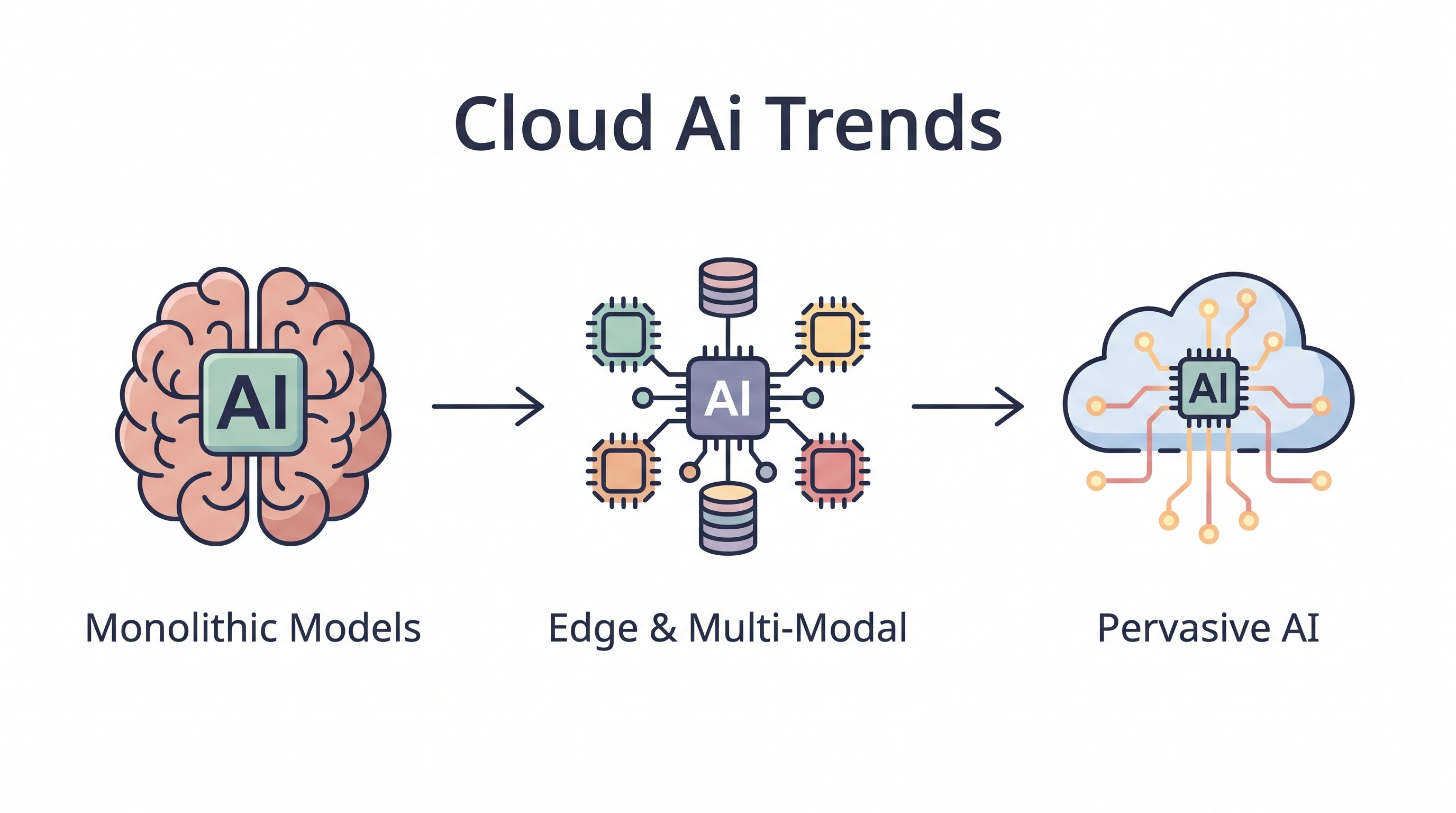
The dominant trend in 2026 is pushing AI inference to the Edge. Hardware manufacturers (like Apple, Qualcomm, and Intel) have deeply integrated Neural Processing Units (NPUs) into consumer devices and edge servers. Instead of querying a massive model in AWS us-east-1, applications are deploying smaller, highly optimized models (like Llama 3 8B) directly to the user's smartphone or a local 5G cell tower. This drastically reduces the central cloud compute bill, eliminates network latency, and radically improves data privacy.
2. The Dominance of Multi-Modal APIs
Text-only Large Language Models (LLMs) are obsolete. The leading cloud AI APIs (like Google Gemini and OpenAI GPT-4 Omni) are natively multi-modal.
These models can simultaneously ingest text, audio, images, and live video streams in real-time. For cloud architects, this changes how data pipelines are built. Instead of stitching together separate speech-to-text, image recognition, and natural language APIs, a single unified endpoint handles the entire unstructured data payload. This dramatically simplifies the operational architecture but drastically increases the bandwidth and payload size handled by the API Gateway.
3. The Cost Reality: Small Models Win
The "bigger is better" philosophy of AI training has hit a financial wall. The inference costs of running massive 1-Trillion parameter models for every minor task are mathematically unsustainable for enterprise unit economics.
The industry has shifted toward Small Language Models (SLMs). Organizations are fine-tuning highly efficient, 7-billion parameter models on their proprietary data. These SLMs frequently outperform massive generalized models on specific corporate tasks (e.g., summarizing internal IT tickets) while consuming a fraction of the compute and memory. The future of enterprise AI is not one massive brain; it is a "mixture of experts" comprising dozens of cheap, highly specialized micro-models.
4. From Chatbots to Agentic Workflows
The user interface of AI is evolving from the reactive "chatbot" (which waits for a user prompt) to proactive "Agentic Workflows."
As discussed in the Intelligent Cloud Automation guide, AI agents are given a high-level goal and autonomous access to cloud IAM roles and APIs. An agent might be instructed to "Research competitor pricing daily and update our DynamoDB database." The agent autonomously breaks the goal down into steps, executes the web scraping, parses the data, and writes to the database without human intervention. This shift requires massive upgrades in cloud security monitoring to ensure autonomous agents do not execute malicious actions (like indirect prompt injections).
5. The Rise of Sovereign AI
Data residency laws are colliding with AI development. As covered in the Cloud Sovereignty Guide, governments (particularly in the EU and Asia) refuse to allow their citizen data or classified intelligence to be processed by AI models hosted in foreign data centers.
This is driving the demand for "Sovereign AI." Nations are building their own highly localized supercomputing clusters, and enterprises are increasingly deploying open-source AI models entirely within their own virtual private clouds (VPCs) rather than sending sensitive proprietary data to external, multi-tenant APIs provided by the hyper-scalers.
Key Takeaway
The Cloud AI landscape of 2026 is defined by efficiency and autonomy. Organizations must abandon the expensive practice of querying massive, centralized models for every task. To achieve profitable unit economics, architects must push inference to the Edge, deploy specialized Small Language Models (SLMs) for specific tasks, and implement rigorous security guardrails to manage the rise of autonomous AI agents operating within their cloud environments.
All in One Place
Atler Pilot decodes your cloud spend story by bringing monitoring, automation, and intelligent insights together for faster and better cloud operations.