
From Good PR to Legal Requirement
For years, tracking the environmental impact of cloud computing was a secondary initiative, driven by corporate marketing departments looking to publish "Green IT" press releases. The numbers were frequently estimates, based on vague methodologies, and rarely audited.
In 2026, the landscape has radically shifted. Environmental, Social, and Governance (ESG) reporting is no longer a public relations exercise; it is a strict, legally mandated requirement. Organizations must accurately track, report, and reduce the carbon emissions generated by their digital infrastructure. Failure to comply can result in massive financial penalties and exclusion from global supply chains.
This guide explores the mechanisms of Cloud ESG reporting, the complexity of tracking carbon scopes, and how organizations are utilizing GreenOps platforms to maintain compliance.
The Regulatory Landscape: CSRD and SEC
The primary drivers for rigorous ESG reporting are global regulatory bodies.
The EU Corporate Sustainability Reporting Directive (CSRD): This sweeping European legislation requires thousands of companies (including non-EU companies operating within the EU) to disclose their detailed carbon footprints, including the emissions generated by their third-party cloud providers.
SEC Climate Disclosure Rules: In the United States, publicly traded companies face increasing pressure and formalized rules regarding the disclosure of climate-related financial risks and material greenhouse gas emissions.
These regulations demand audit-grade data. You cannot simply tell auditors, "AWS is carbon neutral." You must provide the exact metric tons of CO2 equivalent (MTCO2e) generated by your specific workloads.
Understanding Scope 1, 2, and 3 in the Cloud
ESG reporting relies on the Greenhouse Gas (GHG) Protocol, which categorizes emissions into three scopes. When you use a public cloud (AWS, Azure, GCP), the emissions are categorized from your perspective as the customer.
Scope 1 (Direct Emissions): For a cloud customer, this is generally zero. You do not own the diesel backup generators burning fuel at the AWS data center. (If you run a Hybrid Cloud, the diesel generators at your on-premise datacenter are Scope 1).
Scope 2 (Indirect Emissions - Electricity): This represents the electricity purchased by the cloud provider to run the servers hosting your EC2 instances and RDS databases. If the cloud region is powered by a coal grid, your Scope 2 emissions are extremely high.
Scope 3 (Value Chain / Embodied Carbon): The most difficult to track. This is the carbon emitted during the manufacturing and transportation of the physical servers, hard drives, and network switches sitting in the cloud data center.
The Data Collection Challenge
The major cloud providers all offer native Carbon Footprint Tools (e.g., AWS Customer Carbon Footprint Tool). However, these native tools frequently suffer from massive latency (data is often 3 months delayed) and lack the granular resolution required for true engineering accountability.
If the AWS tool says your organization emitted 500 MTCO2e last month, but it cannot tell you which specific engineering team or microservice generated those emissions, the data is useless for optimization.
Building Carbon-Aware Dashboards
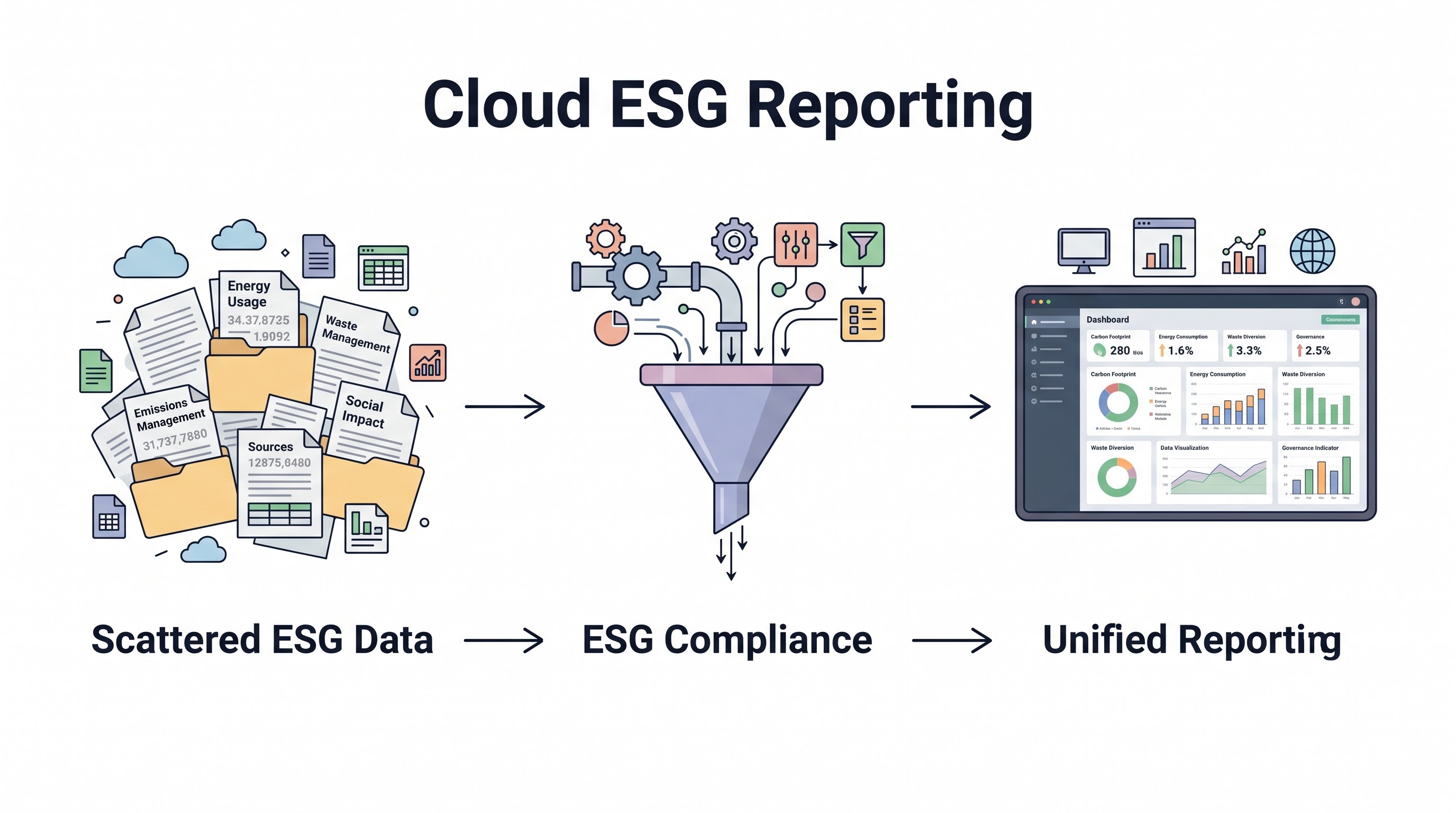
To satisfy ESG requirements and drive actual behavioral change, organizations are deploying advanced, third-party Cloud Sustainability Platforms. These platforms ingest the raw billing data (the CUR file), apply complex carbon intensity conversion factors based on the specific cloud region's electrical grid, and map the emissions back to specific cloud resource tags.
This creates a "Carbon-Aware Dashboard." When the leader of the "Checkout Team" looks at their monthly report, they see two numbers: 1. Total Cloud Spend: $45,000 2. Total Carbon Emissions: 12.4 MTCO2e
This granular visibility allows organizations to hold individual teams accountable for their environmental impact, a crucial requirement for complying with ESG reduction targets.
Integration with FinOps (GreenOps)
ESG reporting is fundamentally an accounting problem, which is why it sits perfectly within the FinOps discipline.
The actions required to improve the ESG report (reduce Scope 2 emissions) are the exact same actions required to reduce the cloud bill. By rightsizing overprovisioned instances, terminating idle EBS volumes, and migrating workloads to highly efficient ARM processors, the FinOps team simultaneously slashes costs and reduces the carbon footprint, turning a regulatory burden into a highly profitable optimization exercise.
Key Takeaway
Cloud ESG reporting is a strict regulatory requirement demanding audit-grade data regarding your Scope 2 and Scope 3 emissions. Organizations cannot rely on delayed, high-level dashboards provided by the hyper-scalers. They must deploy Carbon-Aware platforms that map emissions directly to resource tags, allowing the FinOps/GreenOps team to hold individual engineering teams accountable for reducing both their financial spend and their carbon footprint simultaneously.
All in One Place
Atler Pilot decodes your cloud spend story by bringing monitoring, automation, and intelligent insights together for faster and better cloud operations.