
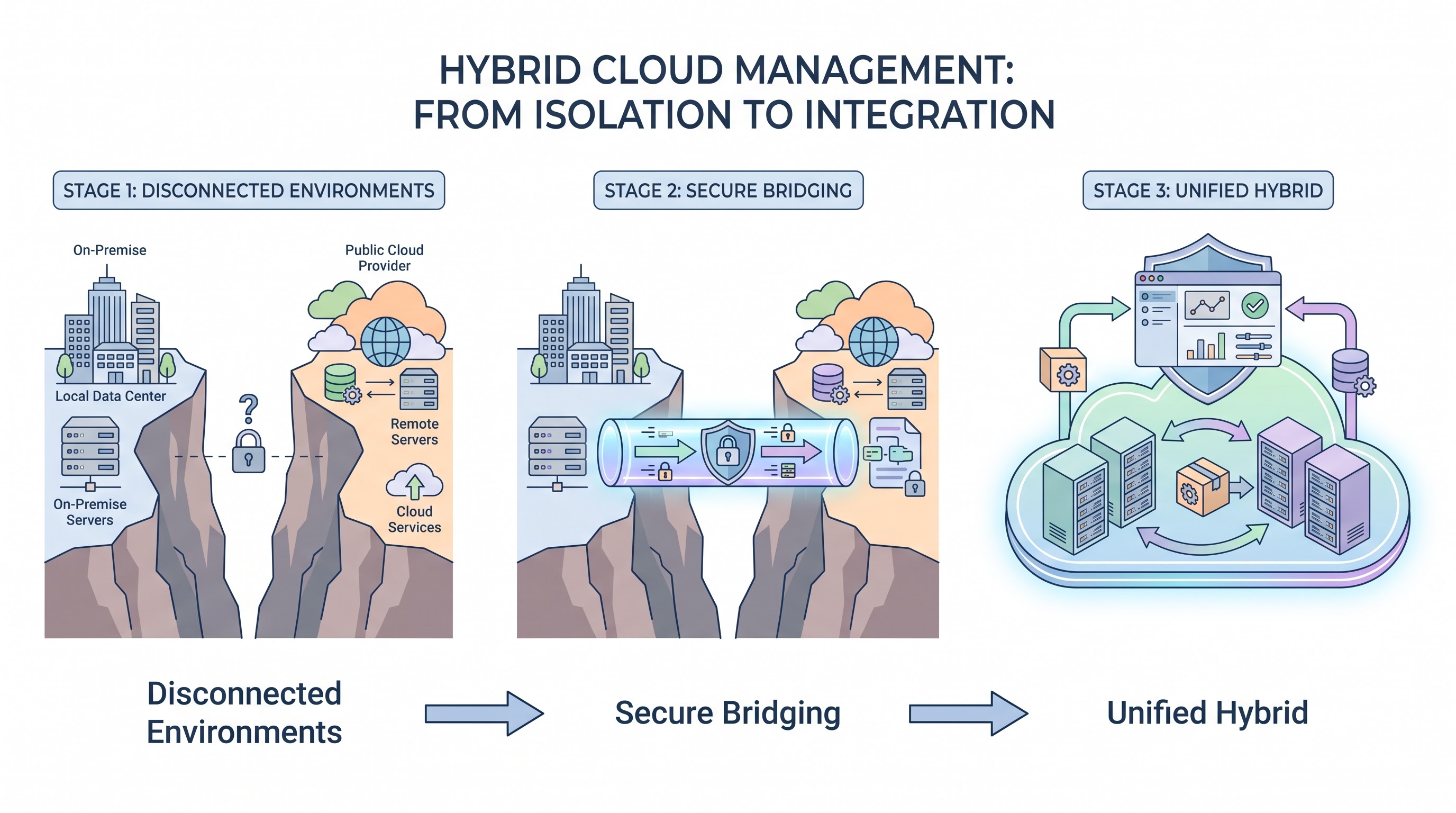
The Persistent Reality of the Data Center
For years, cloud purists predicted the absolute death of the on-premises data center. They were wrong. Due to strict data sovereignty laws, massive sunk investments in mainframe hardware, and applications requiring ultra-low latency to physical manufacturing equipment, the on-premises data center is not dead.
The dominant enterprise architecture of 2026 is the Hybrid Cloud. Organizations run their agile, customer-facing applications in AWS or Azure, while maintaining their core, highly regulated legacy databases in their own private basements. Managing this split personality architecture is incredibly difficult. This guide details the networking, operational, and security requirements to bridge the gap between the public cloud and the private basement.
Hybrid vs. Multi-Cloud: Defining the Terms
These terms are frequently confused, but they describe different architectures.
Multi-Cloud: Using two different public cloud providers (e.g., AWS for compute, GCP for analytics). See the Multi-Cloud Guide.
Hybrid Cloud: Connecting a public cloud (AWS) to a private, on-premises data center owned and operated by the enterprise. The complexity of Hybrid lies in connecting modern, ephemeral cloud APIs to legacy physical hardware.
The Networking Bridge (Direct Connect & ExpressRoute)
A Hybrid Cloud cannot function over the public internet. The latency is too high, and the security risk is unacceptable.
The foundation of a Hybrid architecture is a dedicated physical network line. Organizations must lease an AWS Direct Connect or Azure ExpressRoute. This provides a private, high-bandwidth (e.g., 10 Gbps or 100 Gbps) fiber-optic connection directly from the corporate data center into the cloud provider's network. This dedicated pipe guarantees low latency and bypasses the public internet entirely, satisfying strict compliance regulations and significantly lowering data egress fees.
The Unified Management Plane (Azure Arc & Google Anthos)
If your engineers must use the AWS console to manage the cloud, and VMware vSphere to manage the on-premises servers, operational efficiency collapses. A Hybrid Cloud requires a "Single Pane of Glass."
Cloud providers have recognized this and released massive hybrid control planes, most notably Azure Arc and Google Anthos. These tools allow you to install an agent on your physical, on-premises servers. Suddenly, those physical servers appear inside the Azure or GCP console just like native cloud VMs. You can apply cloud-native Policy-as-Code, monitor logs, and deploy Kubernetes clusters across both the public cloud and your private basement from one unified interface.
The Physics Problem: Data Gravity and Latency
The most common Hybrid Cloud failure is the "split-tier" architecture. An architect deploys the web front-end in AWS (for scalability) but leaves the massive Oracle database on-premises. Every time a user clicks a button, the web server must traverse the Direct Connect line to query the database and wait for the response.
Even with fiber optics, the speed of light is a limiting factor. If the physical distance between the AWS region and the private data center is too far, the application will suffer severe latency. Rule of Hybrid Cloud: Compute and Data must be physically co-located. If the database is on-prem, the heavy compute processing must also be on-prem. Do not split highly chatty application tiers across a hybrid boundary.
Securing the Hybrid Perimeter
A Hybrid Cloud merges two entirely different security philosophies. The public cloud relies on Identity and Access Management (IAM) and Zero Trust. The private data center historically relies on IP addresses and perimeter firewalls.
When bridging the two, you must adopt the stricter cloud model. You cannot blindly trust traffic simply because it comes across the Direct Connect line from the corporate data center. Organizations must implement Zero Trust Network Access (ZTNA) across the entire hybrid boundary, ensuring that every request, regardless of origin, is cryptographically authenticated and authorized.
Key Takeaway
Hybrid Cloud is the pragmatic reality for enterprises with legacy technical debt or strict sovereignty requirements. To operate it effectively, organizations must invest in dedicated, private networking (Direct Connect) to minimize latency, adopt unified control planes (like Azure Arc) to manage on-premise hardware via cloud APIs, and strictly adhere to data gravity principles by ensuring highly chatty application tiers are not split across the physical boundary.
All in One Place
Atler Pilot decodes your cloud spend story by bringing monitoring, automation, and intelligent insights together for faster and better cloud operations.