
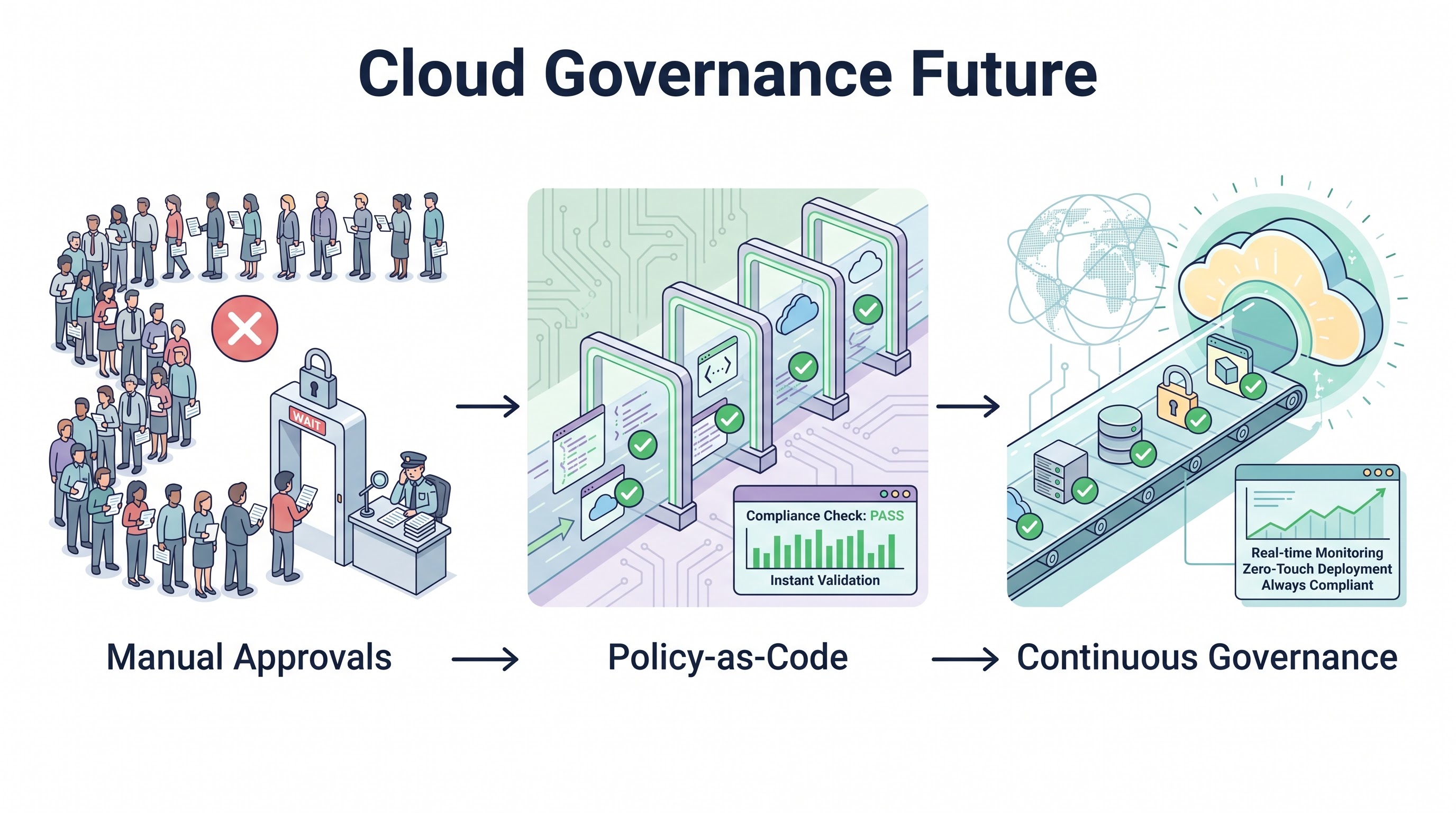
Governance Should Be Invisible
In the early days of cloud adoption, "governance" was synonymous with "friction." The security and compliance teams created massive, 100-page Wiki documents detailing exactly how an S3 bucket must be configured or what EC2 instance types were permitted. Developers routinely ignored these documents because they slowed down deployment.
The resulting architecture was a chaotic, expensive, and highly insecure web of misconfigurations. The modern cloud requires a paradigm shift. Governance can no longer be a manual gating process; it must be completely invisible to the developer, mathematically enforced by the infrastructure itself. This guide explores the future of cloud governance: Policy-as-Code.
The Death of the Wiki Policy
You cannot govern a dynamic, elastic cloud environment using static Word documents. If a developer uses Terraform to spin up 500 Kubernetes pods in three minutes, a human auditor cannot manually verify if those pods comply with the corporate security policy.
The only way to govern code (Infrastructure as Code) is with more code. The rules themselves must be written in a machine-readable format that can be evaluated programmatically in milliseconds.
What is Policy-as-Code?
Policy-as-Code (PaC) is the practice of writing your corporate governance rules in a specialized programming language. Open Policy Agent (OPA) and its language, Rego, have become the de facto industry standard.
Instead of writing a Wiki rule saying "All S3 buckets must be encrypted," the security team writes a 5-line Rego policy that mathematically evaluates a Terraform JSON plan. If the server_side_encryption parameter is missing, the policy returns FALSE.
Shift-Left: Blocking at the Pipeline
The most effective governance happens before the code is ever deployed.
Organizations integrate Policy-as-Code directly into their CI/CD pipelines (e.g., GitHub Actions, GitLab CI). When a developer creates a Pull Request, the pipeline runs the Terraform code against the OPA engine. If the developer attempted to provision an unauthorized, highly expensive GPU instance (violating the FinOps policy), the pipeline instantly fails and blocks the merge. The developer receives immediate feedback directly in their IDE, allowing them to fix the error in seconds. The governance team never even has to get involved.
Reactive Governance: Auto-Remediation
Shift-Left governance handles infrastructure deployed via pipelines, but what if a user logs directly into the AWS Console and makes a manual change?
This requires Reactive Governance tools, like Cloud Custodian or AWS Config. These tools continuously monitor the live state of the cloud. If an engineer manually opens a Security Group to the entire internet (0.0.0.0/0), the policy engine detects the violation within seconds and autonomously executes a remediation script—instantly closing the port and sending an alert to the SecOps team.
Applying Governance to FinOps
Policy-as-Code is not just for security; it is critical for cloud cost control.
A mature FinOps team writes policies that:
Enforce mandatory resource tagging. (e.g., "Block any deployment lacking an
Ownertag").Restrict expensive instance families to specific production accounts.
Enforce TTL (Time To Live) tags on staging environments, allowing an automated script to confidently delete the environment at 6:00 PM on Friday to save money over the weekend.
Key Takeaway
Cloud Governance must transition from human-driven audits to automated Policy-as-Code. By utilizing tools like Open Policy Agent (OPA) in the CI/CD pipeline, organizations can mathematically block non-compliant, insecure, or financially wasteful infrastructure from ever being deployed. Combine this with reactive auto-remediation tools to build a 'frictionless' cloud where developers can move at maximum velocity within absolute, unbreakable guardrails.
All in One Place
Atler Pilot decodes your cloud spend story by bringing monitoring, automation, and intelligent insights together for faster and better cloud operations.